Understanding Pipeline Programming: Concepts, Architecture, and Best Practices
Pipeline programming is a software development paradigm that structures execution as a sequence of discrete processing stages, where the output of one stage serves as the input to the next. This modular architecture enhances code readability, facilitates concurrent processing, and optimizes resource utilization across modern computing environments.
Introduction to Pipeline Programming
In software engineering, complexity management is a perpetual challenge. Whether processing high-throughput data streams, compiling source code, or executing machine learning workflows, monolithic blocks of code quickly become difficult to maintain, test, and scale. Pipeline programming addresses this challenge by decomposing complex computational tasks into a linear or branching sequence of smaller, specialized processing units known as stages or filters.
Unlike traditional procedural programming, where a single routine manages an operation from inception to completion, pipeline programming embraces separation of concerns. Each stage in a pipeline performs a distinct transformation, validation, or computation. Data flows through these stages sequentially or concurrently, much like physical materials moving down an assembly line.
This approach is foundational across numerous technical domains. Operating systems use pipelines to chain command-line utilities. Data engineers use pipelines to ingest, clean, and transform massive datasets. Modern graphics processing units (GPUs) rely on rendering pipelines to convert vector graphics into pixel displays. By understanding the core mechanics, benefits, and implementation patterns of pipeline programming, developers can design highly efficient, scalable, and resilient software systems.
Core Concepts and Terminology
To master pipeline programming, one must become familiar with the specialized vocabulary that describes its components and operational mechanics. While implementations vary across languages and frameworks, the underlying architectural concepts remain consistent.
Stages, Filters, and Transformers
A pipeline is composed of individual steps referred to variously as stages, filters, or transformers.
- Stages represent discrete operational boundaries within the workflow.
- Filters inspect, modify, or filter out data elements based on specific criteria.
- Transformers convert data from one schema, format, or type into another.
Data Buffering and Streaming
Data can move through a pipeline in two primary ways: batch processing and stream processing. In batch pipelines, an entire dataset is collected before being pushed through the stages. In stream pipelines, data items flow continuously as individual records or events, often requiring buffers or queues to manage speed mismatches between adjacent stages.
Backpressure
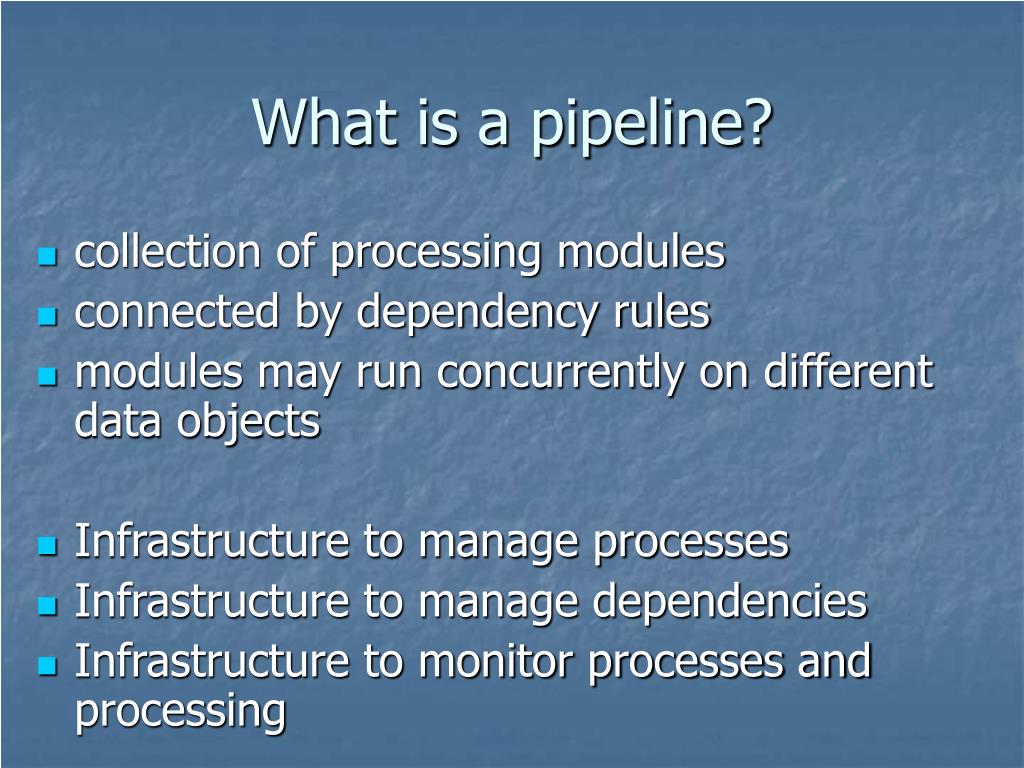
When designing high-throughput pipelines, downstream stages may process data slower than upstream stages produce it. Backpressure is a flow-control mechanism that signals upstream producers to slow down or pause, preventing memory exhaustion and system crashes caused by unbounded queue growth.
Architectural Patterns: Linear vs. Directed Acyclic Graphs (DAGs)
Pipelines range from simple, linear sequences to complex, multi-threaded networks. Choosing the correct architectural pattern depends entirely on the nature of the data processing task.
Linear Pipelines
A linear pipeline is the simplest form, where data flows strictly in a straight line from Stage A to Stage B, then to Stage C, and so on.
[ Input ] ---> [ Stage 1: Parse ] ---> [ Stage 2: Transform ] ---> [ Stage 3: Output ]
Linear pipelines are ideal for straightforward transformations, such as reading a log file, parsing individual lines, masking sensitive information, and writing the results to a database. They are easy to debug and reason about, but they cannot handle tasks that require branching logic or parallel execution paths.
Directed Acyclic Graphs (DAGs)
When a workflow requires conditional branching, merging of multiple data sources, or parallel execution, linear pipelines fall short. Enter the Directed Acyclic Graph (DAG).
In a DAG pipeline, nodes represent processing tasks, and directed edges represent the flow of data. The graph is directed because data flows in a specific direction along the edges, and acyclic because there are no loops or cycles that could cause infinite execution loops. DAGs allow systems to execute independent stages concurrently, maximizing CPU and I/O resource utilization.
| Architectural Pattern | Complexity | Concurrency Support | Best Use Cases |
|---|---|---|---|
| Linear Pipeline | Low | Sequential (or basic threading) | Log processing, text transformation, simple ETL scripts |
| DAG Pipeline | High | High (Parallel node execution) | Machine learning model training, complex data engineering, build systems |
Pipeline Programming in Practice: Implementation Approaches
Different programming languages and runtime environments offer native or library-supported constructs for building pipelines. Implementing a pipeline effectively requires leveraging these constructs correctly.
Object-Oriented and Functional Pipelines
In functional programming languages, pipelines are frequently constructed using higher-order functions like map, filter, and reduce. For instance, modern Java utilizes the Stream API to create declarative pipelines:
List processedNames = names.stream() .filter(name -> name.startsWith("A")) .map(String::toUpperCase) .sorted() .collect(Collectors.toList());
In this example, the collection is processed through a declarative pipeline where data flows through intermediate operations (filter, map, sorted) before reaching a terminal operation (collect). The execution is lazy, meaning intermediate operations are not evaluated until the terminal operation is invoked.
Concurrency and Asynchronous Pipelines
For I/O-bound tasks, such as web scraping or API aggregation, pipelines are often implemented using asynchronous queues, channels, or actor models. Languages like Go utilize Goroutines and channels to build concurrent processing pipelines where stages run independently and communicate via typed message passing.
Advantages of Pipeline Architecture
Adopting a pipeline programming model yields significant architectural and operational benefits across the software lifecycle.
Modularity and Maintainability
Because each stage in a pipeline is encapsulated and decoupled from its neighbors, developers can modify, optimize, or completely rewrite a single stage without altering the rest of the system. This clear separation of concerns makes large codebases much easier to maintain and audit.
Testability
Unit testing monolithic functions often requires complex mocking setups for databases, networks, and state management. In contrast, pipeline stages are typically pure functions or self-contained units that accept an input and return an output. Testing a pipeline stage is as simple as passing a known input and asserting the expected output.
Reusability
Well-designed pipeline stages are generic and reusable across different projects. For example, a CSV-parsing stage, a JSON-validation filter, or an encryption transformer can be dropped into multiple distinct pipelines with zero code duplication.
Common Pitfalls and Troubleshooting
Despite their benefits, poorly implemented pipelines introduce unique technical challenges that can degrade system performance or cause silent data corruption.
Bottlenecks and Resource Starvation
The overall throughput of a pipeline is dictated by its slowest stage—often referred to as the bottleneck. If Stage 2 takes 500 milliseconds per item while Stages 1 and 3 take 10 milliseconds, items will accumulate in the buffer between Stage 1 and Stage 2, consuming memory and increasing latency.
- Troubleshooting: Monitor stage-level execution metrics, identify the slowest component, and consider scaling that specific stage horizontally by introducing parallel worker threads.
Error Handling and Dead Letter Queues
When an error occurs mid-pipeline—such as a malformed record failing schema validation—deciding how to proceed is critical. Crashing the entire pipeline is rarely acceptable for high-availability systems.
- Best Practice: Implement robust exception handling at each stage and route unprocessable records to a Dead Letter Queue (DLQ) for later inspection, allowing the main data flow to continue uninterrupted.
Shared State Corruption
In concurrent or parallelized pipelines, multiple worker threads may attempt to access or modify shared memory or global variables, leading to race conditions and unpredictable data corruption.
- Best Practice: Ensure pipeline stages remain stateless where possible. If state must be shared, utilize thread-safe data structures, immutable objects, or actor-based synchronization primitives.
Frequently Asked Questions
What is the difference between a pipeline and a workflow?
While the terms are often used interchangeably, a pipeline typically implies a strict, automated sequence of data processing steps with a continuous flow of data. A workflow is a broader concept that may include human approvals, branching business logic, manual interventions, and non-linear task scheduling.
How do I handle backpressure in a custom pipeline?
Handling backpressure requires implementing bounded buffers between stages. When a buffer reaches its capacity limit, the upstream writing thread should block or yield until the downstream reader consumes an item and frees up buffer space. Alternatively, reactive streams libraries provide built-in publisher-subscriber protocols for dynamic flow control.
Can pipeline programming be used for UI development?
Yes. Reactive programming frameworks—such as RxJS—use pipeline concepts to handle user interface events. User clicks, keystrokes, and network responses are treated as event streams that flow through a pipeline of operators (like debounceTime, distinctUntilChanged, and switchMap) before updating the application state.
Are pipelines always synchronous?
No. Pipelines can be synchronous, where execution blocks until data passes completely through the chain, or asynchronous/concurrent, where stages run on separate threads, processes, or even distributed machines communicating over networks.
What are popular frameworks for pipeline programming?
Depending on the ecosystem, popular frameworks include Apache Beam and Apache Spark for big data pipelines, Node-RED for IoT visual wiring, Java Streams for functional collection processing, and Go channels for concurrent backend services.
Conclusion and Next Actions
Pipeline programming is an indispensable paradigm for modern software engineering, bridging the gap between clean, modular code and high-performance execution. By breaking complex workflows into manageable, testable stages, developers can build systems that scale gracefully and adapt to changing requirements. To apply these concepts, review an existing data-heavy or sequential workflow in your current codebase, identify distinct operational boundaries, and refactor the monolithic logic into a clean, modular pipeline architecture.
Image Gallery
Select an image to open it in a new tab.
Declan O'Connor
Higher Education and Campus Culture Reporter
