
Workers’ compensation is a mandatory insurance system providing medical benefits and wage replacement to employees injured in the course of employment. In exchange for these guaranteed benefits, employees generally forfeit the right to sue their employer for negligence regarding the injury. Coverage requirements, benefit amounts, and filing deadlines vary significantly by state jurisdiction.
Workers' compensation serves as a "grand bargain" between labor and management. Established over a century ago, this social contract ensures that injured workers do not fall into poverty due to workplace accidents while protecting employers from catastrophic lawsuits that could bankrupt a business. As we navigate the labor landscape of 2026, the system has evolved to address modern challenges, including remote work injuries, mental health claims, and the nuances of the gig economy. Understanding how this system functions is essential for every worker and business owner to ensure safety, compliance, and financial security.
The Foundational Principles of Workers' Compensation
The most critical aspect of workers' compensation is that it is a no-fault system. This means that an injured worker does not need to prove that the employer did something wrong to receive benefits. Even if the employee’s own carelessness contributed to the accident, they are typically still eligible for coverage. Conversely, the employer is protected from being sued for pain and suffering or punitive damages, which are common in personal injury litigation.
However, there are exceptions to the no-fault rule. Benefits may be denied if the injury was self-inflicted, occurred while the employee was intoxicated or under the influence of illegal drugs, or resulted from "horseplay" that violated company policy. Furthermore, while the system prevents most lawsuits, an employee may still be able to sue a third party (such as a manufacturer of a defective machine) or sue the employer directly if the injury was caused by intentional harm.
Who is Covered Under Workers' Compensation?
While the general rule is that "employees" are covered, the definition of an employee has become a point of significant legal discussion. In 2026, the distinction between a W-2 employee and a 1099 independent contractor remains a primary hurdle in claim eligibility.
Employee vs. Independent Contractor
Generally, workers’ compensation laws apply only to traditional employees. Independent contractors, freelancers, and consultants are usually responsible for their own disability and health insurance. However, simply labeling someone an "independent contractor" does not make them one in the eyes of the law. Courts and state agencies look at the degree of control the employer exercises over the worker. If the employer sets the hours, provides the tools, and directs exactly how the work is performed, the worker may be legally classified as an employee entitled to benefits.
Small Business Exemptions
Most states require employers to carry workers’ compensation insurance as soon as they hire their first employee. However, some jurisdictions have "minimum employee" thresholds, such as requiring insurance only once a business has three or more workers. Certain categories of workers, such as domestic servants, seasonal agricultural workers, or casual laborers, may also be exempt depending on specific state statutes.
Remote and Hybrid Workers
In the current era of 2026, many workers perform their duties from home. The "coming and going" rule typically excludes injuries sustained during a normal commute, but injuries sustained while working at a home office are generally compensable. The challenge for these claims is proving the injury occurred "in the course of employment." For example, tripping over a work-related file box in a home office is likely covered, whereas tripping over a pet while heading to the kitchen for lunch may face more scrutiny.

The Core Benefits: What the System Provides
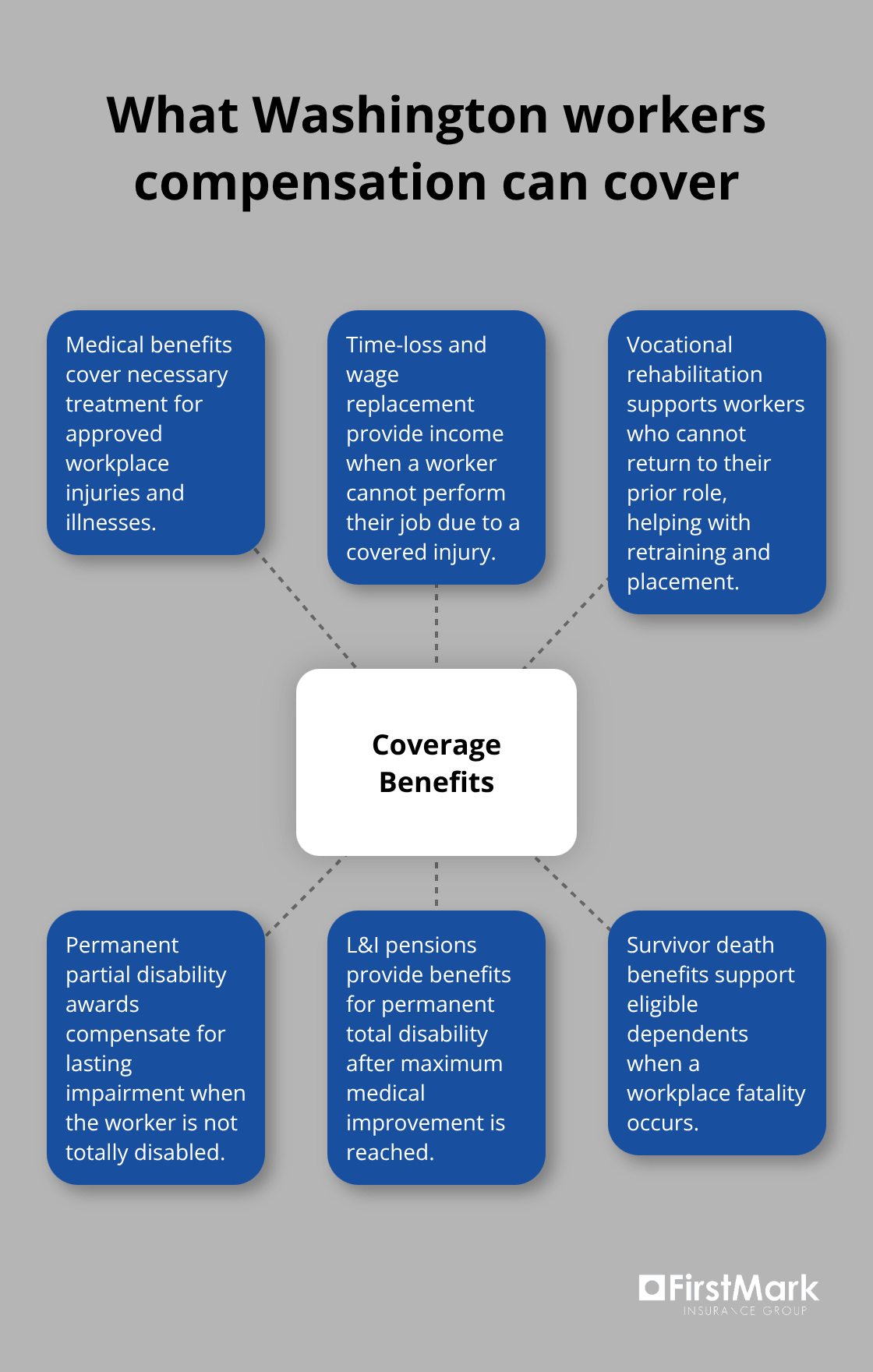
Workers' compensation is not a single payment; it is a package of benefits designed to address the various impacts of a workplace injury. These benefits are generally categorized into four main areas.
1. Medical Treatment
The insurance carrier is responsible for all "reasonable and necessary" medical expenses related to the work injury. This includes emergency room visits, surgeries, hospital stays, prescriptions, physical therapy, and medical devices like crutches or braces. In many states, the employer or the insurance company has the right to choose the initial treating physician, though workers can often request a change of doctor after a certain period.
2. Wage Replacement (Indemnity Benefits)
If a worker cannot return to work or can only work limited hours during their recovery, they are entitled to wage replacement benefits. These are typically calculated as two-thirds (66.6%) of the worker's average weekly wage, up to a state-mandated maximum. These benefits are usually tax-free, which helps offset the fact that they do not represent the worker’s full salary.
3. Vocational Rehabilitation
If an injury is so severe that the worker cannot return to their previous occupation, the system may provide vocational rehabilitation. This includes job retraining, tuition assistance for new certifications, and help with job placement. The goal is to return the individual to the workforce in a capacity that matches their new physical or mental limitations.
4. Death and Survivor Benefits
In the tragic event of a fatal workplace accident, workers’ compensation provides financial support to the deceased worker’s dependents (usually a spouse and minor children). These benefits typically cover funeral expenses and ongoing periodic payments to help replace the lost household income.
Comparison of Disability Classifications
Not all injuries are the same. Workers' compensation categorizes disabilities based on their duration and the extent of the impact on the worker's earning capacity.
| Disability Type | Duration | Impact on Earning Capacity | Common Examples |
|---|---|---|---|
| Temporary Total (TTD) | Short-term | Cannot work at all while recovering | Broken limb, recovery from surgery |
| Temporary Partial (TPD) | Short-term | Can work light duty/reduced hours | Sprained wrist requiring office work only |
| Permanent Partial (PPD) | Permanent | Can work, but has lasting impairment | Loss of a finger, permanent back stiffness |
| Permanent Total (PTD) | Permanent | Cannot return to any gainful employment | Severe spinal cord injury, total blindness |
The Step-by-Step Claims Process
Navigating a workers' compensation claim requires strict adherence to timelines and procedural rules. Failure to follow these steps can result in a valid claim being denied.
Step 1: Immediate Reporting
The moment an injury occurs, or as soon as a repetitive stress injury is identified, the worker must notify their supervisor. Most states have a deadline for this—often 30 days—but reporting it immediately is always better for the credibility of the claim.
Step 2: Seeking Medical Attention
The worker should seek medical care immediately. It is vital to tell the healthcare provider that the injury is work-related. This ensures that the medical records are properly coded and that the billing is directed to the workers' compensation carrier rather than the worker’s private health insurance.
Step 3: Formal Filing of the Claim
While the employer's report starts the process, the worker often needs to file a formal claim with the state’s workers’ compensation board or commission. This "Employee Claim" form establishes the legal record and protects the worker’s rights if the insurance company later decides to stop paying benefits.
Step 4: The Insurance Investigation
Once notified, the insurance company will investigate the claim. They may review medical records, interview witnesses, and examine the scene of the accident. They will then issue a "Notice of Acceptance" or a "Notice of Denial."
Step 5: Adjudication and Appeals
If a claim is denied, the worker has the right to appeal. This usually involves a hearing before an administrative law judge who specializes in workers' compensation cases. Evidence is presented, and the judge makes a binding decision on the eligibility and extent of benefits.
Common Reasons for Claim Denials
Insurance companies are for-profit entities and may deny claims for various reasons. Understanding these common pitfalls can help workers avoid them.
- Late Reporting: If a worker waits months to report an injury, the insurer will likely argue that the injury happened outside of work.
- Lack of Medical Evidence: If a worker does not go to the doctor or fails to follow the prescribed treatment plan, the insurer may claim the injury isn't serious.
- Pre-existing Conditions: Insurers often try to blame current symptoms on an old injury. However, in most states, if a work accident "aggravates" or "accelerates" a pre-existing condition, it is still a compensable claim.
- Injuries Outside the Scope of Employment: This includes injuries sustained while commuting, while on a lunch break off-premises, or while engaging in activities not related to job duties.
The Role of the Independent Medical Examination (IME)
During a claim, the insurance company may request that the worker attend an Independent Medical Examination (IME). Despite the name, these doctors are selected and paid for by the insurance company. The purpose of an IME is often to provide a "second opinion" on whether the worker has reached Maximum Medical Improvement (MMI) or if the treatment being requested is actually necessary.
It is critical for workers to understand that the IME doctor is not their physician and no doctor-patient confidentiality exists in this context. The report generated from this exam can significantly influence the continuation or termination of benefits.
Occupational Diseases and Cumulative Trauma
Workers' compensation isn't just for sudden accidents like falls or equipment malfunctions. It also covers "occupational diseases" and "cumulative trauma."
- Occupational Diseases: These are illnesses caused by long-term exposure to workplace hazards, such as mesothelioma from asbestos or respiratory issues from chemical fumes.
- Cumulative Trauma: These are injuries that develop over time due to repetitive motion, such as carpal tunnel syndrome or degenerative disc disease in the spine from years of heavy lifting.
Proving these claims is often more difficult because there is no single "accident date." Expert medical testimony is usually required to link the condition directly to the work environment.
Employer Responsibilities and Compliance
Employers have several legal obligations under the workers' compensation system. Failure to meet these can lead to severe penalties, including fines and even criminal charges.
- Maintaining Coverage: Employers must purchase insurance from a private carrier, a state fund, or be legally "self-insured" (usually only an option for very large corporations). Information regarding the insurance carrier must be posted in a prominent location, such as a breakroom.
- Reporting Injuries: Employers must report injuries to their insurance carrier and the state board within a specific timeframe once they are notified by the worker.
- Prohibiting Retaliation: It is illegal for an employer to fire, demote, or harass an employee for filing a workers' compensation claim. If retaliation occurs, the employee may have grounds for a separate wrongful termination lawsuit.
- OSHA Recordkeeping: In addition to workers' comp filings, many employers must keep a log of work-related injuries and illnesses (OSHA Form 300) to comply with federal safety regulations. Reference: OSHA Recordkeeping Requirements.
When to Consult a Workers' Compensation Attorney
While simple claims for minor injuries may be handled without legal counsel, more complex situations often require an attorney’s expertise. A lawyer is particularly valuable if:
- The claim is denied.
- The insurance company stops paying benefits before the worker is healed.
- The worker has a permanent disability that prevents them from returning to their old job.
- The employer retaliates against the worker.
- The injury was caused by a third party.
Most workers' compensation attorneys work on a "contingency fee" basis, meaning they only get paid if they successfully recover money for the client. The fee is usually a percentage of the final settlement or back-pay awarded, and these fees are often regulated or capped by state law.
Frequently Asked Questions
Can I be fired while I am on workers' compensation? In most states, your employer cannot fire you specifically because you filed a claim. However, workers' compensation does not provide absolute job security. You can still be fired for unrelated reasons, such as a company-wide layoff or performance issues that existed prior to the injury. Many states also allow employers to replace an injured worker if the worker cannot return to their duties and the employer has an immediate business need to fill the position.
Do I have to see the doctor the insurance company picks? This depends entirely on your state. Some states allow the employer to choose the doctor (at least for the first 30–90 days), while others allow the employee to choose. Always check your local regulations or consult your HR department's posted workers' comp notice to see which rules apply to you.
Is stress or "burnout" covered by workers' compensation? In 2026, many jurisdictions have expanded coverage for mental health issues, but they remain some of the hardest claims to win. Usually, you must prove that the stress was "extraordinary" (greater than the normal stress of a job) or that it was caused by a specific traumatic event at work, such as witnessing a violent crime or a fatal accident.
What happens if my injury was my own fault? Because workers' compensation is a no-fault system, you are generally still covered even if you were negligent. For example, if you forgot to wear safety goggles and sustained an eye injury, you are still eligible for benefits. The only common exceptions are if you were intoxicated or intentionally trying to hurt yourself.
How long do workers' compensation benefits last? Medical benefits last as long as they are medically necessary for the work-related injury. Wage replacement benefits continue until you return to work at your previous salary, or until you reach Maximum Medical Improvement. If you have a permanent impairment after reaching MMI, you may receive a "permanent partial disability" award, which is often a lump-sum payment or a set number of weeks of additional pay.
Practical Next Actions
If you have been injured at work, your priority should be your health and the preservation of your legal rights. Immediately notify your employer in writing, even if you have already told them verbally. This creates a paper trail. Seek a medical evaluation from an authorized provider and be very specific about how the injury happened and what symptoms you are experiencing. Finally, keep a personal log of all communications with your employer and the insurance adjuster, and save copies of every medical document and bill you receive. If the process becomes overwhelming or if benefits are delayed, consult with a qualified workers' compensation professional to ensure you receive the full support allowed under the law.
Image Gallery
Select an image to open it in a new tab.



Omar Farooq
EdTech Innovation and Virtual Pedagogy Journalist
