
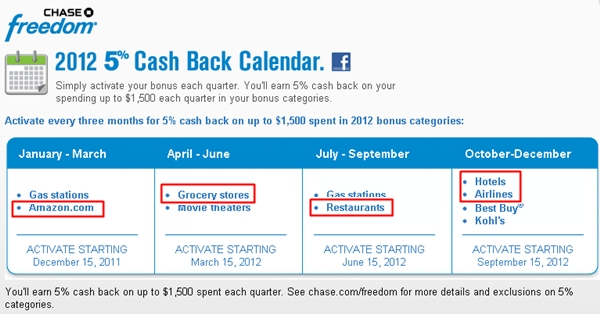
The Chase Freedom rewards calendar offers cardholders 5% cash back on up to $1,500 in combined purchases in specific categories that rotate every three months. To earn this elevated rate, users must manually activate the bonus each quarter through the Chase website, mobile app, or via email prompts.
The Chase Freedom and Chase Freedom Flex cards are among the most popular "no-annual-fee" credit cards in the United States, primarily due to their high-value rotating bonus categories. While many cards offer a flat 1.5% or 2% cash back, the Chase Freedom ecosystem allows users to earn significantly more by aligning their spending with a predetermined quarterly schedule. As we navigate 2026, understanding the nuances of these categories, activation deadlines, and the technicalities of Merchant Category Codes (MCC) is essential for anyone looking to maximize their return on every dollar spent.
Understanding the Chase Freedom and Freedom Flex Reward System
The rotating 5% reward system applies specifically to the legacy Chase Freedom card (which is no longer open to new applicants but remains in use by millions) and the Chase Freedom Flex. While the Freedom Flex also features fixed categories—such as 3% on dining and drugstores—the "Cash Back Calendar" is the centerpiece of both cards' value propositions.
The Mechanism of Rotating Categories
Each calendar year is divided into four quarters:
- Quarter 1 (Q1): January 1 – March 31
- Quarter 2 (Q2): April 1 – June 30
- Quarter 3 (Q3): July 1 – September 30
- Quarter 4 (Q4): October 1 – December 31
Chase typically announces the specific categories for the upcoming quarter roughly two weeks before the quarter begins. For example, the Q2 categories are usually revealed in mid-March. This staggered announcement strategy keeps the card at the "top of mind" for consumers, encouraging them to check their accounts and engage with the Chase ecosystem regularly.
Points vs. Cash Back
Although marketed as "5% cash back," the rewards are actually distributed as Chase Ultimate Rewards (UR) points. Cardholders earn 5 points for every $1 spent in the bonus categories. This distinction is vital because points can often be worth more than one cent each if you also hold a "premium" Chase card, such as the Chase Sapphire Preferred, Chase Sapphire Reserve, or Ink Business Preferred. By transferring points from a Freedom card to a Sapphire card, users can redeem them for travel at a higher value or transfer them to airline and hotel partners like United Airlines, Hyatt, or Southwest.
How the 5% Quarterly Calendar Works
The most critical rule of the Chase Freedom rewards calendar is the requirement for activation. Unlike cards that apply bonus rates automatically, Chase requires users to "opt-in" to the 5% categories every single quarter.
The Activation Window
Activation generally opens about 15 days before the quarter starts and remains open until the 14th day of the final month of that quarter. For example, for the Q1 period (January–March), you usually have until March 14 to activate.
One of the most consumer-friendly aspects of the Chase system is its retroactivity. If you spend money in a bonus category in January but forget to activate until February, Chase will retroactively award the 5% bonus on all eligible purchases made since the beginning of the quarter, provided you activate before the deadline.
The $1,500 Spending Cap
The 5% bonus is not unlimited. It is capped at the first $1,500 in combined purchases within the quarterly categories. Once you hit this $1,500 limit, you have earned a total of 7,500 points (or $75 cash back). Any additional spending in those categories for the remainder of the quarter earns the standard 1% rate.
| Quarter | Typical Categories (Historical & 2026 Projections) | Strategy for Maximization |
|---|---|---|
| Q1 | Grocery Stores, Self-Care, Fitness Clubs | Stock up on non-perishables; prepay gym memberships. |
| Q2 | Amazon.com, Select Streaming Services, Hotels | Load Amazon balance; pay for annual streaming plans. |
| Q3 | Gas Stations, EV Charging, Live Entertainment | Use for summer road trips and concert tickets. |
| Q4 | PayPal, Wholesale Clubs, Charities | Use PayPal at various online retailers for holiday shopping. |

Analyzing Typical 5% Categories and Technicalities
To truly master the rewards calendar, one must understand how Chase defines its categories. Chase relies on Merchant Category Codes (MCC), which are four-digit numbers assigned to a business by credit card processors (Visa or Mastercard) based on the types of goods or services the business provides.
Grocery Stores
This category generally includes supermarkets and neighborhood food stores. However, it specifically excludes "big box" retailers like Walmart and Target, as well as warehouse clubs like Costco or Sam's Club, unless they are specifically mentioned as a separate category. In 2026, Chase has continued to emphasize "Discount Stores" as a separate entity from "Grocery Stores," so checking the MCC via the Chase app after a small purchase is a wise move for new shoppers.
PayPal and Digital Wallets
In recent years, PayPal has become a staple of the Q4 calendar. This is arguably the most flexible category because PayPal is accepted at millions of online retailers. By linking your Chase Freedom Flex to your PayPal account and selecting it as the preferred payment method, you can effectively earn 5% at any online store that accepts PayPal—even if that store’s specific category (like clothing or electronics) isn't on the calendar.
Wholesale Clubs
Wholesale clubs like Sam's Club and BJ's (and historically Costco, though Costco only accepts Visa in-warehouse, which affects the Mastercard-based Freedom Flex) are common features. When these appear, cardholders often "max out" their $1,500 limit by purchasing gift cards for other services (like Shell, Starbucks, or Disney) sold at the warehouse club, effectively locking in a 5% discount on future spending elsewhere.
The Technical Depth of MCC and Category "Gotchas"
A common frustration for cardholders is when a purchase "should" have earned 5% but only earned 1%. This usually occurs due to how the merchant is classified.
- The "Store within a Store" Problem: If you buy coffee at a Starbucks located inside a Target, the transaction may code as "Target" (a discount store) rather than "Dining" or "Coffee Shop." If "Dining" is the 5% category, you might miss out.
- Gas Stations vs. Convenience Stores: Most gas stations code correctly, but some specialized "truck stops" or repair shops that happen to sell gas may code as "Automotive Repair," which would not trigger the 5% gas station bonus.
- Third-Party Delivery Services: When "Dining" is a category, services like DoorDash or UberEats usually code as dining. However, when "Groceries" is the category, using Instacart usually works, but it depends on how the specific grocery chain processes the payment through the platform.
Maximizing Your 5% Rewards Strategy
To get the most out of the Chase Freedom rewards calendar in 2026, you should employ a multi-step strategy that goes beyond simply spending in the categories.
Stacking with Shopping Portals
You can increase your rewards by using the Chase "Shop through Chase" portal or third-party extensions like Rakuten. For example, if the Q2 category is Amazon and you access an eligible retailer through a portal while paying via an Amazon-linked method (or if the category is general "Online Shopping"), you could earn 5% from the card plus an additional 2% to 10% from the portal.
The Gift Card Strategy
If a quarter is coming to an end and you haven't reached the $1,500 spending limit, you can "manufacture" the remaining spend by purchasing gift cards for merchants you know you will visit later. If "Gas Stations" is the category, you can buy $200 worth of gas cards or even grocery gift cards (if sold at the station) to use in the following quarter. This ensures you never "waste" the 5% capacity of the current calendar.
Managing Multiple Freedom Cards
It is a little-known fact that some enthusiasts hold multiple Chase Freedom or Freedom Flex cards. Since each card has its own $1,500 limit, a household with two such cards can earn 5% on up to $3,000 of spending per quarter. This is particularly useful during high-spend periods like Q4 (holiday shopping) or Q1 (when grocery spending is often highest).
Common Mistakes to Avoid
- Forgetting to Activate: This is the most common error. Set a recurring calendar reminder for the 15th of the month preceding each quarter (December 15, March 15, June 15, and September 15).
- Ignoring the "Combined" Limit: The $1,500 limit is shared across all categories in a quarter. If the categories are "Gas Stations" and "Home Improvement," and you spend $1,500 at Home Depot, you will only earn 1% on any subsequent gas purchases.
- Returns and Refunds: If you return an item purchased during a 5% quarter, Chase will claw back the 5 points per dollar. If this happens after the quarter has ended, it could result in a negative point balance if you have already spent your rewards.
FAQs
Do I need to activate the Chase Freedom categories every month?
No, activation is required only once per quarter. Once you activate for a specific quarter, all eligible purchases made during those three months (even those made earlier in that same quarter) will earn 5% cash back, up to the $1,500 limit.
What happens if I spend more than $1,500 in the bonus categories?
Any spending above the $1,500 quarterly limit will earn the base rate of 1% cash back. The limit resets at the start of the next quarter when a new set of categories is introduced.
Does the 5% calendar apply to the Chase Freedom Unlimited?
No, the Chase Freedom Unlimited does not have a rotating 5% calendar. It offers a flat 1.5% on all purchases (with some higher fixed categories like dining and travel). The 5% rotating calendar is exclusive to the Chase Freedom Flex and the "legacy" Chase Freedom card.
Can I see how much of the $1,500 limit I have already used?
Yes, Chase provides a "Rewards Tracker" in the mobile app and on the website. This progress bar shows exactly how much you have spent in the current quarter's bonus categories and how much of the $75 (7,500 points) maximum reward remains.
Are there any categories that never appear on the calendar?
While Chase varies the calendar, some categories like "Insurance Premiums," "Taxes," or "Utilities" rarely appear as 5% categories. These are typically better suited for flat-rate cards or cards with specific utility bonuses.
Practical Recommendation
To master the Chase Freedom rewards calendar in 2026, your first action should be to download the Chase Mobile app and enable push notifications for "Account Alerts." This ensures you are notified the moment activation becomes available. Additionally, consider the "Chase Trifecta" strategy: pair your Freedom card with a Chase Sapphire Preferred and a Chase Freedom Unlimited. Use the Freedom Flex for the 5% calendar, the Sapphire for travel and dining, and the Freedom Unlimited for everything else. By consolidating all your points into the Sapphire account, you can significantly increase the value of the rewards earned through the quarterly calendar, often achieving an effective return of 8% to 10% when redeemed for high-value travel.
Image Gallery
Select an image to open it in a new tab.

Akira Tanaka
International Academic Trends Correspondent
