The Advantages of Qualitative Market Research: Uncovering the "Why" Behind Consumer Behavior

Qualitative market research provides deep insights into consumer motivations, attitudes, and behaviors by focusing on the "why" and "how" of decision-making rather than just the "what." It allows businesses to explore complex emotional drivers, refine product concepts through iterative feedback, and uncover unmet needs that numerical data often overlooks.
In the landscape of 2026, where data saturation is at an all-time high, qualitative research has become the essential bridge between raw numbers and actionable human insight. While quantitative data tells you that a customer stopped using an app, qualitative research reveals the specific frustration or emotional disconnect that led to that departure. By utilizing methods such as in-depth interviews, focus groups, and ethnographic studies, organizations can build more empathetic and effective business strategies.
Depth of Insight and "Thick Description"
One of the primary advantages of qualitative market research is its ability to provide "thick description," a term used to describe the detailed account of field experiences in which the researcher explains not just the behavior, but its context as well. Unlike quantitative surveys that restrict respondents to predefined categories or scales, qualitative methods encourage participants to speak in their own words.
This depth is crucial for understanding the nuance of consumer sentiment. For example, a customer might rate a product 4 out of 5 stars in a survey, which suggests general satisfaction. However, in a one-on-one interview, that same customer might reveal they only gave it a high rating because there are no better alternatives, while simultaneously expressing deep frustration with the user interface. This level of detail helps businesses identify vulnerabilities that a simple numerical score would hide.
Furthermore, qualitative research allows for the exploration of the "customer journey" in a non-linear fashion. Researchers can probe into the specific moments of friction or delight that define a brand relationship. By capturing the language, metaphors, and tone used by consumers, companies can align their marketing copy and brand voice more closely with the actual lived experience of their target audience.
Flexibility and Iterative Discovery
In 2026, market conditions shift rapidly, and qualitative research offers the flexibility required to adapt to these changes in real-time. Quantitative studies are typically rigid; once a survey is launched to 2,000 people, the questions cannot be changed without compromising the data set. Qualitative research, however, is inherently iterative.
If a moderator notices an unexpected trend or a recurring mention of a competitor during the first three interviews of a study, they can adjust the discussion guide for the remaining sessions. This ability to "follow the trail" allows researchers to discover insights they didn't even know they were looking for. This exploratory nature is particularly valuable in the early stages of product development or when entering a new, unfamiliar geographic market.
This flexibility also extends to the environment. With the advancement of mobile ethnography and remote collaboration tools in 2026, researchers can observe consumers in their natural habitats—their homes, offices, or while shopping—through live video feeds. This provides a more authentic look at how products are actually used, rather than how consumers say they use them in a clinical laboratory setting.

Uncovering Subconscious Emotional Drivers
Human decision-making is rarely purely rational. Behavioral economics has long established that emotions, cognitive biases, and social pressures drive most of our purchases. Qualitative research is uniquely positioned to peel back these layers of subconscious motivation.
Techniques such as projective mapping, laddering, and word association help bypass the "rationalizing" brain. When asked directly why they bought a specific brand of luxury watch, a consumer might cite "build quality" or "investment value." However, through qualitative probing, the researcher may find the true driver is a desire for social validation or a specific childhood memory associated with the brand.
Understanding these emotional anchors allows marketing teams to create campaigns that resonate on a deeper level. Instead of competing on features and price alone—a "race to the bottom" that characterizes many saturated markets in 2026—brands can compete on values and emotional connection. This leads to higher brand loyalty and a more resilient customer base.
Fueling Innovation and Product Development
Qualitative research serves as the engine for innovation by identifying "unmet needs." Quantitative data is excellent at measuring the performance of existing products, but it is less effective at imagining products that do not yet exist. By observing the workarounds and frustrations of consumers, qualitative researchers can identify "pain points" that represent significant market opportunities.
In 2026, many companies utilize the "Jobs to be Done" (JTBD) framework within their qualitative studies. This approach focuses on the "job" a consumer is trying to hire a product to do. For instance, a person doesn't just buy a lawnmower; they "hire" it to keep their yard looking neat so they feel like a responsible homeowner. Qualitative research uncovers these underlying "jobs," allowing R&D teams to design features that directly address the functional, social, and emotional dimensions of the task at hand.
Additionally, qualitative methods allow for "co-creation." Bringing "lead users" or brand enthusiasts into a focus group to brainstorm or react to early-stage prototypes can significantly reduce the risk of product failure. This iterative feedback loop ensures that the final product is built with the user’s perspective integrated from the start, rather than being retrofitted later.
Humanizing Big Data
The rise of Big Data and AI-driven analytics has, ironically, made qualitative research more important than ever. While 2026-era algorithms can predict what a consumer might do next with startling accuracy, they often struggle to explain why. Relying solely on data patterns can lead to "algorithm bias" or a fundamental misunderstanding of the human intent behind the clicks.
Qualitative research provides the "human" context that breathes life into data points. It acts as a reality check for quantitative findings. For example, if data shows a spike in website traffic but a drop in conversions, qualitative user testing can quickly identify if the issue is a confusing checkout button, a lack of trust in the payment processor, or a mismatch between the ad copy and the landing page content.
By integrating qualitative insights with quantitative metrics—a "mixed-methods" approach—organizations can achieve a 360-degree view of their market. This prevents the "echo chamber" effect where businesses only look at the data that confirms their existing biases.
Comparing Qualitative and Quantitative Research
To better understand where qualitative research excels, it is helpful to compare it directly with its quantitative counterpart. Most successful organizations in 2026 use a strategic mix of both.
| Feature | Qualitative Research | Quantitative Research |
|---|---|---|
| Primary Goal | To explore ideas, motivations, and "why" | To measure frequency, scale, and "how many" |
| Sample Size | Small (often 8–30 participants) | Large (often 200–5,000+ participants) |
| Data Format | Text, video, audio, and observation | Numbers, statistics, and charts |
| Question Type | Open-ended and unstructured | Closed-ended and structured |
| Flexibility | High; researchers can pivot mid-study | Low; standardized for all participants |
| Analysis | Thematic analysis and pattern recognition | Statistical significance and regression |
| Common Tools | Focus groups, IDIs, ethnography | Surveys, polls, A/B testing, clickstream |
Cost-Effectiveness and Speed for Directional Insights
A common misconception is that qualitative research is always more expensive or slower than quantitative research. While the cost per participant is higher in qualitative studies (due to incentives and professional moderation), the total project cost for a targeted qualitative study is often lower than a massive, statistically significant national survey.
For many business decisions, you do not need 1,000 responses to know you are on the wrong track. Five to eight in-depth interviews can often reveal the same core usability issues or branding missteps as a much larger study. In 2026, the speed of qualitative research has been further enhanced by AI-assisted transcription and coding. What used to take weeks of manual analysis can now be processed in days, allowing businesses to move from insight to execution at a much faster pace.
This "directional" insight is invaluable for startups and agile teams who need to make quick decisions without the budget for longitudinal quantitative tracking. It allows for "failing fast" and pivoting before significant capital is invested in a flawed concept.
Addressing Limitations and Ensuring Quality
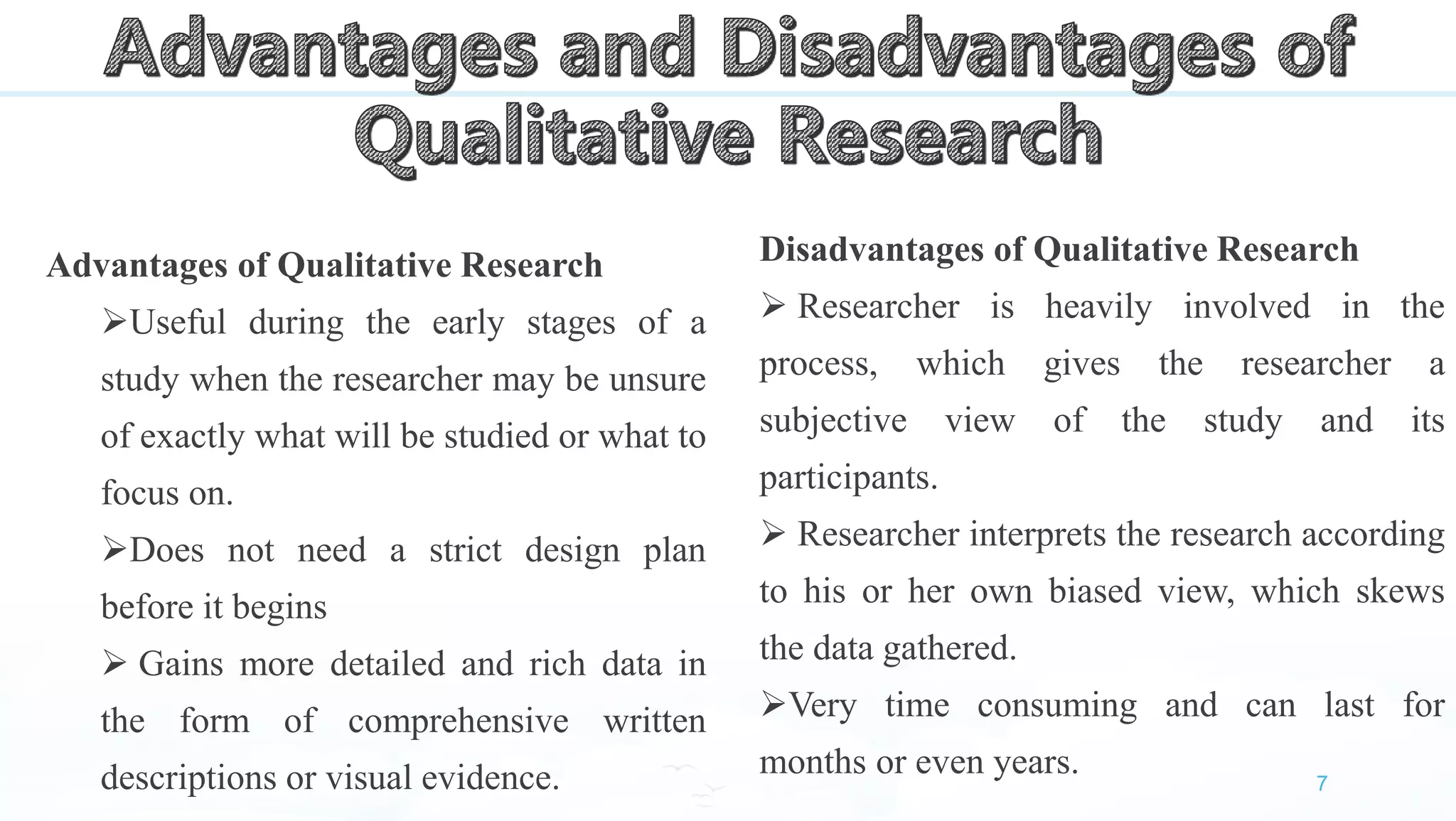
While the advantages are numerous, qualitative research must be conducted with rigor to avoid common pitfalls. The most significant risk is researcher bias, where the moderator’s own expectations influence the participants or the interpretation of the data.
To mitigate this in 2026, professional researchers use several techniques:
- Triangulation: Using multiple researchers to analyze the same data set to ensure consistency.
- Neutral Moderation: Employing third-party moderators who have no stake in the project's outcome.
- Negative Case Analysis: Actively looking for data that contradicts the emerging themes to ensure a balanced view.
It is also important to remember that qualitative research is not "statistically representative." You cannot say "70% of the market feels this way" based on ten interviews. Instead, the goal is to identify the range of opinions and the depth of feeling. Once a qualitative study identifies a key driver, a quantitative study can then be used to measure how prevalent that driver is across the broader population.
Frequently Asked Questions
Is qualitative research better than quantitative research?
Neither is inherently "better"; they serve different purposes. Qualitative research is superior for exploring new ideas, understanding complex emotions, and identifying the "why" behind behaviors. Quantitative research is superior for measuring scale, predicting trends, and providing statistical validation. The most robust business strategies typically utilize both.
How do you determine the sample size for qualitative research?
In qualitative research, sample size is usually determined by "data saturation." This is the point at which new interviews or focus groups no longer yield significantly new information or themes. For a relatively homogeneous target audience, saturation often occurs between 10 and 15 in-depth interviews.
Can AI replace human moderators in 2026?
While AI tools in 2026 are excellent at transcribing, summarizing, and identifying basic sentiment, they cannot yet replace the empathy and intuition of a human moderator. A human researcher can pick up on subtle body language, awkward silences, and emotional subtext that an AI might miss, allowing for more effective "probing" into sensitive topics.
How long does a typical qualitative research project take?
With 2026 technology, a streamlined qualitative project (such as a series of remote mini-focus groups) can be completed in two to three weeks. This includes the recruitment of participants, the sessions themselves, and the delivery of a thematic report. More complex ethnographic studies may take longer depending on the depth of observation required.
What are the most common qualitative methods?
The most common methods include In-Depth Interviews (IDIs), Focus Groups, Ethnography (observing people in their environment), Diary Studies (where participants record their experiences over time), and Usability Testing (observing how people interact with a product or interface).
Strategic Recommendation
To maximize the advantages of qualitative market research, organizations should integrate it into every stage of the business lifecycle, rather than treating it as a one-off "sanity check." Start with qualitative exploration to define the problem space and identify consumer pain points. Use the insights gained to develop prototypes, and then return to qualitative methods for iterative testing and refinement. Finally, pair these deep insights with quantitative data to validate findings and scale your strategy with confidence.
Image Gallery
Select an image to open it in a new tab.


Ingrid Bjornson
Global Cyber Policy and Regulation Analyst
