What the Theogony of Hesiod Actually Says: A Detailed Guide to the Greek Creation Myth
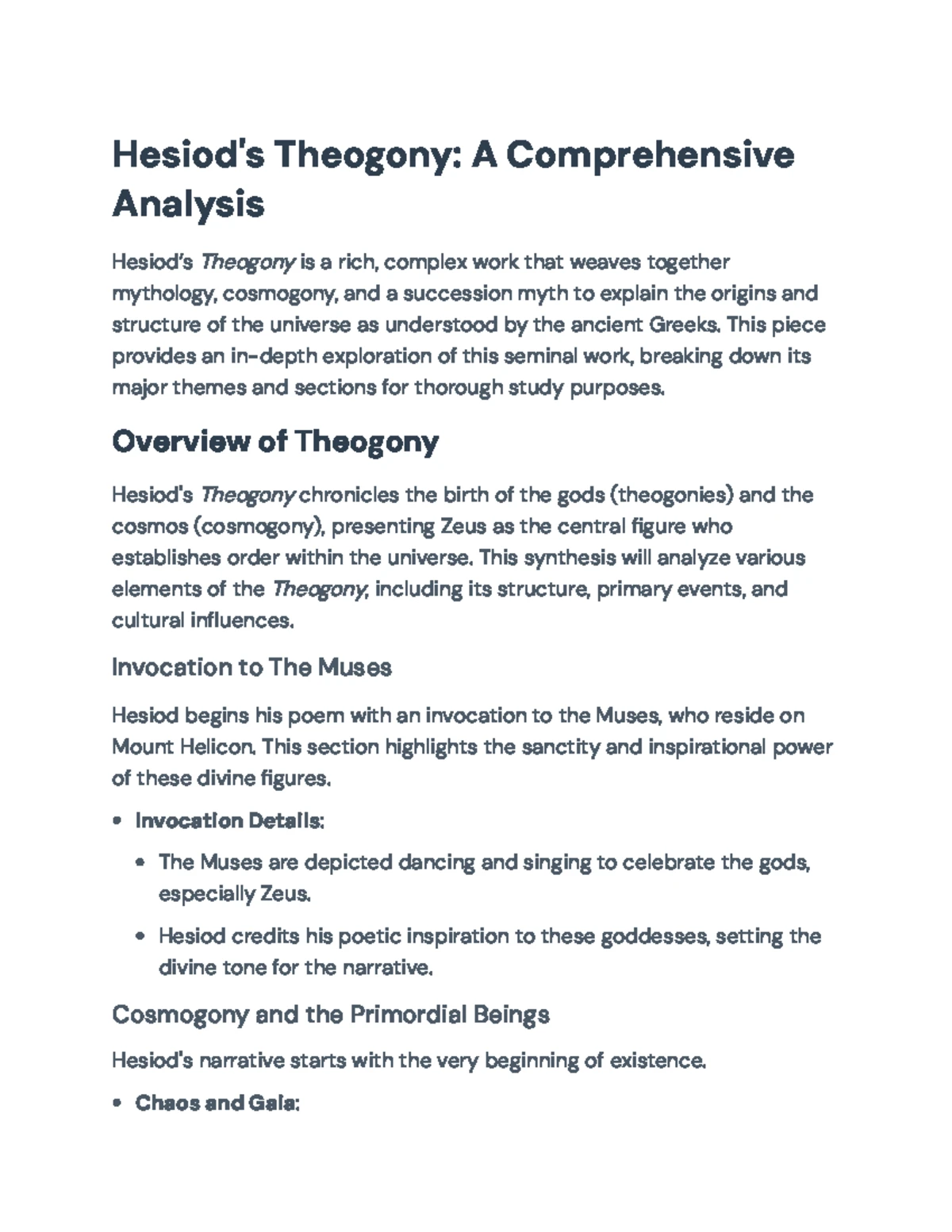
The Theogony of Hesiod is an 8th-century BCE epic poem that systemizes the origins of the Greek cosmos and the genealogy of its gods. It traces the universe from its primordial state—beginning with Chaos—to the eventual, permanent establishment of Zeus as the sovereign king of the gods, providing the foundational theological framework for ancient Greek religion and cultural identity.
Composed in dactylic hexameter, the Theogony remains one of our earliest and most vital sources for understanding how the ancient Greeks conceptualized the divine. While it is often read alongside Homer’s Iliad and Odyssey, Hesiod’s work serves a different purpose: it is an "origins story" that attempts to organize a vast, often contradictory oral tradition into a single, coherent narrative of cosmic evolution. As of 2026, it continues to be the primary text for scholars studying the transition from chaotic natural forces to an ordered, justice-based divine hierarchy.
The Prooemion: The Muses and the Poet’s Authority
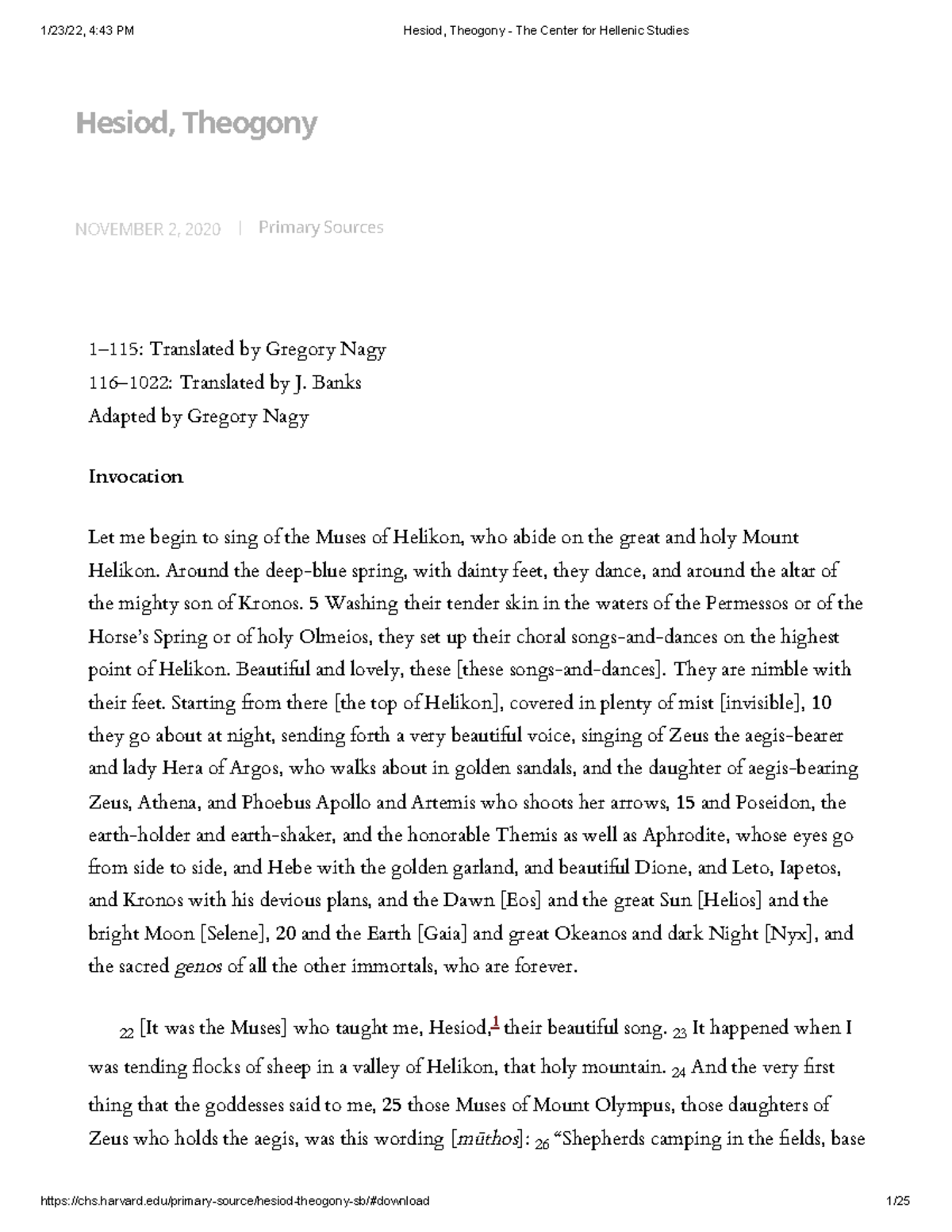
The Theogony does not begin with the creation of the world, but with a hymn to the Muses. This 115-line introduction, known as the prooemion, is essential because it establishes Hesiod’s authority as a poet. Hesiod claims that while he was shepherding his lambs on Mount Helicon, the Muses appeared to him and breathed into him a "divine voice."
This passage is famous for the Muses' cryptic statement: "We know how to speak many false things as though they were true; but we know, when we will, to utter true things." This suggests that Hesiod’s account is not merely one of many stories, but the "true" version authorized by the gods themselves. The Muses provide the poet with the knowledge of things that were, things that are, and things that shall be, specifically focusing on the lineage of the "blessed gods who live for ever."
By beginning with the Muses, Hesiod signals that the order of the universe is mirrored by the order of the song. The Muses represent the transition from the physical labor of the shepherd to the intellectual labor of the poet, a transformation made possible by divine grace.
The First Generation: The Primordial Deities
The actual cosmogony—the birth of the universe—begins at line 116. Hesiod identifies four entities that appear first, though he does not explicitly state how they came to be.
- Chaos: Often misunderstood in modern English as "disorder," the Greek Chaos literally means a "gap," "void," or "chasm." It is the empty space from which all else emerges.
- Gaia (Earth): The wide-bosomed, permanent foundation of all things.
- Tartarus: A dark, misty place deep within the earth.
- Eros (Desire): The most beautiful of the immortal gods, who "unnerves the limbs and overcomes the mind." Eros is the driving force of procreation that allows the subsequent generations of gods to be born.
From Chaos, Erebos (Darkness) and Nyx (Night) are born. Through the power of Eros, Night and Darkness mate to produce Aether (Radiance) and Hemera (Day). This signifies the emergence of light from darkness without the need for a "creator" figure; in Hesiod’s world, the universe grows and differentiates itself like a biological organism.
The Succession Myth: The Reign of Ouranos
Gaia, acting alone, first gives birth to Ouranos (Sky), the Mountains, and Pontos (Sea). She then mates with Ouranos to produce the first great generation of deities: the twelve Titans, the three one-eyed Cyclopes, and the three Hecatoncheires (Hundred-Handed Ones).
The Titans include figures who would become central to later myths:
- Oceanus and Tethys: The origins of the world's waters.
- Hyperion and Theia: The parents of the Sun (Helios), Moon (Selene), and Dawn (Eos).
- Mnemosyne: The personification of Memory.
- Themis: The personification of Divine Law.
- Kronos: The youngest and most "wily" of the Titans.
Ouranos, however, is a tyrannical father. He hates his children and refuses to let them emerge from Gaia’s womb, hiding them away in a secret place of Earth. This causes Gaia immense physical and emotional distress. She fashions a sickle of "grey adamant" and appeals to her children for help. Only Kronos is brave enough to take action. When Ouranos comes to Gaia at night to mate, Kronos reaches out and castrates his father.
This act of violence is the first major shift in cosmic power. The blood from Ouranos falls upon Gaia, giving birth to the Furies (Erinyes), the Giants, and the Meliae (Ash-tree Nymphs). The severed genitals fall into the sea, where they produce white foam, from which Aphrodite, the goddess of love and beauty, emerges near the island of Cyprus.
The Reign of Kronos and the Birth of the Olympians
With Ouranos sidelined, Kronos becomes the ruler of the gods. He takes his sister Rhea as his consort. However, Kronos learns from Gaia and Ouranos that he is destined to be overthrown by one of his own children. To prevent this, he adopts a policy even more brutal than his father’s: as Rhea gives birth to each child, Kronos swallows them whole.
The children swallowed by Kronos are the first generation of the well-known Olympian gods: Hestia, Demeter, Hera, Hades, and Poseidon. When Rhea becomes pregnant with her sixth child, Zeus, she seeks the help of her parents to save him. She travels to Crete to give birth in secret and presents Kronos with a stone wrapped in swaddling clothes, which he promptly swallows, believing it to be the infant.
Zeus is raised in secret on Crete. Upon reaching maturity, he uses a potion (often attributed to the Titaness Metis in later interpretations) to make Kronos vomit up the stone and then his five siblings. The stone is placed at Pytho (Delphi) as a monument. This leads directly to the greatest conflict in the poem: the Titanomachy.
The Titanomachy and the Rise of Zeus
The Theogony describes the Titanomachy as a decade-long war between the younger Olympian gods (led by Zeus) and the older Titans (led by Kronos). The battle is a stalemate until Zeus, following the advice of Gaia, releases the Hecatoncheires—Cottus, Briareos, and Gyes—from the underworld where Ouranos had originally imprisoned them.
Zeus provides the Hecatoncheires with nectar and ambrosia to restore their strength, and they join the fight. The description of the ensuing battle is one of the most violent and vivid in ancient literature. Zeus unleashes his full power:
"The earth crashed in burning, and the vast wood crackled loud with fire... the whole earth seethed, and the streams of Ocean... the heat unspeakable reached even the bright upper air."
With the Hundred-Handed ones throwing three hundred stones at once and Zeus wielding his lightning bolts (forged for him by the Cyclopes), the Titans are finally defeated. They are cast down into the depths of Tartarus and imprisoned behind bronze gates, guarded forever by the Hecatoncheires.
The Conflict with Prometheus
Nestled within the genealogical accounts is the story of Prometheus, the son of the Titan Iapetus. This episode is crucial because it explains the relationship between gods and humans, as well as the origin of human suffering.
At a meeting in Mecone, Prometheus attempts to trick Zeus regarding the division of a slaughtered ox. He hides the good meat inside the ox's stomach and covers the bare bones with a layer of glistening fat. Zeus, seeing through the trick but allowing it to play out to justify his future punishment of man, chooses the pile of fat and bones. This "etiological" myth explains why, in Greek ritual, humans eat the meat and burn the bones as a sacrifice to the gods.
In retaliation, Zeus withholds fire from humanity. Prometheus steals it back in a hollow fennel stalk. In response, Zeus orders the creation of the first woman, Pandora (though Hesiod does not name her in the Theogony, only in Works and Days). She is described here as a "beautiful evil" (kalon kakon), whose descendants—women—are portrayed by Hesiod as a source of toil and trouble for men. This episode reinforces Zeus's status as an all-knowing and inescapable judge; even the cleverest of Titans cannot outwit him.
The Battle with Typhoeus
Even after the Titans are defeated, Zeus’s rule is challenged one last time. Gaia, mating with Tartarus, gives birth to Typhoeus (or Typhon), a monstrous creature with a hundred snake heads that fire and speak with the voices of bulls, lions, and dogs.
Typhoeus represents the ultimate threat of cosmic regression—a return to mindless, monstrous chaos. If Typhoeus had won, he would have ruled over both mortals and immortals. However, Zeus perceives the threat immediately. He leaps from Olympus and strikes the monster with his thunderbolts, scorching all its heads. Typhoeus is cast into Tartarus, and from his remains come the "ill-blowing winds" that wreck ships and ruin crops, contrasting with the "good" winds (Notus, Boreas, Zephyrus) created by the gods.
| Stage of Creation | Primary Ruler | Key Event/Conflict | Resulting Order |
|---|---|---|---|
| Primordial | Chaos / Gaia | Emergence of Eros | Potential for life and differentiation |
| First Dynasty | Ouranos | Castration by Kronos | Separation of Earth and Sky; birth of Aphrodite |
| Second Dynasty | Kronos | Swallowing of the Olympians | Period of stagnation and tyranny |
| The Transition | War (Titanomachy) | Battle for Olympus | Defeat of the Titans; imprisonment in Tartarus |
| Third Dynasty | Zeus | Defeat of Typhoeus | Permanent, justice-based divine monarchy |
The Marriages of Zeus and the New Divine Order
The final sections of the Theogony detail how Zeus consolidates his power through a series of strategic marriages and offspring. Unlike Ouranos and Kronos, who tried to suppress their children, Zeus integrates his offspring into his administration, ensuring stability.
- Metis (Wisdom): Zeus’s first wife. When she becomes pregnant with Athena, Zeus swallows Metis herself (on the advice of Gaia and Ouranos) to prevent a son from overthrowing him. Thus, Wisdom becomes a permanent part of Zeus, and Athena is later born from his head.
- Themis (Law/Custom): Their children include the Horae (Order, Justice, and Peace) and the Moirae (Fates). This symbolizes that justice and order are now central to the universe.
- Eurynome: Mother of the Graces (Charites), who bring beauty and joy to the gods.
- Demeter: Mother of Persephone.
- Mnemosyne (Memory): Mother of the nine Muses.
- Leto: Mother of Apollo and Artemis.
- Hera: His final "legal" wife, mother of Hebe, Ares, and Eileithyia.
The poem concludes with a list of goddesses who mated with mortal men to produce heroes, serving as a bridge to the (now largely lost) Catalogue of Women.
Frequently Asked Questions
Did Hesiod really write the Theogony?
While the poem identifies "Hesiod" as the author in the prologue, most modern scholars (writing as of 2026) view Hesiod as a historical figure representing a specific poetic tradition. The Theogony is an oral-derived text, meaning it was likely composed through a long tradition of oral performance before being fixed in writing around 700-650 BCE.
How does Hesiod's creation story differ from the Bible?
Unlike the Judeo-Christian Genesis, where a pre-existing God creates the world out of nothing (ex nihilo), Hesiod’s gods are the world. Gaia is the literal earth; Ouranos is the literal sky. Furthermore, the Greek gods are not omnipotent or inherently "good" in a modern sense; they are powerful beings who must struggle against one another to establish order.
Why is Zeus considered the "hero" of the Theogony?
Zeus is the hero because he ends the cycle of generational violence. While Ouranos and Kronos were selfish tyrants who feared their children, Zeus distributes honors (timai) among the other gods and incorporates wisdom and justice into his reign. He creates a stable system that doesn't rely on suppressing the next generation but on organizing it.
What is the significance of the "Stone" swallowed by Kronos?
The stone, known as the Omphalos (navel), was a real cult object at Delphi. By including it in the myth, Hesiod provides a divine origin for a physical location in the Greek world, linking the "time of the gods" to the "time of humans."
What does the word "Theogony" actually mean?
The word is derived from the Greek theos (god) and gone (birth/origin). It literally means "the birth of the gods." Because the gods are identified with natural elements, a theogony is also a cosmogony (the birth of the universe).
Further Recommendations for Readers
To fully grasp the impact of what the Theogony actually says, it is helpful to read it alongside Hesiod's other major work, Works and Days. While the Theogony focuses on the divine realm, Works and Days focuses on the human realm, providing a more cynical but practical view of life under the reign of Zeus.
For those interested in the technical aspects of the text, the Perseus Digital Library offers a line-by-line breakdown of the Greek text with English translations. Additionally, M.L. West’s scholarly commentary remains the gold standard for understanding the Near Eastern influences (such as the Hittite Song of Kumarbi) that likely shaped Hesiod’s narrative of the succession of gods.
Image Gallery
Select an image to open it in a new tab.


Omar Farooq
EdTech Innovation and Virtual Pedagogy Journalist
