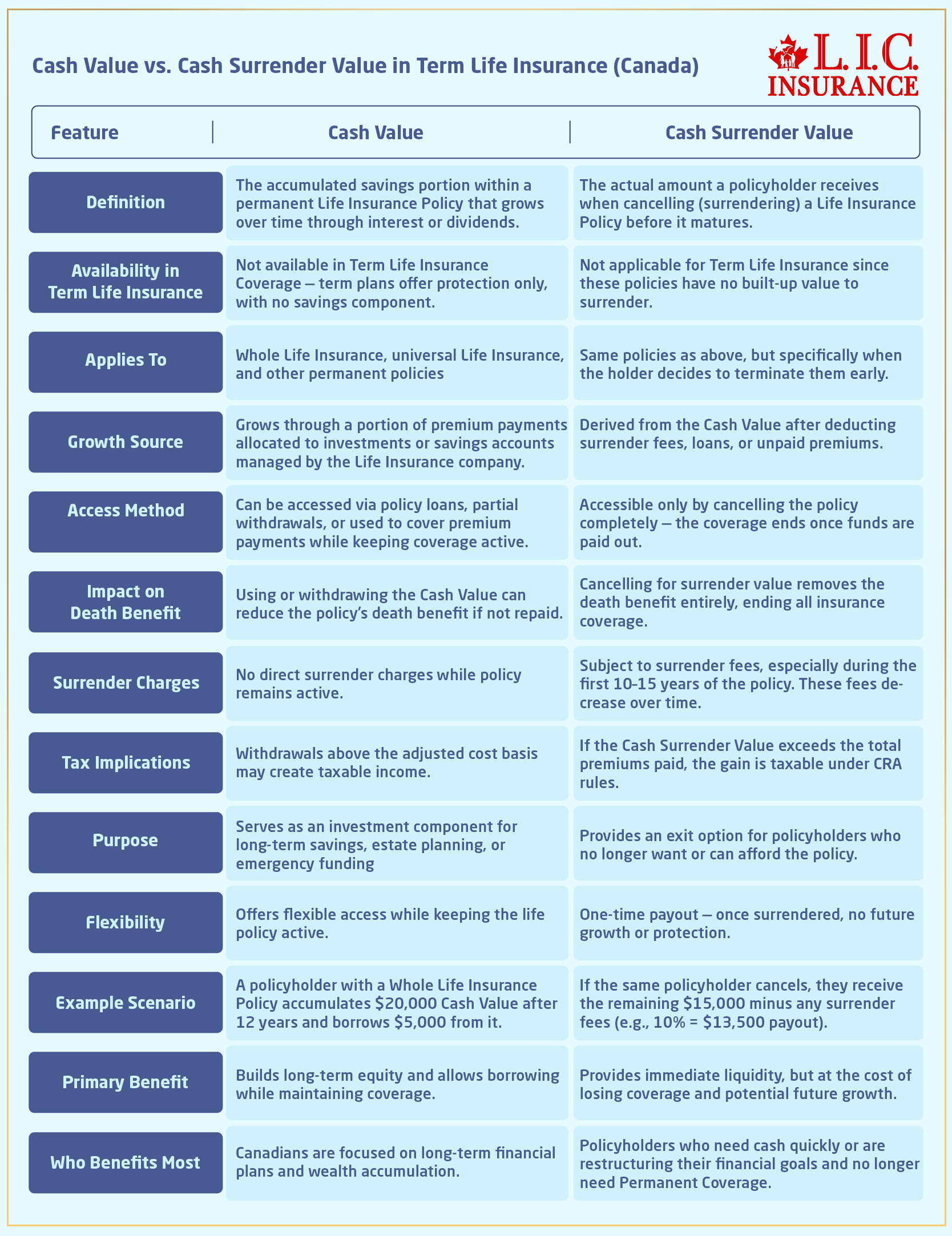
Cash value life insurance offers tax-deferred growth, tax-free withdrawals up to your policy's cost basis, and tax-free policy loans, provided the policy remains active. However, surrendering a policy, allowing a policy to lapse with outstanding loans, or violating IRS funding limits can trigger substantial ordinary income tax liabilities and penalties.
How Cash Value Accumulates: The Tax-Deferred Growth Mechanism
Permanent life insurance policies—such as whole life, universal life, variable universal life, and indexed universal life—contain a savings component known as the cash value. Under Internal Revenue Code (IRC) Section 72, cash value within a qualifying life insurance contract grows on a tax-deferred basis. This means that annual interest credits, dividend accumulations, or investment gains realized within the policy are not subject to federal or state income taxation in the year they are earned.
- Gross Premium Payment
- Policy Cost Deductions
- Cost of Insurance, Administrative Fees, Rider Charges
- Net Cash Value Growth Account
- Tax-Deferred Growth: Interest / Dividends / Indexing
Tax deferral creates a compounding advantage over traditional taxable brokerage accounts. In a taxable investment account, annual dividends, realized capital gains, and interest payments are assessed income tax annually, diminishing the principal balance available for compound growth. Within a permanent life insurance policy, un-taxed growth remains fully invested, enabling the account value to compound at a faster rate over extended periods.
To maintain this favorable tax treatment, the contract must meet the statutory definition of a life insurance policy under IRC Section 7702. Section 7702 sets forth explicit financial testing requirements—specifically the Cash Value Accumulation Test (CVAT) or the Guideline Premium and Cash Value Corridor Test (GPT)—to ensure the contract functions primarily as an insurance instrument rather than an investment vehicle. If an insurance contract fails to satisfy Section 7702 tests, the annual increase in net cash surrender value (plus the net cost of life insurance protection) is treated as ordinary income taxable to the policy owner in that tax year.
Tax Treatment of Distributing Cash Value: Withdrawals, Loans, and Surrenders
Accessing accumulated cash value can be accomplished through three primary mechanisms: direct withdrawals (surrenders of paid-up additions), policy loans, or a complete surrender of the policy contract. Each access method carries distinct tax consequences under United States federal tax law.
Cost Basis: The Foundation of Life Insurance Taxing
To evaluate the tax consequences of any cash value distribution, policyholders must first calculate their policy's cost basis (also called investment in the contract).
The general formula for determining cost basis is:
$$\text{Cost Basis} = \text{Total Premiums Paid} - \text{Cumulative Non-Taxable Withdrawals} - \text{Non-Taxable Dividends Received}$$
Dividends received from a mutual insurance company are legally classified as a non-taxable refund of excess premium paid, provided the total accumulated dividends do not exceed the cumulative premiums paid into the policy. Once total cumulative dividends or withdrawals equal the total premiums paid, any subsequent dividend received in cash or applied as a distribution is taxed as ordinary income.
Direct Withdrawals (The FIFO Accounting Rule)
For standard, non-MEC permanent life insurance contracts, partial withdrawals are governed by the First-In, First-Out (FIFO) accounting rule pursuant to IRC Section 72(e). Under FIFO rules, partial surrenders are treated as coming from your non-taxable cost basis first.
- Withdrawals Below Cost Basis: Distributions up to the amount of the cumulative cost basis are treated as a non-taxable return of capital. No federal or state income tax is owed, and no reporting form is triggered for taxable income.
- Withdrawals Exceeding Cost Basis: Once cumulative withdrawals exhaust the cost basis, every dollar withdrawn thereafter represents policy earnings. Earnings are taxed as ordinary income in the tax year received—not at lower capital gains tax rates.
Exception Note: If a policyholder surrenders cash value during the first 15 policy years and that cash surrender leads to a reduction in the policy's death benefit, IRC Section 7702(f)(7) establishes a special rule. Under this rule, a portion of the withdrawal within this initial 15-year window may be taxed on a Force-Out Gain basis (taxing earnings before basis), depending on the policy design.
Policy Loans: Tax-Free Borrowing Mechanics
One of the most powerful features of cash value life insurance is the ability to access liquidity via policy loans without triggering an immediate taxable event. Under IRC Section 72(e), a loan taken against a standard life insurance contract is not treated as a taxable distribution. The IRS views a policy loan as a third-party debt obligation secured by the cash value acting as collateral.
Key tax rules governing policy loans include:
- Non-Taxable Principal: Borrowed funds are received income-tax-free, regardless of whether the loan amount exceeds the policy’s underlying cost basis.
- Accruing Loan Interest: Interest charged by the insurer on outstanding loan balances is generally non-deductible for personal tax purposes under IRC Section 264.
- The Lapsing Loan Trap: If a policy carries an outstanding loan balance and subsequently lapses, terminates, or is surrendered, the IRS treats the outstanding loan balance as a constructive distribution. If the total unpaid loan plus cash received exceeds the policy's cost basis, the excess is immediately taxable as ordinary income to the policy owner.
Warning: A policy lapse with large outstanding loans can generate a severe tax liability—often referred to as a "tax phantom income event"—where the policyholder owes substantial income taxes without receiving any cash proceeds at policy termination.
Full Policy Surrender
When a policyholder completely cancels (surrenders) a permanent policy, the insurance company disburses the net cash surrender value (total cash value minus surrender charges and outstanding loan balances).
The surrender tax calculation follows a straight math formula:
$$\text{Taxable Ordinary Income} = (\text{Gross Cash Value} - \text{Surrender Charges}) - \text{Remaining Cost Basis}$$
If the net proceeds plus forgiven loans exceed the investment in the contract, the difference is taxed entirely as ordinary income. Losses realized upon policy surrender (where cost basis exceeds total cash value) are generally classified as non-deductible personal losses by the IRS.

The Modified Endowment Contract (MEC) Rules (IRC Section 7702A)
To prevent life insurance policies from being utilized purely as short-term, tax-sheltered investment vehicles, Congress enacted the Technical and Miscellaneous Revenue Act of 1988 (TAMRA), creating the Modified Endowment Contract (MEC) classification under IRC Section 7702A.
The 7-Pay Test Mechanics
A life insurance policy becomes a MEC if cumulative premiums paid into the contract at any time during the first seven policy years exceed the sum of net level premiums required to pay off the policy death benefit in seven annual payments. This regulatory standard is known as the 7-Pay Test.
- Policy Issue Date
- 7-PAY MONITORING PERIOD (Years 1 to 7)
- Pass 7-Pay Test?
- YES: Standard Life Insurance Tax Status
- FIFO Withdrawals
- Tax-Free Loans
- No Age Penalty
- NO: Modified Endowment Contract (MEC) Status (Permanent & Irreversible)
- LIFO Withdrawals
- Taxable Policy Loans
- 10% Early Withdrawal Penalty
- YES: Standard Life Insurance Tax Status
Policy actions that can trigger MEC status include:
- Paying single-premium or heavily front-loaded premiums.
- Substantially increasing premium contributions in early contract years.
- Material policy changes (such as dropping coverage or changing policy terms) which reset or recalculate the 7-pay premium limits.
Once a policy fails the 7-pay test and is designated as a MEC, it remains a MEC permanently. The status cannot be reversed in subsequent policy years.
Tax Consequences of MEC Status
While a MEC retains tax-deferred growth on inside build-up and delivers income-tax-free death benefits to beneficiaries, lifetime distributions lose preferential tax treatment:
- LIFO Accounting (Last-In, First-Out): Distributions—including partial withdrawals, policy loans, and collateral assignments—are taxed on a LIFO basis. All accumulated policy earnings are distributed and taxed as ordinary income before any tax-free cost basis can be recovered.
- 10% Penalty Tax: Under IRC Section 72(v), taxable distributions taken from a MEC prior to the policy owner reaching age 59½ are subject to an additional 10% federal penalty tax, mirroring early distribution penalties associated with traditional IRAs and 401(k) plans.
- Exceptions to Penalty: The 10% penalty is waived if the policyholder is totally and permanently disabled, or if the distribution is structured as a series of substantially equal periodic payments (SOSEPP) over the owner's life expectancy.
Death Benefits vs. Estate Taxes (IRC Sections 101 & 2042)
The primary estate planning benefit of life insurance is the tax treatment applied to death benefit proceeds upon the death of the insured.
Income Tax Exemption (IRC Section 101(a))
Under IRC Section 101(a)(1), gross proceeds paid to a beneficiary by reason of the death of the insured are generally 100% exempt from federal income tax. The beneficiary receives the full face amount without paying income taxes on accumulated gains or historical growth inside the contract.
Exceptions to Income Tax-Free Death Benefits:
- Transfer-for-Value Rule (IRC Sec. 101(a)(2)): If a life insurance contract is sold or transferred to another party for valuable consideration, the death benefit loses its full tax exemption. The death benefit proceeds minus the purchase price and subsequent premiums paid become taxable as ordinary income. Exemptions apply for transfers to the insured, partners of the insured, partnerships containing the insured, or corporations where the insured is an officer or shareholder.
- Employer-Owned Life Insurance (EOLI - IRC Sec. 101(j)): Death benefits from corporate-owned policies (e.g., key-person insurance) may be taxable unless notice and consent requirements were satisfied before policy issuance, and specific employee eligibility rules were met.
Federal Estate Tax Inclusion (IRC Section 2042)
Although death benefit proceeds are free from income tax, they are not automatically exempt from federal or state estate taxes.
Under IRC Section 2042, the gross estate of a deceased individual includes the full face value of a life insurance policy if:
- The proceeds are payable directly or indirectly to the decedent's estate; OR
- The decedent possessed any incidents of ownership in the policy at the time of death (or transferred those rights within three years prior to death under IRC Section 2035).
Incidents of ownership include the right to:
- Change or designate beneficiaries.
- Surrender, cancel, or convert the policy.
- Borrow against the cash value or pledge the policy as collateral.
- Assign ownership of the policy.
If policy proceeds push the total gross estate above the federal estate tax exemption threshold, estate tax rates up to 40% apply to the excess value.
- DETERMINING ESTATE TAX EXPOSURE
- Did the deceased hold Incidents of Ownership?
- YES: Included in Gross Estate; Subject to Federal Estate Taxes if Estate Exceeds Threshold (IRC Section 2042)
- NO: Excluded from Gross Estate; Transfers to Beneficiaries Income Tax-Free & Estate Tax-Free (e.g., ILIT owned)
To prevent policy proceeds from being included in the taxable estate, wealthy individuals frequently establish an Irrevocable Life Insurance Trust (ILIT). The ILIT acts as the applicant, owner, and beneficiary of the life insurance policy, removing incidents of ownership from the insured individual and sheltering death benefit proceeds from estate tax claims.
Tax-Free Rollovers: Section 1035 Exchanges
IRC Section 1035 permits tax-free exchanges of life insurance policies without recognizing gain realized during the transfer.
Under a valid 1035 exchange, a policyholder can exchange an existing life insurance policy for:
- Another life insurance policy with different coverage options or lower costs.
- An endowment contract.
- A non-qualified fixed, variable, or indexed annuity contract.
- A qualified tax-qualified long-term care insurance policy.
- Existing Policy Owner
- Accumulated Cash Value
- Deferred Gains
- Direct Transfer (IRC Sec. 1035)
- Replacement Policy
- Life, Annuity, or LTC
- Gains Deferred
- Basis Preserved
Strict Requirements for Section 1035 Treatment
- Direct Assignee Transfer: Funds must transfer directly between insurance carriers. If the owner receives a check for cash surrender value, the tax deferral is permanently broken, triggering immediate tax on all policy gains.
- Insured Entity Alignment: The owner and insured on the replacement policy must be identical to the owner and insured on the original policy.
- Loan Balance Handling: If an existing policy has an outstanding policy loan that is extinguished or canceled during the 1035 exchange process, the forgiven loan balance is treated as boot (taxable distribution) to the extent of gains built up in the original contract.
Comparison Matrix: Life Insurance Tax Scenarios
The following matrix contrasts the tax treatment applied across key policy transactions:
| Transaction Type | Policy Status | Basis Accounting Method | Tax Treatment of Proceeds | Penalty Details |
|---|---|---|---|---|
| Tax-Deferred Growth | Standard / MEC | N/A | Tax-free while accumulated inside policy | None |
| Partial Withdrawal | Non-MEC | FIFO (Basis First) | Tax-free up to cost basis; ordinary income above basis | None |
| Partial Withdrawal | MEC | LIFO (Earnings First) | Taxable ordinary income on earnings first | 10% penalty if taken prior to age 59½ |
| Policy Loan | Non-MEC | N/A | Tax-free while policy remains active | None |
| Policy Loan | MEC | LIFO (Earnings First) | Taxable ordinary income to extent of policy gains | 10% penalty if taken prior to age 59½ |
| Complete Surrender | Non-MEC / MEC | Gain Over Basis | Ordinary income on amount exceeding cost basis | None |
| Policy Lapse (with Loan) | Non-MEC / MEC | Debt Net Basis | Ordinary income on loan relief exceeding cost basis | None |
| Death Benefit Paid | Non-MEC / MEC | Tax-Exempt | 100% Income-Tax-Free to beneficiary (IRC Sec. 101) | Subject to Estate Tax if owner holds ownership rights |
| 1035 Exchange | Non-MEC / MEC | Basis Carries Over | Tax-deferred rollover of values | Taxable if policy loans are forgiven |
Common Tax Pitfalls to Avoid
Managing cash value life insurance requires active oversight to avoid unexpected tax assessments.
1. The Lapsing Phantom Income Trap
Policyholders who borrow heavily against cash values later in life often stop paying annual premiums. As policy charges and loan interest compound, cash values deplete. If the policy lapses, the insurance carrier terminates coverage, releasing outstanding debt. The IRS views this forgiven debt as a constructive payout, triggering an immediate tax liability on gains that the owner no longer has cash to pay.
2. Unintentional MEC Conversions
Making unplanned premium payments, funding lump sums into policy options, or reducing a policy's face amount can alter 7-pay test thresholds, causing a standard life insurance contract to convert into a MEC.
3. Transferring Ownership Improperly
Gifting a life insurance policy with an outstanding loan balance higher than the policy's cost basis can inadvertently trigger both income taxation (under transfer-for-value rules) and gift tax consequences.
Frequently Asked Questions
Are life insurance premiums tax-deductible for individuals?
No. Personal life insurance premiums paid by individuals are classified as non-deductible personal expenses under IRC Section 262. Business-paid premiums are also non-deductible if the business is directly or indirectly a beneficiary under the policy (IRC Section 264).
Do cash value policy loans affect your credit score or income tax reporting?
No. Policy loans are secured entirely by the policy's cash value collateral. Insurance carriers do not report policy loans to credit bureaus, nor do they report non-taxable loan draws on Form 1099-R to the IRS.
How are life insurance dividends taxed?
Dividends issued by mutual life insurance companies are considered a tax-free return of premium paid, reducing your policy's cost basis. Dividends only become taxable as ordinary income if total cumulative dividends received exceed total premiums paid into the contract, or if dividends are paid out in cash from a MEC.
What happens to cash value when the insured dies?
Upon the death of the insured, the insurer pays the designated face amount (death benefit) to beneficiaries income-tax-free. In standard policy structures, any remaining cash value is absorbed back into the insurance company to offset the death benefit claim, unless the contract specifically includes an increasing death benefit option rider.
Is policy cash value subject to state income taxes?
Yes. When a cash value distribution generates taxable ordinary income at the federal level (such as surrenders exceeding basis or MEC withdrawals), that gain is also treated as taxable personal income under most state and local tax statutes.
Actionable Next Steps
To maximize tax advantages and mitigate unforeseen tax liabilities within permanent life insurance policies, take these practical steps:
- Calculate Your Exact Cost Basis: Contact your life insurance carrier and request an official Policy Illustration and Statement of Cost Basis. Verify total premiums paid minus non-taxable distributions or dividends received to date.
- Audit Policy Loan Balances: If you have active loans, monitor your policy annually to ensure accumulated interest does not cause the policy to lapse, creating a phantom income tax event.
- Verify MEC Status Before Adding Premium: Prior to paying additional funds into an existing policy, request a 7-Pay Test Calculation from your carrier to ensure extra payments will not trigger permanent MEC status.
- Review Estate Planning Ownership: Evaluate whether policy ownership should be transferred to an Irrevocable Life Insurance Trust (ILIT) or third party to keep death benefits out of your taxable gross estate.
- Consult Qualified Tax Professionals: Tax law regarding IRC Sections 72, 101, 7702, and 7702A involves intricate rules. Always work with a Certified Financial Planner (CFP), Certified Public Accountant (CPA), or tax attorney prior to surrendering contracts or executing major policy modifications.
Image Gallery
Select an image to open it in a new tab.

Celine Dubois
Contemporary Living and Global Arts Columnist
