Becoming a PSAT National Merit Scholar: Requirements, Timeline, and Scoring

To become a National Merit Scholar, a high school student must take the PSAT/NMSQT during their junior year and earn a Selection Index score that meets or exceeds their state’s qualifying cutoff. Top-scoring students progress through Semifinalist and Finalist stages by meeting additional academic, leadership, and endorsement requirements to secure scholarships.
The National Merit Scholarship Program (NMSP) stands as one of the most prestigious academic competitions for high school students in the United States. Conducted by the National Merit Scholarship Corporation (NMSC), the program utilizes the Preliminary SAT/National Merit Scholarship Qualifying Test (PSAT/NMSQT) as the initial screen for more than 1.3 million entrants annually. As we move through 2026, the transition to the digital testing format has standardized the experience, yet the competition remains as rigorous as ever, demanding not only high test scores but also a consistent record of academic excellence and community involvement.
The Role of the PSAT/NMSQT in Qualification
The journey toward becoming a National Merit Scholar begins exclusively with the PSAT/NMSQT. It is critical for students and parents to distinguish this specific exam from the PSAT 10 or the PSAT 8/9. While those preliminary tests offer valuable practice, only the NMSQT—typically administered in October of a student's junior year (11th grade)—serves as the official entry point for the scholarship competition.
As of 2026, the exam is fully digital, utilizing an adaptive format that adjusts the difficulty of questions based on a student’s performance in the first module of each section. The test is divided into two primary sections: Reading and Writing, and Math. The total score ranges from 320 to 1520. However, for the purposes of the National Merit Scholarship Program, the NMSC does not look at the total score alone. Instead, they calculate a Selection Index (SI) score.
Calculating the Selection Index Score
The Selection Index is a specialized metric designed to weight the verbal and mathematical components of the test. To calculate the Selection Index, the NMSC uses the following formula based on the student's section scores:
- Identify Section Scores: Take the Reading and Writing section score (e.g., 740) and the Math section score (e.g., 720).
- Apply the Formula: (2 × Reading and Writing Score + Math Score) / 10.
- Example calculation: (2 × 74 + 72) = 220.
Because the Reading and Writing score is doubled, the NMSP places a higher premium on verbal proficiency and literacy than the standard SAT total score does. This weighting system is a legacy of the program's history and continues to be the standard in 2026.
Eligibility Requirements and Participation
To participate in the 2026-2027 National Merit Scholarship Program, students must meet specific eligibility criteria established by the NMSC. Failure to meet any of these requirements will result in disqualification, regardless of how high the student’s PSAT score may be.
- Grade Level: Students must be enrolled as high school students (traditional or homeschooled) and must be planning to enroll in college no later than the fall following high school graduation. Most students enter the competition in their third year (junior year/11th grade) of high school.
- Citizenship Status: Participants must be citizens of the United States or lawful permanent residents of the U.S. (or have applied for permanent residence, the application for which has not been denied). Students attending high school outside the U.S. may also be eligible if they are U.S. citizens.
- Testing Timeline: Students must take the PSAT/NMSQT in the specified year. For the class of 2027, this means taking the test in October 2025. For the class of 2028, the test occurs in October 2026.
In rare cases where a student misses the PSAT/NMSQT due to an emergency or illness, the NMSC provides an "Alternate Entry" process. This requires the student to write to the NMSC shortly after the October test date to request permission to use their SAT scores as a substitute for the PSAT/NMSQT. This request must be postmarked or submitted via official channels according to strict deadlines.
The Tiers of Recognition
The National Merit competition is a multi-stage process that narrows a massive pool of applicants down to a select group of winners. Understanding the distinction between these levels is essential for students aiming for the "Scholar" title.
Commended Students
Of the roughly 1.3 to 1.5 million students who take the PSAT/NMSQT, approximately 50,000 receive recognition. The top 34,000 high scorers (who do not qualify as Semifinalists) are named Commended Students. While these students do not continue in the competition for National Merit Scholarships, they receive a Letter of Commendation and may become eligible for Special Scholarships sponsored by corporations and businesses.
Semifinalists
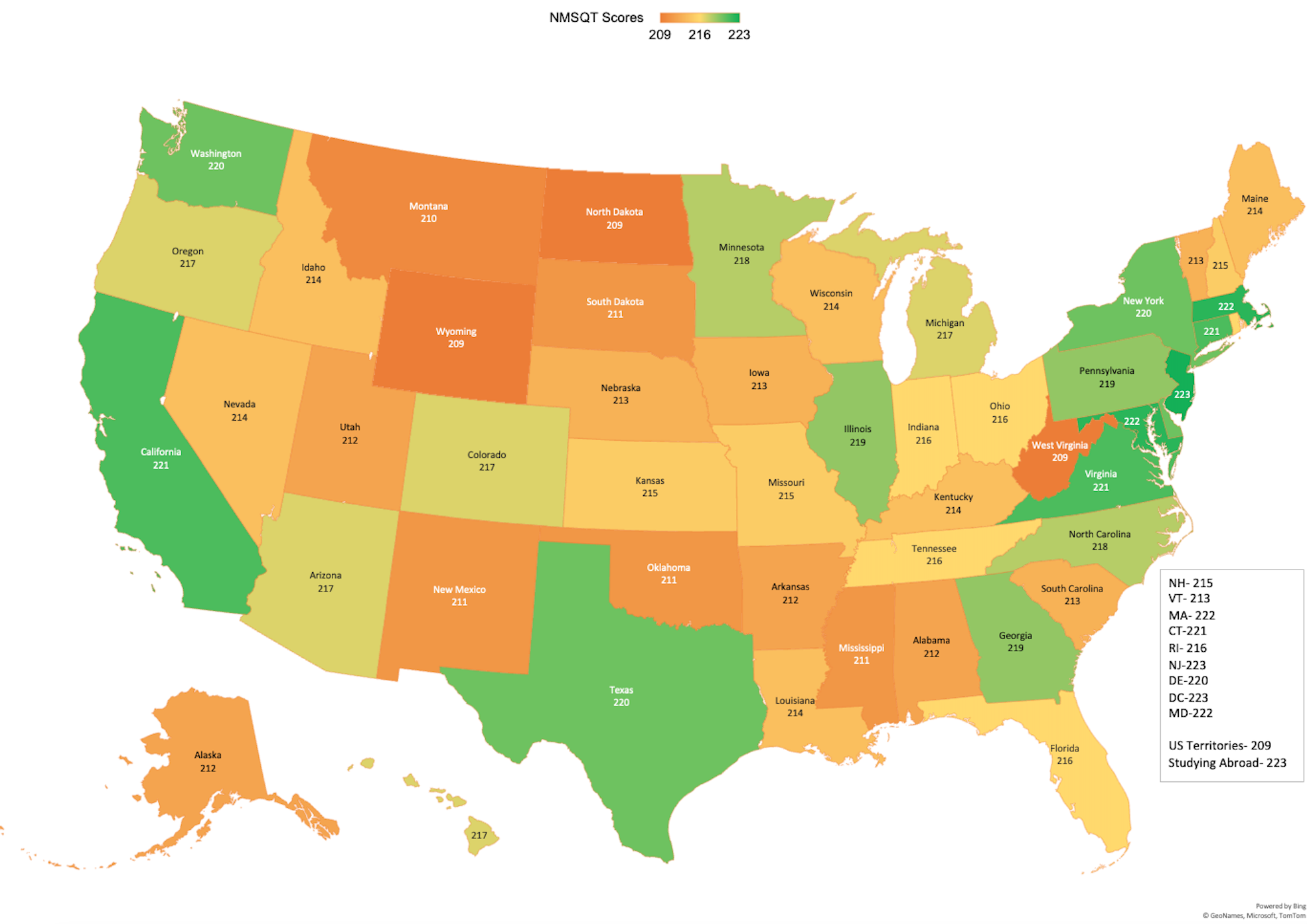
The top 16,000 students—roughly the top 1% of each state's high school seniors—are designated as Semifinalists. The NMSC allocates Semifinalist slots on a state-proportional basis. This means the Selection Index cutoff varies significantly depending on where a student attends school. For instance, high-population or academically competitive states like New Jersey, California, or Virginia often have cutoffs near 221-223, whereas states with lower average scores might have cutoffs near 208-212.
Finalists
To move from Semifinalist to Finalist, students must complete a detailed scholarship application. In 2026, this application is primarily digital and requires:
- An outstanding academic record (transcript).
- A recommendation from the high school principal (or a designated official).
- A self-authored essay.
- Information about extracurricular activities, awards, and leadership positions.
- A confirming SAT or ACT score: Semifinalists must take the SAT or ACT and earn a score that validates their PSAT performance.
Approximately 15,000 of the 16,000 Semifinalists achieve Finalist status. Most of those who do not advance fail to do so because they did not complete the application or had a significant decline in their high school grades.
National Merit Scholars (Winners)
All National Merit Scholarship winners are chosen from the pool of Finalists. The designation of National Merit Scholar is reserved specifically for those who receive a financial award. In early 2026, about 7,100 Finalists are notified that they have been selected to receive a scholarship.
| Competition Stage | Approximate Number of Students | Primary Requirement | Award Potential |
|---|---|---|---|
| Entrants | 1,300,000+ | Take the PSAT/NMSQT in 11th Grade | N/A |
| Commended | 34,000 | High Selection Index (National) | Special Scholarships Only |
| Semifinalist | 16,000 | High Selection Index (State-specific) | Prestige; Potential for College Awards |
| Finalist | 15,000 | Application, Essay, Confirming Score | Eligibility for all NMSP Awards |
| Scholar (Winner) | 7,100 | Selected by NMSC Committee | Financial Grant; Title of "Scholar" |
Types of National Merit Scholarships
Winning the competition can result in three distinct types of financial awards. It is a common misconception that all "Scholars" receive the same amount of money.
- National Merit $2,500 Scholarships: These are one-time awards given to Finalists on a state-representational basis. Every Finalist is considered for one of these awards, which are funded by the NMSC itself.
- Corporate-Sponsored Scholarships: Many corporations sponsor awards for Finalists who are children of their employees, residents of communities where the company operates, or students planning careers the sponsor wishes to encourage. Some are one-time payments, while others are renewable for four years of college.
- College-Sponsored Scholarships: These are often the most valuable. Many participating colleges and universities offer renewable scholarships to Finalists who name that institution as their "first choice" on the NMSC application. Some universities, particularly large state schools seeking to boost their academic profile, offer full-tuition or even full-ride scholarships to National Merit Finalists.
Strategies for Achieving Scholar Status
Because the PSAT/NMSQT is the only gateway into the program, preparation must begin well before the October test date of the junior year. In 2026, the availability of high-quality digital prep tools has made the competition even more intense.
Targeted PSAT Prep
Students should focus on the specific nuances of the digital PSAT. This includes familiarizing themselves with the Bluebook app, the official testing platform provided by the College Board. Practicing with the built-in Desmos calculator and understanding the adaptive nature of the modules is essential. Since the Selection Index doubles the Reading and Writing score, students who are naturally stronger in math must spend extra time refining their grammar, rhetoric, and reading comprehension skills to maximize their SI.
Maintaining the Academic Record
Becoming a Semifinalist is based on a single test score, but becoming a Finalist and Scholar requires a sustained high GPA. The NMSC reviews transcripts for the rigor of the courses taken. Students should aim for Honors, AP, or IB courses to demonstrate they can handle collegiate-level work. A "C" grade on a transcript can, in some cases, prevent a Semifinalist from advancing to Finalist status.
The "Confirming Score"
A common pitfall for high-scoring PSAT students is failing to take the SAT or ACT in a timely manner. The NMSC requires a confirming score to ensure that the PSAT performance was not a fluke. Students should plan to take the SAT or ACT at least once during their junior year or the summer before their senior year to satisfy this requirement.
Important Deadlines and Timeline (2026 Context)
The NMSP operates on a multi-year cycle. For a student graduating in the Class of 2027, the timeline is as follows:
- October 2025: Take the PSAT/NMSQT.
- December 2025: Receive PSAT scores and Selection Index.
- September 2026: Official announcement of Semifinalists.
- October 2026: Deadline for Semifinalists to submit the National Merit Scholarship Application.
- February 2027: Notification of Finalist standing.
- March–June 2027: Announcement of Scholarship Winners (Scholars).
For students currently in their senior year in 2026 (Class of 2026), they are currently in the Finalist notification and Scholar selection phase.
FAQ: Common Questions About National Merit
What is a "good" Selection Index score for 2026?
A "good" score depends entirely on your state of residence. Historically, a Selection Index of 220 or higher is safe for Semifinalist status in almost any state. However, in less competitive states, a score as low as 208 may qualify. Commended status usually requires a score around 207-210 nationally.
Can I become a National Merit Scholar with the SAT?
You cannot enter the competition using the SAT unless you qualify for Alternate Entry due to a missed PSAT/NMSQT. Even then, you must follow specific NMSC protocols. However, you do need an SAT or ACT score later in the process to confirm your PSAT results and move from Semifinalist to Finalist.
Does the scholarship follow me to any college?
The $2,500 National Merit Scholarships and many corporate-sponsored awards are "portable," meaning they can be used at any accredited U.S. college or university. However, college-sponsored scholarships are "institutional." If you receive a National Merit Scholarship from the University of Oklahoma, you cannot use that specific money at Texas A&M.
Is the National Merit Scholar title worth it if I don't get the money?
Yes. Being named a National Merit Semifinalist or Finalist is a top-tier honor that carries significant weight in the admissions offices of elite universities. It serves as a national benchmark of your academic standing relative to millions of your peers.
Can home-schooled students participate?
Absolutely. Home-schooled students follow the same requirements as traditionally schooled students. They must make arrangements with a local high school to take the PSAT/NMSQT in October of their junior year.
Next Steps for Aspiring Scholars
If you are a sophomore or a junior approaching the October test date, your first action should be to take a full-length practice digital PSAT on the College Board’s Bluebook app. This will provide an immediate Selection Index estimate. From there, identify your weakest areas—particularly in the Reading and Writing section—and use resources like Khan Academy to bridge the gap.
For those who have already taken the test and are waiting for Semifinalist announcements in September 2026, ensure your high school transcript remains strong and begin brainstorming your scholarship essay. The transition from Semifinalist to Finalist is not automatic; it requires an application that reflects the same level of excellence that your test scores suggested.
For more information on the official rules and historical cutoffs, students should refer to the National Merit Scholarship Corporation and the College Board's PSAT/NMSQT official portals.
Image Gallery
Select an image to open it in a new tab.