Managing a capstone project effectively requires a combination of early scope definition, disciplined schedule tracking, and proactive communication with stakeholders. By treating the project as a professional deliverable rather than just a final assignment, students can systematically navigate the research, development, and presentation phases to ensure both academic excellence and professional readiness.
The capstone project serves as the bridge between academic theory and professional practice. Whether you are in an engineering, business, nursing, or computer science program, this final hurdle demands a level of independence and organizational skill that standard coursework rarely requires. In 2026, the landscape of project management has evolved to include sophisticated AI-integrated tools and remote collaboration frameworks, making it essential to adopt a structured approach from day one.
Understanding the Foundations of a Successful Capstone
Before the first line of code is written or the first data set is analyzed, you must understand the dual nature of the capstone. It is both an academic requirement and a portfolio piece. To manage it effectively, you must align your personal interests with the requirements of your institution and, if applicable, the needs of an industry partner.
Effective management begins with objective setting. You are not just "finishing a project"; you are solving a specific problem. A common mistake is selecting a topic that is too broad, leading to "scope creep" where the project becomes unmanageable within a single semester. Instead, focus on a "Minimum Viable Product" (MVP) or a specific research question that can be thoroughly explored within your timeframe.
The second foundational pillar is resource assessment. This includes your own technical skills, the availability of your advisor, and any physical or digital tools required. If your project requires specialized hardware or premium software licenses, these must be secured during the first two weeks. Waiting until the middle of the term to realize you lack the necessary data or tools is a primary cause of capstone failure.
Selecting a Project Management Methodology
The methodology you choose will dictate how you handle tasks, deadlines, and pivots. In 2026, most capstone students lean toward one of three primary frameworks: Agile, Waterfall, or a Hybrid approach.
The Agile Approach
Agile is ideal for projects where the final outcome is iterative, such as software development or creative design. By breaking the project into two-week "sprints," you can produce small, working increments of your project. This prevents the "all-nighter" culture by forcing regular progress. Agile is particularly effective for team projects, as it relies on daily or weekly check-ins to identify "blockers."
The Waterfall Approach
Waterfall is more linear and is better suited for research-heavy projects or structural engineering capstones where one phase must be completed before the next begins. For example, you cannot analyze data before the data collection phase is finished. Waterfall requires heavy up-front planning and a very detailed timeline, but it provides a clear roadmap for students who prefer a structured, step-by-step progression.
The Hybrid Model
Many successful students use a Hybrid model: they use Waterfall for the high-level milestones (e.g., Proposal, Midterm Review, Final Submission) but use Agile sprints to manage the day-to-day work within those milestones. This provides the safety of a long-term schedule with the flexibility of short-term iteration.
Phase 1: Initiation and the Project Proposal
The proposal is the most critical document you will write. It acts as a contract between you and your department. To manage this phase effectively, you must move beyond a simple description of your idea and into a technical specification.
A high-quality proposal should include:
- The Problem Statement: Why does this project matter? What gap is it filling?
- The Scope: Explicitly state what the project will and will not do. This prevents advisors from asking for "just one more feature" late in the semester.
- The Methodology: How will you achieve your goals?
- The Risk Assessment: Identify three things that could go wrong (e.g., data loss, equipment failure) and explain your backup plan.
During this phase, establishing a relationship with your Project Advisor is paramount. Treat your advisor like a senior consultant. Prepare a specific agenda for every meeting. Instead of asking "What should I do next?", present two options you are considering and ask for their professional critique.
Phase 2: Planning and Tool Selection
Once the proposal is approved, the management of tasks becomes the priority. Relying on memory or a simple to-do list is insufficient for a project of this scale. In 2026, project management software has become more intuitive, often featuring AI that can help estimate how long a task will take based on historical data.
Essential tools for capstone management include:
- Task Tracking: Tools like Trello or Asana allow you to visualize your workflow using Kanban boards. This helps you see where tasks are piling up.
- Version Control: For any technical or writing-heavy project, GitHub or similar repositories are mandatory. They prevent the "Final_Version_v2_REAL_FINAL.doc" syndrome by keeping a clean, recoverable history of your work.
- Documentation and Knowledge Management: Notion or Obsidian serve as excellent "second brains" for storing research papers, meeting notes, and draft snippets.
| Feature | Agile (Scrum) | Waterfall | Hybrid |
|---|---|---|---|
| Best For | Software, Apps, Design | Research, Construction | Complex, Multi-disciplinary |
| Flexibility | Very High | Low | Moderate |
| Planning | Continuous | Extensive Up-front | Up-front + Iterative |
| Documentation | Just-in-time | Comprehensive | Milestone-based |
| Risk Handling | Identified early in sprints | Identified during planning | Balanced |
Phase 3: Execution and Iteration
The execution phase is where most projects encounter the "mid-semester slump." To manage this effectively, you must maintain momentum through milestones. If your project is a 15-week endeavor, set a significant internal deadline every three weeks.
During execution, focus on the "Core Functionality" first. If you are building a medical diagnostic app, the core logic that processes the data is more important than the login screen's color. By securing the core early, you ensure that even if you run out of time, you have a functioning project to present.
Communication in Team Projects: If you are working in a group, management becomes as much about people as it is about tasks. Use a RACI matrix (Responsible, Accountable, Consulted, Informed) to clarify who is doing what. This prevents the common issue of three people working on the same task while another critical task is ignored. Regular "Sync Meetings" should be kept short—no more than 15 minutes—focusing only on what was done yesterday, what will be done today, and what is in the way.
Phase 4: Quality Control and Testing
Many students forget to budget time for testing. A capstone project that looks great but fails during a live demonstration is a nightmare scenario. You should allocate at least 20% of your total project time to "Verification and Validation."
- Verification: Did you build the project according to the specifications in your proposal?
- Validation: Does the project actually solve the problem you identified?
For research projects, this phase involves peer review and statistical verification. For technical projects, it involves "stress testing" and user acceptance testing. In 2026, academic standards emphasize the ethical use of technology, so ensure your testing phase includes a review of data privacy and algorithmic bias if applicable.
Phase 5: Documentation and Final Delivery
The final deliverable is rarely just the "thing" you built; it is the documentation that explains it. Effective management means writing your documentation while you work, not after you finish.
Professional documentation should follow the standards of your field. For example, if you are writing a scientific paper, ensure your citations are managed using tools like Zotero to avoid last-minute formatting errors. The Purdue Online Writing Lab (OWL) remains a gold standard for ensuring your documentation meets current APA or IEEE standards.
The final presentation or defense is the climax of your project. To manage this effectively:
- Draft a Narrative: Don't just list features. Tell a story of the problem, your struggle, and your ultimate solution.
- Prepare for the "Q&A": Anticipate the three hardest questions your professors might ask. Have "backup slides" with extra data or technical details ready to show if those questions arise.
- The Live Demo: If you are doing a live demonstration, have a pre-recorded video of the project working as a backup. Technical glitches are common during presentations; a video ensures you can still show your results.
Common Pitfalls and How to Avoid Them
Even with the best management, capstones face hurdles. Scope creep is the most common; avoid it by referring back to your approved proposal whenever a new idea arises. If an idea is good but not essential, put it in a "Future Work" section of your report rather than trying to squeeze it in now.
Another pitfall is isolation. Students who stop checking in with their advisors often find themselves heading down a path that doesn't meet departmental requirements. Maintain a bi-weekly cadence of communication, even if you don't have major updates.
Finally, burnout is a significant risk. Effective management includes scheduling downtime. A project managed through consistent, moderate effort is almost always superior to one fueled by a three-week caffeine binge at the end of the semester.
Frequently Asked Questions
How do I choose a capstone topic if I have no ideas?
Start by looking at the "Future Work" sections of previous years' capstone papers in your university library. These sections often list unresolved problems that are perfectly sized for a new project. Additionally, look at current industry trends on platforms like LinkedIn or technical forums to see what problems professionals are currently trying to solve.
What should I do if my project teammate isn't contributing?
Address the issue immediately through documented communication. First, have a direct conversation to see if there are external factors affecting their work. If the behavior continues, refer to your team's project charter or RACI matrix and involve your advisor early. Do not wait until the final week to report a non-contributing member, as advisors have limited options to help you that late in the process.
Can I change my capstone topic halfway through the semester?
Changing a topic mid-way is a high-risk move that usually requires departmental approval. If your original topic is truly unfeasible due to a lack of data or resources, it is better to "pivot" to a related, smaller topic rather than starting from scratch. Consult your advisor immediately; they may allow you to document the failure of the first topic as part of your research, which can still be academically valuable.
How much time should I realistically spend on my capstone each week?
In 2026, most accredited programs expect a capstone to represent 10 to 15 hours of work per week. This is equivalent to a part-time job. Treat it as such by blocking out specific "deep work" hours in your calendar that are non-negotiable.
What is the most important part of the final grading?
While every department differs, most graders look for "Critical Thinking and Problem Solving." It is often better to have a project that partially failed but was analyzed deeply than a project that "worked" but was superficial or copied from existing templates. The process of management and the depth of your analysis are what prove you are ready for graduation.
Final Recommendation
To manage your capstone project effectively, you must embrace the role of a Project Manager. Start by securing a clear, narrow scope in your proposal and immediately implement a task-tracking system like a Kanban board. By breaking the semester into manageable three-week milestones and maintaining a transparent relationship with your advisor, you reduce the project's complexity and your own stress. Success in a capstone is not found in a final burst of genius, but in the disciplined, daily execution of a well-structured plan.
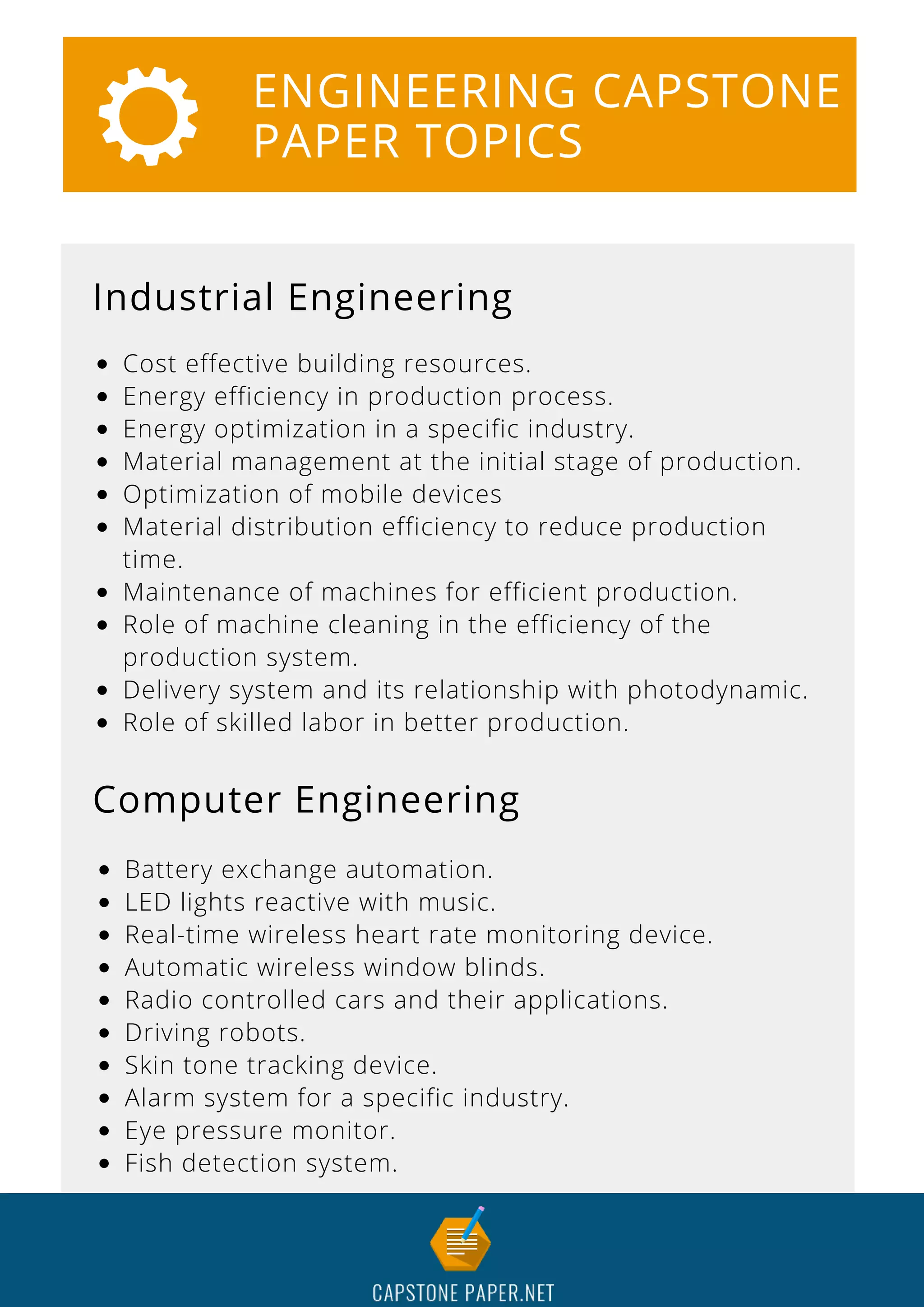
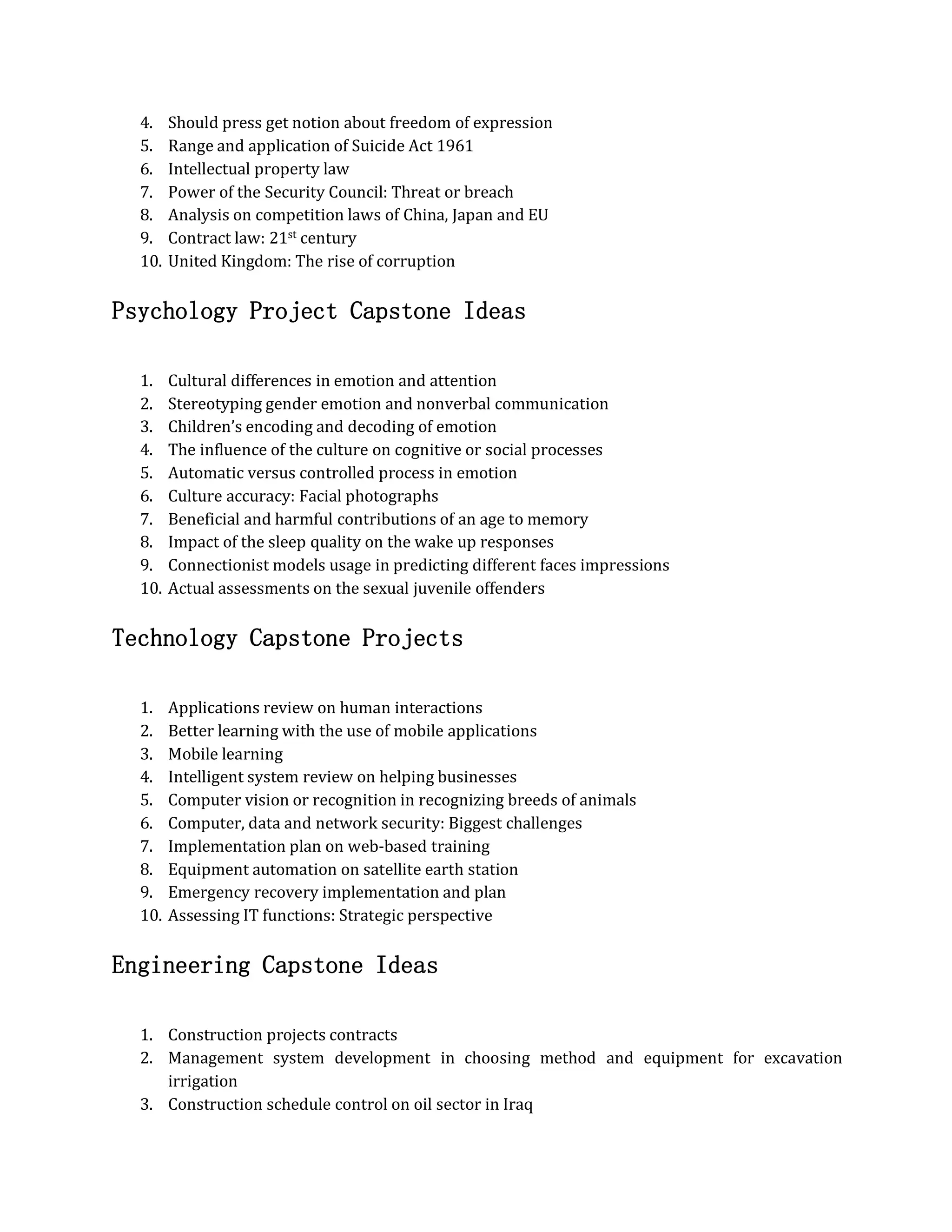
Image Gallery
Select an image to open it in a new tab.
Declan O'Connor
Higher Education and Campus Culture Reporter
