To master Spanish pronunciation and orthography, you must understand how vowels group together. A diptongo (diphthong) combines two vowels into one syllable, while a triptongo (triphthong) combines three. Conversely, a hiato (hiatus) occurs when two adjacent vowels are pronounced in separate syllables, often requiring an accent mark to break the natural phonetic flow.
Effective communication in Spanish relies heavily on the correct division of syllables. This division determines where the stress (acento prosódico) falls and whether a written accent (tilde) is required. In 2026, the standards set by the Real Academia Española (RAE) remain the definitive guide for these linguistic structures. By understanding the relationship between "strong" and "weak" vowels, learners and native speakers alike can navigate the complexities of Spanish spelling and rhythm.
The Foundation: Vowel Classification in Spanish
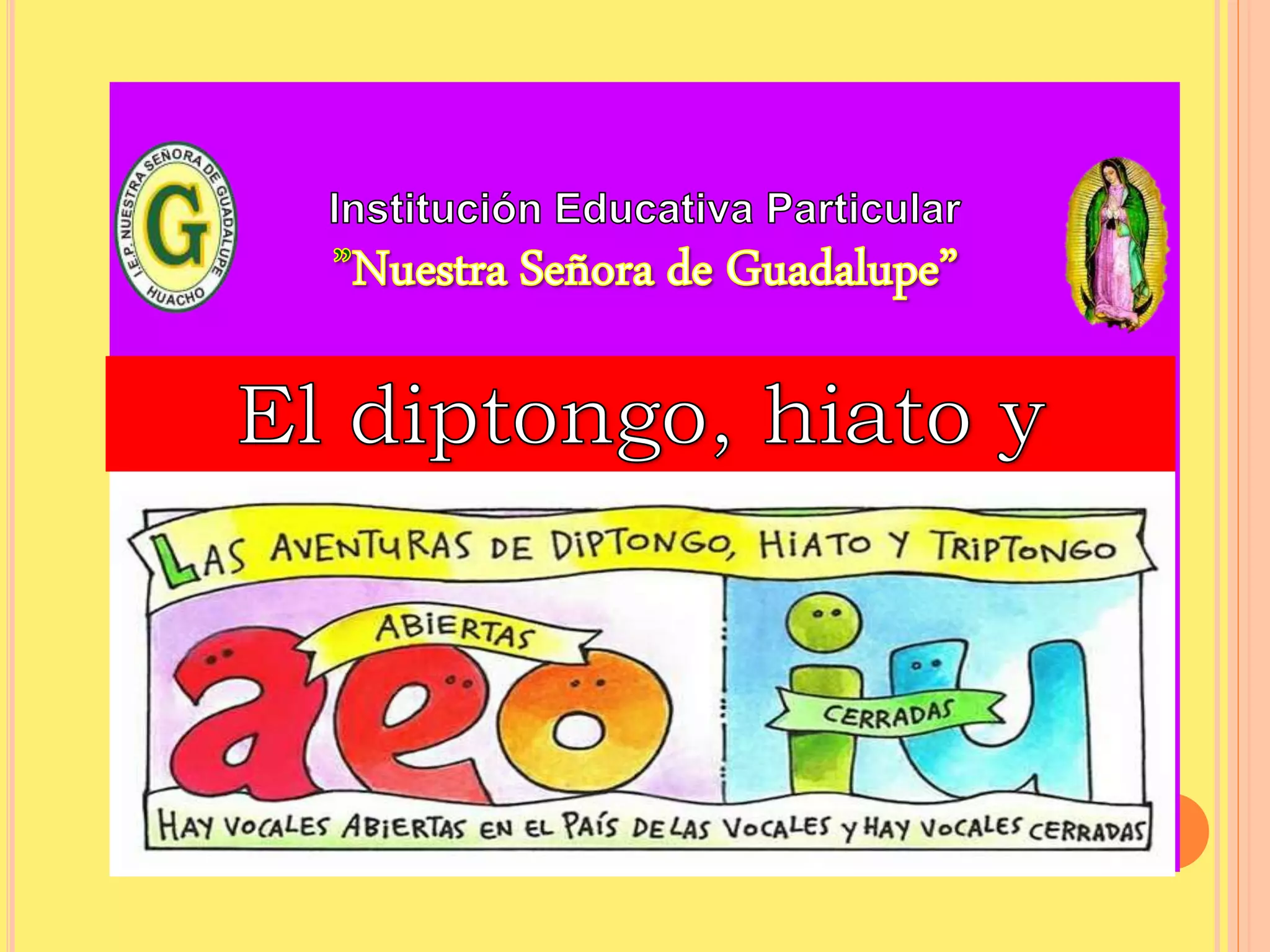
Before examining the three main vowel combinations, it is essential to categorize the five Spanish vowels. Spanish phonology divides vowels into two distinct groups based on the position of the tongue and the opening of the mouth during articulation.
Open Vowels (Vocales Abiertas or Fuertes)
The vowels A, E, and O are considered "strong" or "open" vowels. When you pronounce these, your mouth is more open. In any vowel combination, these tend to dominate the syllable unless specific accentuation rules intervene.
Closed Vowels (Vocales Cerradas or Débiles)
The vowels I and U are "weak" or "closed" vowels. These are produced with a narrower opening of the vocal tract. Their "weakness" allows them to blend easily with other vowels to form single phonetic units, unless they receive a rhythmic stress that transforms them into a stronger sound.
Understanding this binary—Strong vs. Weak—is the key to identifying whether you are looking at a diptongo, triptongo, or hiato.
What is a Diptongo?
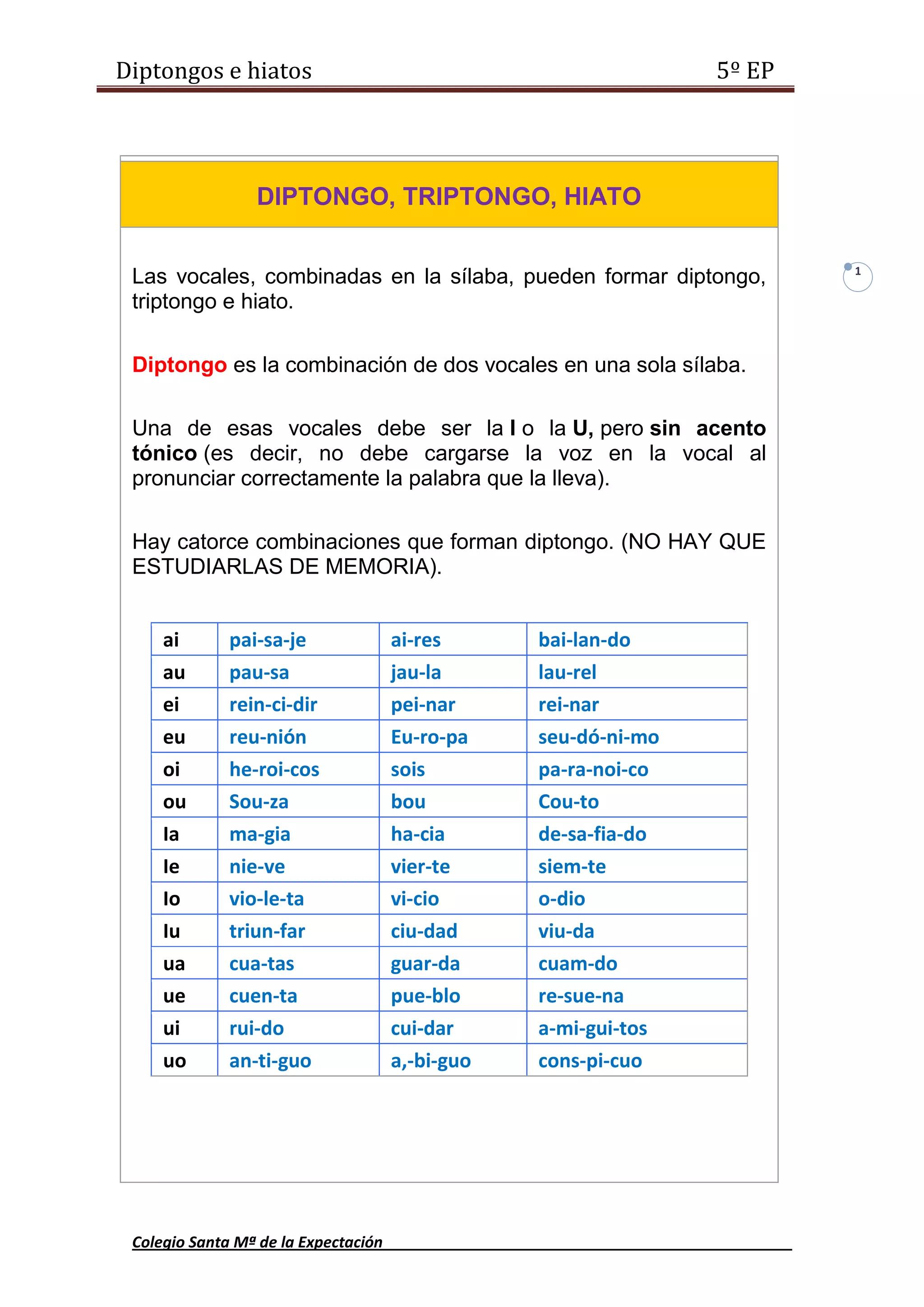
A diptongo is the union of two vowels in a single syllable. In Spanish, there are 14 possible combinations that result in a diphthong. For a diphthong to exist, the vowels must follow one of these two structural patterns:
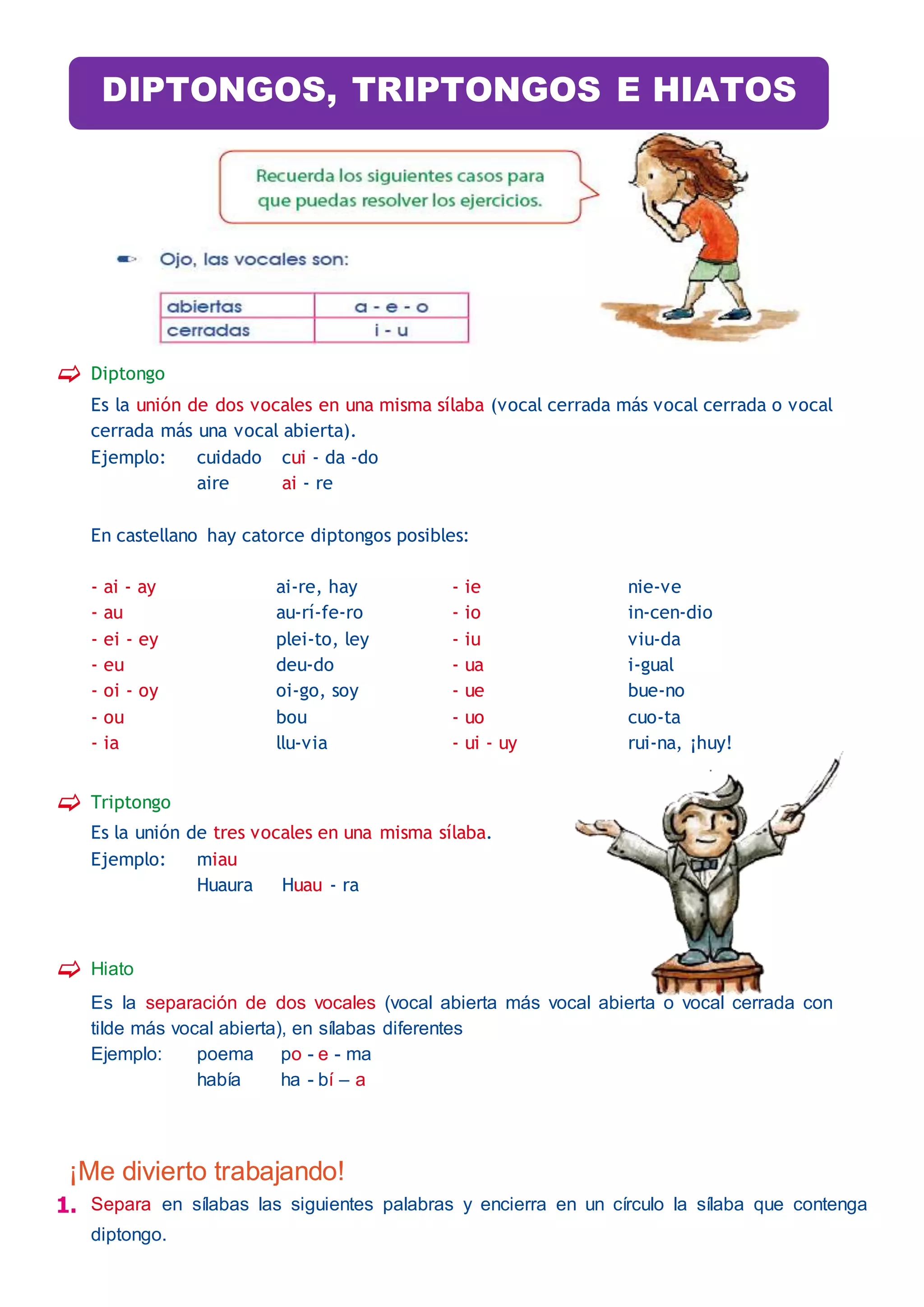
- A closed vowel + an open vowel (or vice versa): The stress naturally falls on the open vowel. Examples include aire (ai-re), viento (vien-to), and causa (cau-sa).
- Two different closed vowels: The union of 'i' and 'u'. Examples include ciudad (ciu-dad) and ruido (rui-do).
Types of Diphthongs
Linguists further categorize diphthongs based on the phonetic "movement" of the sound:
- Growing Diphthongs (Crecientes): These start with a closed vowel and end with an open one (ia, ie, io, ua, ue, uo). The "opening" of the mouth increases as the syllable progresses. Example: comedia (co-me-dia).
- Decreasing Diphthongs (Decrecientes): These start with an open vowel and end with a closed one (ai, ei, oi, au, eu, ou). The mouth closes slightly by the end of the sound. Example: paisaje (pai-sa-je).
- Homogeneous Diphthongs: These consist of two closed vowels (iu, ui). Example: viuda (viu-da).
Accentuation Rules for Diphthongs
Diphthongs follow the general Spanish rules for accent marks (agudas, llanas, and esdrújulas).
- If the diphthong requires a tilde and is composed of an open and closed vowel, the tilde always goes on the open vowel (a, e, o). For example, estáis, recién.
- If the diphthong consists of two closed vowels (iu, ui), the tilde goes on the second vowel. For example, veintiún, cuídate.
Understanding the Hiato
A hiato occurs when two adjacent vowels do not form a single syllable but are instead split into two distinct syllables. This separation is vital for maintaining the correct word rhythm. There are two primary ways a hiatus is formed:
1. The Simple Hiatus (Hiato Simple)
This occurs when two open vowels (A, E, O) are next to each other. Because both vowels are "strong," they cannot occupy the same syllable. They naturally repel each other into separate phonetic beats.
- Teatro is divided as te-a-tro.
- Canoa is divided as ca-no-a.
- Poema is divided as po-e-ma.
Even if the vowels are the same (e.g., leer, poseer), they form a hiatus: le-er.
2. The Accentual Hiatus (Hiato Acentual)
This is perhaps the most important rule for learners. A hiatus is formed when a closed vowel (I, U) is placed next to an open vowel (A, E, O), but the closed vowel carries the stress.
When you put an accent mark on the "weak" vowel, it becomes "strong" enough to stand as its own syllable, breaking the diphthong.
- Tía: Without the accent, it might be a diphthong. With the accent on the 'i', it becomes tí-a.
- Baúl: The stress on the 'u' separates it from the 'a', resulting in ba-úl.
- Río: The stress on the 'i' creates rí-o.
Important Rule: The accentual hiatus always requires a written tilde on the weak vowel, regardless of whether the word follows the general rules for agudas or llanas.
The Complexity of the Triptongo
A triptongo is the combination of three vowels in a single syllable. This is less common than the diphthong but follows a very strict structure:
Closed Vowel + Open Vowel + Closed Vowel (Weak + Strong + Weak)
In a triphthong, the central vowel must be the open one (A, E, or O), and it is the one that carries the phonetic stress. If any of the "weak" vowels on the flanks carry the stress, the triphthong is broken, and a hiatus is formed instead.
Common Examples of Triphthongs
- Averigüéis (a-ve-ri-güéis)
- Uruguay (U-ru-guay) - Note that the 'y' acts as an 'i' phonetically.
- Estudiáis (es-tu-diáis)
- Biau (bi-au) - as in some onomatopoeias.
In 2026, many students still struggle with the "y" at the end of words. For the purposes of diphthongs and triphthongs, a "y" at the end of a word (like rey, hoy, or Paraguay) counts as a closed vowel (i). However, if the word requires a tilde based on general rules, these words usually do not take one because they end in a consonant that doesn't follow the "n, s, or vowel" rule for agudas.
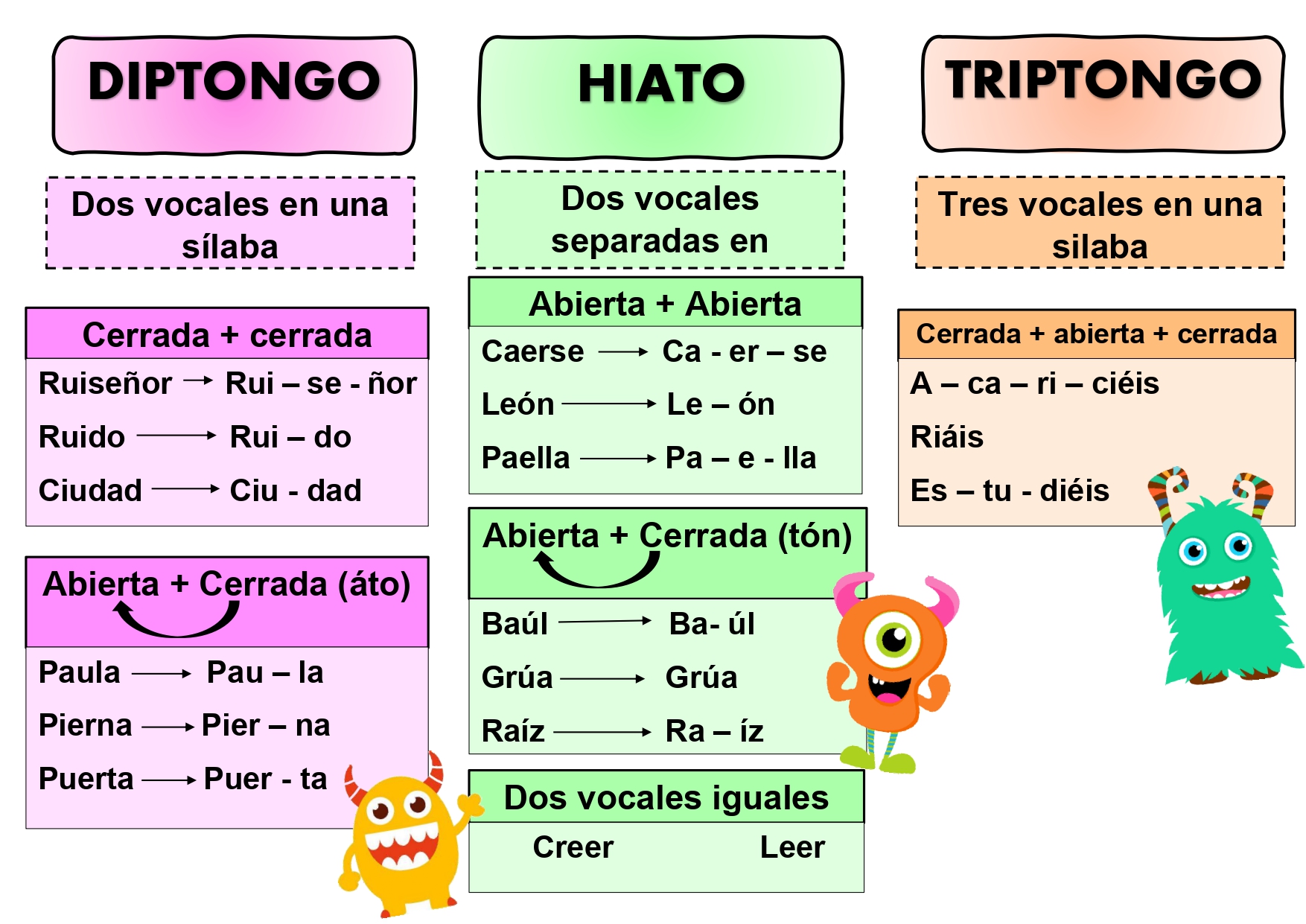
Comparing Hiato, Diptongo, and Triptongo
To differentiate these three concepts clearly, we can look at how they interact with syllable boundaries and vowel types.
| Feature | Diptongo | Triptongo | Hiato |
|---|---|---|---|
| Number of Vowels | 2 | 3 | 2 |
| Syllable Count | 1 Syllable | 1 Syllable | 2 Syllables |
| Vowel Pattern | Weak+Strong, Strong+Weak, or Weak+Weak | Weak+Strong+Weak | Strong+Strong or Stressed Weak+Strong |
| Key Example | Cielo (cie-lo) | Cambiáis (cam-biáis) | Héroe (hé-ro-e) |
| Role of Tilde | Placed on strong vowel (or 2nd weak) | Placed on the middle strong vowel | Placed on weak vowel to break union |
| Phonetic Feel | A smooth slide between sounds | A "wave" rising then falling | A distinct "break" or pause |
The Role of the Letter "H" in Vowel Groups
In Spanish, the "h" is silent (muda). Because it has no sound, it does not interfere with the formation of a diphthong or a hiatus.
- Diphthong with H: In the word ahijado (godson), the 'h' is ignored phonetically. The 'a' and 'i' form a diphthong: ahi-ja-do.
- Hiatus with H: In the word alcohol, the 'o' and 'o' are both strong vowels. The 'h' does not stop them from forming a hiatus: al-co-hol.
- Accentual Hiatus with H: In the word búho (owl), the 'u' is stressed next to an 'o'. The 'h' sits between them, but the stress on the 'u' forces the hiatus: bú-ho.
When analyzing syllables for a Spanish exam or a professional document in 2026, always treat the silent "h" as if it were invisible. Focus entirely on the vowel sounds.
Why Syllable Division Matters for Professionals
Understanding these rules is not just an academic exercise. In professional Spanish writing, particularly in legal, medical, or technical fields, the incorrect use of a tilde can change the meaning of a word or render it unintelligible.
For example, consider the word secretaria (secretary) versus secretaría (department/office).
- Secretaria (se-cre-ta-ria) contains a diphthong at the end. It is a llana word ending in a vowel, so it needs no tilde.
- Secretaría (se-cre-ta-rí-a) contains an accentual hiatus. The stress on the 'i' requires a tilde and changes the word's grammatical and semantic function.
Properly identifying these groups allows you to apply the rules of Acentuación correctly:
- Agudas: Stress on the last syllable. Tilde if ending in n, s, or vowel.
- Llanas (Graves): Stress on the penultimate syllable. Tilde if NOT ending in n, s, or vowel.
- Esdrújulas: Stress on the third-to-last syllable. Always carry a tilde.
Without knowing if a vowel pair is a diphthong or a hiatus, you cannot determine which syllable is the "last" or "penultimate" one.
Common Pitfalls and How to Avoid Them
Even advanced speakers encounter "doubtful zones" in Spanish orthography. Here are the most frequent errors:
Confusing "ui" and "iu"
Remember that ui and iu are always diphthongs. Many people try to separate them, but unless the word is a specific exception or a foreign loanword, they stay together. In words like ruido or viuda, there is no hiatus. If a tilde is needed (as in casuística), it goes on the second vowel.
The "Destruction" of Triphthongs
A triphthong is fragile. If you stress either of the two "weak" vowels on the outside, the triphthong vanishes.
- Vivíais (You all used to live): This looks like it could be a triphthong (i-a-i), but because the first 'i' is stressed (vi-ví-ais), it actually contains a hiatus (í-a) followed by a diphthong (ai).
Words with "Y"
As mentioned previously, the "y" functions as a vowel at the end of words. However, the RAE rules state that for the purposes of accentuation, "y" is considered a consonant. This is why convoy or virrey do not have tildes, even though they are agudas ending in a "vowel sound."
Frequently Asked Questions
Does the presence of a "u" after a "q" or "g" count as a diphthong?
No. In combinations like que, qui, gue, gui, the "u" is a graphic marker used to maintain the hard sound of the 'q' or 'g'. It is silent. Therefore, there is no vowel union because there is only one vowel sound being produced. However, in güe or güi (using the diéresis, like in pingüino), the "u" is pronounced, and it does form a diphthong.
Can a hiatus exist between two weak vowels?
Technically, no. In Spanish, when two identical weak vowels meet (like in chiita), they form a hiatus (chi-i-ta) because they are treated like any two identical vowels. However, two different weak vowels (i, u) will almost always form a diphthong.
How do I know if a word has a triptongo if it ends in 'y'?
Listen to the sound. If the word ends in a sequence of three vowels where the middle one is open and stressed (like Paraguay or buey), it is a triphthong. The 'y' is simply the orthographic representation of the final 'i' sound.
Why does "río" have an accent if it's a two-syllable word?
The word río (river) has a tilde because of the rule of accentual hiatus. If it didn't have the tilde, the 'i' and 'o' would form a diphthong (rio), and the word would be pronounced as a single syllable (which is actually the past tense of the verb reír: "he laughed"). The tilde is necessary to break the vowels apart and ensure the 'i' is the stressed syllable.
Are there regional differences in how these are pronounced?
While the orthographic rules (how we write them) are standardized by the RAE across all Spanish-speaking countries, phonetic realization can vary. In some dialects, certain diphthongs might be pronounced so quickly they almost disappear, or certain hiatuses might be slightly compressed, but the writing remains the same.
Practical Recommendation for Learners
To internalize these rules, start by practicing syllable division manually. When you encounter a new Spanish word with two or more vowels together, follow this checklist:
- Identify the vowels: Are they open (A, E, O) or closed (I, U)?
- Check for tildes: Is there a tilde on a weak vowel? If yes, you have a hiato.
- Check the combination: Are there two strong vowels? If yes, you have a hiato. Is it a Weak+Strong or Weak+Weak combination? You have a diptongo.
- Count the group: Are there three vowels in a Weak-Strong-Weak pattern? You have a triptongo.
Mastering these patterns will drastically improve your reading fluency and spelling accuracy. For those preparing for official exams like the DELE or SIELE in 2026, syllable division is a foundational skill that examiners look for in written compositions.
Image Gallery
Select an image to open it in a new tab.

Omar Farooq
EdTech Innovation and Virtual Pedagogy Journalist
