
Open source e-commerce platforms provide businesses with the underlying source code of their online store, allowing for total customization, data ownership, and self-managed hosting. Unlike proprietary SaaS models, open source solutions enable developers to modify any aspect of the software to meet specific enterprise requirements, ensuring long-term flexibility and platform independence.
Understanding the Landscape of Open Source E-commerce
As we move through 2026, the distinction between "free" software and "open source" e-commerce has never been clearer. Open source e-commerce refers to platforms where the source code is publicly accessible under licenses such as the GNU General Public License (GPL) or the MIT License. This transparency allows developers to audit security, build bespoke integrations, and optimize performance without being tethered to a specific service provider’s roadmap.
In the current digital economy, the shift toward composable commerce has redefined how we view these platforms. No longer are open source solutions limited to monolithic "all-in-one" architectures. Modern iterations often utilize a headless approach, where the back-end commerce engine is decoupled from the front-end presentation layer. This evolution ensures that businesses can use a robust open source core while deploying highly interactive, high-performance front-ends using frameworks like Next.js or Nuxt.
The Shift from Monolithic to Composable
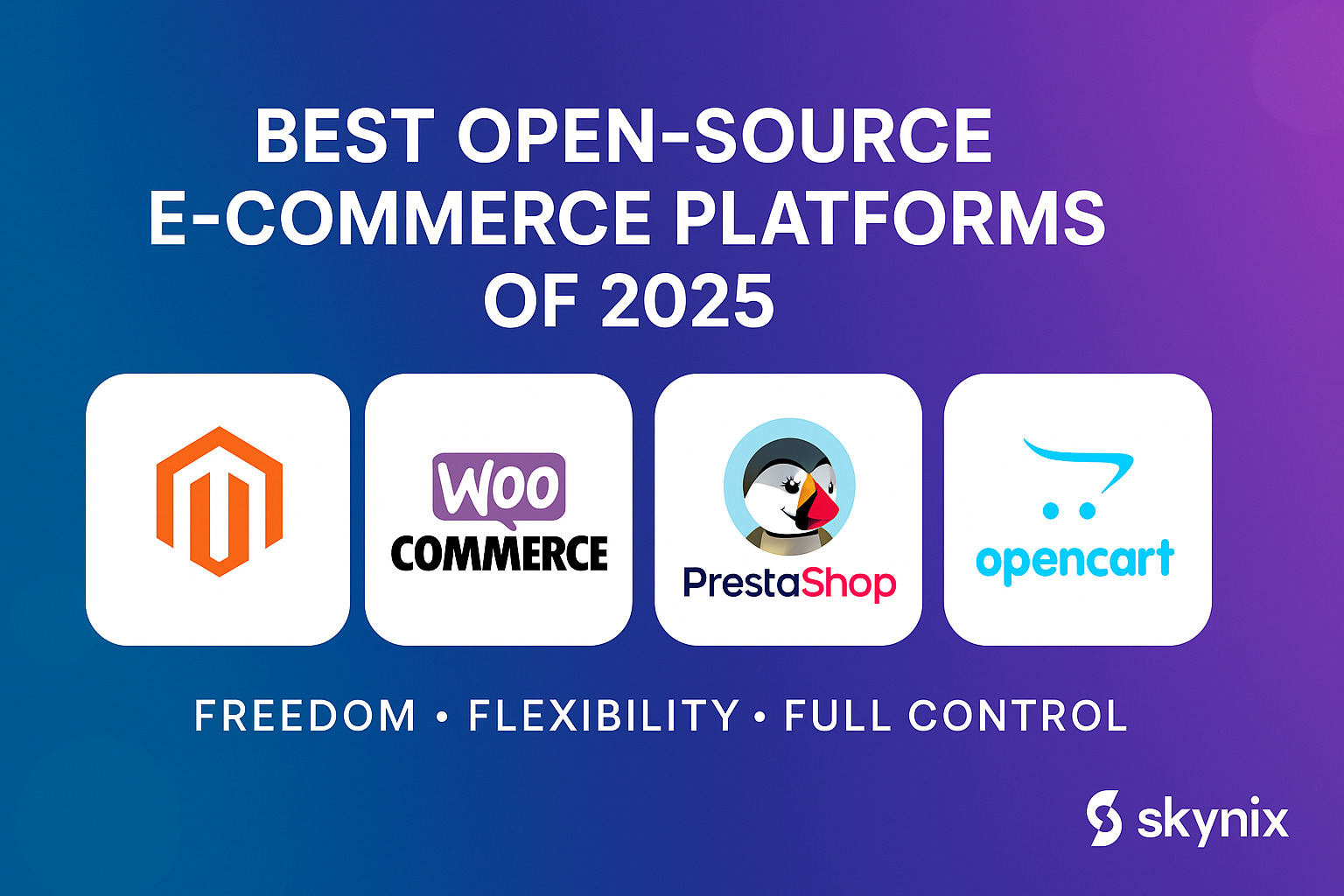
Historically, platforms like Magento (now Adobe Commerce) and WooCommerce dominated by offering everything in a single package. By 2026, the trend has shifted toward modularity. Enterprises now prefer picking specific open source "microservices" for cart management, checkout, and inventory, often connecting them via APIs. This modularity reduces technical debt, as individual components can be updated or replaced without dismantling the entire ecosystem.
Why Businesses Choose Open Source in 2026
The decision to adopt an open source e-commerce framework is rarely about avoiding subscription fees. Instead, it is a strategic move toward digital sovereignty. As data privacy regulations become more stringent globally, having complete control over where customer data is stored and how it is processed is a significant legal and competitive advantage.
Unrivaled Customization and Flexibility
Proprietary platforms operate within "walled gardens." If a specific feature—such as a complex B2B loyalty program or a niche regional payment gateway—isn't supported, the merchant is out of luck. Open source removes these barriers. Developers can hook into any part of the checkout flow, modify the database schema, or build custom administrative dashboards.
Ownership and Platform Independence
With open source, you own your store’s "engine." If a hosting provider increases prices or changes their terms of service, you can migrate your entire database and codebase to a new server. This level of independence is impossible with SaaS providers, where "moving" essentially means rebuilding the entire store from scratch on a different platform.
Cost-Efficiency at Scale
While the initial setup costs for open source are often higher due to development requirements, the Total Cost of Ownership (TCO) can be significantly lower for high-volume merchants. SaaS platforms often charge a percentage of revenue or high per-transaction fees. In contrast, open source costs are primarily tied to infrastructure (hosting) and development talent, which do not necessarily scale linearly with sales volume.
Key Challenges and Technical Requirements
Choosing an open source path is not without its demands. It requires a higher degree of technical literacy and a proactive approach to maintenance. In 2026, the complexity of web environments means that "set it and forget it" is not a viable strategy for self-hosted commerce.
The Responsibility of Security
When you use an open source platform, the burden of PCI-DSS compliance and data security rests largely on your shoulders. You are responsible for:
- Applying security patches immediately upon release.
- Ensuring server-side firewalls and Web Application Firewalls (WAF) are correctly configured.
- Managing SSL/TLS certificates.
- Conducting regular penetration testing to identify vulnerabilities in custom code.
Maintenance and Technical Debt
Open source software evolves. Core updates may occasionally break third-party plugins or custom themes. A dedicated development team—either in-house or via an agency—is essential to manage these updates, ensure database optimization, and maintain compatibility with modern PHP, Node.js, or Python versions.
Leading Open Source E-commerce Platforms in 2026
The market is diverse, with solutions tailored to different business sizes and technical stacks. Below are the most prominent contenders currently leading the industry.
1. WooCommerce
Built on top of WordPress, WooCommerce remains the most popular e-commerce solution globally due to its massive ecosystem.
- Best for: Small to medium businesses and content-heavy sites.
- Strengths: Unmatched plugin library, huge developer pool, and seamless integration with the world's most popular CMS.
- Considerations: Can become sluggish with thousands of SKUs if not properly optimized and hosted on high-performance infrastructure.
2. Adobe Commerce (Magento Open Source)
Magento remains the "heavyweight" of the open source world, catering to complex enterprise needs.
- Best for: Large enterprises with high SKU counts and complex B2B requirements.
- Strengths: Native multi-store management, advanced attribute systems, and high scalability.
- Considerations: Extremely high technical barrier to entry. Requires specialized Magento developers and robust AWS or Google Cloud hosting environments.
3. Medusa
A newer, high-growth contender that has gained massive traction by 2026. Medusa is a JavaScript-based headless commerce engine.
- Best for: Developers looking for a modern, API-first alternative to Shopify.
- Strengths: Highly modular, built with Node.js, and designed specifically for headless architectures.
- Considerations: Does not come with a "built-in" front-end; you must build or connect a storefront (though they provide excellent starters).
4. Shopware
A German-engineered platform that has expanded significantly across the international market.
- Best for: Mid-market brands wanting a balance between power and ease of use.
- Strengths: Excellent "Shopping Experiences" (CMS features), modern Vue.js front-end, and strong focus on internationalization.
- Considerations: The ecosystem is growing but still smaller than WooCommerce or Magento.
5. PrestaShop
A long-standing favorite in the European market, PrestaShop offers a balanced middle ground.
- Best for: International merchants requiring strong multi-language and multi-currency support out of the box.
- Strengths: Relatively easy to use compared to Magento, with a strong marketplace for modules.
- Considerations: Many essential modules are paid, which can increase the initial cost of deployment.
Comparative Analysis of Open Source Platforms
The following table compares the primary attributes of the top open source e-commerce platforms to help in the decision-making process.
| Platform | Primary Language | Architecture | Ideal SKU Count | Developer Availability |
|---|---|---|---|---|
| WooCommerce | PHP | Monolithic | 1 - 5,000 | Very High |
| Magento (OS) | PHP | Monolithic / Headless | 10,000 - 1M+ | Medium (Specialized) |
| Medusa | Node.js (JS/TS) | Headless | 1 - 100,000+ | High (General JS) |
| Shopware | PHP / Vue.js | API-First | 1,000 - 500,000 | Medium |
| PrestaShop | PHP | Monolithic | 1 - 50,000 | High (Europe) |
Total Cost of Ownership (TCO) Breakdown
One of the biggest misconceptions in 2026 is that "open source" means "free." While the license fee is zero, the operational costs are real. A professional open source implementation typically involves several cost pillars.
Hosting and Infrastructure
Unlike SaaS, you must pay for the servers. For a small store, this might be $30–$100 per month. For a high-traffic enterprise store using clustered environments on Amazon Web Services (AWS) or Microsoft Azure, hosting costs can exceed $2,000 per month. You are paying for CPU, RAM, and bandwidth, as well as Content Delivery Networks (CDNs) to ensure global speed.
Development and Design
You will need a budget for the initial build and ongoing maintenance. In 2026, senior e-commerce developers typically command rates between $80 and $180 per hour depending on the platform's complexity. A custom-built open source store can take anywhere from 200 to over 1,000 hours to launch.
Security and Third-Party Services
While the core platform is open source, you will likely use paid services for:
- Payment Gateways: Standard transaction fees (e.g., Stripe, PayPal, or regional banks).
- Email Marketing: Integration with platforms like Klaviyo or Mailchimp.
- Search Engines: Advanced search tools like Algolia or Elasticsearch.
- Security Audits: Annual or quarterly third-party vulnerability scans.
Step-by-Step Selection Process
Choosing the wrong platform can result in a "re-platforming" project within two years—an expensive and disruptive process. Follow these steps to ensure the right fit.
- Define Your Complexity: If you have complex product configurations (e.g., custom-built machinery or highly variable apparel), prioritize platforms like Magento or Medusa that offer flexible data schemas.
- Evaluate In-House Talent: Do you have PHP developers or JavaScript developers? Choosing a platform that matches your team’s existing skillset will significantly reduce long-term maintenance costs.
- Check the Ecosystem: Visit the marketplace for each platform. If the specific shipping carrier or ERP system you use doesn't have a pre-built connector, you will have to pay for a custom integration.
- Consider the "Headless" Requirement: If you plan to sell across multiple touchpoints (web, mobile app, IoT devices, smart mirrors), a headless-first platform like Medusa or the Shopware 6 API core is superior.
- Trial the Admin Interface: Your marketing and catalog teams will spend hours in the back-end every day. Ensure the interface is intuitive enough for non-technical staff to manage products and promotions.
Future-Proofing Your Open Source Store
In 2026, "future-proofing" means ensuring your store can adapt to AI and machine learning trends. Open source platforms are uniquely positioned here because they allow for the direct integration of self-hosted Large Language Models (LLMs) for localized product recommendations or automated customer service bots without sending data to third-party AI providers.
Furthermore, ensure your chosen platform supports PHP 8.4+ or the latest stable Node.js versions. Performance is a critical ranking factor in 2026, and modern runtimes offer significant execution speed improvements that directly impact your Google Core Web Vitals and, consequently, your SEO.
Frequently Asked Questions
Is open source e-commerce more secure than Shopify or BigCommerce?
Open source is not inherently more or less secure; the responsibility simply shifts. While SaaS providers handle security at the platform level, open source allows you to implement even tighter, custom security protocols. However, if you fail to update your software, open source becomes a larger target for automated exploits.
Can I migrate from a SaaS platform to an open source solution?
Yes, most open source platforms have migration tools or APIs that allow you to import products, customers, and order history. However, your front-end design and custom functionalities cannot be "transferred"—they must be rebuilt to match the logic of the new platform.
Do I need a dedicated server for an open source store?
For small stores, high-quality "Cloud Hosting" (like managed VPS) is usually sufficient. However, as your traffic grows, you should move to a dedicated or auto-scaling cloud environment to prevent downtime during peak sales events like Black Friday.
How do I handle payment processing on an open source site?
You integrate a payment gateway via a plugin or API. The open source software handles the cart and checkout logic, but the actual sensitive credit card data is usually handled via "tokens" or "iframes" provided by the payment processor (like Stripe), ensuring you don't store sensitive card details on your own server.
What is the most "user-friendly" open source platform?
WooCommerce is generally considered the most user-friendly for beginners because of its familiarity to anyone who has used WordPress. Shopware also receives high marks for its intuitive "Drag and Drop" CMS features designed for marketers.
Practical Recommendation
If you are a growing brand that has outgrown the limitations of a SaaS "template" and requires deep integration with an ERP or unique customer workflows, Medusa is the recommended choice for modern, JS-heavy environments, while WooCommerce remains the best bet for those who want the largest possible support community. For true enterprise-scale operations with millions of combinations, Magento Open Source (Adobe Commerce) remains the gold standard for backend power. Your next step should be to audit your current technical stack and consult with a lead developer to determine which language (PHP vs. JavaScript) aligns with your 2026-2030 business goals.
Image Gallery
Select an image to open it in a new tab.


Lars Thomsen
Global Labor Markets and Economic Strategy Editor
