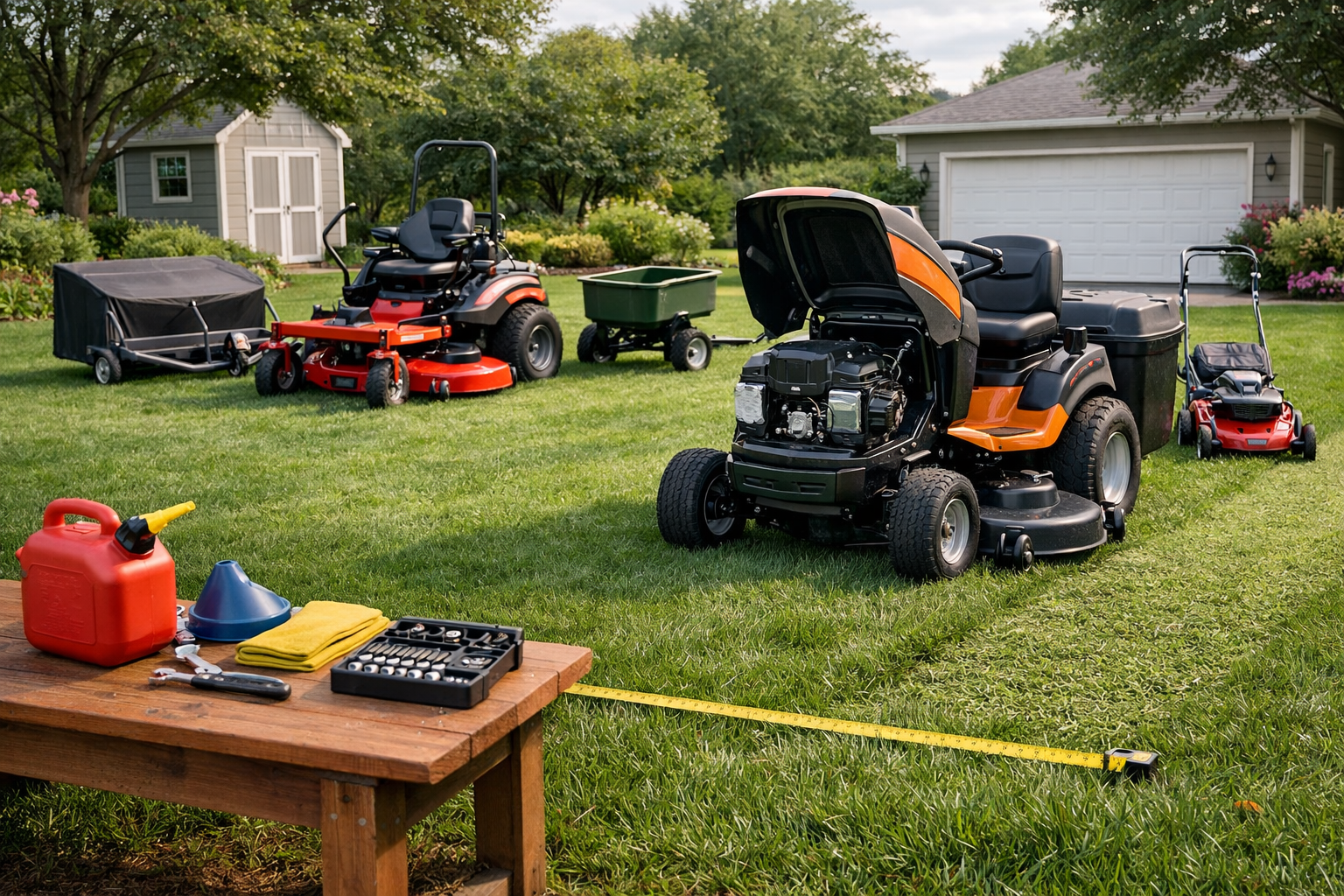
Choosing the best residential mower requires matching the machine’s power source, cutting width, and drive system to your yard’s specific acreage and topography. For small, flat lots under a quarter-acre, a cordless electric push mower is ideal, while larger properties over one acre typically necessitate a zero-turn or riding tractor for efficiency.
Assessing Your Terrain and Yard Size
Before browsing specific models or power ratings, you must accurately measure the usable turf area of your property. Yard size is the primary determinant of mower category, as using a tool designed for a smaller space on a large lot leads to premature engine or motor wear and excessive operator fatigue.
Small Lots (Under 1/4 Acre)
Properties of this size are the most versatile. In 2026, the dominant choice for small residential lots is the cordless electric walk-behind mower. Because these yards typically feature tighter corners and more landscaping obstacles—such as flower beds, patios, and play sets—a standard 20-inch or 21-inch cutting deck provides the necessary maneuverability. Manual push mowers are sufficient here if the ground is level, as the weight of modern battery-powered units is significantly lower than their internal combustion predecessors.
Medium Lots (1/4 to 1 Acre)
Once a property exceeds a quarter-acre, the physical exertion required for a standard push mower increases significantly. For these mid-sized lots, self-propelled mowers or robotic mowers are the standard recommendation. A self-propelled model with a rear-wheel-drive system helps navigate thicker grass and slight inclines without requiring the user to manhandle the machine. On the higher end of this range (near the full acre mark), many homeowners transition to small-frame riding mowers or high-capacity battery walk-behinds with 25-inch to 30-inch "timed" twin-blade decks to reduce mowing time.
Large Estates (Over 1 Acre)
For properties exceeding one acre, manual walking is rarely practical. Zero-turn radius (ZTR) mowers and lawn tractors are the primary tools for high-acreage residential use. ZTR mowers are preferred for yards with many trees or obstacles due to their ability to turn 360 degrees on a dime, while lawn tractors are better suited for open stretches of grass and for those who wish to use the machine for towing aerators, carts, or spreaders.
Power Sources: The 2026 Landscape
The transition from internal combustion to electrification has reached a tipping point in the residential sector. While gas remains relevant for specific heavy-duty applications, battery technology has matured to meet the needs of most homeowners.
Cordless Electric (Battery)
By 2026, lithium-ion and early-stage solid-state battery platforms have become the standard. Modern residential systems typically operate on 56V, 60V, or 80V architectures.
- Pros: Minimal maintenance (no oil changes, spark plugs, or air filters), near-silent operation, and instant starting.
- Cons: Limited runtime on a single charge (though swappable batteries mitigate this), and higher initial purchase price compared to entry-level gas models.
- Performance: High-torque brushless motors now rival the "stalling torque" of 160cc to 190cc gas engines, allowing them to handle damp or overgrown grass effectively.
Internal Combustion (Gasoline)
Gas mowers continue to serve users with massive properties or those without reliable access to high-capacity charging.
- Pros: Unlimited "runtime" provided you have fuel, generally lower upfront cost for riding categories, and a long-established repair infrastructure.
- Cons: High noise levels, local emissions, and the requirement for seasonal maintenance. In many regions, environmental regulations have made high-efficiency EFI (Electronic Fuel Injection) engines the only available gas option for new residential purchases.
Understanding Mower Categories and Drive Systems
Selecting the right "tool" also involves choosing how the machine moves across your lawn. The drive system dictates how much physical effort you must expend and how well the mower handles slopes.
Push vs. Self-Propelled
A push mower relies entirely on the operator's strength. These are best for flat, small lots. Self-propelled mowers use a transmission to turn the wheels.
- Front-Wheel Drive (FWD): Excellent for level ground with many obstacles. You can easily pivot the mower by pushing down on the handle to lift the drive wheels.
- Rear-Wheel Drive (RWD): The gold standard for hills and bagging. As the bag fills with clippings, the weight shifts to the rear, providing better traction for the drive wheels.
- All-Wheel Drive (AWD): Specialized for very steep residential slopes where traction is difficult to maintain.
Zero-Turn vs. Lawn Tractors
- Zero-Turn Mowers: Controlled by two lap bars, these machines control each rear drive wheel independently. This allows the mower to spin in place. They are significantly faster than tractors, often reaching speeds of 7–9 mph, making them the best choice for productivity.
- Lawn Tractors: Steered with a traditional steering wheel, these are more intuitive for new users. They are designed for stability and "ground-engaging" tasks. If you need to clear snow or move mulch in a trailer, a tractor is the more versatile residential tool.
Robotic Mowers
In 2026, robotic mowers have moved beyond niche products. Most modern units utilize RTK-GPS (Real-Time Kinematic Global Positioning System) rather than physical perimeter wires. They mow the lawn in systematic patterns and return to a charging station automatically. These are ideal for homeowners who prioritize time savings over the traditional "Saturday morning" yard work ritual.
Technical Specifications: What to Look For
When comparing models, certain technical specs indicate the machine’s durability and capability.
- Deck Width: Residential decks typically range from 21 to 54 inches. A wider deck cuts more grass per pass but is harder to store and cannot fit through standard 36-inch garden gates.
- Deck Material: Stamped steel decks are common and lightweight. Fabricated (welded) steel decks are found on "prosumer" models; they are heavier and much more durable against rocks and debris.
- Cutting Height Adjustment: Look for a "single-point" adjustment system that moves all four wheels with one lever, rather than four individual levers.
- Discharge Options: The best residential mowers offer "3-in-1" capability: mulching (finely chopping grass to return nutrients to the soil), bagging (for a clean finish), and side discharge (for very tall, rough grass).
Comparison of Residential Mower Types
| Mower Type | Recommended Yard Size | Power Source | Best For | Maintenance Level |
|---|---|---|---|---|
| Electric Push | < 0.25 Acre | Battery | Flat, quiet neighborhoods | Very Low |
| Self-Propelled (RWD) | 0.25 – 0.75 Acre | Battery or Gas | Hilly terrain, bagging | Moderate |
| Robotic Mower | 0.10 – 1.0 Acre | Battery | Continuous maintenance | Low (Blade swap only) |
| Lawn Tractor | 0.5 – 2.0+ Acres | Gas or Battery | Multi-purpose, towing | High (Gas) / Med (Elec) |
| Zero-Turn (ZTR) | 1.0 – 5.0 Acres | Gas or Battery | Speed, obstacles, large lots | High (Gas) / Med (Elec) |
Maintenance and Longevity in 2026
To ensure your investment lasts the intended 10 to 15 years, consistent maintenance is required. For battery-powered units, the focus is on battery health. In 2026, it is recommended to store batteries in a climate-controlled environment during winter months and avoid leaving them at 0% or 100% charge for extended periods of storage.
For gas-powered machines, the transition to ethanol-free fuel or the use of fuel stabilizers is non-negotiable. Ethanol attracts moisture, which can corrode carburetors and fuel lines during the off-season. Regardless of the power source, blade sharpening remains the most overlooked aspect of mower care. A dull blade tears the grass rather than cutting it, leading to "brown tipping" and increased susceptibility to lawn diseases. Residential blades should be sharpened at least twice per season.
Frequently Asked Questions
Which is better for hills: a zero-turn or a lawn tractor?
For residential slopes, a lawn tractor is generally safer than a standard zero-turn mower. Zero-turns rely on the rear wheels for both steering and traction; on a steep incline, the front casters can lose contact or slide, leading to a loss of control. If you choose a zero-turn for hills, look for models specifically equipped with "steering wheel" control for all four wheels, which provides significantly better lateral stability.
Do electric mowers have enough power for thick grass?
Yes. By 2026, brushless motor technology coupled with high-voltage battery packs (60V+) provides enough torque to handle standard residential turf, even if it is slightly damp. However, for extremely overgrown fields or wet, heavy forage, a high-displacement gas engine still offers a slight edge in continuous power throughput without thermal throttling.
How long do residential mower batteries last?
Most lithium-ion residential mower batteries are rated for 500 to 1,000 full charge cycles. For the average homeowner mowing 25 to 30 times a year, the battery pack should remain functional for 8 to 10 years before seeing a significant drop in runtime. Many manufacturers in 2026 offer 5-year warranties on the battery packs specifically.
Is mulching better than bagging?
In most cases, yes. Mulching returns nitrogen and other essential nutrients to the soil, acting as a natural fertilizer. It also saves time, as you do not need to stop and empty a bag. Bagging is preferred only if the grass is diseased, if you have an abundance of weeds that are seeding, or if the grass has grown so long that mulching would leave thick clumps that might smother the lawn.
Can robotic mowers handle leaves and sticks?
Robotic mowers are designed for "maintenance mowing," meaning they cut a tiny amount of grass frequently. While they can handle very small twigs, they are not designed to mulch heavy leaf fall or large branches. For a yard with heavy deciduous tree cover, you will still need to rake or use a traditional mower with a high-lift blade to clear debris in the autumn.
Final Recommendation: Selecting the Right Tool
To choose the right tool for your yard, start by prioritizing maneuverability versus speed. If your yard is a complex maze of gardens and trees, a zero-turn mower or a high-end robotic unit with obstacle avoidance is the best investment. If your yard is a simple, open rectangle, a lawn tractor or a wide-deck self-propelled mower will provide the best value.
Once you have identified the category, choose the power platform. If you already own cordless power tools (drills, blowers, trimmers) from a specific brand, staying within that battery ecosystem is often the most cost-effective path. Finally, ensure the mower has a local service center. Even the best residential mowers require occasional professional belt replacements, software updates, or structural repairs.
Image Gallery
Select an image to open it in a new tab.
Akira Tanaka
International Academic Trends Correspondent
