A Massive Online Open Course (MOOC) is a free or low-cost digital learning model that provides university-level instruction to an unlimited number of participants worldwide. Unlike traditional classrooms, MOOCs leverage scalable technology to deliver pre-recorded video lectures, interactive assessments, and global peer forums, allowing anyone with an internet connection to access elite education.
While the term entered the mainstream in the early 2010s, the MOOC of 2026 has evolved from a simple experiment in open education into a sophisticated ecosystem of professional credentials and stackable degrees. To understand what a MOOC really is, one must look beyond the "free" label and examine the structural, pedagogical, and economic frameworks that allow these courses to function at a massive scale.
The Four Pillars of the MOOC Framework
The acronym MOOC serves as the functional definition of the medium. However, each word in the name carries specific technical and philosophical weight that distinguishes it from other forms of online learning, such as webinars or private corporate training modules.
Massive: The Architecture of Scale
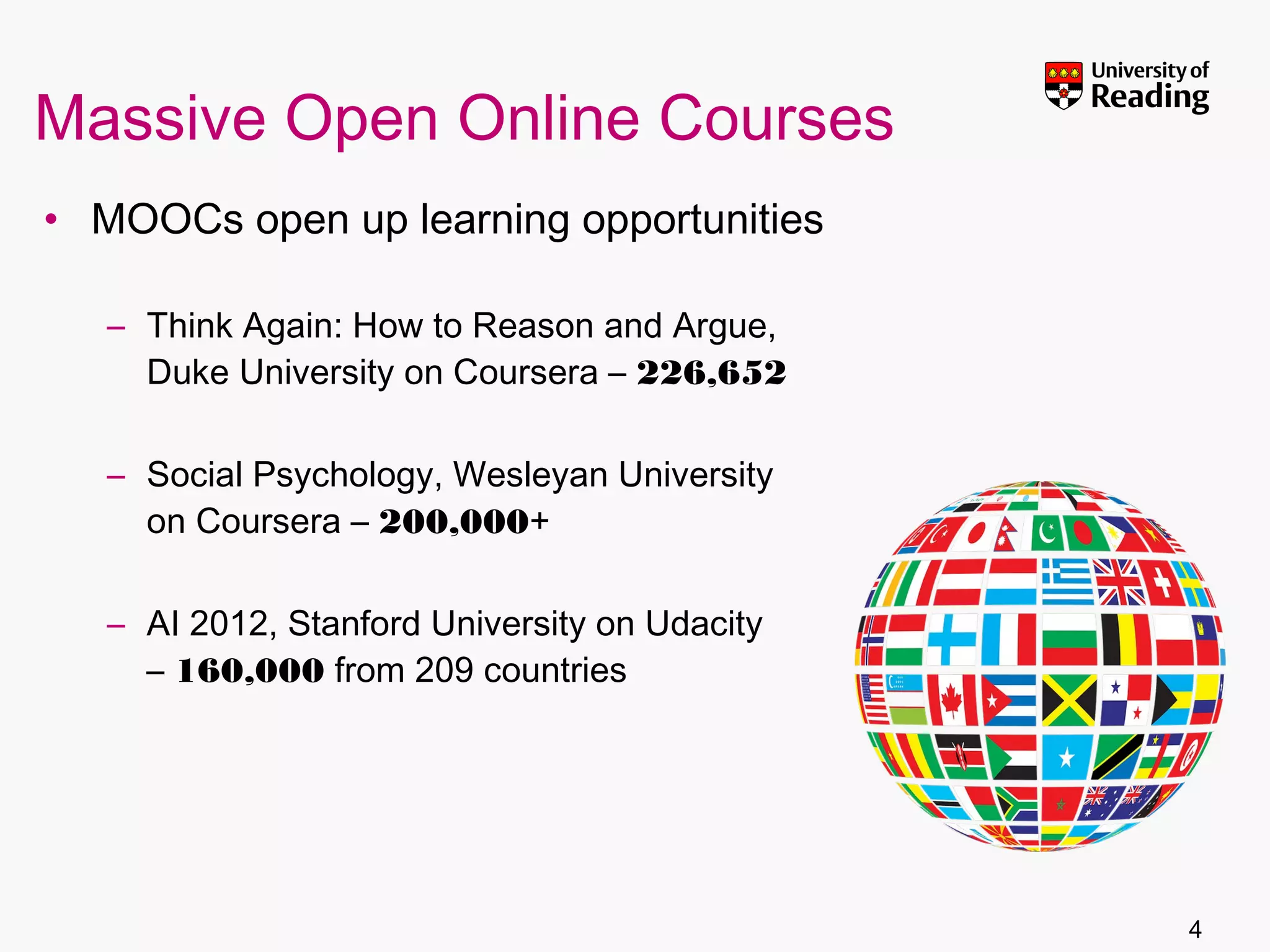
The term "massive" refers to the course's ability to support thousands—and sometimes hundreds of thousands—of students simultaneously. In a traditional university setting, a class size of 300 is considered large. In the MOOC world, the 2011 Stanford University Artificial Intelligence course, which catalyzed the movement, enrolled over 160,000 students.
Achieving this scale requires a specific technological infrastructure. Platforms like Coursera and edX use cloud-based hosting to manage high traffic and automated grading systems to handle assessments. Because human instructors cannot grade 50,000 essays, MOOCs rely on machine-graded multiple-choice tests and peer-review systems, where students grade each other's work based on strict rubrics provided by the professor.
Open: Accessibility and Its Limits
"Open" originally meant that the course was free of charge and used open-source licensing. Over time, this definition has shifted. In 2026, "open" primarily refers to open enrollment—meaning there are no prerequisites, geographic restrictions, or application processes. Anyone can sign up regardless of their academic background.
However, the "open" nature of these courses is often tiered. Many providers follow a "freemium" model where the course content is free to audit (watch and read), but a fee is required to submit graded assignments and receive a verified certificate. True open educational resources (OER) remain a subset of the MOOC world, but the commercialization of the "open" pillar is now a standard industry practice.
Online: The Digital Learning Environment
MOOCs are delivered entirely via the internet. This excludes hybrid models that require physical attendance for exams or labs. The online nature of the MOOC allows for asynchronous learning, where students progress at their own pace rather than following a synchronized weekly schedule. This flexibility is the primary driver for adult learners and working professionals who cannot commit to the rigid timelines of a brick-and-mortar institution.
Course: Pedagogical Structure
A MOOC is not just a collection of YouTube videos. It is a structured educational experience with a defined start and end date (or a suggested duration), learning objectives, a syllabus, and assessments. It mirrors the academic rigor of a college course, often being designed and taught by faculty from prestigious institutions like MIT, Harvard, or Stanford.
The Historical Evolution: cMOOCs vs. xMOOCs
To understand the current state of MOOCs, it is essential to distinguish between the two primary pedagogical branches that have shaped the industry.
The Connectivist MOOC (cMOOC)
The very first MOOC, titled "Connectivism and Connective Knowledge," was launched in 2008 by Stephen Downes and George Siemens. This was a cMOOC. It was based on the theory of connectivism, which suggests that learning occurs through the networking of information and people. In a cMOOC, the students are as much a source of knowledge as the instructor. There is no central textbook; instead, students use blogs, social media, and forums to share ideas and co-create knowledge.
The Extended MOOC (xMOOC)
The xMOOC is the version most people recognize today. These are "extended" versions of traditional university courses. They follow a more teacher-centric model where the professor provides the content and the students consume it. Platforms like Coursera and edX are built on the xMOOC model. While they lack the experimental collaborative nature of cMOOCs, they are much easier to scale and provide a standardized level of quality that employers find easier to verify.
How MOOCs Function: The Technical Ecosystem
The operation of a MOOC involves a complex interplay between the Content Provider (universities or corporations) and the Platform Provider (the LMS or Learning Management System).
- Content Creation: Professors work with instructional designers to break down a 15-week semester into "micro-lectures"—videos typically ranging from 5 to 12 minutes. This format is optimized for digital attention spans and mobile viewing.
- Assessment Engines: To maintain academic integrity, MOOCs use sophisticated testing engines. These include randomized question banks, timed exams, and anti-plagiarism software. In advanced tracks, virtual labs and coding environments are integrated directly into the browser.
- Peer Interaction: Discussion forums are the heartbeat of a MOOC. Because the student-to-teacher ratio is often 10,000:1, instructors rarely post. Instead, "Community TAs"—volunteers who have previously completed the course—moderate the discussions and help resolve technical issues.
- Credentialing: Upon completion, the platform verifies the student's identity (often through photo ID and keystroke analysis) and issues a digital certificate. These certificates are frequently shared on LinkedIn and other professional portfolios.
The Economics of Online Learning in 2026
In 2026, the "free" aspect of MOOCs has become a gateway to a multi-billion dollar credentialing industry. The revenue models have stabilized into several distinct categories:
| Feature | Audit (Free) | Verified Certificate | Professional Specialization | Full Online Degree |
|---|---|---|---|---|
| Cost | $0 | $49 – $199 | $300 – $1,000 | $10,000 – $25,000 |
| Content Access | Full Video/Reading | Full Access | Project-based | Full Faculty Support |
| Grading | None or Automated | Automated + Peer | Expert Feedback | Faculty Graded |
| Credential | None | Digital Certificate | Professional Badge | University Diploma |
| Prerequisites | None | None | Recommended Skills | Strict Admissions |
The Rise of "Stackability"
The most significant trend in the MOOC landscape is stackability. This allows a student to take a single MOOC for a certificate, then "stack" several certificates to earn a MicroMasters or a Professional Certificate. Eventually, these credits can be transferred into a full Master’s degree program at a participating university. This reduces the financial risk for students, as they can "try before they buy" an expensive degree.
Why MOOCs Matter: Impact and Accessibility
MOOCs have democratized high-level knowledge in a way that was previously unimaginable. They serve three primary audiences:
- Lifelong Learners: Retirees or hobbyists who want to learn about Roman History or Quantum Physics from the world's leading experts without the pressure of grades.
- Career Switchers: Individuals in developing economies or underserved communities who use MOOCs to learn high-demand skills like Python programming, Data Science, or Digital Marketing. For these users, a $50 certificate from a top-tier university can be a life-changing addition to a resume.
- Corporate Training: Many companies now use MOOC platforms as their primary employee development tool, replacing expensive in-person seminars with curated "learning paths" on Coursera for Business or LinkedIn Learning.
Common Criticisms and Limitations
Despite their success, MOOCs are not a perfect replacement for traditional education. Several challenges persist:
- Completion Rates: Historically, MOOCs have suffered from extremely low completion rates, often below 10%. Because there is no financial or social penalty for dropping out, many students sign up with good intentions but fail to finish.
- Digital Divide: While the courses are "open," they require high-speed internet and a modern computer. This effectively excludes millions of potential learners in regions with poor infrastructure.
- Academic Integrity: Despite identity verification measures, cheating and "contract cheating" (paying someone else to take the course) remain difficult to eliminate entirely in a massive, unproctored environment.
- Social Isolation: Learning is often a social process. While forums exist, the lack of face-to-face interaction and real-time debate can make the experience feel mechanical and isolating for some students.
Comparing Leading MOOC Platforms
| Platform | Primary Focus | Notable Partners | Best For |
|---|---|---|---|
| Coursera | Academic & Professional | Yale, Google, Stanford | Professional Certificates & Degrees |
| edX | Non-profit/Academic | Harvard, MIT, Oxford | Rigorous academic subjects |
| Udacity | Tech/Vocational | Nvidia, AWS, Mercedes-Benz | "Nanodegrees" in tech fields |
| FutureLearn | Social Learning | Open University, British Council | UK/European focus & Healthcare |
| Khan Academy | K-12 Mastery | N/A (Independent) | Foundational math and science |
Frequently Asked Questions
Are MOOC certificates recognized by employers?
Yes, but their value depends on the field. In technology, data science, and business, verified certificates from reputable platforms are highly regarded as evidence of self-motivation and up-to-date skills. In more traditional fields like law or medicine, they are viewed as supplemental rather than primary qualifications.
Can I get university credit for a MOOC?
Direct credit is rare for individual free courses. However, many MOOC platforms now offer "MicroMasters" or "Specializations" that carry ECTS (European Credit Transfer and Accumulation System) or traditional credit if you are later admitted to a full degree program at the sponsoring university.
How much time does a MOOC require?
Most MOOCs are designed to take between 3 and 8 hours of work per week. A typical course lasts 4 to 6 weeks. However, professional certifications and degree-track courses can require 15 to 20 hours per week and last several months.
Do I need a degree to take a MOOC?
No. One of the defining features of a MOOC is its "open" enrollment. While some advanced courses (like Graduate Algorithms) might be difficult without a background in math, there are no formal barriers to entry.
Is there a difference between a MOOC and an "Online Course"?
Yes. All MOOCs are online courses, but not all online courses are MOOCs. A standard online course usually has a small class size, direct instructor-student interaction, and high tuition costs. A MOOC is defined by its "Massive" scale and "Open" access.
Summary and Next Actions
A Massive Online Open Course is more than just a video lecture series; it is a scalable, digital gateway to global expertise. Whether you are looking to pivot careers, supplement your current studies, or simply satisfy a curiosity about the stars, MOOCs provide a flexible and affordable path to high-quality education.
If you are ready to begin, the best next step is to visit a major aggregator like Class Central to search for subjects that interest you. Before paying for a certificate, audit a few modules to ensure the instructor's style and the course's technical level match your needs. By 2026 standards, the wealth of knowledge available at your fingertips is virtually limitless—the only real requirement is your own discipline.
Image Gallery
Select an image to open it in a new tab.



Ingrid Bjornson
Global Cyber Policy and Regulation Analyst
