
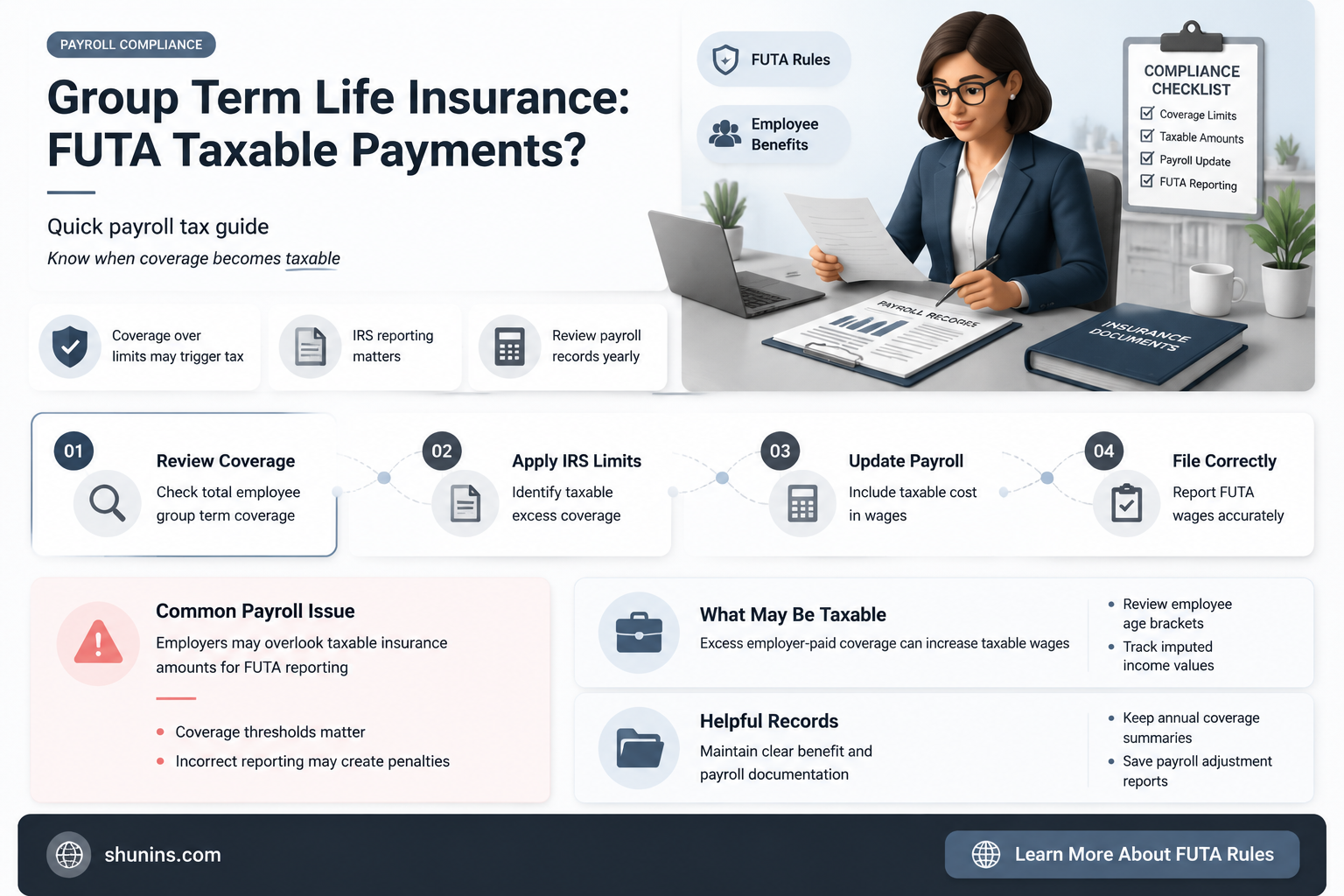
The taxability of group term life insurance (GTLI) is considered a hidden cost because while the premiums are paid by the employer, coverage exceeding $50,000 generates "imputed income." As of 2026, this non-cash income increases your total taxable wages, resulting in higher federal income, Social Security, and Medicare tax withholdings from your take-home pay.
Group term life insurance is one of the most common employee benefits offered across the United States. It provides a foundational level of financial security for families, often provided at little to no direct premium cost to the employee. However, the tax treatment of this benefit—governed by Internal Revenue Code Section 79—frequently catches employees by surprise. Because the "cost" of this insurance is not deducted as a line item labeled "tax" on every pay stub in a way that is easily identifiable, many workers remain unaware that their "free" life insurance is actually reducing their monthly net income.
To determine if this benefit is a true "hidden cost" for your specific financial situation, it is necessary to understand how the IRS calculates the value of this coverage, the thresholds for taxability, and how these figures manifest on your W-2 at the end of the year.
The Section 79 Framework: The $50,000 Threshold
The IRS allows employers to provide up to $50,000 of group term life insurance coverage to employees as a tax-free fringe benefit. For the vast majority of entry-level or mid-market roles where the benefit is a flat $50,000 or one times the annual salary (up to $50,000), there is no tax impact. The employee receives the coverage, and the employer deducts the premiums as a business expense.
The complexity—and the "hidden cost"—begins when the coverage exceeds $50,000. In 2026, many corporate benefit packages offer two, three, or even five times an employee's annual salary in life insurance coverage. If an employee earning $100,000 a year receives a benefit equal to twice their salary ($200,000), the first $50,000 remains tax-exempt, but the remaining $150,000 is subject to taxation.
This excess coverage is not taxed based on what the employer actually pays the insurance carrier. Instead, the IRS uses a standardized "Uniform Premium Table," commonly known as Table I, to determine the "value" of that insurance. This value is then added to the employee's gross income as imputed income.
Understanding Imputed Income and Table I Rates
Imputed income is a term used to describe the value of a service or benefit provided to an employee that must be treated as cash compensation for tax purposes. It is "imputed" because you never actually see the money in your paycheck; rather, the value is recorded so the government can collect taxes on it.
The IRS Table I rates are calculated based on five-year age brackets. As an employee gets older, the "cost" of the insurance—and thus the imputed income—increases significantly. This is where the cost stops being a minor nuance and becomes a material consideration for older employees or those with high-value policies.
IRS Table I: Monthly Cost per $1,000 of Coverage (2026 Status)
The following table outlines the monthly cost used by the IRS to determine the taxable value of GTLI coverage exceeding $50,000.
| Age Bracket (as of last day of the year) | Monthly Cost per $1,000 of Excess Coverage |
|---|---|
| Under 25 | $0.05 |
| 25 to 29 | $0.06 |
| 30 to 34 | $0.08 |
| 35 to 39 | $0.09 |
| 40 to 44 | $0.10 |
| 45 to 49 | $0.15 |
| 50 to 54 | $0.23 |
| 55 to 59 | $0.43 |
| 60 to 64 | $0.66 |
| 65 to 69 | $1.27 |
| 70 and above | $2.06 |
Note: These rates have remained consistent under IRS regulations through 2026, providing a standardized way to measure the economic benefit of employer-provided life insurance.

Step-by-Step: Calculating the Hidden Tax Cost
To visualize how this works, let’s look at a practical example for a 52-year-old executive in 2026 who has a group term life insurance policy worth $500,000 provided by their employer.
- Determine the Excess Coverage: Total Coverage ($500,000) - Tax-Exempt Limit ($50,000) = $450,000 of taxable coverage.
- Apply the Table I Rate: A 52-year-old falls into the "50 to 54" bracket, which has a rate of $0.23 per $1,000.
- Calculate Monthly Imputed Income: ($450,000 / $1,000) * $0.23 = $103.50 per month.
- Calculate Annual Imputed Income: $103.50 * 12 = $1,242.00 per year.
In this scenario, $1,242 is added to the employee’s W-2 as taxable wages. If the employee is in a 24% federal tax bracket, they will pay an additional $298.08 in federal income tax, plus roughly $95.01 in FICA taxes (Social Security and Medicare), totaling $393.09 in actual out-of-pocket costs for the year.
While $393 for $500,000 of coverage is still an exceptional value compared to private individual policies, it is a cost that the employee might not have planned for, especially since it is often deducted incrementally through increased tax withholding on every paycheck.
Why This Cost Is Often "Hidden" from Employees
The taxability of GTLI is frequently described as a hidden cost due to several factors related to payroll processing and benefit communication:
1. Lack of Direct Deduction
Unlike a health insurance premium or a 401(k) contribution, there isn't a specific line item that says "Life Insurance Premium" on the deduction side of the pay stub. Instead, the imputed income is added to the "Gross Pay" or "Earnings" side (often labeled as "GTL" or "Imputed Inc"), and then the total tax is calculated on that higher amount. Because the cash isn't leaving the employee's hands in a single recognizable chunk, the cost is obscured.
2. The Age "Cliff"
As shown in Table I, the rates jump significantly as an employee moves from one age bracket to the next. An employee might spend five years with a negligible tax impact, only to see their take-home pay drop unexpectedly when they turn 50, 55, or 60, as the IRS rate for their coverage doubles or triples.
3. Year-End Surprises
Some employers do not calculate imputed income on every pay cycle. Instead, they may perform a "catch-up" calculation in December. This can lead to a significantly smaller final paycheck of the year as the payroll system tries to withhold all the necessary taxes for the year's total imputed income in a single period.
4. Impact on Social Security and Medicare
Many employees assume that if a benefit is "taxable," it only refers to income tax. However, imputed income for GTLI is also subject to FICA taxes. For high earners who have already hit the Social Security wage base cap, this may only affect Medicare taxes, but for most workers, it is a full tax hit.
Group Term vs. Individual Life Insurance: A Cost Comparison
Is the "hidden cost" of GTLI enough to justify turning down the coverage or seeking a private policy? In most cases, the answer is no, but the gap narrows as an employee ages.
- Under Age 45: The imputed income rates are so low that the tax cost is almost always lower than the premiums for an equivalent private term life policy.
- Ages 50 to 60: This is the "break-even" zone. While the group coverage is still usually cheaper, the tax cost becomes more noticeable.
- Over Age 65: For older employees, the Table I rates ($1.27 to $2.06 per $1,000) are quite high. If an employee is in a high tax bracket, the actual tax paid on a large group policy might approach the cost of a private term policy, which has the added benefit of being portable (meaning you keep it if you leave your job).
Portability and the Hidden Risk
One often overlooked "cost" of group life insurance is its lack of portability. If you rely solely on your employer's group plan because it feels "free" (despite the imputed income tax), you risk losing all coverage if you lose your job or become too ill to work. Purchasing a private policy when you are older or less healthy can be prohibitively expensive. In this context, the hidden cost is not just the tax, but the potential loss of insurability.
Special Considerations for 2026: Key Employees and Retirees
There are specific circumstances where the standard $50,000 exemption does not apply, or the tax rules change:
Key Employees and Nondiscrimination
If a group term life insurance plan discriminates in favor of "key employees" (officers, certain shareholders, or highly compensated individuals), those employees may lose the $50,000 exclusion. In such cases, the key employee must include the greater of the actual cost of the insurance or the Table I cost for the entire amount of coverage in their taxable income.
Retirees and Disabled Employees
The IRS provides certain exceptions to the imputed income rules. If an employee's coverage continues after they retire and they are "permanently and totally disabled," the coverage may be entirely tax-exempt. However, for standard retirees, the $50,000 rule and Table I rates generally still apply if the former employer continues to provide the benefit.
Employee-Paid Premiums
If you pay for your GTLI coverage with after-tax dollars (voluntary life insurance), those payments reduce the amount of imputed income you must report. For example, if the IRS calculates your imputed income at $100 but you already paid $40 in after-tax premiums for that coverage, you only report $60 as imputed income.
Strategies to Manage GTLI Tax Impacts
If you are concerned about the hidden tax costs of your life insurance benefit, consider the following actions:
- Review Your Benefit Election: During open enrollment, calculate the potential imputed income for coverage levels above $50,000. If you are in a high-age bracket and a high-tax bracket, the cost may be higher than you realize.
- Evaluate the "Opt-Out" or "Cap" Options: Some employers allow you to cap your life insurance coverage at $50,000 to avoid the administrative and tax headache of imputed income.
- Compare with Private Term Insurance: Get a quote for a 10-year or 20-year level term private policy. If the private policy is affordable, you might choose to cap your employer coverage at $50,000 and use the private policy for your primary protection. This also solves the portability issue.
- Analyze the Impact of After-Tax Contributions: If your employer offers a choice between pre-tax and after-tax contributions for supplemental life insurance, check which is more advantageous. After-tax contributions for the employee's portion of the premium can offset imputed income dollar-for-dollar.
FAQs
1. Does the $50,000 tax-free limit apply to accidental death and dismemberment (AD&D) insurance?
No. AD&D insurance is generally not subject to the same imputed income rules as group term life insurance. The premiums paid by an employer for AD&D are typically excluded from an employee's gross income under separate sections of the tax code (Section 106), meaning there is no "hidden cost" for AD&D coverage regardless of the policy amount.
2. Can I avoid the tax by naming a charity as the beneficiary?
Yes, but with conditions. If you name a charitable organization as the sole beneficiary of your group term life insurance for the entire year, the cost of the coverage is not included in your taxable income. However, you must ensure that the designation is irrevocable for the period in question and complies with IRS Section 79 requirements.
3. Is "Whole Life" insurance provided by an employer taxed the same way?
No. The $50,000 exclusion and Table I rates apply specifically to term life insurance. If an employer provides whole life or any insurance with a cash value component, the entire premium paid by the employer is generally considered taxable income to the employee from the first dollar of coverage.
4. How does the IRS know my age for Table I calculations?
The IRS uses your age as of the last day of the calendar year. Even if you turn 45 on December 31st, you are considered 45 for the entire year's imputed income calculation. This can cause a sudden jump in tax liability in the year of a milestone birthday.
5. If my employer pays for life insurance for my spouse or children, is that taxed?
Yes. Generally, the cost of employer-provided life insurance for a spouse or dependent is taxable if the coverage amount exceeds $2,000. Unlike the $50,000 threshold for employees, the "de minimis" threshold for dependents is very low, meaning almost any dependent life insurance benefit will result in some imputed income.
Recommendation for 2026
To manage the taxability of group term life insurance effectively, you should first identify the total volume of coverage provided by your employer. If the amount is significantly higher than $50,000—especially if you are over the age of 45—use the Table I rates to estimate your annual imputed income. Compare this "hidden" tax cost and the risk of losing coverage upon job separation against the cost of a private, level-premium term life policy. For many, a combination of the tax-free $50,000 employer benefit and a separate private policy provides the most cost-effective and secure long-term strategy.
Image Gallery
Select an image to open it in a new tab.





Mateo Castillo
Decentralized Finance and E-Payments Strategist
