The Martini-Henry Rifle: A Definitive Guide to History, Mechanics, and Collecting
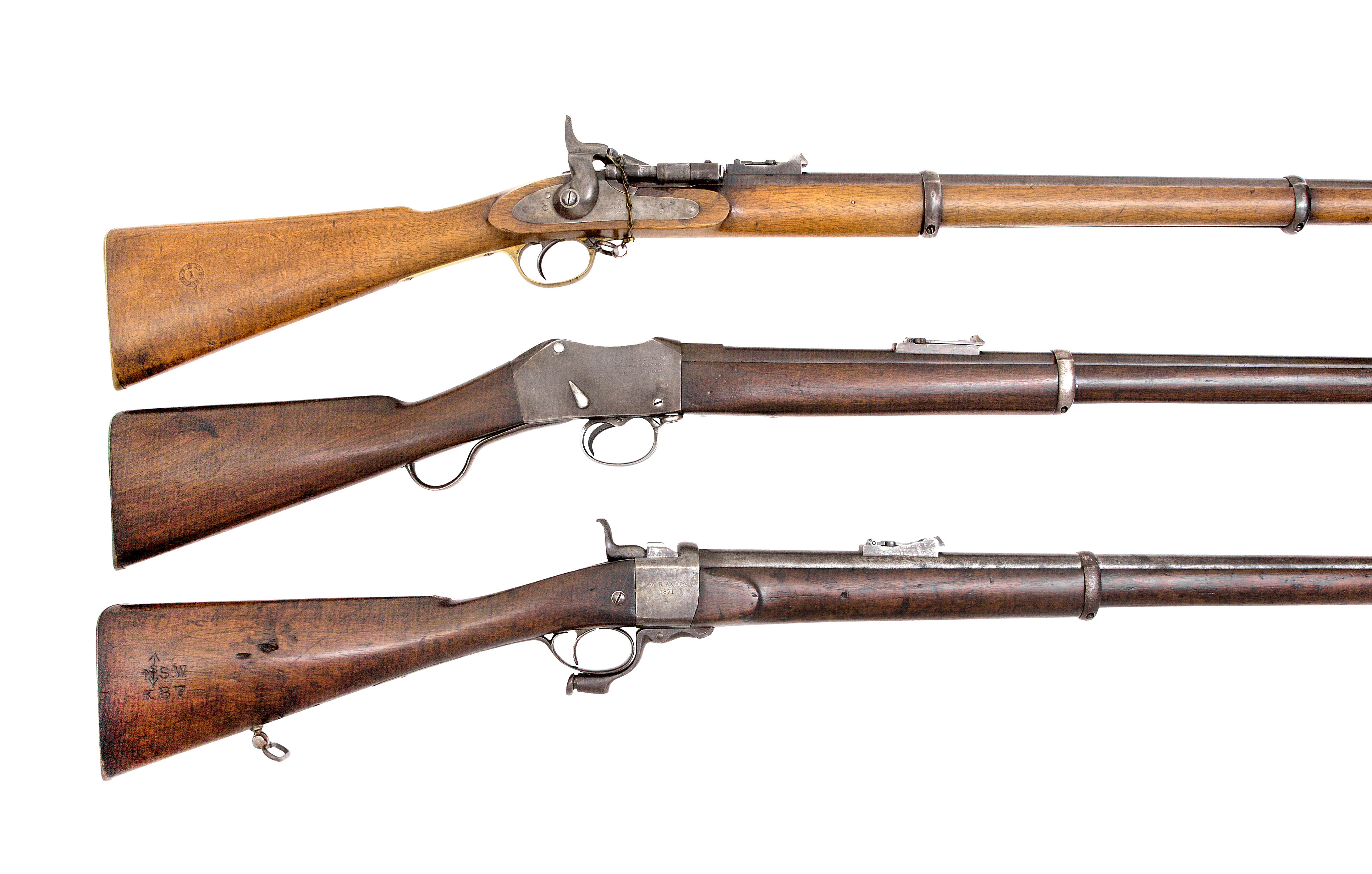
The Martini-Henry is a breech-loading, lever-action, single-shot rifle adopted by the British Army in 1871. Combining the tilting-block action of Friedrich von Martini with the polygonal rifling of Alexander Henry, it served as the British Empire's primary infantry weapon for over two decades, famously participating in the Anglo-Zulu War and the Second Anglo-Afghan War.
The Evolution of British Breech-Loaders
To understand the Martini-Henry, one must first look at the vacuum it filled. In the mid-19th century, the British military was undergoing a rapid technological shift. The Crimean War had demonstrated the superiority of the rifle over the smoothbore musket, but the American Civil War highlighted the future: the breech-loader. The British initially adopted the Snider-Enfield in 1866 as a "stop-gap" measure. The Snider was essentially a conversion of the older muzzle-loading Pattern 1853 Enfield, featuring a hinged "shoe-box" breech.
While the Snider was effective, the War Office sought a purpose-built breech-loading rifle that could withstand the pressures of higher-velocity cartridges and provide better accuracy at distance. In 1867, a committee was formed to evaluate over 120 designs. The winning combination paired a modified Peabody action, refined by the Swiss engineer Friedrich von Martini, with a .450-caliber barrel featuring the seven-groove rifling designed by Edinburgh gunmaker Alexander Henry.
The result was the Martini-Henry, which entered service in 1871. It represented a leap forward in infantry technology, offering a faster rate of fire—up to 12 rounds per minute in practiced hands—and a significantly more powerful cartridge than its predecessors.
Technical Specifications and Action Mechanics
The Martini-Henry is defined by its "falling block" or "tilting block" action. Unlike the bolt-action rifles that would follow it, the Martini-Henry utilizes a lever located behind the trigger guard to operate the internal mechanism.
The Loading Cycle
When the user pushes the lever downward, the front of the breech block drops, exposing the chamber. Simultaneously, this action compresses the striker spring (the Martini-Henry uses a striker rather than a traditional external hammer) and activates the extractor. The extractor hits the rim of the spent cartridge case, flinging it out of the rear of the rifle.
A new round is then slid into the chamber across the top of the dropped block. When the lever is pulled back up, the block rises, sealing the breech and locking the striker in the cocked position. A small teardrop-shaped indicator on the side of the receiver provides a tactile and visual confirmation that the weapon is cocked.
The Alexander Henry Rifling
The barrel was equally revolutionary. While previous rifles used standard lands and grooves, Henry’s design utilized a heptagonal (seven-sided) cross-section with a slow twist. This was designed to reduce lead fouling, a major issue with early black powder firearms. By minimizing the "corners" where lead could accumulate, the rifle maintained its accuracy over longer strings of fire, a critical requirement for a colonial superpower often engaged in prolonged skirmishes.

The .577/450 Martini-Henry Cartridge
The rifle’s power came from its unique ammunition. The .577/450 Martini-Henry was a bottlenecked centerfire cartridge. It was created by necking down the existing .577 Snider casing to accept a .45-caliber bullet.
In the early years of service (1871–1885), these cartridges were "rolled brass" foil cases rather than solid-drawn brass. These were made of thin strips of brass with an iron base. While economical, they were prone to expanding and jamming in the chamber when the rifle became hot and fouled with black powder—a failure that contributed to the British casualties at the Battle of Isandlwana in 1879.
The ballistics of the .577/450 were formidable for the era:
- Bullet Weight: 480 grains (lead).
- Propellant: 85 grains of black powder.
- Muzzle Velocity: Approximately 1,300 feet per second.
- Effective Range: 400–600 yards, though the sights were graduated up to 1,400 yards for volley fire.
The heavy lead projectile carried immense kinetic energy, often described by contemporaries as having "stopping power" that could drop a charging adversary instantly. However, the trade-off was a punishing recoil that could bruise a soldier’s shoulder after only a few rounds.
Primary Marks and Variants
During its service life, the Martini-Henry went through four primary "Marks" (revisions), each addressing specific battlefield feedback.
Mark I (1871)
The original production model. It featured a short lever and a bronze firing pin (which was later changed to steel due to brittleness). Most Mark I rifles were eventually upgraded to Mark II specifications.
Mark II (1877)
The most iconic variant, used extensively in the Zulu Wars. It featured a revised trigger group, an improved rear sight, and a different cleaning rod. The Mark II is the version most sought after by collectors today due to its direct historical link to the height of the Victorian British Empire.
Mark III (1879)
This version introduced a simplified method of attaching the forearm to the barrel using a hook rather than a pin. It also featured a smaller cocking indicator and a reinforced receiver.
Mark IV (1888)
The final major iteration, often referred to as the "Long Lever" Martini. By the mid-1880s, the British were experimenting with the .402 Enfield-Martini, but the adoption of the .303 Lee-Metford made that caliber obsolete. The unfinished .402 receivers were converted back to .577/450. The Mark IV featured a much longer cocking lever to provide more mechanical advantage for extracting stuck cartridges, a response to the jamming issues seen in the Sudan and Africa.
| Feature | Mark II (Standard) | Mark IV (Long Lever) | Gahendra (Nepalese) |
|---|---|---|---|
| Action Origin | British (Enfield/BSA) | British (Enfield) | Nepalese Hand-forged |
| Lever Length | Short (approx. 3.5") | Long (approx. 6") | Short |
| Caliber | .577/450 | .577/450 | .577/450 |
| Rifling | Henry 7-groove | Henry 7-groove | Varied (often 5-groove) |
| Sight Type | Slide-adjusting ramp | Enhanced ladder | Traditional ladder |
| Production Period | 1877–1880s | 1888–1889 | 1880s–1900s |
The Royal Nepalese Cache and the Gahendra
For decades, Martini-Henry rifles were rare and expensive. This changed in 2003 when International Military Antiques (IMA-USA) and Christian Cranmer discovered a massive cache of over 50,000 antique firearms in the Lagan Silekhana Palace in Kathmandu, Nepal.
This cache included thousands of British-made Martini-Henrys sent to Nepal as aid, but more interestingly, it contained the "Gahendra" Martini. The Gahendra was a locally produced, hand-forged variant of the Martini-Henry. While functionally similar, the Gahendra is not parts-interchangeable with British models. It features a slightly different internal geometry and was manufactured using traditional blacksmithing techniques.
For modern collectors in 2026, the Nepalese cache remains the primary source for "untouched" rifles that require restoration, though the supply of high-quality British-made Mark IIs from this source has significantly dwindled over the last 20 years.
Collecting and Owning a Martini-Henry in 2026
As of 2026, the Martini-Henry occupies a unique legal niche in many countries. Because it fires an obsolete black powder cartridge, it is often classified as an "antique" or "curio and relic."
Legal Status
- United States: Under the Gun Control Act of 1968, any firearm manufactured in or before 1898 is generally considered an antique and can be bought and sold without an FFL (Federal Firearms License) in most states.
- United Kingdom: Under Section 58(2) of the Firearms Act 1968, the Martini-Henry is considered an antique held as a "curiosity or ornament" because it is chambered for an obsolete caliber. It can be owned without a license unless you intend to fire it, at which point it must be registered on a Firearm Certificate (FAC).
Market Value
Condition is the primary driver of value. An "untouched" rifle from the Nepal cache might sell for $800 to $1,000, while a pristine, British-proofed Mark II with a clear bore and original finish can command between $1,800 and $3,500. Rare carbine versions, such as the Artillery or Cavalry Carbines, often fetch higher premiums due to their scarcity.
Practical Guidance: Shooting and Maintenance
If you intend to shoot a Martini-Henry in 2026, you are entering the world of advanced handloading. Commercial ammunition has not been produced for this rifle in nearly a century, with the exception of limited runs by specialized manufacturers like Kynoch.
Handloading Challenges
The primary hurdle is the brass. Modern shooters often use 24-gauge brass shotshells (such as those from Magtech) and "fire-form" them to the .577/450 shape using specialized dies.
- Propellant: Only use Black Powder or approved Black Powder substitutes (like Hodgdon 777). Never use modern smokeless powder, as the pressure curves can shatter the 150-year-old steel or iron receivers.
- Bullets: Most shooters use a .459 to .468 diameter lead bullet, often paper-patched to replicate the original military load. Paper patching involves wrapping the lead bullet in thin paper to ensure a tight seal with the rifling without causing leading.
Maintenance
Black powder is highly corrosive. After a shooting session, the rifle must be cleaned thoroughly with hot soapy water or a dedicated black powder solvent. Failure to do so will result in "flash rusting" within hours, which can ruin the Henry rifling. Pay special attention to the breech block; carbon buildup inside the block can cause the striker to hang up or fire sluggishly.
Common Issues and Troubleshooting
When inspecting or operating a Martini-Henry, keep the following technical issues in mind:
- Broken Striker Spring: After a century and a half, these springs often lose their tension or snap. If the cocking indicator moves but the rifle fails to fire, the internal spring is the likely culprit.
- Breech Block Misalignment: On worn rifles, the block may not sit perfectly flush with the chamber. This can cause "light strikes" where the firing pin does not hit the primer with enough force.
- The "Gahendra Trap": Many new collectors mistake the Nepalese Gahendra for a British Martini-Henry. While historical, Gahendras are made of softer steel. They are generally considered "advanced" projects for shooters and should always be inspected by a gunsmith before any attempt to fire them.
- Forearm Cracks: The wood on these rifles is often over 140 years old. Over-tightening the barrel bands or the stock bolt can cause the walnut or sal wood to split.
FAQ
Is the Martini-Henry a legal antique in the US?
Yes, the vast majority of Martini-Henry rifles were manufactured before 1898, qualifying them as antiques under federal law. However, always check local state laws, as jurisdictions like New Jersey or New York may have specific restrictions on antique possession.
Can I use modern .45-70 Government ammunition in it?
Absolutely not. While the bullet diameters are similar, the chamber dimensions and pressure limits are entirely different. Attempting to fire a different caliber or smokeless powder through a Martini-Henry is extremely dangerous and will likely result in a catastrophic failure of the firearm.
How do I tell if my Martini-Henry is British or Nepalese?
Look at the receiver markings. British rifles will have a crown over "V.R." (Victoria Regina), the manufacturer (e.g., Enfield or BSA), the Mark (e.g., II), and the year of manufacture. Nepalese Gahendra rifles usually have Devanagari script hand-engraved on the top or sides of the receiver and lack British proof marks.
Why does the rifle have a small lever on the side?
That is not a lever, but a cocking indicator. It is directly connected to the internal striker. When it points forward, the rifle is cocked. It is a vital safety feature for a rifle that lacks a traditional manual safety catch.
What bayonet fits the Martini-Henry?
The most common is the Pattern 1876 "Socket" bayonet, often called the "lunger" due to its 22-inch triangular blade. There is also the Pattern 1879 Sword Bayonet, which was primarily issued to artillery and sergeant units.
Final Recommendations for Enthusiasts
The Martini-Henry is more than a firearm; it is a mechanical artifact of a bygone era. For those looking to enter the hobby in 2026, start by acquiring a British Mark II from a reputable dealer. While the "untouched" Nepalese rifles are cheaper and offer a rewarding restoration project, they require significant tools and expertise to make safe and functional.
If your goal is to shoot, invest in a high-quality set of reloading dies and a dedicated black powder cleaning kit. Join historical shooting societies like the Victorian Rifleman or the Muzzle Loaders Association of Great Britain (MLAGB) for specific load data and safety protocols. By treating these rifles with the respect their age and history deserve, you can preserve a piece of 19th-century engineering for the next generation.
Image Gallery
Select an image to open it in a new tab.


Lars Thomsen
Global Labor Markets and Economic Strategy Editor
