Auto Insurance Coverage of Accidents Caused by DUI in Arizona
Navigating auto insurance coverage after a driving under the influence (DUI) accident in Arizona involves understanding strict state financial responsibility laws, potential policy cancellations, and mandatory high-risk filings. When a driver causes a collision while impaired, standard liability policies generally cover third-party bodily injury and property damage up to policy limits, but insurers retain the right to drop coverage or deny payouts to the policyholder under specific policy exclusions.
Understanding Arizona Auto Insurance Laws and DUI Mandates
Arizona operates under a fault-based auto insurance system, meaning the driver who causes a traffic collision is legally responsible for the resulting damages. State law mandates that all registered vehicle owners carry minimum liability coverage, which currently stands at $25,000 for bodily injury or death of one person, $50,000 for total bodily injury or death per accident, and $15,000 for property damage.
When a driver receives a DUI conviction, the legal and financial landscape shifts dramatically. A DUI is classified as a serious traffic violation and a criminal offense under Arizona Revised Statutes (A.R.S. § 28-1381). Insurance companies monitor driving records closely through motor vehicle record (MVR) checks, typically upon policy renewal or through continuous monitoring programs. Once an insurer discovers a DUI conviction or a related administrative license suspension, the underwriting risk profile of that driver changes immediately, triggering mandatory surcharges, non-renewals, or mid-term cancellations where permitted by state regulations.
Note: This article provides general educational information regarding insurance and legal frameworks in Arizona and should not be construed as formal legal or financial advice. Individuals facing DUI charges should consult a qualified attorney licensed in Arizona.
How Liability Insurance Responds to a DUI Accident
A common misconception is that auto insurance companies will completely refuse to pay out claims if the policyholder was intoxicated at the time of an accident. In most standard personal auto insurance policies, third-party liability coverage still applies to victims injured by an impaired driver, up to the purchased policy limits.
Third-Party Coverage Protections
Public policy in Arizona generally requires that liability insurance protects innocent third parties on the road. If a policyholder drives under the influence and crashes into another vehicle, the insurer is legally obligated to pay for the other party's medical bills, vehicle repairs, and other covered losses, provided the policy was active at the time of the crash. This protects the public from uncompensated losses caused by insolvent or reckless drivers.
Reservation of Rights and Disclaimer
While insurers pay third-party claimants, they often issue a "reservation of rights" letter to the policyholder. This legal notice states that the insurance company will investigate and defend or settle the claim, but it preserves its right to deny coverage later or seek reimbursement from the insured driver if policy violations are found. For instance, if the DUI involved intentional criminal acts or if the driver explicitly violated specific exclusions written into the contract, the insurer may attempt to claw back payouts directly from the at-fault driver.

Policyholder Exclusions and Intentional Acts
Every auto insurance policy is a legally binding contract governed by specific terms, conditions, and exclusions. Reviewing the fine print reveals how insurers handle illegal activities.
Most standard personal auto policies contain exclusionary clauses regarding the commission of a felony or intentional acts. While driving under the influence is typically a misdemeanor for a first offense in Arizona (unless aggravated factors like driving with a child passengers or driving on a suspended license are present), repeat offenses or extreme DUI charges can escalate to felonies. If an accident occurs while the driver is engaged in a felony act explicitly excluded by the policy language, the insurer may deny coverage for the policyholder's own vehicle damages.
Furthermore, if a driver intentionally causes a collision—even while under the influence—insurance contracts universally void coverage for intentional damage. However, intoxication alone rarely meets the legal threshold of "intentional" destruction, as impaired drivers typically lack the specific intent to cause a crash, meaning negligence rules and standard liability coverage still govern the incident.
Impact on Personal Coverage: Collision and Comprehensive
While third-party victims receive compensation from the liability portion of the policy, the impaired driver's own physical damage coverages—Collision and Comprehensive—face a different reality.
- Collision Coverage: This pays to repair or replace the policyholder's vehicle when it collides with another car or object. Insurers frequently deny collision payouts for single-vehicle or multi-vehicle accidents where the driver is convicted of a DUI, citing policy exclusions related to illegal activities or operating a vehicle while under the influence of drugs or alcohol.
- Comprehensive Coverage: This handles non-collision events such as theft, fire, or animal strikes. A DUI generally does not impact a comprehensive claim unless the intoxication directly contributed to the loss event, though insurers may still use the incident to re-rate or cancel the policy at the next renewal cycle.
Even if an insurer pays a collision claim, the resulting out-of-pocket costs via deductibles, combined with skyrocketing future premiums, often make filing a claim for one's own vehicle financially impractical.
Financial Consequences and Premium Surcharges
A DUI conviction is one of the most severe rating factors an auto insurance provider can process. The financial fallout extends far beyond court-mandated fines, legal fees, and ignition interlock device costs.
Insurance companies evaluate risk through actuarial data, which consistently shows that drivers with DUI convictions have a significantly higher statistical probability of future accidents. Consequently, insurance premiums increase dramatically.
| Insurance Impact Category | Pre-DUI Status | Post-DUI Status (Arizona Average Estimates) |
|---|---|---|
| Risk Classification | Standard or Preferred | High-Risk (Non-Standard) |
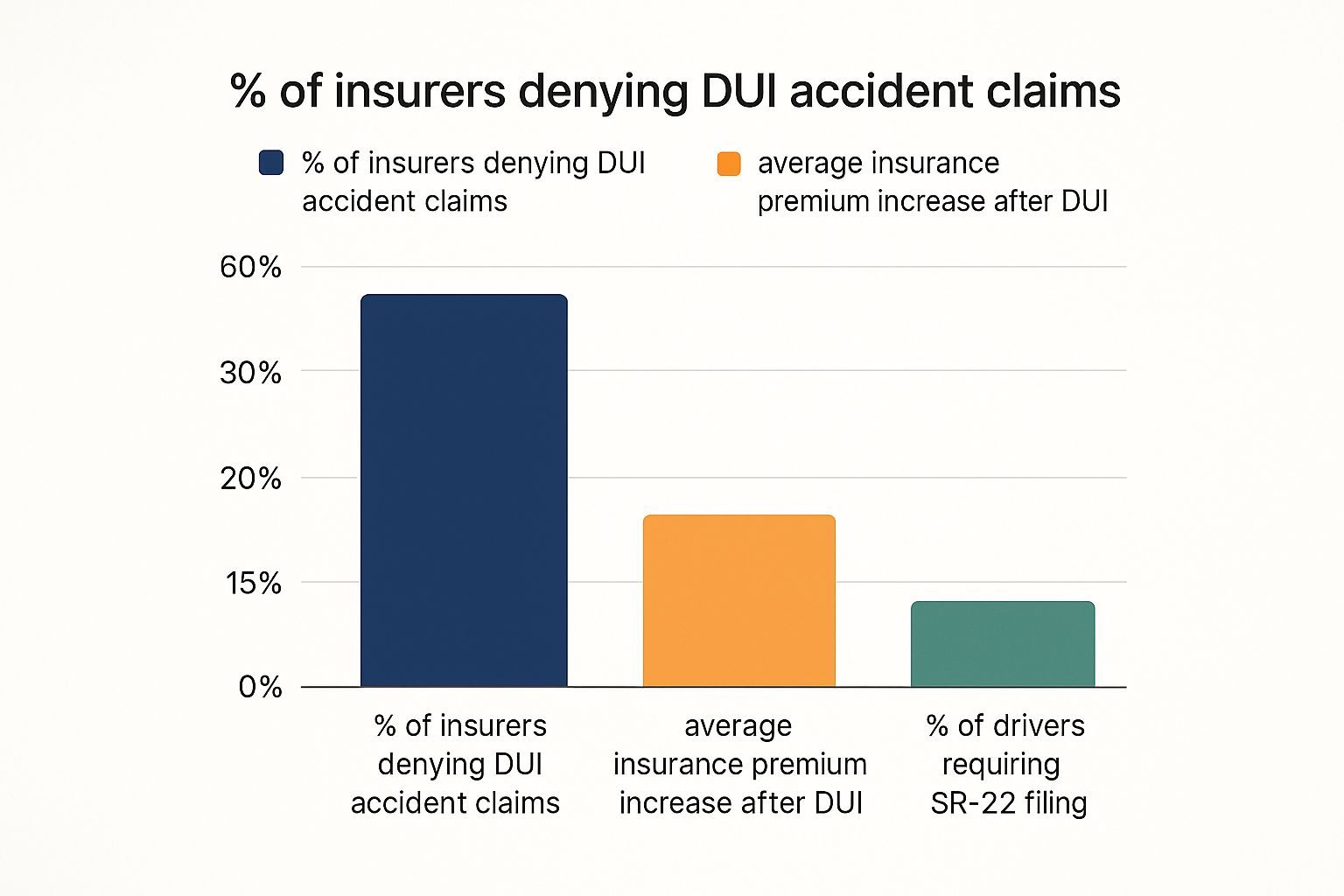
| Average Premium Increase | Baseline Rates | 80% to 150%+ Increase |
| Mandatory Filings | None | Certificate of Financial Responsibility (SR-22) |
| Policy Status | Renewed Automatically | Potential Non-Renewal or Cancellation |
| Available Discounts | Applies (Safe Driver, Multi-Policy) | Frequently Removed |
Because traditional preferred carriers often refuse to insure drivers with a recent DUI, motorists are frequently forced to seek coverage from non-standard auto insurance companies specializing in high-risk drivers. These specialized policies carry substantially higher rates for fewer coverage features.
The Role of the SR-22 in Arizona
In Arizona, a DUI conviction typically requires the driver to file an SR-22 form with the Arizona Motor Vehicle Division (MVD).
An SR-22 is not a standalone insurance policy; rather, it is a certificate of financial responsibility issued by an authorized auto insurance provider. It serves as an official guarantee to the state that the driver carries at least the minimum liability insurance required by law.
- Filing Requirement: The court or the MVD mandates the SR-22 filing, usually for a period of three consecutive years.
- Insurance Notification: If the policy lapses, is cancelled, or is terminated for any reason, the insurance carrier is legally required to notify the Arizona MVD immediately by submitting an SR-26 form, which results in the immediate re-suspension of the driver's license.
- Cost Factor: In addition to higher insurance premiums, drivers requiring an SR-22 often face a small filing fee from their insurer and must maintain uninterrupted coverage to avoid administrative penalties.
Steps to Manage Insurance After a DUI in Arizona
Drivers facing a DUI charge or conviction in Arizona must navigate their insurance obligations carefully to maintain legal driving privileges and manage long-term costs.
- Be Transparent with Your Insurer: Do not attempt to hide a DUI arrest or conviction from your insurance company. Insurers routinely audit driving records, and failure to disclose material changes can lead to policy rescission for misrepresentation, leaving the driver completely uninsured.
- Shop for High-Risk Coverage Early: If your current provider issues a non-renewal notice, research non-standard insurance carriers that specialize in high-risk drivers and SR-22 filings before your current policy officially terminates.
- Fulfill SR-22 Requirements Promptly: Work with your insurer to ensure the SR-22 certificate is submitted correctly to the Arizona MVD to prevent delays in license reinstatement or unnecessary license suspension periods.
- Utilize Safe Driving and Discounts: Over time, maintaining a clean driving record, completing court-ordered alcohol education or treatment programs, and practicing defensive driving can help gradually lower high-risk insurance premiums.
Frequently Asked Questions
Will my auto insurance automatically cancel if I get a DUI in Arizona?
Not immediately. While some insurance companies have strict underwriting guidelines that permit mid-term cancellation for major criminal convictions, many providers will wait until the current policy term expires before issuing a non-renewal notice. However, your rates may increase mid-term depending on contract terms and state regulations.
Does my insurance cover damage to my own car if I caused a DUI accident?
Usually no. Most standard auto insurance policies contain exclusions that deny collision coverage payouts if the damage occurred while the policyholder was operating the vehicle under the influence of alcohol or illegal substances. You will likely have to pay for your own vehicle repairs out of pocket.
How long do I need to carry an SR-22 in Arizona after a DUI?
In Arizona, drivers are typically required to maintain an SR-22 certificate of financial responsibility for three consecutive years from the date of the DUI conviction or license reinstatement requirement. Allowing your insurance policy to lapse during this period will trigger an automatic re-suspension of your driver's license.
Will my insurance rates stay high forever after a DUI?
No. While a DUI remains on your Arizona motor vehicle record for several years (typically five years for standard reporting, though insurance companies may look back three to five years for rating purposes), rates tend to decrease over time if you maintain a clean driving record and demonstrate responsible behavior.
Do I need to report a DUI arrest to my insurance company immediately?
It depends on your policy contract. Some policies require notification upon arrest or indictment, while others require notification upon conviction. Review your specific policy documents or speak with an insurance professional to understand your obligations and avoid accidental policy violations.
Image Gallery
Select an image to open it in a new tab.

Lars Thomsen
Global Labor Markets and Economic Strategy Editor
