Understanding Standard Workers’ Compensation Rates in 2026
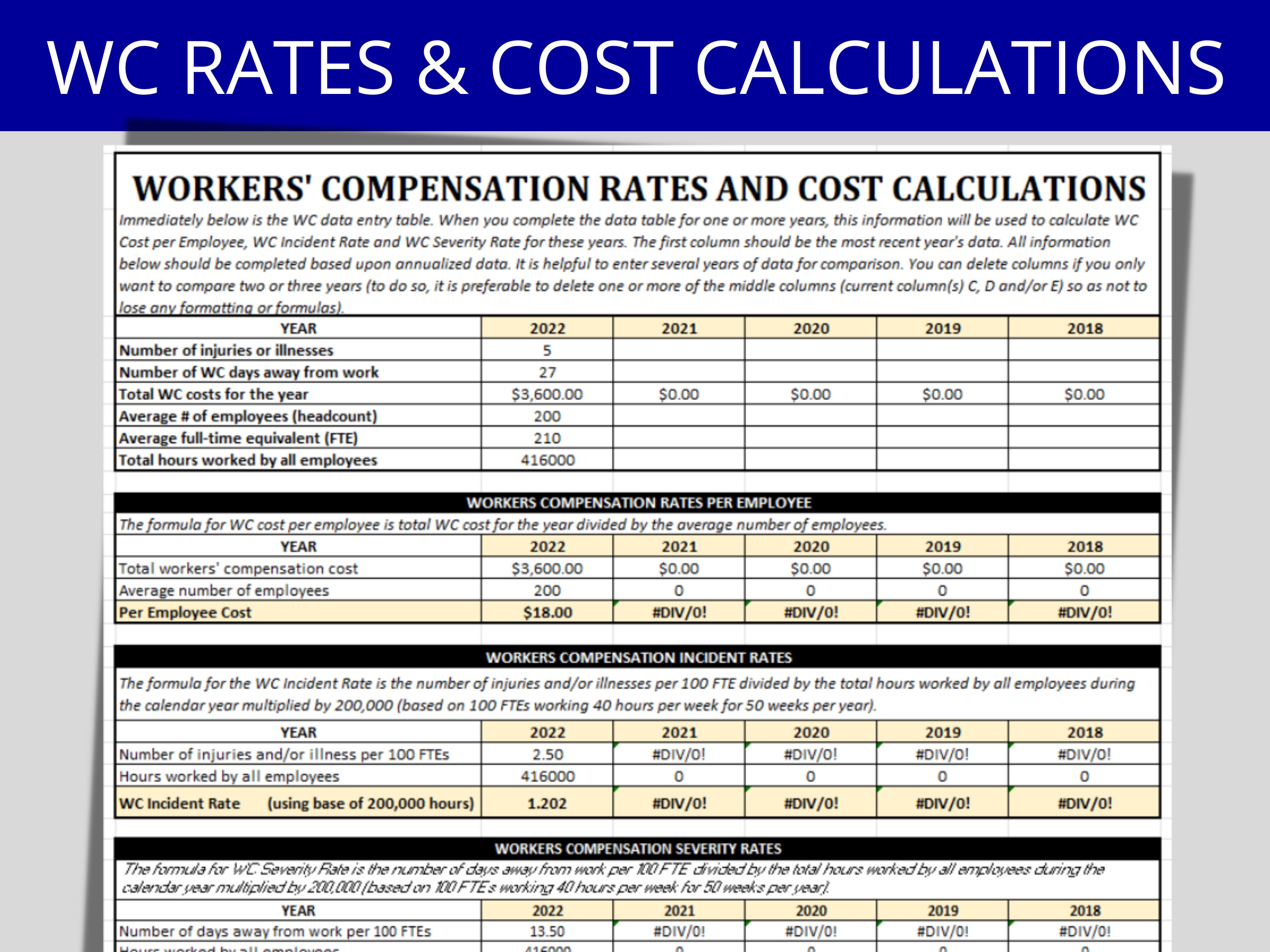
Standard workers’ compensation rates are calculated as a dollar amount per $100 of employee payroll. These rates are determined by a combination of a business’s industry classification (class codes), the state where the work is performed, and the company’s individual claims history, known as the Experience Rating Modifier (E-Mod).
Workers’ compensation insurance is a mandatory requirement for most employers across the United States. However, because each state manages its own workers’ compensation system, there is no single "national" rate. Instead, pricing is a complex intersection of actuarial data, legislative mandates, and industry-specific risk assessments. As we navigate the economic landscape of 2026, understanding these rates requires a deep dive into the mechanics of classification codes, state-level pricing variations, and the specific factors that can drive an individual business's premiums up or down.
The Fundamental Formula for Workers' Compensation Premiums
To understand "standard" rates, one must first understand how they are applied to a business’s bottom line. The insurance industry uses a standardized formula to determine the manual premium before any discounts or credits are applied.
The basic formula is: (Classification Rate × (Total Payroll / 100)) × Experience Modifier = Total Premium.
The "rate" part of this equation is the amount charged for every $100 of a specific type of labor. For example, if a clerical worker’s rate is $0.15, the employer pays fifteen cents for every hundred dollars that employee earns. If a roofer’s rate is $15.00, the employer pays fifteen dollars for every hundred dollars of payroll. This discrepancy highlights the core philosophy of workers' compensation: the riskier the job, the higher the rate.
The Role of NCCI and Independent Bureaus
The National Council on Compensation Insurance (NCCI) is the primary organization responsible for gathering data and recommending rates (known as "loss costs") in more than 35 states. NCCI analyzes billions of dollars in claims data to determine how much money is needed to cover the medical expenses and lost wages of injured workers in specific job categories.
In states that do not use NCCI—such as California, New York, and New Jersey—independent state bureaus perform similar functions. These bureaus set their own "pure premium" or "manual rates." In 2026, while the methodology remains consistent, the underlying data reflects the rising costs of specialized medical care and the shifting nature of the American workforce, particularly the prevalence of hybrid and remote work models.
Understanding Industry Classification Codes (Class Codes)
The most significant variable in determining a standard rate is the Class Code. There are over 700 distinct classification codes used to categorize different types of work. Each code is assigned a rate based on the historical frequency and severity of injuries associated with that specific task.
High-Risk vs. Low-Risk Classifications
Rates are inherently tied to the physical environment of the job.
- Clerical Office Employees (Code 8810): Historically the lowest-rated category. Because office environments are relatively safe, the rate in many states in 2026 remains below $0.20 per $100 of payroll.
- Construction and Roofing (Code 5551): Among the highest-rated categories. Due to the high probability of falls and severe injuries, roofing rates can exceed $20.00 per $100 of payroll in high-cost jurisdictions.
- Healthcare and Nursing (Code 8833): This category has seen steady rate increases over the last decade due to the rising frequency of musculoskeletal injuries related to patient handling and the long-term impacts of respiratory illnesses.
It is common for a single business to have multiple class codes. A construction firm will have one rate for its field laborers and a much lower rate for its administrative staff. Misclassifying employees is a frequent error that leads to significant "sticker shock" during annual premium audits.
The Impact of Geography: State-by-State Rate Variances
Geography is just as influential as industry type. Each state has unique laws governing benefit levels, medical fee schedules, and legal remedies, all of which dictate the "standard" rate.
Competitive vs. Monopolistic States
Most states operate in a competitive market, where private insurance companies compete for business. In these states, the state bureau sets a "loss cost," and insurance carriers add their own "multiplier" to cover administrative overhead and profit.
However, four states—North Dakota, Ohio, Washington, and Wyoming—are monopolistic. In these jurisdictions, employers must purchase insurance directly from a state-operated fund. These states do not use the NCCI system and have their own unique rating structures and classification systems.
2026 Rate Benchmarks by State (Estimates)
While specific rates change annually, the relative ranking of states by cost remains fairly consistent. High-benefit states with high costs of living generally have higher workers' compensation rates.
| State Type | Representative State | Average Rate per $100 (Blended) | Regulatory Environment |
|---|---|---|---|
| High Cost | New Jersey | $1.90 - $2.40 | Competitive Market / High Benefits |
| High Cost | New York | $1.75 - $2.25 | Heavily Regulated / High Medical Costs |
| Moderate | Illinois | $1.20 - $1.60 | Reforming Medical Fee Schedules |
| Moderate | Texas | $1.00 - $1.40 | Optional Coverage (Nonsubscription) |
| Low Cost | Utah | $0.60 - $0.90 | Low Litigation / Efficient Care |
| Low Cost | Indiana | $0.50 - $0.85 | Lowest National Averages |
Note: These figures are blended averages across all industries and are intended for comparative purposes only.
The Experience Rating Modifier (E-Mod): Your Personal Rate Factor
While "standard" rates are the starting point, the Experience Rating Modifier (E-Mod) is the factor that truly determines what a business pays. The E-Mod is a numerical representation of a company’s claims history compared to other companies in the same industry.
- The Benchmark (1.0): An E-Mod of 1.0 is considered the industry average. If your company has a 1.0, you pay exactly the standard rate.
- The Credit (Below 1.0): If a company has a superior safety record with fewer claims than average, they may receive an E-Mod of, for example, 0.85. This results in a 15% discount on the standard rate.
- The Debit (Above 1.0): If a company has a poor safety record, they may receive an E-Mod of 1.25. This acts as a 25% surcharge on the standard rate.
In 2026, the NCCI and state bureaus continue to emphasize "claim frequency" over "claim severity." This means that multiple small injuries are often more damaging to a company’s E-Mod than a single, large, accidental injury, as high frequency is viewed as a sign of poor safety management.
External Factors Influencing 2026 Rates
Beyond payroll and class codes, several macroeconomic factors influence the "standard" rates set by bureaus in 2026.
Medical Inflation and Advanced Technology
The cost of medical care is the largest component of workers' compensation claims. In 2026, the integration of advanced prosthetics, robotic-assisted surgeries, and personalized biological treatments has improved outcomes for injured workers but has also increased the baseline "loss cost" for insurers. Conversely, the widespread use of wearable safety technology in manufacturing and logistics has begun to put downward pressure on frequency rates, helping to stabilize premiums in those sectors.
Legislative Shifts
State legislatures frequently adjust "maximum weekly benefits." As wages have risen through 2025 and into 2026, states have increased the caps on what an injured worker can receive. These benefit increases are directly reflected in the standard rates charged to employers. Additionally, expanded coverage for mental health (PTSD) for first responders and, in some states, general employees, has introduced new variables into the actuarial models used to determine rates.
The Remote Work Discount
One of the most notable shifts in 2026 is the refined rating for remote workers. After years of data collection following the permanent shift toward hybrid work, many carriers now offer "telecommuter" classifications that carry significantly lower rates than traditional office codes, acknowledging the reduced risk of workplace accidents in a home office environment.
How to Verify Your Workers’ Compensation Rates
Businesses should not take their insurance quotes at face value. Because the system is prone to human error, verification is essential for cost control.
- Review the NCCI Scopes Manual: This manual provides the official definitions for every class code. Ensure your employees are not being "up-rated" into a riskier category than their actual job duties warrant.
- Verify the Experience Rating Worksheet: Obtain a copy of your E-Mod worksheet from the NCCI or your state bureau. Check for "closed" claims that are still being reported as "open" or incorrect payroll figures that might be inflating your modifier.
- Request a Loss Run Report: This report from your insurance carrier lists all claims and the "reserves" (money set aside) for those claims. Over-reserved claims can artificially inflate your rates.
- Perform an Internal Audit: Before the insurance company performs its annual audit, conduct your own. Ensure that overtime pay is properly excluded from the premium calculation (most states only tax the "straight time" portion of overtime) and that sub-contractor certificates of insurance are on file.
Common Mistakes That Inflate Rates
- Failure to Separate Payroll: If an employee performs two different jobs (e.g., driving a truck and working in a warehouse), many states allow you to split their payroll between two class codes—provided you keep meticulous records. Failure to do so usually results in the entire salary being billed at the higher-rated code.
- Neglecting Subcontractor Certificates: If you hire a subcontractor who does not have their own workers’ compensation insurance, your carrier will charge you the full premium for that subcontractor’s labor at your highest available rate.
- Ignoring Small Claims: In some instances, paying for a very minor "medical-only" claim out of pocket (where legal) can prevent that claim from hitting the E-Mod, though many states require all injuries to be reported regardless of payment source.
Summary of Average Rates by Occupational Group (2026)
| Occupational Group | Typical Class Codes | Estimated Rate Range (per $100) |
|---|---|---|
| Professional/Clerical | 8810, 8871, 8742 | $0.10 – $0.35 |
| Retail/Mercantile | 8017, 8018, 8044 | $0.80 – $2.10 |
| Manufacturing | 3066, 3632, 4410 | $2.00 – $5.50 |
| Transportation | 7219, 7380, 8350 | $5.00 – $11.00 |
| Construction/Trades | 5183, 5403, 5551 | $6.00 – $25.00+ |
Frequently Asked Questions
Why do workers' compensation rates change every year?
Rates change annually because they are based on the previous few years of "loss experience." If an industry sees an increase in the number or cost of injuries, the NCCI or state bureau will increase the recommended rate to ensure there is enough money in the system to pay future claims. Economic factors like inflation and changes in state laws also play a significant role.
Can I negotiate my workers' compensation rate?
In competitive states, you can negotiate the "carrier multiplier" or "schedule rating." While the base loss cost (set by the state) is fixed, insurance companies can apply credits (discounts) or debits (surcharges) of up to 25% based on their subjective assessment of your safety programs, management quality, and premises condition.
Does every employee have the same rate?
No. Rates are assigned based on the specific work performed. A sales representative who travels (Code 8742) will have a different rate than a warehouse worker (Code 8292). The only exception is the "Standard Exception" rule, which applies to clerical and outside sales roles that are almost always rated separately from the main business operation.
What happens if I misclassify an employee?
If an insurance auditor discovers that an employee was classified under a code with a lower rate than their actual duties require, they will retroactively charge you the difference. This often results in a "large audit premium" bill at the end of the policy year. Conversely, if you overpay due to misclassification, you may be entitled to a refund, though these are harder to secure after the audit is finalized.
Is workers' compensation mandatory for remote employees?
Yes. In 2026, workers' compensation laws generally cover any injury that arises "out of and in the course of employment," regardless of whether it happens in a corporate office or a home office. Employers must report the payroll for remote workers to their insurance carrier, usually under the 8871 (Telecommuter) or 8810 (Clerical) class codes.
Practical Recommendation for Employers
To manage workers’ compensation costs effectively in 2026, employers should move beyond viewing insurance as a fixed cost. Implement a formal "Return-to-Work" program that brings injured employees back to the office in a light-duty capacity as soon as medically possible. This significantly reduces the "indemnity" (lost wage) portion of a claim, which is a primary driver of E-Mod increases. Furthermore, conducting quarterly reviews of your loss run reports with your broker can help identify trending safety issues before they manifest as permanent rate hikes.
Professional Disclaimer: The information provided in this article is for educational purposes only and does not constitute legal, financial, or insurance advice. Workers' compensation laws vary significantly by jurisdiction and are subject to change. Consult with a licensed insurance professional or legal counsel in your specific state to determine your exact requirements and rates.
Image Gallery
Select an image to open it in a new tab.
Mateo Castillo
Decentralized Finance and E-Payments Strategist
