Understanding Liabilities in Economics: A Comprehensive Guide for 2026

In economics and finance, a liability represents a present obligation of an entity to transfer an economic resource as a result of past events. These obligations signify a claim by creditors against the entity's assets, effectively representing how a portion of those assets is financed through debt rather than equity or direct ownership.
Liabilities are the structural counterpart to assets. While assets represent what a person, company, or government owns or is owed, liabilities represent what they owe to others. In the broader economic context, liabilities are essential for the functioning of modern credit markets, allowing for the temporal shifting of consumption and investment. Understanding liabilities requires looking beyond simple debt; it involves analyzing the timing of outflows, the cost of servicing those obligations, and the legal or constructive nature of the promise to pay.
The Core Nature of Economic Liabilities
To understand a liability, one must first recognize its role within the fundamental accounting equation: Assets = Liabilities + Equity. This equation dictates that everything an entity owns is funded either by borrowing (liabilities) or by the owners' investment and retained earnings (equity).
In economics, a liability is not merely a "bill" to be paid. It is a contractual or constructive tie that binds future production to past consumption. When a firm takes on a liability, it is essentially pulling future purchasing power into the present to fund operations, expansion, or research. This mechanism is the engine of capitalist growth, but it also introduces systemic risks, such as insolvency and liquidity crises, if the expected future returns do not manifest.
Characteristics of a Liability
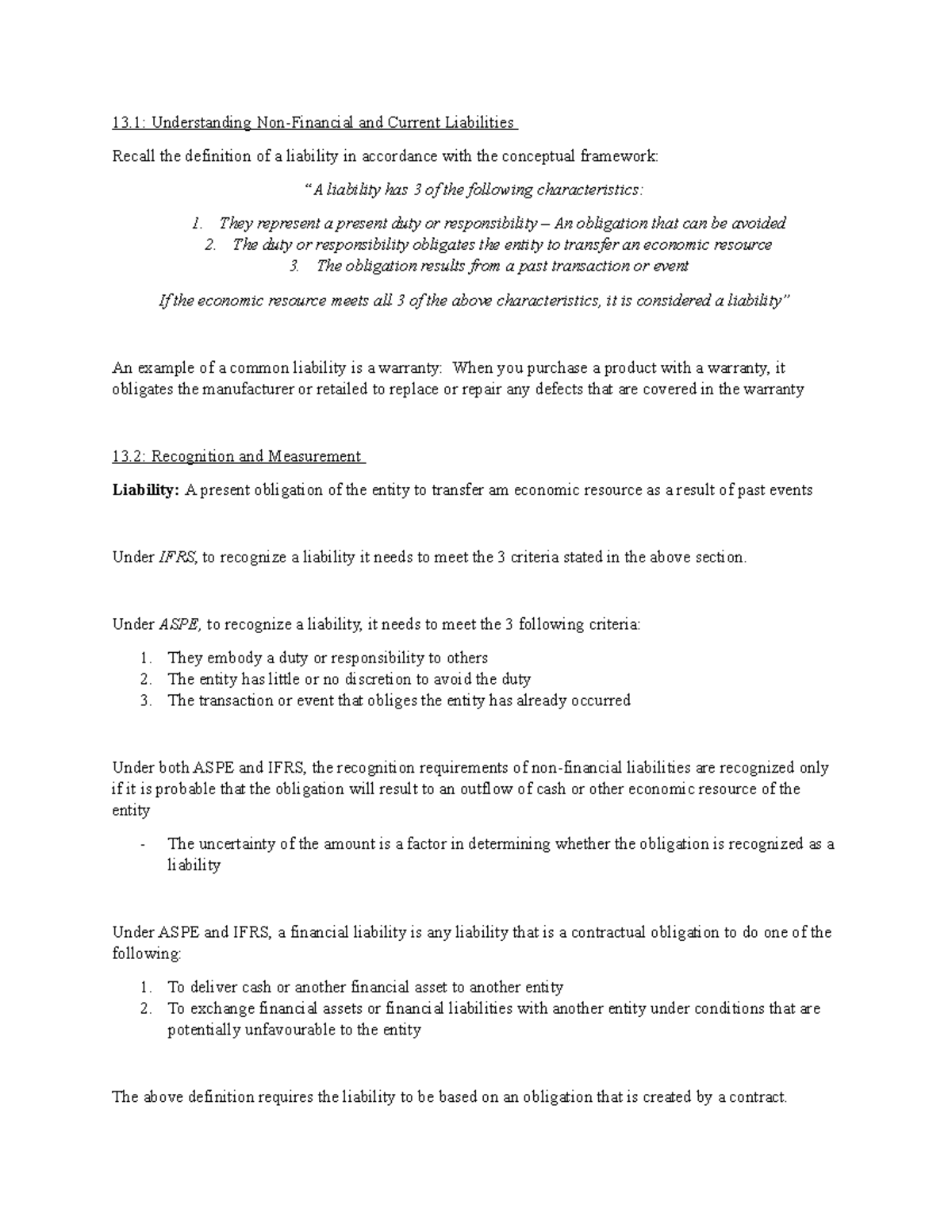
For an obligation to be classified as a liability in 2026, it generally must satisfy three specific criteria:
- A Present Obligation: The entity has a duty or responsibility to act or perform in a certain way. This is not a future intent but a current requirement.
- Arising from Past Events: The obligation must result from a transaction or event that has already occurred, such as the delivery of goods, a signed loan agreement, or damage caused that requires compensation.
- Resulting in an Outflow of Resources: Settling the obligation will require the transfer of cash, the provision of services, or the sacrifice of another asset.
Classification of Liabilities: Current vs. Non-Current
The distinction between different types of liabilities is primarily based on the timeline of settlement. In economic analysis, the "term structure" of debt determines an entity’s vulnerability to short-term shocks.
Current Liabilities
Current liabilities are obligations expected to be settled within one year or within a single operating cycle. These are critical for assessing an entity's liquidity. If an organization has high current liabilities but low liquid assets (like cash or accounts receivable), it faces a high risk of default, even if its long-term prospects are healthy.
Common examples include:
- Accounts Payable: Money owed to suppliers for goods or services purchased on credit.
- Short-term Loans: Lines of credit or commercial paper that must be repaid quickly.
- Accrued Expenses: Obligations for which no invoice has been received yet, such as wages earned by employees but not yet paid.
- Deferred Revenue: An obligation to provide a service in the future for which payment has already been received.
Non-Current (Long-Term) Liabilities
Non-current liabilities are obligations that will be settled beyond the one-year mark. These are used to fund long-term capital investments, such as building a factory or purchasing a fleet of vehicles. From a macroeconomic perspective, long-term liabilities are less sensitive to immediate market volatility but are heavily influenced by long-term interest rate trends.
Common examples include:
- Bonds Payable: Formal certificates of debt issued to investors.
- Long-term Lease Obligations: Commitments to pay for the use of property or equipment over several years.
- Pension Liabilities: The estimated future cost of providing retirement benefits to employees.
- Deferred Tax Liabilities: Taxes that are owed but will not be paid until a future period due to differences between accounting and tax laws.
The Role of Liabilities in Corporate Finance and Leverage
In the corporate sector, liabilities are a tool for financial leverage. Leverage refers to the use of borrowed money to increase the potential return on investment. If a company can borrow money at a 5% interest rate and invest it in a project that yields 10%, the "spread" increases the wealth of the shareholders.
However, leverage is a double-edged sword. In a recessionary environment, fixed liabilities must still be serviced regardless of the company's revenue. If the yield on investments drops below the cost of debt, the liabilities begin to erode equity rapidly. This is why economists closely monitor the debt-to-equity ratio. A high ratio suggests that a company is aggressively financing its growth with debt, which may lead to volatile earnings and a higher risk of bankruptcy.
Contingent Liabilities: The Hidden Risks
A contingent liability is a potential obligation that may occur depending on the outcome of an uncertain future event. For example, a pending lawsuit or a product warranty represents a contingent liability. While they do not appear as a standard line item on the balance sheet unless the loss is "probable and estimable," economists must factor them into the valuation of an entity. In 2026, stricter transparency regulations often require detailed disclosures of these "off-balance-sheet" risks to prevent the systemic surprises seen in previous financial crises.
Macroeconomic Liabilities: National Debt and Central Banks
When we move from microeconomics (individuals and firms) to macroeconomics, liabilities take on a different character. The most prominent macroeconomic liability is Sovereign Debt.
National Debt
Governments issue liabilities in the form of Treasury bonds, notes, and bills. These liabilities allow governments to fund infrastructure, social programs, and defense without immediate taxation. While a private entity must eventually "pay off" its debt to survive, a sovereign state with its own currency often "rolls over" its liabilities—issuing new debt to pay off old debt. The primary concern for economists is not the total amount of the liability, but the Debt-to-GDP ratio and the interest-to-revenue ratio, which determine sustainability.
Central Bank Liabilities
Interestingly, the money in your wallet or the digital balance in your bank account is a liability of the central bank (e.g., the Federal Reserve). When a central bank prints currency, it records that currency as a liability on its balance sheet, backed by assets such as gold, foreign currency reserves, or government bonds. In 2026, the rise of Central Bank Digital Currencies (CBDCs) has further refined how we view these liabilities, as they represent a direct, digital claim by the public on the central bank's resources.
Measurement and Valuation of Liabilities
Valuing a liability is not always straightforward. While a bank loan has a clear "face value," other liabilities require complex estimation.
- Historical Cost: Recording the liability at the original amount incurred.
- Amortized Cost: Adjusting the value of the liability over time as interest is paid and the principal is reduced.
- Fair Value: Assessing what it would cost to "transfer" the liability to another party in the current market. This is common for derivative liabilities and complex financial instruments.
- Present Value: For long-term obligations like pensions, economists use a discount rate to determine what a future payment is worth in today’s dollars. If interest rates rise, the present value of future liabilities typically falls, which can significantly alter the perceived health of an organization.
Comparison: Assets, Liabilities, and Equity
The following table illustrates the relationship and differences between these three core components of economic standing.
| Feature | Assets | Liabilities | Equity (Net Worth) |
|---|---|---|---|
| Basic Definition | Resources owned or controlled. | Obligations owed to others. | The residual interest in assets. |
| Economic Role | Generates future income/value. | Funds current or past activity. | Represents owner's stake. |
| Cash Flow Impact | Potential inflow of cash. | Future outflow of cash. | Benefit of remaining value. |
| Examples | Cash, Inventory, Patents, Land. | Loans, Payables, Bonds, Taxes. | Common Stock, Retained Earnings. |
| Risk Factor | Depreciation, Obsolescence. | Default risk, Interest rate risk. | Value depletion, Market risk. |
| 2026 Valuation | Market value or Fair value. | Present value of future outflows. | Market capitalization (for firms). |
Common Misconceptions in Understanding Liabilities
One of the most frequent errors in economic thinking is viewing all liabilities as "bad." In reality, the strategic use of liabilities is essential for wealth creation.
- Productive vs. Unproductive Debt: A liability used to purchase a depreciating consumer good (like a car for personal use) is often unproductive. However, a liability used to purchase an education or a piece of machinery that increases productivity is an investment.
- The "Debt-Free" Fallacy: Many believe a company or government should aim to be debt-free. Economically, this is often inefficient. If the cost of debt is lower than the return on assets, a zero-liability position represents a "lost opportunity" for growth.
- Inflation’s Impact: Inflation often benefits the holder of the liability. If a person owes $100,000 and inflation devalues the currency, the "real" value of that liability decreases because they are paying back the debt with "cheaper" dollars.
Risks Associated with High Liability Loads
While liabilities are tools for growth, they introduce several layers of risk that must be managed:
1. Interest Rate Risk
If a liability has a variable interest rate, an increase in market rates can suddenly increase the cost of servicing that debt. This can lead to a "squeeze" where all available cash flow is diverted to interest payments, leaving nothing for operations.
2. Refinancing (Rollover) Risk
This occurs when an entity has a large liability coming due and must issue new debt to pay it off. If the credit markets "freeze" or the entity's credit rating drops, they may be unable to find new lenders, leading to an immediate liquidity crisis.
3. Solvency Risk
Solvency risk is the danger that an entity's total liabilities will exceed its total assets. Even if the entity can make its payments today (liquidity), it is technically "underwater" if its total obligations outweigh its total value.
Next Steps for Economic Analysis
To effectively manage or analyze liabilities, one should move toward a holistic view of the balance sheet. For individuals, this means calculating your debt-to-income ratio to ensure personal liabilities do not outpace earning potential. For investors, it involves looking at the interest coverage ratio—a measure of how many times a company can pay its interest expenses with its current operating income.
In the 2026 economic landscape, data-driven tools and real-time accounting have made it easier to track these metrics. However, the fundamental principle remains: a liability is a promise of future value. The health of any economic actor depends on their ability to fulfill that promise without compromising their future growth.
Frequently Asked Questions
Is an expense the same as a liability? No. An expense is the cost of operations that occurs within a specific period (like electricity used this month), whereas a liability is an obligation to pay someone in the future. If you pay for the electricity immediately, it is an expense but never becomes a liability. If you receive the bill and wait to pay it, it is both an expense and a liability (Accounts Payable) until the cash is transferred.
Can a liability ever be considered an asset? From the perspective of the borrower, no. However, every liability is an asset for someone else. Your bank loan is a liability for you, but it is a primary asset for the bank because it represents a right to receive future cash flows.
How do digital currencies affect liabilities in 2026? Digital currencies and smart contracts have automated the settlement of liabilities. "Programmable debt" can now automatically trigger payments when certain conditions are met, reducing the risk of administrative default but increasing the need for precise cash flow management.
What is the "Debt Overhang" effect? Debt overhang occurs when an entity’s existing debt is so great that it cannot easily borrow more money, even for highly profitable projects. The burden of existing liabilities acts as a "tax" on new investment, often leading to prolonged periods of economic stagnation.
How does the 2026 interest rate environment impact long-term liabilities? The 2026 environment emphasizes "real rates" (interest rates adjusted for inflation). Entities with long-term fixed-rate liabilities have benefited from price stability, while those reliant on short-term floating-rate debt have had to adopt more aggressive hedging strategies to manage volatility.
Practical Recommendation: When assessing the financial health of any entity—be it a household or a corporation—always compare the maturity profile of liabilities against the liquidity profile of assets. A mismatch, where long-term assets are funded by short-term liabilities, is the most common precursor to financial distress.
Disclaimer: This information is for educational and informational purposes only and does not constitute financial, legal, or investment advice. Consult with a qualified professional regarding your specific financial situation.
Image Gallery
Select an image to open it in a new tab.


Ingrid Bjornson
Global Cyber Policy and Regulation Analyst
