Understanding the Irish Catholic and Protestant Divide: A Historical and Sociopolitical Framework

The Irish Catholic and Protestant divide refers to a complex, multi-century conflict rooted in religious, political, and national identities. While often framed through the lens of theology, the divide is primarily a struggle over national sovereignty, land ownership, and historical governance, centered largely on the status of Northern Ireland and its relationship with the Republic of Ireland and the United Kingdom.
The Historical Genesis of the Divide
The origins of the sectarian divide in Ireland are found in the 16th and 17th centuries, particularly through the Tudor conquest and the subsequent Plantation of Ulster. Under British rule, land was systematically confiscated from native Irish Catholic landowners and granted to Scottish and English Protestant settlers. This was not merely a relocation of people; it was an attempt to stabilize British control by creating a loyalist power base in the northern province of Ulster.
By the 17th century, the cultural and religious demographics of Northern Ireland had been fundamentally altered. The Protestant settlers, largely Presbyterian and Anglican, held the land and occupied positions of administrative power, while the indigenous Catholic population was pushed toward social and economic marginalization. This power imbalance established a lasting dynamic: Catholics became associated with Irish nationalism and the desire for independence, while Protestants were largely associated with Unionism—the desire to remain part of the United Kingdom.
The Act of Union and the Rise of Home Rule
The 1801 Act of Union, which abolished the Irish Parliament and made Ireland a formal part of the United Kingdom, solidified the divide. Throughout the 19th century, the "Irish Question" dominated British politics. As the campaign for "Home Rule" (the right for Ireland to have its own parliament) gained momentum, the divide hardened.
Protestants in Ulster feared that an independent Ireland would be dominated by Catholic interests, leading to the phrase "Home Rule is Rome Rule." This resulted in the formation of the Ulster Volunteer Force in 1912, a paramilitary organization dedicated to preventing Irish independence. Conversely, Catholics and nationalists viewed the British presence as an illegal occupation, fueling a sense of suppressed national identity that demanded self-determination.
The Partition of 1921
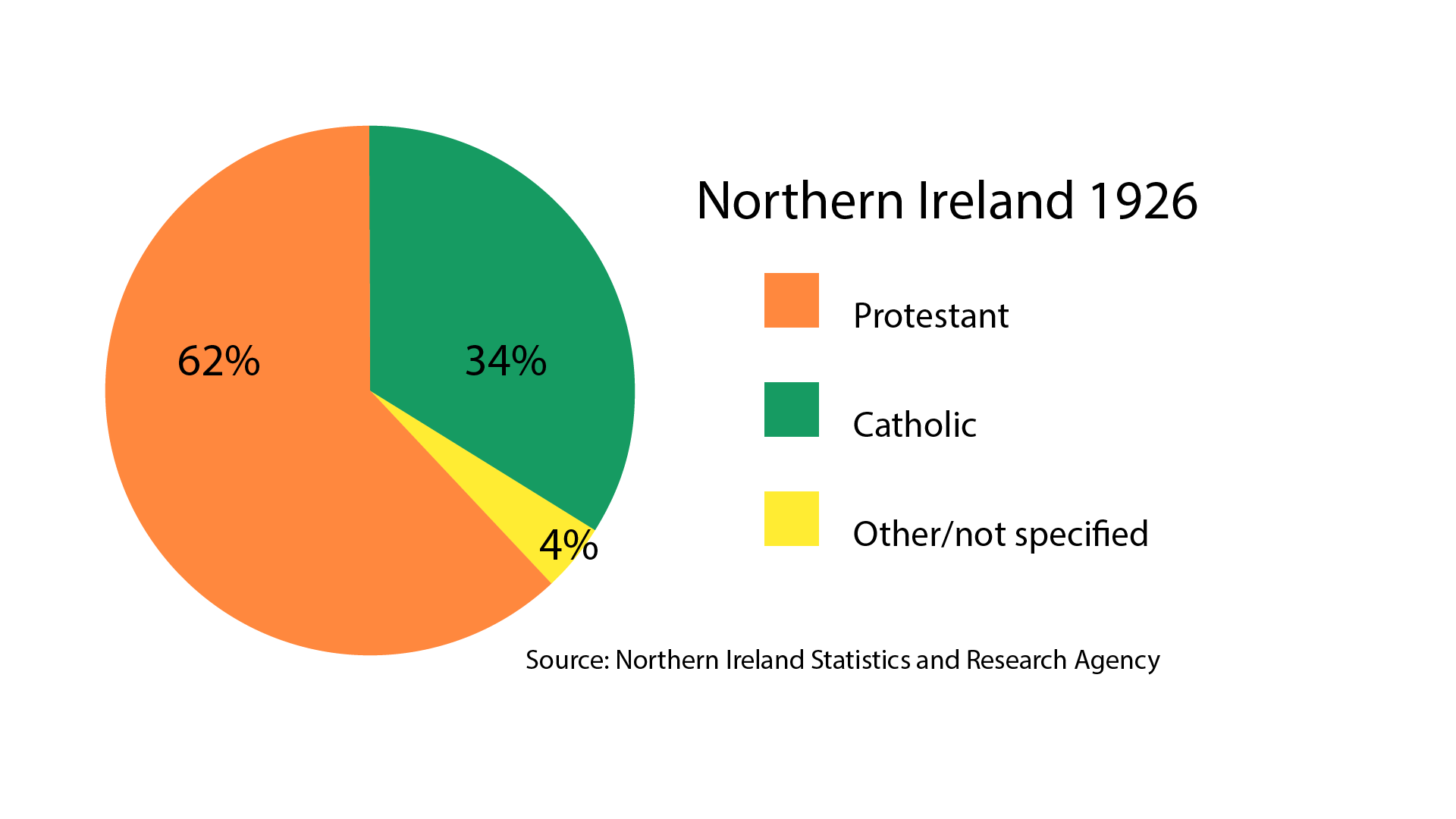
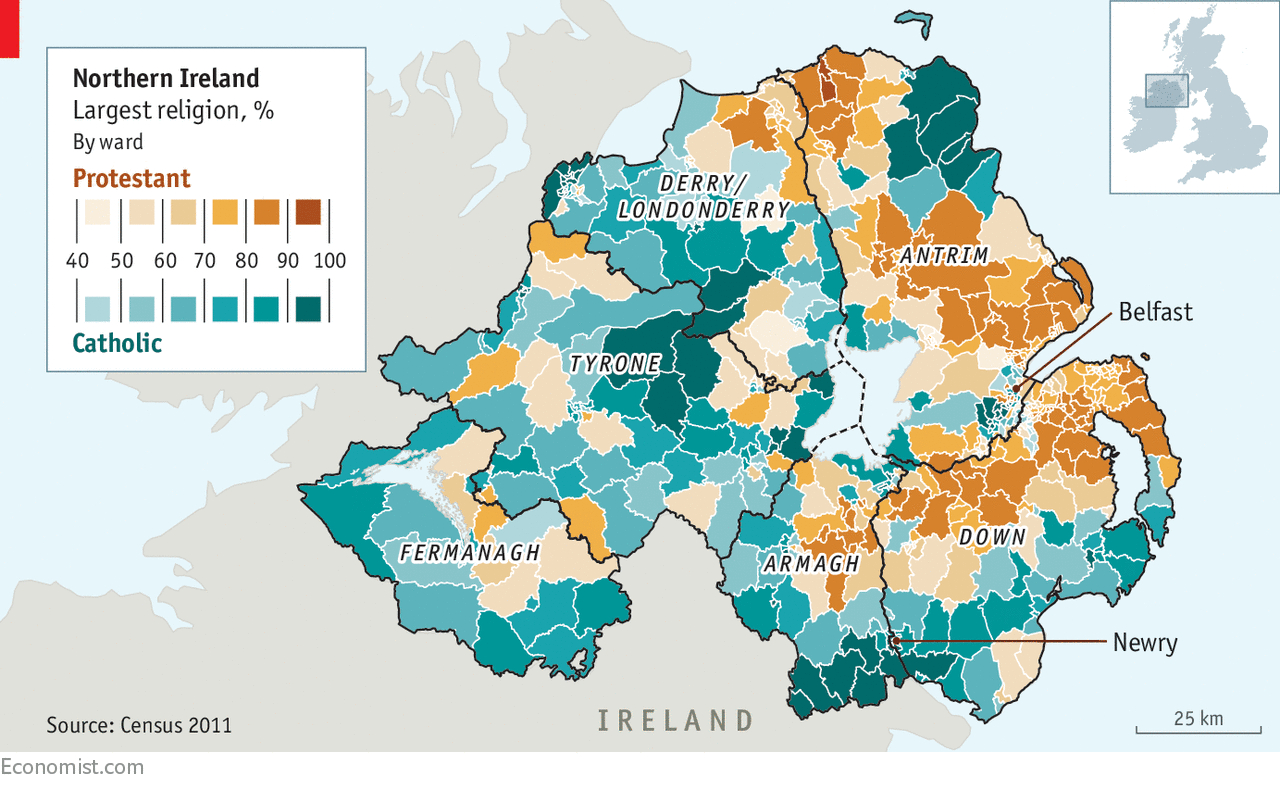
The partition of Ireland in 1921, formalized by the Government of Ireland Act 1920 and the subsequent Anglo-Irish Treaty of 1921, attempted to solve this conflict by creating two separate entities. The Irish Free State (later the Republic of Ireland) was established as an independent nation, while Northern Ireland—comprising six counties in Ulster with a Protestant majority—remained part of the United Kingdom.
Partition did not resolve the divide; it merely contained it within smaller borders. Northern Ireland was established with a built-in Protestant majority, leading to decades of governance that frequently marginalized the Catholic minority. This imbalance in housing, employment, and electoral representation provided the fuel for the later instability that would define the late 20th century.
The Troubles: 1968–1998
The period known as "The Troubles" was an escalation of this historical friction. Beginning in the late 1960s, the Civil Rights Movement in Northern Ireland sought an end to discriminatory practices. The state’s response, often seen as heavy-handed and biased toward the Unionist population, triggered an cycle of violence that lasted for 30 years.
During this period, identity became highly polarized. The conflict involved the British Army, the Royal Ulster Constabulary (the police force, largely Protestant), and paramilitary groups from both sides, such as the Irish Republican Army (IRA) on the nationalist side and the Ulster Volunteer Force (UVF) on the unionist side. By the time the Good Friday Agreement was signed in 1998, over 3,500 people had lost their lives.
The Good Friday Agreement and Modern Status
The 1998 Good Friday Agreement remains the foundational political document for modern Northern Ireland. It established a power-sharing government, requiring representatives from both the nationalist (Catholic) and unionist (Protestant) communities to work together in the Northern Ireland Assembly.
As of 2026, the region operates under the principle of consent: Northern Ireland remains part of the United Kingdom until a majority of its people decide otherwise through a border poll. The divide, while no longer characterized by daily paramilitary conflict, remains evident in the cultural landscape, the segregated nature of schools, and the lingering political tensions surrounding the Windsor Framework and post-Brexit trade relations.
Comparing Core Perspectives
Understanding the current divide requires acknowledging that both communities often operate from different, sometimes conflicting, historical narratives.
| Aspect | Nationalist (Largely Catholic) | Unionist (Largely Protestant) |
|---|---|---|
| National Identity | Irish | British |
| Constitutional Goal | A united, independent Ireland | Maintenance of the United Kingdom |
| Cultural Focus | Irish language, Gaelic sports, Catholicism | British monarchy, Orange Order, Protestantism |
| View of 1921 Partition | An artificial, illegitimate division | A necessary protection of rights |
| Political Focus | Integration with the European Union | Sovereignty within the UK framework |
The Role of Social and Cultural Institutions
The division is perpetuated by institutional structures, most notably in education. A significant percentage of children in Northern Ireland attend "segregated" schools—either state-run schools (historically Protestant) or maintained schools (historically Catholic). While "integrated" education is growing, the legacy of schooling along sectarian lines continues to shape social circles and worldviews from a young age.
Furthermore, cultural symbols play a significant role. The "marching season," where the Orange Order—a Protestant fraternity—holds parades, is a flashpoint for tension. These marches are often seen by Protestants as a celebration of heritage and history, while they are frequently viewed by Catholics as acts of territorial provocation.
Frequently Asked Questions
1. Is the divide in Ireland primarily a theological conflict? No. While the labels "Catholic" and "Protestant" are used to denote the two sides, the conflict is not about religious doctrine or liturgy. The terms act as shorthand for two distinct ethnic and political identities—nationalism and unionism—which have evolved over centuries of land disputes and power struggles.
2. How did Brexit impact the Catholic-Protestant divide? Brexit significantly complicated the status of Northern Ireland. Because the Republic of Ireland remained in the EU, the creation of a "hard border" between the North and South was avoided through the Windsor Framework. However, this has created new friction, as many Unionists feel that Northern Ireland is being treated differently from the rest of the UK, while Nationalists see the current trade arrangements as a necessary stabilization of the peace process.
3. What is the likelihood of a United Ireland? Under the Good Friday Agreement, a border poll can be called if it appears likely that a majority of the electorate would support a change in status. While political support for Irish unity has fluctuated, there is no official consensus or immediate timeline for such a vote as of 2026. The decision rests entirely with the people of Northern Ireland.
4. What are the main obstacles to full reconciliation? Obstacles include the legacy of the Troubles, the persistence of segregated housing and education, and the influence of "sectarian blocks" in local politics. Achieving reconciliation is often hampered by the fear that one side will lose their cultural identity if they concede too much to the other.
5. How does the government ensure fair treatment for both sides? The power-sharing arrangements require cross-community support for major decisions. This ensures that no single group can govern without the cooperation of the other, effectively forcing a collaborative approach to lawmaking and administration, even when tensions are high.
Moving Toward the Future
The path forward in Northern Ireland involves moving beyond the binary "Catholic/Protestant" categorization. Many in the younger generation now identify as "neither" or simply "Northern Irish," a movement that signals a shift toward a post-sectarian identity.
The primary recommendation for those looking to understand the divide is to recognize that it is a living history. While the violence of the 20th century has largely ceased, the political and social questions regarding identity and governance remain at the heart of the Northern Irish experience. Engaging with the region requires a commitment to listening to the distinct, and often irreconcilable, narratives held by both communities.

Image Gallery
Select an image to open it in a new tab.




Declan O'Connor
Higher Education and Campus Culture Reporter
