Understanding the New Jersey Workers' Compensation State Fund and Assigned Risk Pool

In New Jersey, there is no state-owned insurance company that competes with the private market. Instead, the "state fund" refers to the New Jersey Workers’ Compensation Insurance Plan, an assigned risk pool for employers unable to find coverage elsewhere, and specialized funds like the Second Injury Fund and the Uninsured Employers’ Fund.
New Jersey operates under a "private market" system for workers' compensation. By law, every employer in the state must provide coverage for their employees, either through a private insurance carrier or through a state-approved self-insurance program. However, because the law mandates coverage, the state must ensure that even "high-risk" businesses can obtain a policy. This is where the concept of a state-managed "fund" or plan becomes critical for business operations in 2026.
Does New Jersey Have a Traditional State Insurance Fund?
To understand the New Jersey landscape, one must distinguish between the three types of workers' compensation systems used in the United States. Some states, like Ohio or Washington, have "monopolistic" state funds where the government is the sole provider. Others, like New York or California, have "competitive" state funds that act as state-owned insurance companies competing with private firms.
New Jersey follows a third path. It is a strictly private market state. There is no state-operated insurance company (like NYSIF in New York) that writes policies for the general public. When people search for the "New Jersey Workers' Compensation State Fund," they are usually looking for one of three entities:
- The New Jersey Workers’ Compensation Insurance Plan (The Assigned Risk Pool): This is the safety net for employers who have been rejected by at least two private insurance carriers.
- The Second Injury Fund (SIF): A state-administered fund that encourages the hiring of workers with pre-existing disabilities by limiting the employer's liability if a subsequent work injury occurs.
- The Uninsured Employers’ Fund (UEF): A fund designed to pay benefits to injured workers whose employers failed to purchase the required insurance.
In 2026, the New Jersey Compensation Rating and Inspection Bureau (CRIB) remains the central authority responsible for overseeing these mechanisms and setting the manual rates that all insurers must follow.
The New Jersey Workers’ Compensation Insurance Plan (Assigned Risk)
For many small businesses or high-risk industries—such as roofing, trucking, or new ventures with no safety record—obtaining insurance on the "voluntary market" can be difficult. Private insurers may decline coverage if they deem the risk too high.
The New Jersey Workers’ Compensation Insurance Plan is the state’s solution to this problem. It ensures that no employer is left without a way to comply with the law. This plan is often referred to informally as the "state fund" because it is mandated by the state and overseen by CRIB.
How the Assigned Risk Pool Functions
When an employer is placed in the assigned risk pool, CRIB assigns them to a private insurance company (the "servicing carrier"). This carrier issues the policy, collects the premium, and manages claims just like a standard policy. However, the financial risk is shared among all insurance companies writing workers' compensation in New Jersey.
Eligibility and Application in 2026
To qualify for the assigned risk plan in 2026, an employer must demonstrate that they have made a good-faith effort to secure coverage in the voluntary market and have been denied. Specifically, you must provide proof of at least two recent rejections from non-affiliated insurance companies.
The application process is typically handled through a licensed insurance broker. The broker submits the application to CRIB, which then determines the premium based on the state’s established manual rates plus a mandatory surcharge known as the "Assigned Risk Pricing Differential."
Mandatory Insurance Requirements and Compliance
As of 2026, New Jersey law continues to mandate that all corporations, partnerships, LLCs, and sole proprietorships with at least one employee (who is not the owner) must carry workers' compensation insurance. This requirement applies regardless of whether the employees are full-time, part-time, or seasonal.
Who Must Be Covered?
- Regular Employees: Anyone performing services for an employer for financial consideration is generally considered an employee.
- Corporate Officers: In New Jersey, corporate officers are considered employees and must be covered, though they may elect to exclude themselves from coverage under specific, strictly defined legal circumstances.
- Domestic Workers: Homeowners who employ domestic help (nannies, housekeepers) for a certain number of hours per week are often required to have coverage, which is frequently bundled into homeowners' insurance policies.
Penalties for Non-Compliance
The New Jersey Department of Labor and Workforce Development (NJDOL) is aggressive in its enforcement of insurance mandates. Failing to carry insurance is a disorderly persons offense and can lead to:
- Fines of up to $5,000 for the first 10 days of non-compliance.
- Additional fines of up to $5,000 for each subsequent 10-day period.
- In cases of willful non-compliance, criminal charges and potential jail time.
- Personal liability for any workplace injuries that occur while the business is uninsured.
Specialized State Funds: SIF and UEF
While the "State Fund" for purchasing insurance is actually an assigned risk pool, New Jersey does operate two physical funds through the Division of Workers' Compensation that serve specific legal purposes.
The Second Injury Fund (SIF)
The Second Injury Fund is designed to promote the employment of people with disabilities. If a worker with a pre-existing permanent disability (from a prior injury or a congenital condition) suffers a new workplace injury that renders them totally and permanently disabled, the employer is only responsible for the portion of the disability caused by the second injury. The SIF pays the remainder of the total permanent disability benefits.
This fund is financed through annual assessments on all insurance carriers and self-insured employers in the state. In 2026, the SIF remains a vital component of the New Jersey social safety net, ensuring that employers are not penalized for hiring workers with diverse physical histories.
The Uninsured Employers’ Fund (UEF)
The Uninsured Employers’ Fund provides for the payment of medical expenses and temporary disability benefits to injured workers when their employer is illegally uninsured and fails to pay benefits. While the UEF pays the worker, it also pursues the employer for reimbursement of every dollar spent, plus significant penalties and interest.
Premium Costs and Rate Calculations in 2026
Workers' compensation premiums in New Jersey are not arbitrary. They are calculated using a formula that considers the nature of the work, the company's payroll, and its safety record.
The Basic Formula
Premium = (Payroll / 100) × Class Code Rate × Experience Modification Factor
- Class Codes: Every type of job is assigned a four-digit classification code by CRIB. A secretary (Class 8810) has a much lower rate than a structural steel worker (Class 5040) because the risk of injury is significantly lower.
- Payroll: Premiums are based on every $100 of gross payroll. In 2026, certain caps may apply to executive officer payroll for premium calculation purposes.
- Experience Modification Factor (MOD): This is a multiplier based on the employer's claims history compared to other businesses in the same industry. A MOD of 1.0 is average. A MOD of 0.8 means the employer has a good safety record and receives a 20% discount. A MOD of 1.2 means a poor safety record and a 20% surcharge.
Comparison of Coverage Options
| Feature | Voluntary Private Market | Assigned Risk Pool (Plan) | Self-Insurance |
|---|---|---|---|
| Availability | Subject to insurer underwriting | Guaranteed for eligible firms | Only for large, stable firms |
| Cost | Market-competitive rates | Manual rate + Surcharge | Direct cost of claims + Admin |
| Flexibility | High (Bundling, Dividends) | Low (Standardized) | High (Total control) |
| Best For | Most established businesses | High-risk or new businesses | Large corporations / Public entities |
| Provider | Private carriers (e.g., Travelers, Liberty Mutual) | Servicing carriers via CRIB | The employer (via a TPA) |
The Claims Process and Employee Rights
If an employee is injured on the job in New Jersey in 2026, they are entitled to specific benefits regardless of who was at fault for the accident. This "no-fault" system is the core of the workers' compensation "grand bargain": employees give up the right to sue their employer in civil court in exchange for guaranteed medical and wage benefits.
Types of Benefits
- Medical Benefits: All "necessary and reasonable" medical treatment, prescriptions, and hospital stays related to the work injury must be paid for by the insurer. In New Jersey, the employer or their insurer has the right to select the treating physician.
- Temporary Disability Benefits: If a worker is unable to work for more than seven days, they are entitled to 70% of their average weekly wage, subject to state-mandated maximum and minimum limits.
- Permanent Partial Disability: If the injury results in a permanent loss of function (e.g., loss of a finger or a permanent back injury), the worker receives a monetary award based on a schedule of disabilities.
- Permanent Total Disability: If a worker can no longer perform any gainful employment, they may receive benefits for life.
Filing a Claim
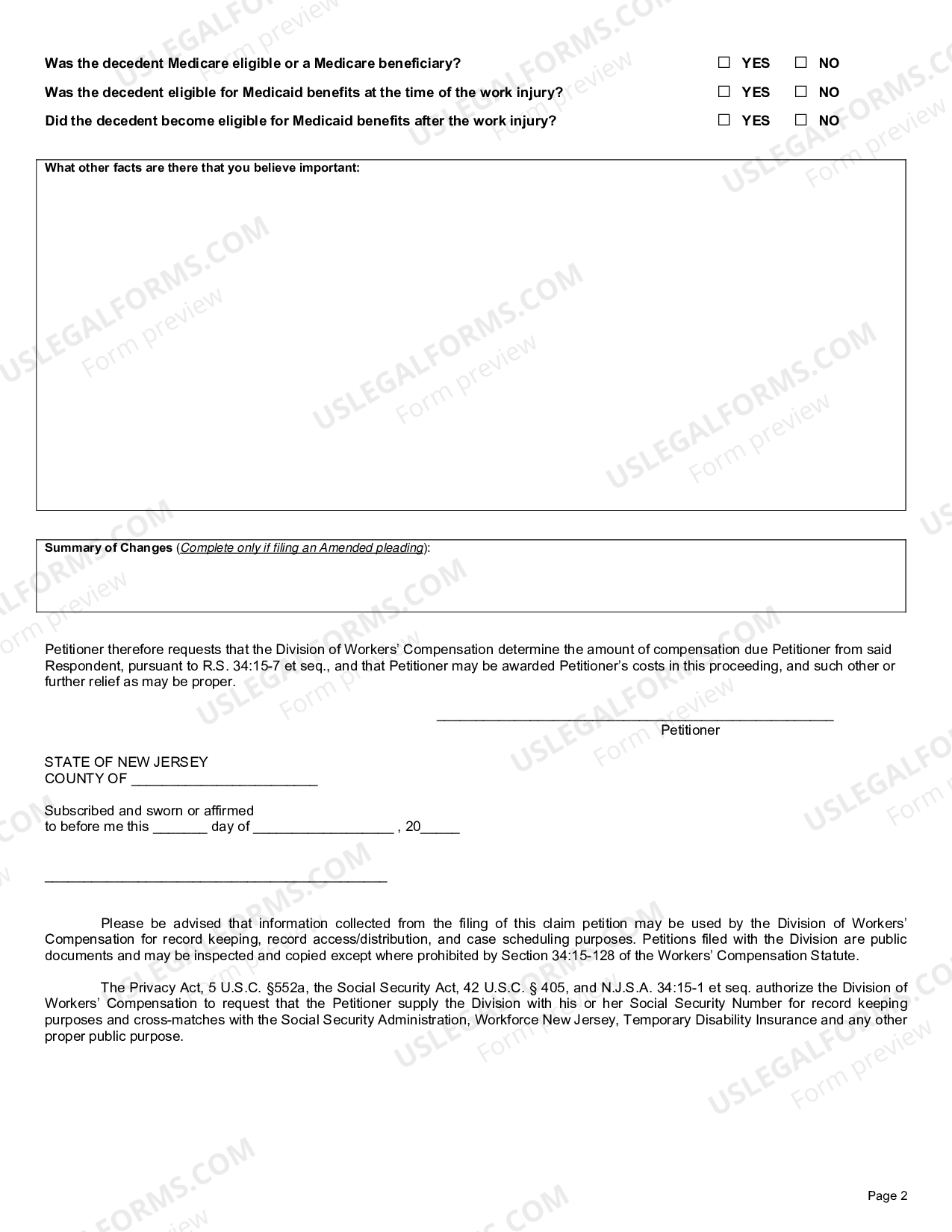
The process begins with the employee notifying the employer of the injury as soon as possible. The employer must then file a First Report of Injury with their insurance carrier and the Division of Workers' Compensation. If a dispute arises regarding the nature of the injury or the extent of disability, either party can file a formal Claim Petition with the Division, which will then be heard by a Judge of Compensation.
Common Mistakes Employers Make with the "State Fund"
Navigating the New Jersey system can be complex, and errors often lead to financial penalties or gaps in coverage.
- Assuming the "State Fund" is Cheap: Many employers assume that because the Assigned Risk Plan is state-overseen, it is the most affordable option. In reality, it is almost always more expensive than the voluntary market due to mandatory surcharges.
- Misclassifying Employees as Independent Contractors: Simply labeling a worker a "1099 contractor" does not exempt an employer from providing workers' compensation. The NJDOL uses a strict "ABC Test" to determine employment status. If the state determines these workers are employees, the employer faces massive back-premiums and penalties.
- Lapses in Coverage: New Jersey does not have a "grace period" for workers' compensation. If a policy expires on Monday and an injury occurs on Tuesday, the employer is personally liable.
- Failure to Report Changes in Payroll: Premiums are estimated at the start of the year. An annual audit is conducted at the end of the policy term. If payroll was significantly higher than estimated, the business may face a large, unexpected "audit premium" bill.
Frequently Asked Questions
Can I buy workers' comp directly from the state of New Jersey?
No. You cannot buy a policy directly from a government agency. You must buy it from a private insurance company or apply through a broker to the New Jersey Workers’ Compensation Insurance Plan (Assigned Risk Pool), which then assigns your policy to a private servicing carrier.
How do I find out who my employer's insurance carrier is?
You can verify an employer's workers' compensation insurance coverage through the CRIB Policy Verification tool. This tool allows employees and medical providers to search by employer name and address to identify the carrier and policy number.
What is the 2026 maximum weekly benefit for disability?
The maximum and minimum weekly benefit rates for workers' compensation are adjusted annually based on the New Jersey Statewide Average Weekly Wage. For 2026, these rates are determined by the Commissioner of Labor and are typically published in the late months of the preceding year. You should check the NJDOL website for the specific 2026 figures.
Is workers' compensation insurance tax-deductible for NJ businesses?
Generally, yes. Premiums paid for workers' compensation insurance are considered a necessary business expense and are typically deductible for federal and state income tax purposes. However, you should consult with a tax professional regarding your specific business structure.
Does the Second Injury Fund help me if I have a pre-existing condition?
The Second Injury Fund does not provide immediate benefits for a new injury. It is a mechanism that pays benefits only when a new work injury combined with a previous permanent disability results in total and permanent disability. It is designed to protect the employer's financial interests while ensuring the worker is fully compensated.
Final Recommendations for New Jersey Employers
In 2026, maintaining workers' compensation coverage is not just a legal requirement; it is a critical risk management strategy. To ensure your business is protected:
- Consult a Broker Early: If you are a new business or in a high-risk industry, start the application process at least 30 days before you hire your first employee.
- Audit Your Class Codes: Ensure your employees are classified correctly. Misclassification can lead to overpaying or failing a state audit.
- Prioritize Workplace Safety: Because your premium is directly tied to your "MOD" factor, investing in safety training and equipment is the single most effective way to lower your long-term insurance costs.
- Shop the Voluntary Market First: Even if you have had claims in the past, always attempt to find coverage in the voluntary market before settling for the Assigned Risk Pool to avoid the mandatory surcharges.
Image Gallery
Select an image to open it in a new tab.


Celine Dubois
Contemporary Living and Global Arts Columnist
