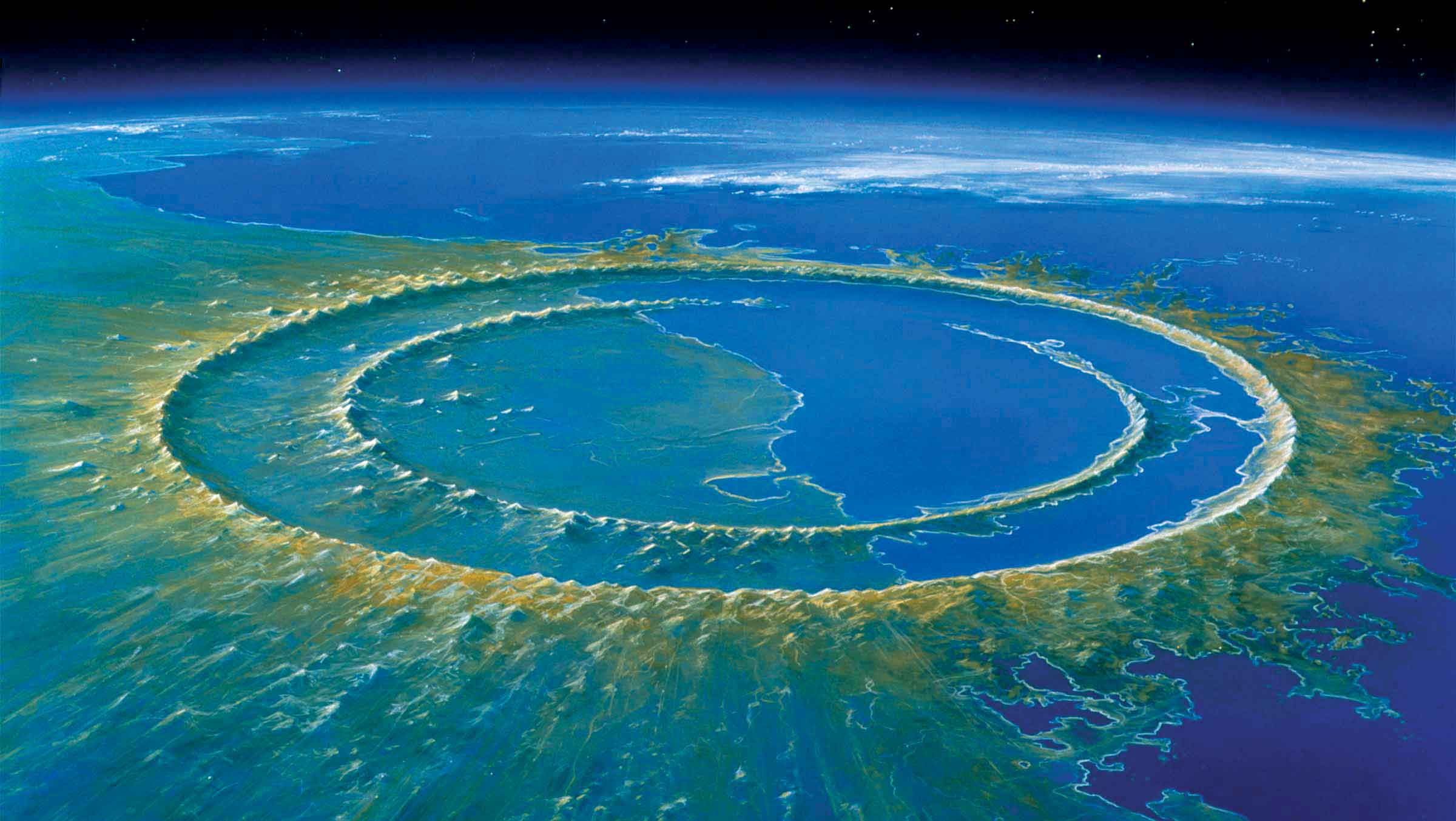
The Chicxulub crater in Mexico is a prehistoric impact structure buried beneath the Yucatán Peninsula. Measuring roughly 180 kilometers (110 miles) in diameter, it was formed 66 million years ago by a massive asteroid. This event triggered a global mass extinction, effectively ending the reign of the dinosaurs and paving the way for mammalian dominance.
Understanding the Chicxulub crater requires looking past the surface. Unlike the well-preserved Meteor Crater in Arizona, Chicxulub is invisible to the naked eye, hidden under hundreds of meters of Cenozoic sedimentary rock and the waters of the Gulf of Mexico. Yet, its legacy is etched into the very chemistry of our planet’s strata and the unique hydrology of the Yucatán. As of 2026, scientific drilling and geophysical mapping have revealed it to be one of the most significant geological sites on Earth.
The Event That Changed the World: The K-Pg Impact
The formation of the Chicxulub crater marks the Cretaceous-Paleogene (K-Pg) boundary. Approximately 66 million years ago, an asteroid estimated at 10 to 15 kilometers (6 to 9 miles) in diameter struck the Earth at a velocity of nearly 20 kilometers per second. The energy released was equivalent to billions of atomic bombs, creating a transient cavity nearly 30 kilometers deep before the Earth’s crust recoiled to form the crater we study today.
The Immediate Aftermath
The impact did not just create a hole; it vaporized the target rock, which was rich in carbonates and sulfates. This released massive quantities of carbon dioxide, sulfur aerosols, and water vapor into the atmosphere. The immediate results were catastrophic:
- Thermal Pulse: A wall of fire and intense heat radiated from the impact site, igniting global wildfires.
- Mega-Tsunamis: The displacement of water in the Gulf of Mexico sent waves hundreds of meters high crashing into the coasts of North and South America.
- The Ejecta Curtain: Millions of tons of vaporized rock were launched into orbit, falling back as "spherules" that heated the atmosphere to the temperature of a pizza oven.
Global Nuclear Winter
The long-term effects were even more lethal. The sulfur aerosols and soot from wildfires blocked sunlight for several years. This "nuclear winter" halted photosynthesis, causing the collapse of food chains both on land and in the oceans. Scientists estimate that roughly 75% of all species, including non-avian dinosaurs, pterosaurs, and large marine reptiles, went extinct during this period.
The Story of Discovery: From Oil to Science
The discovery of the Chicxulub crater is a masterclass in scientific persistence and interdisciplinary collaboration. For decades, the cause of the dinosaur extinction was a subject of heated debate, with theories ranging from volcanic activity to gradual climate change.
The Iridium Anomaly
In 1980, physicist Luis Alvarez and his son, geologist Walter Alvarez, discovered a thin layer of clay at the K-Pg boundary in Italy and Denmark. This layer contained unusually high concentrations of iridium, an element rare on Earth's surface but abundant in asteroids. They proposed that a giant impact had occurred, but they lacked the "smoking gun"—the crater itself.
The PEMEX Breakthrough
Unbeknownst to the academic community, geophysicists Antonio Camargo and Glen Penfield had already spotted "anomalies" while working for PEMEX (Petróleos Mexicanos), the Mexican state oil company, in the late 1970s. While conducting airborne magnetic and gravity surveys to find oil deposits, they noticed a massive, semi-circular underwater structure off the coast of the Yucatán. Because the data was proprietary, it wasn't until the early 1990s that the connection between the PEMEX data and the Alvarez hypothesis was officially confirmed, identifying Chicxulub as the K-Pg impact site.
Geological Features and the "Ring of Cenotes"
Because the crater is buried, its most famous surface manifestation is the Ring of Cenotes. The Yucatán Peninsula is a limestone platform riddled with underground rivers and sinkholes known as cenotes.
How the Crater Formed the Cenotes
The weight and impact of the asteroid fractured the underlying limestone. Over millions of years, groundwater flowed along these circular faults and fractures at the crater’s rim. This accelerated the dissolution of the limestone, creating a distinct semi-circular alignment of cenotes that corresponds exactly to the crater’s edge. For modern visitors, these cenotes are the only tangible surface evidence of the cataclysm.
Peak Rings and Melt Rocks
Deep-sea drilling projects, such as the IODP-ICDP Expedition 364, have explored the "peak ring" of the crater. Chicxulub is a "multi-ring" crater, similar to those found on the Moon or Venus. The peak ring is a circle of mountains within the main crater rim, formed when the Earth’s crust behaved like a liquid upon impact. The rocks found here are shocked granites and "impactites"—rocks that were melted and reformed in seconds.
| Feature | Description | Measurement/Value |
|---|---|---|
| Total Diameter | The outer rim of the impact structure. | ~180 - 200 km |
| Impact Velocity | Speed of the asteroid upon entry. | ~20 km/second |
| Energy Release | Estimated kinetic energy. | ~100 million megatons of TNT |
| Target Rock | Composition of the Yucatán at the time. | Carbonate and Evaporite |
| Burial Depth | Amount of sediment covering the crater. | 600 to 1,000 meters |
| UNESCO Status | Protected status for scientific value. | Part of the Ring of Cenotes |
Visiting Chicxulub: What to See in 2026
If you travel to Mexico expecting a gaping hole in the ground like the Grand Canyon, you will be disappointed. However, for those interested in science and natural history, the region offers several key sites that interpret the impact.
Chicxulub Puerto
The small coastal town of Chicxulub Puerto is the "ground zero" of the impact. While it looks like a typical quiet fishing village, a small monument in the town square commemorates its status as the center of the crater. It is a symbolic visit rather than a geological one, but it remains a pilgrimage site for science enthusiasts.
Science and Technology Park of Yucatán (PCTY)
Located near Mérida, the Museo de Ciencias del Cráter de Chicxulub (Chicxulub Crater Science Museum) is the premier destination for learning about the event. In 2026, the museum features:
- Core Samples: Displays of actual rock cores drilled from the crater’s peak ring.
- Virtual Reality: Immersive experiences that simulate the impact and the subsequent "nuclear winter."
- Biological Exhibits: Extensive displays on the species that survived the extinction and how life rebounded.
Exploring the Cenotes
To see the crater’s footprint, visitors should travel the "Ruta de los Cenotes." Diving or swimming in cenotes like Cuzamá or Homún allows you to experience the hydrological legacy of the impact. These sites are located along the fracture zones of the crater’s edge, where the water is exceptionally clear and the cave formations are world-class.
Scientific Research and Future Outlook
Even in 2026, the Chicxulub crater remains a primary site for active research. Scientists are no longer just asking "what happened," but "how did life recover?"
The Recovery of Life
Recent findings from drilling expeditions have shown that life returned to the crater much faster than previously thought. Within years of the impact, microscopic organisms were already thriving in the crater’s hydrothermal systems. This research helps astrobiologists understand how life might exist on other planets where impact craters are the primary geological features.
Climate Change Lessons
The Chicxulub impact is the ultimate case study in rapid climate change. By studying the amount of CO2 and sulfur injected into the atmosphere 66 million years ago, climate scientists can better model the resilience of the modern atmosphere and the potential long-term effects of greenhouse gas emissions.
Practical Information for Travelers
Visiting the crater area is best done with Mérida as your home base. The capital of Yucatán offers excellent infrastructure, from luxury hotels to budget hostels, and is within an hour's drive of the key sites.
- Transport: Renting a car is the most efficient way to see the Ring of Cenotes, as public transport to the more remote sinkholes is limited.
- Timing: Visit during the dry season (November to April) to avoid the intense humidity and mosquitoes of the Yucatán summer.
- Guides: Hire a certified geological guide if you want to understand the specific rock formations and the history of the PEMEX discovery in detail.
Frequently Asked Questions
Can you see the Chicxulub crater from space?
No, the crater is not visible from space with the naked eye because it is buried under hundreds of meters of limestone and sediment. However, satellite imagery using gravity mapping and radar topography clearly shows the circular "gravity anomaly" and the alignment of cenotes that mark its presence.
Is the Chicxulub crater the biggest in the world?
It is the third-largest confirmed impact structure on Earth. The Vredefort crater in South Africa (approx. 300 km) and the Sudbury Basin in Canada (approx. 130 km but originally larger) are older and larger, but Chicxulub is the best-preserved large impact crater and the only one with a recognized "peak ring."
Where is the exact center of the crater?
The center of the crater is located offshore, near the town of Chicxulub Puerto on the northern coast of the Yucatán Peninsula. The coordinates are approximately 21.4°N, 89.5°W.
Why didn't the impact kill all life on Earth?
While the impact was devastating, certain groups were able to survive. Small mammals living in burrows, birds (which are avian dinosaurs), and organisms in deep-sea or freshwater environments that didn't rely solely on a sunlight-based food chain had a higher survival rate. These survivors eventually diversified to fill the ecological niches left empty by the dinosaurs.
Can I find pieces of the asteroid at the site?
It is highly unlikely for a casual visitor to find asteroid fragments. The immense heat of the impact vaporized most of the asteroid. What remains are "spherules" (tiny droplets of glass) and "shocked quartz," which are generally microscopic or buried deep underground, accessible only through scientific drilling.
Final Recommendation
For anyone fascinated by the history of life on Earth, the Chicxulub crater is more than just a geological site; it is the turning point of our planet's biological narrative. To get the most out of a visit, start at the Science Museum in Mérida to understand the "why" and "how," then spend several days exploring the Ring of Cenotes to experience the physical scale of the event. By acknowledging the sheer power of this 66-million-year-old catastrophe, we gain a deeper appreciation for the fragility and resilience of life in 2026.
Image Gallery
Select an image to open it in a new tab.
Celine Dubois
Contemporary Living and Global Arts Columnist
