
Disney’s 2017 live-action adaptation of Beauty and the Beast brought the 1991 animated classic into a new dimension, blending photorealistic CGI with high-profile human performances. Directed by Bill Condon, the film serves as a faithful reimagining of the original fairy tale, featuring an ensemble cast that balances veteran theatrical experience with contemporary stars to bring the enchanted inhabitants of the Beast’s castle to life.
Understanding the Casting Philosophy
The casting process for the 2017 live-action Beauty and the Beast required a unique blend of vocal performance and physical acting. Because many of the central characters—the castle’s servants—appear for the majority of the film as CGI-rendered household objects, the production needed actors capable of delivering profound emotional resonance through their voices alone. Conversely, the human roles demanded actors who could handle the intense musical requirements of Alan Menken’s iconic score while maintaining the heightened, fairytale-esque tone established by the original animated film.
The result was an eclectic mix of British and American talent. The strategy focused on "name" actors for the primary roles, ensuring that even when a character was fully digital, the audience could recognize the subtle nuances and vocal signatures of performers they already knew. This approach ensured that the "enchanted objects" remained grounded in human personality, preventing them from feeling like mere visual effects.
The Human Leads: Belle and the Prince
At the center of the narrative are Belle and the Beast, whose relationship forms the emotional anchor of the film.
Emma Watson as Belle
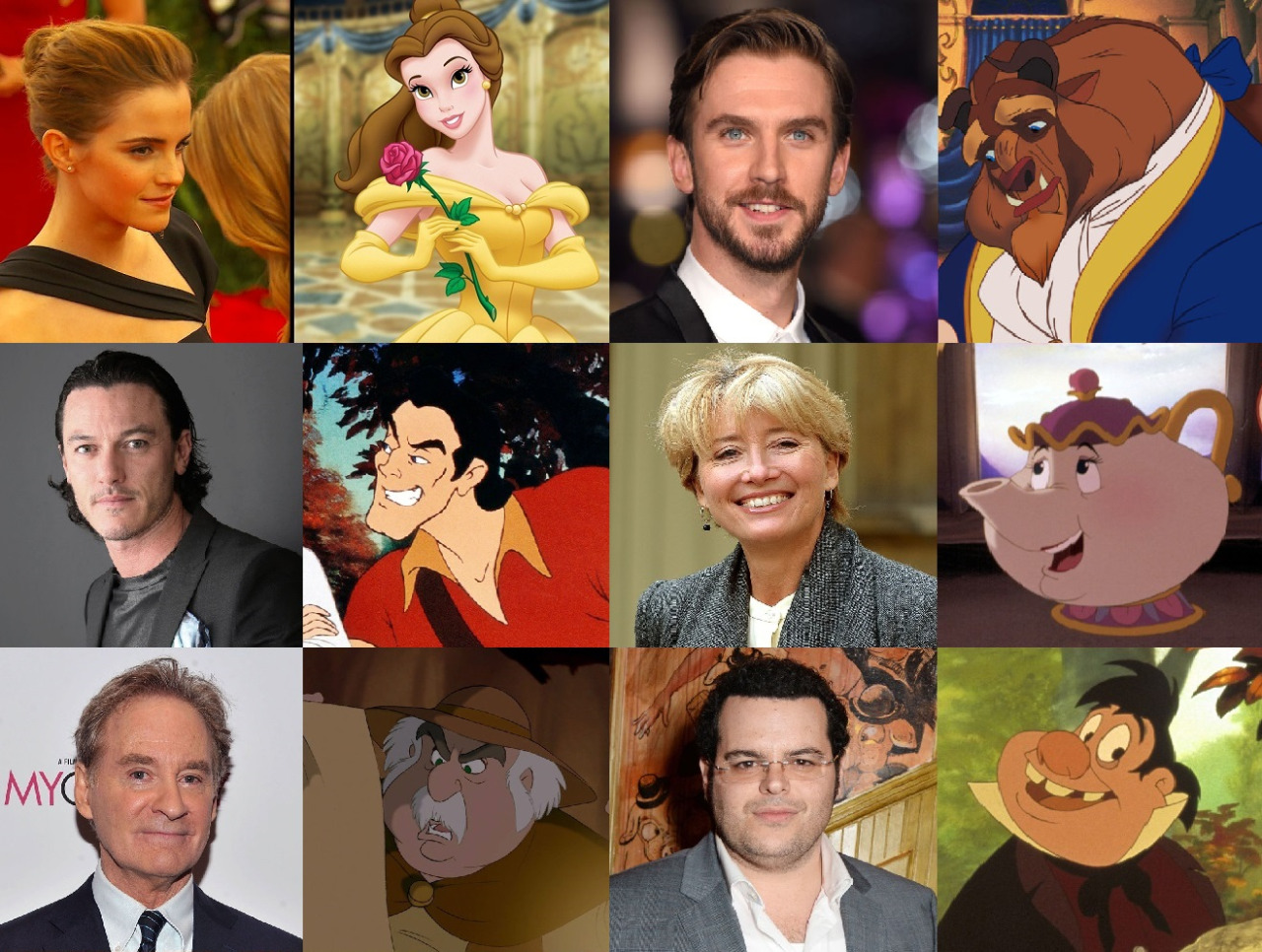
Emma Watson was cast as Belle, the provincial French girl who dreams of adventure. Her performance is characterized by an intellectual and independent spirit, aligning with the updated characterization of Belle as an inventor rather than just a reader. Watson’s background, while not traditionally associated with musical theater, was supplemented by rigorous vocal training to prepare for the film's complex songbook, including "Belle (Reprise)" and "Something There."
Dan Stevens as The Beast
The Beast presents a complex technical challenge. Dan Stevens provided both the physical motion-capture performance and the voice for the Beast. Throughout the majority of the film, Stevens was filmed in a motion-capture suit, allowing the animators to translate his facial expressions and body language into the digital beast. His portrayal is noted for its gradual transition from ferocity to vulnerability, a feat achieved by blending human-like sensitivity with the creature's imposing, supernatural design.

The Supporting Human Cast
The villagers and the castle staff-members who appear in human form provide the structural conflict and comedic relief of the film.
- Luke Evans as Gaston: Evans brings a swaggering, narcissistic energy to the role of the primary antagonist. As a veteran of West End and Broadway theater, his performance is notable for its vocal power, particularly during the tavern song "Gaston."
- Josh Gad as LeFou: Gad, known for his work in musical theater and voice acting, provides the comedic foil to Gaston. His portrayal of LeFou offers a more nuanced look at the character’s blind loyalty, serving as the connective tissue between the villagers and the castle’s mystery.
- Kevin Kline as Maurice: As Belle’s father, Kline plays a more proactive role in the 2017 version, emphasizing his role as an artist and craftsman. His performance serves to ground Belle’s character arc, highlighting her protective nature.
The Enchanted Objects: Vocal Performances
The castle staff—cursed by the enchantress to become household items—required vocal performances that could carry the film's charm. The production utilized high-caliber talent to ensure these characters retained their classic appeal.
Ewan McGregor as Lumière
Ewan McGregor voiced the charismatic candelabra, Lumière. Bringing a theatrical flair to the role, McGregor’s performance is defined by his playful French accent and exuberant delivery during the show-stopping musical number, "Be Our Guest."
Ian McKellen as Cogsworth
The fussy, anxiety-ridden mantel clock, Cogsworth, was voiced by Sir Ian McKellen. His performance relies on precise timing and dry wit. McKellen’s presence provides a comedic counterpoint to Lumière, representing the voice of cautious logic within the chaotic magical castle.
Emma Thompson as Mrs. Potts
Taking on the iconic role of the teapot, Mrs. Potts, Emma Thompson was tasked with delivering the film’s title song. Her performance is marked by a warm, maternal gravity that serves as the heart of the servants' efforts to bring Belle and the Beast together.
Cast Comparison: Human vs. Digital
The following table outlines the key members of the cast, the roles they performed, and the nature of their appearance in the live-action film.
| Character | Actor | Role Type | Performance Method |
|---|---|---|---|
| Belle | Emma Watson | Human | Physical Performance |
| Beast | Dan Stevens | Human/Creature | Motion-Capture & Voice |
| Gaston | Luke Evans | Human | Physical Performance |
| LeFou | Josh Gad | Human | Physical Performance |
| Maurice | Kevin Kline | Human | Physical Performance |
| Lumière | Ewan McGregor | Enchanted Object | Voice & CGI |
| Cogsworth | Ian McKellen | Enchanted Object | Voice & CGI |
| Mrs. Potts | Emma Thompson | Enchanted Object | Voice & CGI |
| Plumette | Gugu Mbatha-Raw | Enchanted Object | Voice & CGI |
Technical Challenges of the Live-Action Adaptation
The "live-action" nature of the film is technically a misnomer; while the human actors were on set, the vast majority of the environment and the supporting cast were rendered through digital artistry. This created a unique set of challenges for the actors. Because many of their scene partners were digital entities that did not exist during the actual filming, actors had to rely on imaginative performance or temporary "stand-ins" (often just markers or animatronic props) to interact with their characters.
Furthermore, the post-production process required a meticulous alignment between the vocal takes and the digital facial animation. This explains why the filmmakers sought out actors with significant stage experience; stage actors are accustomed to "projecting" emotion that can withstand being translated through various mediums—whether it be the distance of a theater balcony or, in this case, the layers of a CGI model.
Frequently Asked Questions
1. Did the actors provide their own singing voices?
Yes, all the primary actors, including Emma Watson, Dan Stevens, and Luke Evans, provided their own singing voices. The production prioritized casting performers who were capable of navigating the musical requirements, and extensive vocal coaching was provided to ensure the quality met the standards of the original Alan Menken score.
2. How was the Beast created if Dan Stevens was on set?
Dan Stevens wore a motion-capture suit with a specialized facial rig. While he performed all the movements and facial expressions on set, these were later translated into the final digital Beast model by a team of visual effects artists. This allowed the character to remain expressive and retain Stevens's recognizable human-like eyes and movements.
3. Was the 2017 film a frame-by-frame remake?
While it is often cited as a faithful adaptation, the 2017 film includes new musical numbers and provides expanded backstories for characters like Belle and Maurice. The cast was tasked with honoring the spirit of the 1991 characters while introducing new depth that reflected the live-action medium.
4. Who plays the Enchantress in the film?
The Enchantress, who sets the film's events in motion by cursing the Prince, is played by Hattie Morahan. Although her role is brief, it serves as the crucial framing device that establishes the film's fairy-tale logic.
5. Why were the enchanted objects designed to look so realistic?
The design team opted for a photorealistic aesthetic to match the live-action background of the film. This necessitated that the characters (like the clock, teapot, and candelabra) looked like physical, aged objects. This choice was intended to contrast the "magical" nature of their existence with the "realism" of their metal and porcelain textures.
Final Recommendation
For viewers looking to fully appreciate the performances in Beauty and the Beast, it is recommended to watch the film with an eye toward the vocal nuances provided by the voice-only cast, particularly in the musical sequences. Observing how performers like Ewan McGregor and Emma Thompson imbue inanimate household objects with distinct personalities reveals the depth of the casting choices. For those interested in the technical aspects, exploring the "behind-the-scenes" featurettes included in the home media releases provides excellent insight into the intersection of motion-capture technology and live-action performance.
Image Gallery
Select an image to open it in a new tab.



Ingrid Bjornson
Global Cyber Policy and Regulation Analyst
