
A total solar eclipse occurs when the Moon passes directly between the Sun and Earth, completely obscuring the Sun’s face and casting a deep shadow on our planet. During this celestial alignment, observers within the narrow "path of totality" experience a brief period of midday darkness, revealing the Sun’s elusive outer atmosphere, known as the corona.
A total solar eclipse is often described as one of nature’s most awe-inspiring sights. While partial and annular eclipses are noteworthy, a total eclipse is a unique event where the celestial geometry allows the Moon to perfectly mask the Sun's disk. This phenomenon is not merely a visual display; it is a complex interaction of orbital mechanics, atmospheric changes, and historical scientific significance. In 2026, as we witness major solar events across the globe, understanding the underlying physics and safety requirements is essential for any observer.
The Celestial Mechanics of Totality
The occurrence of a total solar eclipse relies on a specific alignment known as syzygy. This refers to the straight-line configuration of three celestial bodies—in this case, the Sun, Moon, and Earth. However, the Moon orbits the Earth approximately once every 27.3 days, yet we do not see a solar eclipse every month.
The reason for this rarity lies in the tilt of the Moon’s orbit. The lunar path is inclined at an angle of about five degrees relative to the Earth’s orbit around the Sun (the ecliptic). Most of the time, the Moon passes slightly above or below the Sun from our perspective. An eclipse can only occur during an "eclipse season," a period of about 34 days when the Moon crosses the ecliptic plane at points called nodes. When a new moon coincides with a nodal crossing, the shadow of the Moon can fall upon the Earth’s surface.
The Role of Apparent Size
A remarkable coincidence of nature makes total solar eclipses possible on Earth. The Sun is approximately 400 times larger in diameter than the Moon. Coincidentally, the Sun is also about 400 times farther away from Earth than the Moon is. This ratio results in both bodies appearing to be nearly the same size in the sky, an angular diameter of about 0.5 degrees.
Because the Moon’s orbit is elliptical, its distance from Earth varies. When the Moon is at its closest point (perigee), it appears large enough to cover the Sun entirely. If an eclipse occurs when the Moon is at its farthest point (apogee), it appears smaller and cannot cover the Sun completely, resulting in an annular or "ring of fire" eclipse.
The Anatomy of a Shadow: Umbra and Penumbra
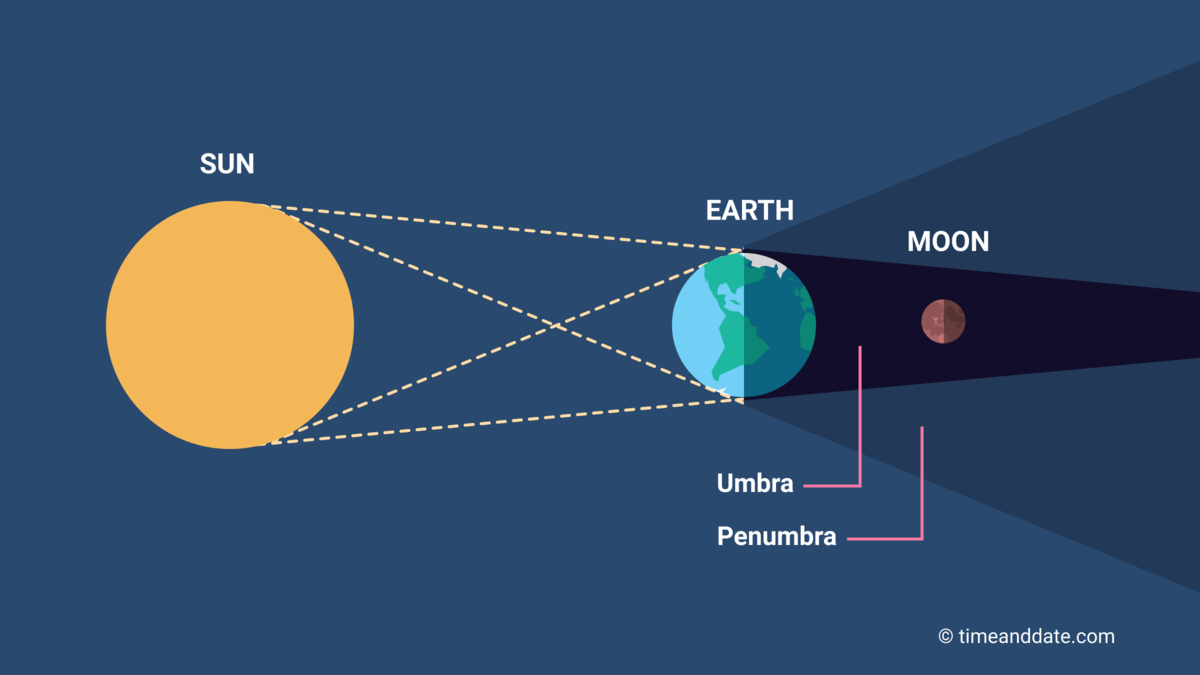
When the Moon blocks the Sun, it casts two distinct types of shadows on Earth. Understanding these shadows explains why only a small portion of the world experiences totality during any given event.
- The Umbra: This is the darkest, central part of the lunar shadow. It is a cone-shaped region where all direct sunlight is blocked. To see a total solar eclipse, an observer must be located within the path of the umbra as it sweeps across the Earth's surface. This path is typically only 100 to 150 miles wide.
- The Penumbra: This is the outer, lighter shadow. In this region, the Moon only partially covers the Sun. Observers in the penumbra see a partial solar eclipse, where the Sun appears as a crescent shape. The penumbra covers a much larger geographic area than the umbra.
Outside of these two regions, no eclipse is visible, and the Sun appears as its normal, full disk.

The Five Stages of a Total Solar Eclipse
A total solar eclipse is a progression of phases, each offering unique visual phenomena. The entire process can take several hours, though the period of "totality"—the total darkness—lasts only a few minutes.
1. First Contact (Partial Phase Begins)
The eclipse begins when the edge of the Moon first touches the edge of the Sun. From the observer's perspective, it looks as though a small "bite" has been taken out of the solar disk. During this stage, which lasts about an hour, the sky remains bright, but the Sun’s shape gradually changes into a thinning crescent.
2. Second Contact (Totality Begins)
This is the moment the Moon completely covers the Sun. Just seconds before second contact, observers may see Baily’s Beads and the Diamond Ring effect. As the last sliver of sunlight disappears, the sky darkens rapidly, and the temperature can drop by 10 to 15 degrees Fahrenheit.
3. Totality (The Maximum Phase)
During totality, the Moon's disk is a black void surrounded by the Sun's corona, the wispy, white outer atmosphere. The corona is normally invisible to the naked eye due to the Sun's overwhelming brilliance. Stars and planets become visible in the darkened sky, and animals may exhibit nocturnal behaviors, such as birds returning to their nests or crickets beginning to chirp.
4. Third Contact (Totality Ends)
As the Moon continues its orbit, the first glint of sunlight appears on the opposite side from where it disappeared. This marks the end of totality and the return of the Diamond Ring effect. The corona vanishes, and the sky begins to brighten instantly.
5. Fourth Contact (Partial Phase Ends)
The Moon continues to move away until its trailing edge no longer overlaps the Sun. The Sun returns to its full circular shape, marking the official conclusion of the eclipse event.
Visual Phenomena to Watch For
Observers should look for specific optical effects that occur only during the transition into and out of totality. These moments are fleeting but provide some of the most dramatic imagery in astronomy.
- Baily’s Beads: Named after British astronomer Francis Baily, these are brilliant spots of light that appear around the edge of the Moon just before and after totality. They are caused by sunlight peering through the valleys and craters on the Moon’s rugged horizon.
- The Diamond Ring: This occurs when only a single "bead" of sunlight remains. The combination of this bright point of light and the glowing ring of the corona creates the appearance of a celestial diamond ring.
- Shadow Bands: Just before and after totality, some observers notice faint, shimmering lines of light and dark moving across flat, light-colored surfaces on the ground. These are caused by the Earth’s turbulent atmosphere refracting the thin sliver of solar light, similar to how stars twinkle.
- The Chromosphere: For a few seconds after the Sun disappears, a thin, reddish-pink layer of the Sun’s atmosphere may be visible just above the Moon’s limb. This color is produced by hydrogen gas.
Comparison of Solar Eclipse Types
Not every solar eclipse results in total darkness. The type of eclipse depends on the distance between the Earth, Moon, and Sun at the time of alignment.
| Eclipse Type | Moon Position | Visual Appearance | Visibility Area |
|---|---|---|---|
| Total | Near perigee (closer to Earth) | Sun is completely covered; corona is visible. | Narrow path of totality (Umbra). |
| Annular | Near apogee (farther from Earth) | "Ring of Fire" around the Moon; corona invisible. | Narrow path of annularity (Antumbra). |
| Partial | Off-center alignment | Sun looks like a crescent or "bitten" cookie. | Broad geographic area (Penumbra). |
| Hybrid | Transitioning distance | Shifts between total and annular along the path. | Extremely rare and narrow path. |
Safety and Observation Equipment
Protecting your eyes is the most critical aspect of viewing a solar eclipse. The Sun’s radiation can cause "solar retinopathy," which is permanent damage to the retina, even if you do not feel pain immediately.
Solar Viewing Glasses
The only safe way to look directly at the Sun during the partial phases is through specialized solar filters that meet the ISO 12312-2 international standard. Ordinary sunglasses, even very dark ones, do not block the infrared and ultraviolet radiation that damages the eyes.
When Can You Remove Your Glasses?
You can only safely look at the Sun with the naked eye during the few minutes of totality, when the Sun's face is completely blocked. As soon as the first bit of the Sun reappears at Third Contact, you must put your solar glasses back on immediately.
Indirect Observation Methods
If you do not have solar glasses, you can use indirect methods:
- Pinhole Projector: Poke a small hole in a piece of cardstock and allow the sunlight to pass through the hole onto a second piece of paper held a few feet away. You will see an inverted image of the eclipsed Sun.
- Telescope/Binocular Filters: Never look through an unfiltered telescope or binoculars at the Sun. These devices require specialized solar filters mounted at the front (objective) lens, not the eyepiece.
Scientific Importance of Total Solar Eclipses
While they are beautiful to watch, total solar eclipses are also vital scientific opportunities. Before the invention of modern space-based telescopes, eclipses were the only time astronomers could study the Sun’s corona.
One of the most famous scientific breakthroughs involving an eclipse occurred in 1919. Sir Arthur Eddington used a total solar eclipse to test Albert Einstein’s General Theory of Relativity. By measuring the positions of stars near the eclipsed Sun, Eddington proved that the Sun’s gravity bent the light from distant stars, confirming Einstein’s theory and revolutionizing our understanding of physics.
Even in 2026, scientists use eclipses to study the solar wind, magnetic loops in the corona, and the effects of sudden solar dimming on the Earth’s ionosphere. NASA and other space agencies often launch high-altitude balloons and aircraft to capture data during the path of totality.
Planning for Future Eclipses
Total solar eclipses occur somewhere on Earth approximately every 18 months, but because they are visible only from a narrow path, any single location on Earth might only see one every 375 years on average.
As of 2026, many eclipse chasers are looking toward upcoming events. For instance, the total solar eclipse of August 12, 2026, is highly anticipated as it will pass over Greenland, Iceland, and Spain. Planning for such an event requires checking local weather patterns, as cloud cover is the primary enemy of a successful eclipse viewing. Sites like NASA’s Eclipse Web Site provide detailed maps and timing for these future occurrences.
Common Questions About Total Solar Eclipses
How long does a total solar eclipse last?
The duration of totality varies for each eclipse. It can last from a few seconds to a maximum of about 7 minutes and 32 seconds. The length depends on the relative distances of the Moon and Sun from Earth and where the observer is located within the path of totality. Most events provide between 2 and 4 minutes of darkness.
Does a total solar eclipse happen every year?
Solar eclipses (of some type) happen between two and five times a year. However, a total solar eclipse occurs only about once every 18 months. Because the Earth is mostly covered by water, many of these paths fall over the oceans, making them difficult for most people to witness without a ship or plane.
Can animals sense a solar eclipse?
Yes, many animals react to the sudden change in light and temperature. Nocturnal animals like bats or owls may become active, while daytime animals like cows or songbirds often begin their evening routines. Scientists and citizen scientists frequently document these behaviors during the path of totality.
Why isn't every solar eclipse a total one?
Two factors prevent every eclipse from being total: alignment and distance. If the Moon is not perfectly centered with the Sun, we get a partial eclipse. If the Moon is too far from Earth (near apogee), it appears smaller than the Sun, resulting in an annular eclipse where a ring of light remains visible.
Is it safe to take photos of an eclipse?
Capturing a solar eclipse requires the same safety precautions as viewing it. You must use a solar filter over your camera lens or smartphone camera during the partial phases to prevent the intense sunlight from melting the camera sensor. During totality, you can remove the filter to photograph the corona.
Next Steps for Observers
If you are planning to view a total solar eclipse, your first priority should be obtaining certified solar viewing equipment from a reputable vendor. Once equipped, identify your location relative to the "Path of Totality." Being even a few miles outside this path means you will only see a partial eclipse, which lacks the dramatic darkness and the visibility of the corona. Use interactive maps provided by astronomical organizations to find the exact start and end times for your specific coordinates to ensure you don't miss the transition to totality.
Image Gallery
Select an image to open it in a new tab.


Zara El-Hashem
Sociocultural Dynamics and Academics Writer
