The Main Message of the Monroe Doctrine Explained
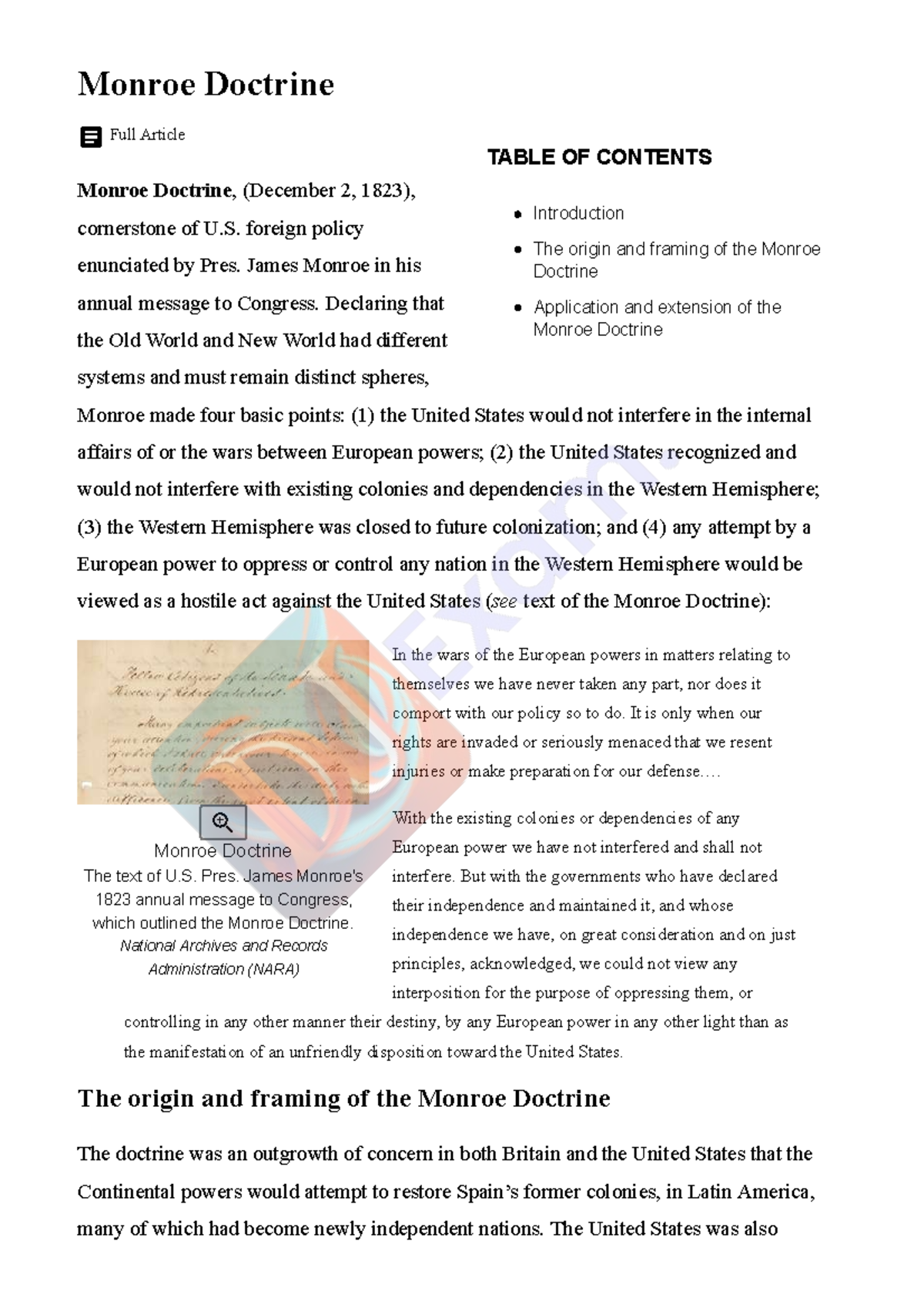
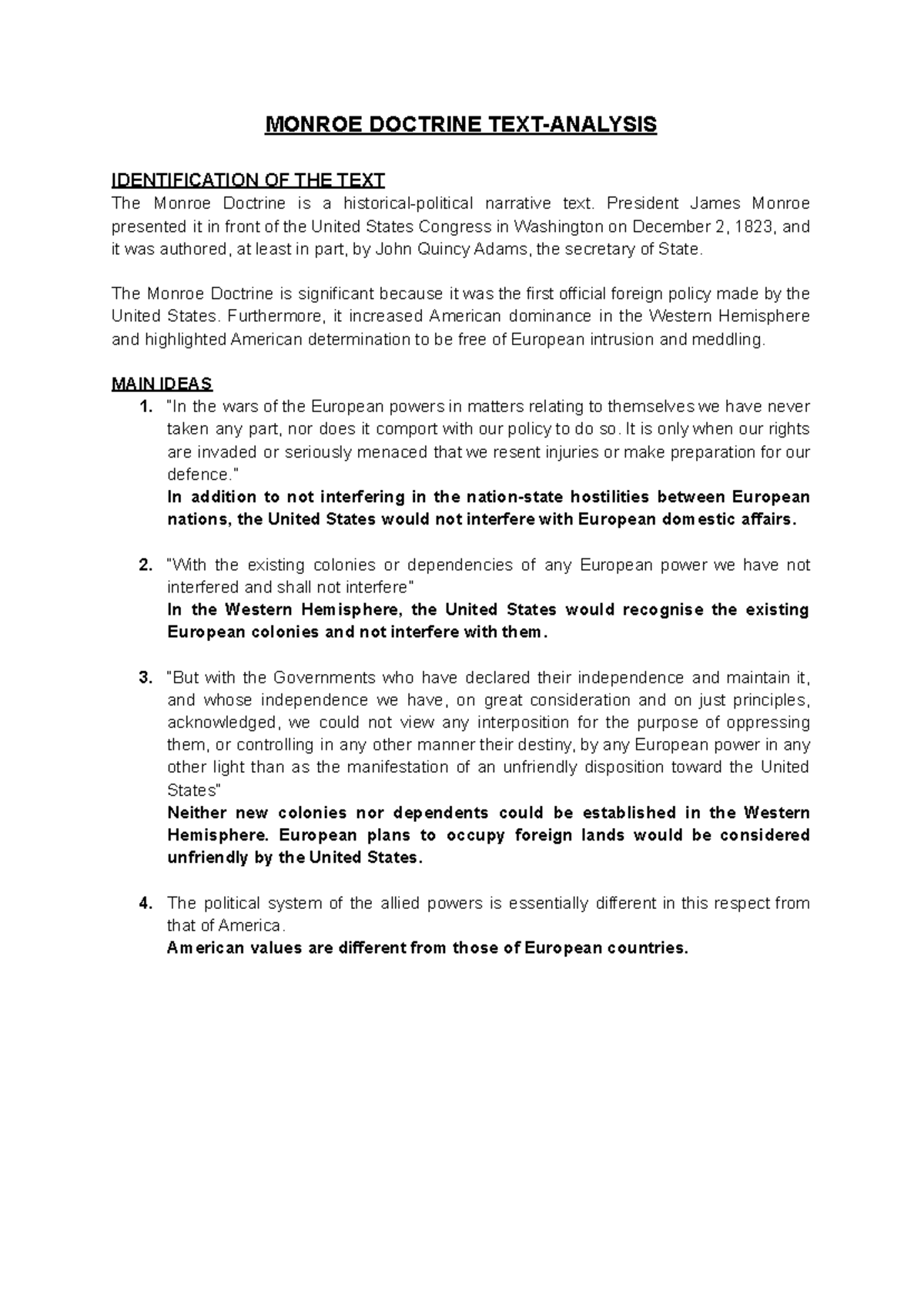
The main message of the Monroe Doctrine was that the United States considered the Western Hemisphere closed to any future European colonization or political intervention, establishing a clear line between the Old World and the New. Delivered by President James Monroe in 1823, the policy warned European powers that the Americas were no longer open to imperial expansion and that the United States would view any attempt to impose European political systems on independent nations in the Western Hemisphere as a threat to its own peace and safety.
Historical Context and Origins of the Doctrine
To fully understand the Monroe Doctrine, one must examine the geopolitical landscape of the early 19th century. Following the Napoleonic Wars, European monarchies formed the Concert of Europe, an alliance aimed at maintaining the balance of power and suppressing revolutionary movements across the continent. Prominent members of this alliance, particularly reactionary regimes in Austria, Prussia, and Russia, toyed with the idea of helping Spain reconquer its former colonies in Latin America, which had recently fought and won their independence.
Simultaneously, the Russian Empire pushed southward along the Pacific coast of North America, issuing edicts that restricted foreign shipping and fishing in waters off the Alaskan territory down to the 51st parallel. These twin pressures—the threat of European re-colonization in Latin America and Russian expansionism in the Pacific Northwest—alarmed American statesmen.
President James Monroe, acting upon the advice of Secretary of State John Quincy Adams, chose to address these vulnerabilities in his annual message to Congress on December 2, 1823. Although framed as a presidential address rather than a formal treaty or statutory law, the policy statement became a cornerstone of United States foreign policy. Adams played a pivotal role in shaping the doctrine's wording, ensuring that the United States maintained an independent stance rather than acting as a junior partner to Great Britain, which had proposed a joint declaration to protect mutual commercial interests in the Americas.
Core Principles of the 1823 Declaration
The Monroe Doctrine rested upon several fundamental principles that separated United States foreign policy from European power politics. Rather than a single monolithic rule, the text of Monroe’s message established specific boundaries regarding sovereignty, non-intervention, and the separation of political spheres.
The Non-Colonization Principle
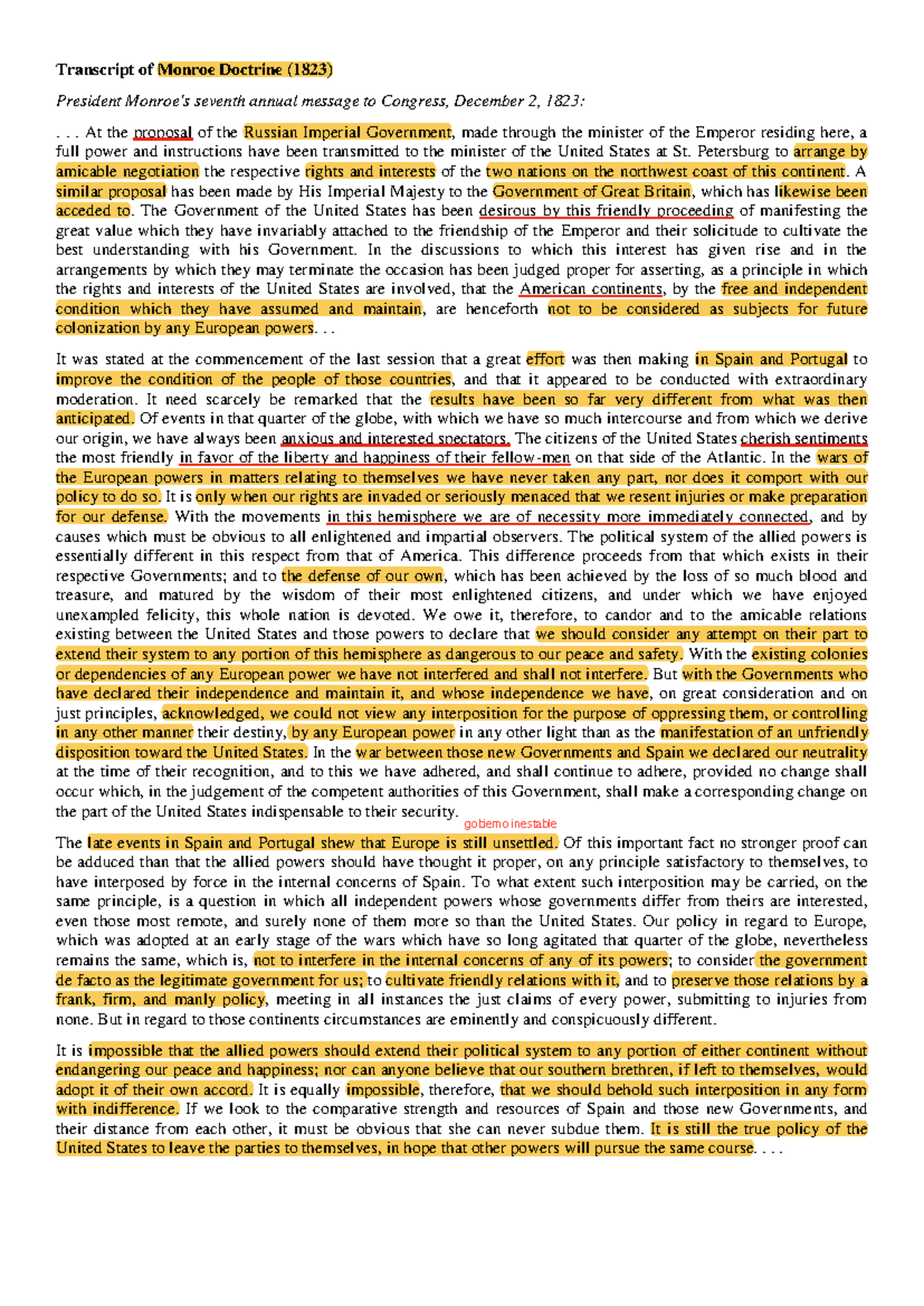
The first core pillar stated that the American continents were "thenceforward not to be considered as subjects for future colonization by any European powers." This declaration directly targeted Russian territorial claims in the Pacific Northwest and preempted any European nations from attempting to establish new footholds in Central or South America. By drawing a hard line against new imperial land grabs, the United States sought to secure its borders and preserve geographical space for republican governance.
The Non-Intervention and Separate Spheres Principle
The second core pillar established that the political systems of the Americas differed fundamentally from those of Europe. Monroe asserted that the United States would consider any attempt by European powers to extend their monarchical system to any portion of the Western Hemisphere as "dangerous to our peace and safety." This principle created two distinct diplomatic spheres: the European sphere, characterized by monarchy, balance-of-power politics, and dynastic alliances; and the American sphere, characterized by republicanism, national self-determination, and independence.
The Pledge of Non-Interference in Europe
As a counterpart to warning Europe away from the Americas, Monroe explicitly pledged that the United States would not interfere in the internal affairs or existing colonies of European nations. This commitment was designed to reassure European powers that the United States harbored no aggressive territorial ambitions across the Atlantic and sought only security and commercial freedom in its own hemisphere.

Comparison of Monroe Doctrine Eras and Evolutions
| Era / Phase | Primary Historical Driver | Major Policy Adaptation | Key Figures Involved |
|---|---|---|---|
| Original 1823 Doctrine | Post-Napoleonic European threats and Latin American independence movements. | Declaration of separate spheres; ban on future European colonization. | James Monroe, John Quincy Adams |
| Polk Corollary (1845) | Manifest Destiny and British/French influence in Texas and Oregon. | Reinvigorated the doctrine to counter European diplomatic maneuvering during territorial expansion. | James K. Polk |
| Roosevelt Corollary (1904) | Dominican Republic debt crisis and risk of European military intervention for debt collection. | Claimed an "international police power" for the US to intervene in unstable Latin American nations. | Theodore Roosevelt |
| Clark Memorandum (1928) | Shift away from aggressive interventionism and toward regional cooperation. | Clarified that the corollary applied strictly to European threats, not as justification for US domestic intervention in Latin America. | J. Reuben Clark, Frank B. Kellogg |
The Evolution and Expansion of the Doctrine Over Time
Over the course of the 19th and 20th centuries, the Monroe Doctrine evolved far beyond its original defensive intent. Successive administrations reinterpreted the doctrine to justify expanded United States geopolitical dominance, transforming a shield against European aggression into a sword for regional hegemony.
In 1845, President James K. Polk invoked the doctrine to support American territorial expansion, warning European powers against interfering in the annexation of Texas and the Oregon boundary dispute. Polk used the doctrine to assert that American expansion was a domestic matter free from European vetoes.
The most significant structural alteration occurred in 1904 with the introduction of the Roosevelt Corollary. President Theodore Roosevelt faced a crisis in which European creditor nations threatened military force to collect debts from bankrupt Caribbean and Latin American republics, such as the Dominican Republic. To prevent European armies from establishing permanent bases in the region, Roosevelt declared that the United States would act as an "international police power" in the Western Hemisphere. This corollary inverted the original doctrine: instead of merely warning Europe to stay out, the United States claimed the right to intervene directly in the internal affairs of Latin American nations to maintain order and financial stability.
Subsequent administrations used the Roosevelt Corollary to justify military occupations and interventions in countries such as Nicaragua, Haiti, and Cuba. This aggressive application generated profound resentment across Latin America, where critics viewed the Monroe Doctrine as an instrument of United States imperialism rather than a protective shield.
By the late 1920s and 1930s, the diplomatic tide shifted. The Clark Memorandum of 1928 repudiated the Roosevelt Corollary, arguing that the Monroe Doctrine was directed solely against European intervention, not against Latin American sovereignty. This paved the way for President Franklin D. Roosevelt’s "Good Neighbor Policy," which formally renounced unilateral military intervention in Latin America and emphasized hemispheric cooperation.
Strategic Implications and Global Impact
The Monroe Doctrine profoundly shaped the trajectory of United States foreign relations and international law. By articulating a clear policy of hemispheric preeminence, the United States signaled its emergence as a regional power capable of challenging European diplomatic dominance in its own backyard.
In practical terms, the doctrine relied heavily on the implicit backing of the British Royal Navy during the 19th century. Because Great Britain shared an interest in keeping rival European powers out of Latin America and maintaining open trade routes, the British fleet enforced the naval reality behind the American diplomatic warning. This created a paradoxical situation where a fledgling United States military successfully projected power and deterred European empires largely because its interests aligned with the world's preeminent naval superpower.
For Latin American nations, the doctrine's legacy remains mixed. While it initially discouraged reconquest by Spain and helped fledgling republics consolidate their independence, its later iterations fostered a deep-seated distrust of United States intentions. The doctrine symbolized a paternalistic attitude that treated Latin America as an American sphere of influence rather than a collection of fully sovereign equals.
During the Cold War, the spirit of the Monroe Doctrine found new life in the context of anti-communism. United States administrations invoked the principle of hemispheric defense to oppose Soviet influence and left-wing revolutionary movements in the Americas, leading to interventions in Guatemala, Cuba, the Dominican Republic, and Chile.
Frequently Asked Questions About the Monroe Doctrine
Who wrote the Monroe Doctrine?
While delivered by President James Monroe, the substance and phrasing of the doctrine were crafted primarily by Secretary of State John Quincy Adams. Adams insisted on an independent American statement rather than a joint Anglo-American declaration to preserve United States diplomatic autonomy.
Did the Monroe Doctrine apply to all foreign powers?
Yes, the text applied broadly to all European powers. However, its immediate targets in 1823 were the members of the European Concert considering intervention in Latin America and the Russian Empire expanding its territorial claims down the Pacific coast of North America.
How did the Roosevelt Corollary change the Monroe Doctrine?
The Roosevelt Corollary, introduced in 1904, altered the doctrine by claiming that the United States possessed an "international police power" in the Western Hemisphere. This shifted the policy from a defensive warning against European colonization to an active justification for United States military intervention in Latin American domestic affairs.
Why was Great Britain supportive of the Monroe Doctrine initially?
Great Britain supported the underlying concept because it feared that European intervention in Latin America would disrupt lucrative British trade networks with the newly independent republics. Although Britain preferred a joint declaration, the unilateral United States stance achieved the mutual goal of keeping rival continental European powers out of the region without requiring formal British military commitments.
Is the Monroe Doctrine still active today?
As a formal legal instrument, the Monroe Doctrine has no standing in modern international law. However, its historical legacy influences contemporary discussions regarding United States foreign policy, regional diplomacy, sovereignty, and great-power competition in the Western Hemisphere.
Practical Next Steps for Students and Researchers
For those examining the Monroe Doctrine in academic research or historical analysis, review original documents such as President Monroe’s 1823 Seventh Annual Message to Congress alongside John Quincy Adams's diplomatic papers. Comparing the original text with the 1904 Roosevelt Corollary illuminates the shifting nature of American foreign policy from isolationism to imperial intervention. Examine primary source collections at the National Archives or the Library of Congress to explore how Latin American statesmen and newspapers reacted to the doctrine across different historical eras.
Image Gallery
Select an image to open it in a new tab.



Zara El-Hashem
Sociocultural Dynamics and Academics Writer
