
Group term life insurance proceeds paid to a surviving spouse as a lump-sum death benefit are generally not taxable as federal income. However, if the benefit is distributed in installments that accumulate interest, the interest portion is subject to income tax. Additionally, employer-paid premiums for spouse coverage exceeding $2,000 create taxable imputed income for the employee during life.
Disclaimer: This article provides general educational information regarding U.S. federal tax laws applicable in 2026. Tax obligations depend on individual financial circumstances and state tax codes. Consult a certified public accountant (CPA) or estate planning attorney for specific tax advice.
The Core Rule: Taxability of Lump-Sum Death Benefits
Under Internal Revenue Code (IRC) Section 101(a), gross income does not include amounts received under a life insurance contract if those amounts are paid by reason of the death of the insured. This fundamental tax rule applies equally to individual policies and employer-sponsored group term life insurance contracts.
When an employee passes away and their employer-provided group term life policy names a surviving spouse as the designated beneficiary, the primary death benefit is delivered tax-free at the federal level. The surviving spouse does not need to report this lump-sum death benefit as taxable income on their federal income tax return (Form 1040).
- Group Term Life Insurance Death Benefit Payout
- Lump-Sum Distribution
- 100% Federal Income TAX-FREE
- Installment Payouts
- Principal: Income Tax FREE
- Interest: Taxable as Ordinary Income
- Lump-Sum Distribution
Federal vs. State Income Tax Obligations
In almost all U.S. jurisdictions, state income tax codes follow federal rules regarding life insurance proceeds. In most states, if a death benefit is exempt from federal income tax, it is also exempt from state income tax. However, surviving spouses residing in states with unique revenue codes or inheritance taxes should verify local regulations.
When Group Term Life Insurance Proceeds Become Taxable
While the general rule protects lump-sum death benefits from income taxation, specific scenarios alter the tax treatment of group term life insurance for both the employee during employment and the surviving spouse following the employee's death.
1. Interest Earned on Delayed or Installment Payouts
If a surviving spouse chooses not to receive the death benefit as an immediate lump sum, or if the insurance company delays the payout beyond standard processing timelines, the underlying funds generate interest.
Under IRC Section 101(d), any interest earned on life insurance proceeds after the insured's death is fully taxable as ordinary income.
- Principal Amount: The original face value of the group term policy remains 100% tax-free.
- Interest Portion: The additional money earned while the insurer retains the funds is taxable. The insurance company reports this taxable earnings amount to the spouse and the IRS using Form 1099-INT (or Form 1099-R depending on the settlement arrangement).
Example: A surviving spouse is entitled to a $200,000 group term life insurance payout. They elect an annuity settlement option that pays out over five years, yielding $215,000 total. The core $200,000 is tax-free income, while the additional $15,000 represents taxable interest spread over the payout period.
2. Imputed Income on Employer-Paid Premiums During Life
Tax obligations regarding group term life insurance often arise while the employee is still alive. The IRS distinguishes between coverage provided to the employee and dependent coverage provided for a spouse.
Employee Coverage Over $50,000 (IRC Section 79)
Under IRC Section 79, the cost of up to $50,000 of employer-provided group term life insurance is tax-exempt for the employee. If an employer provides coverage exceeding $50,000, the cost of the coverage above $50,000—minus any after-tax contributions made by the employee—is treated as imputed income.
This imputed income is calculated using the IRS Uniform Premium Rate Table (Table I) and is added to the employee's gross taxable wages in Box 1 of their Form W-2. It does not directly tax the spouse, but it increases the household's annual taxable income during the employee's career.
Dependent and Spouse Coverage
When an employer provides group term life insurance that specifically covers an employee’s spouse, different tax limits apply under IRS regulations outlined in IRS Publication 15-B (Employer's Tax Guide to Fringe Benefits):
- The $2,000 De Minimis Rule: If the face value of group life insurance provided by the employer on the spouse's life is $2,000 or less, the benefit is classified as a de minimis fringe benefit and is completely tax-free to the employee.
- Coverage Exceeding $2,000: If employer-paid group life coverage on the spouse exceeds $2,000, the entire fair market value of the coverage (calculated using IRS Table I rates), minus any after-tax employee contributions, is added to the employee’s W-2 taxable income.
- Employer-Paid Dependent Coverage on Spouse
- Policy <= $2,000
- De Minimis Benefit: Completely Tax-Free
- Policy > $2,000
- Entire Table I Value Taxed as Imputed Income
- Policy <= $2,000
3. The Transfer-for-Value Rule
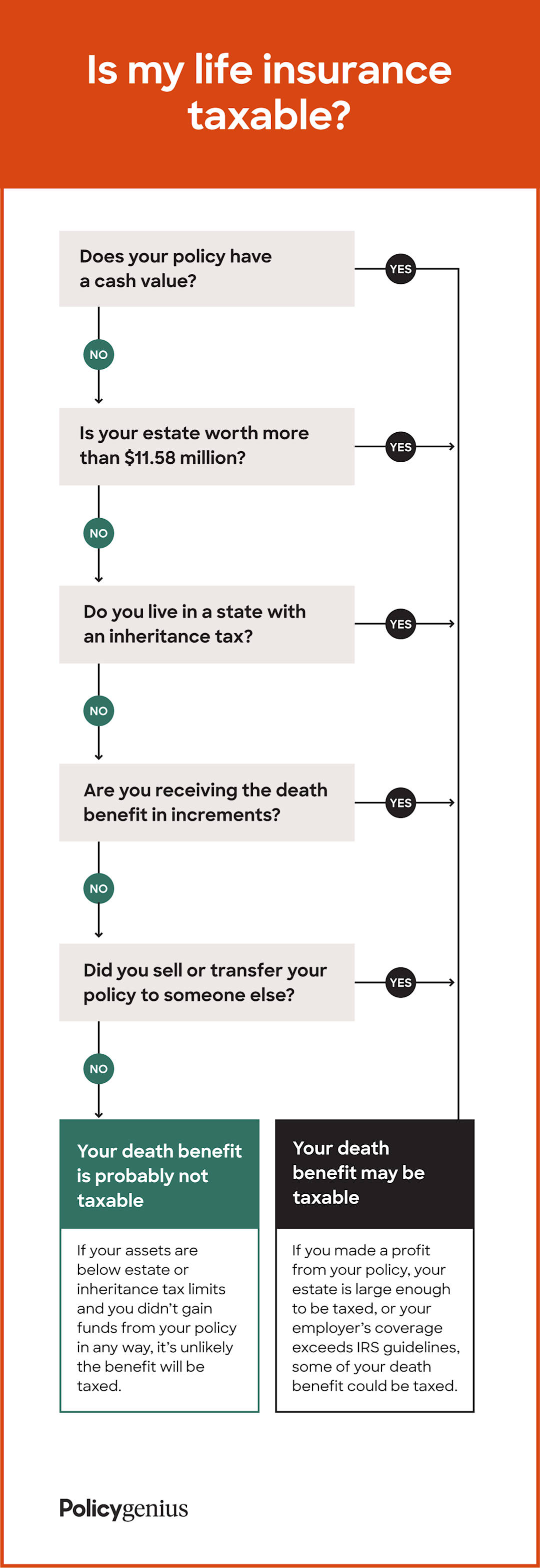
The transfer-for-value rule under IRC Section 101(a)(2) states that if a life insurance policy (or any interest in that policy) is transferred for valuable consideration (sold or exchanged for cash or assets), the death benefit tax exemption is lost.
In such cases, the surviving spouse could owe ordinary income tax on the portion of the payout that exceeds the consideration paid plus subsequent premiums. While rare in group term arrangements, transfer-for-value issues can occur during corporate restructuring, buy-sell agreements, or divorce settlements.
Federal Estate Tax vs. Income Tax for Surviving Spouses
It is vital to distinguish between income tax and estate tax when evaluating life insurance payouts.
While group term life proceeds paid to a spouse are almost universally exempt from federal income tax, they can be included in the calculation of the deceased employee’s gross estate under IRC Section 2042 if the employee retained "incidents of ownership" (such as the right to change beneficiaries or convert the policy).
The Unlimited Marital Deduction (IRC Section 2056)
Even if life insurance proceeds are included in the deceased employee's gross estate, proceeds left to a surviving spouse who is a U.S. citizen are generally exempt from federal estate tax.
Under IRC Section 2056, the Unlimited Marital Deduction allows an individual to transfer an unrestricted amount of assets to their U.S. citizen spouse free of federal estate and gift taxes. Consequently, a group term life insurance death benefit paid directly to a surviving U.S. citizen spouse will not trigger a federal estate tax liability, regardless of the policy's size or the total value of the estate.
Non-U.S. Citizen Spouse Exception
The Unlimited Marital Deduction does not automatically apply if the surviving spouse is not a U.S. citizen (even if they are a permanent resident). In these situations, assets—including large group term life insurance payouts included in the gross estate—may be subject to federal estate taxes if the total estate exceeds the applicable federal estate tax exemption threshold.
To preserve tax deference for a non-U.S. citizen spouse, estate planners often utilize a Qualified Domestic Trust (QDOT) under IRC Section 2056A.
Tax Treatment Matrix: Group Term Life Insurance Scenarios
The following matrix compares common group term life insurance scenarios, outlining their tax implications for employees and surviving spouses.
| Scenario | Tax Category | Tax Liability Status | Taxed Party | Key IRS Provision |
|---|---|---|---|---|
| Lump-sum payout to spouse upon employee's death | Federal Income Tax | Tax-Free | None | IRC Section 101(a) |
| Interest earned on deferred installment payouts | Federal Income Tax | Taxable as Ordinary Income | Surviving Spouse | IRC Section 101(d) |
| Employer-paid employee coverage up to $50,000 | Imputed Income | Tax-Free | None | IRC Section 79 |
| Employer-paid employee coverage over $50,000 | Imputed Income | Taxable Wages (W-2 Box 1) | Active Employee | IRS Table I Rates |
| Employer-paid spouse coverage of $2,000 or less | Fringe Benefit | Tax-Free (De Minimis) | None | Treasury Reg. § 1.132-6 |
| Employer-paid spouse coverage over $2,000 | Imputed Income | Taxable Wages (W-2 Box 1) | Active Employee | IRS Table I Rates |
| Payout to U.S. citizen spouse (Estate Tax) | Federal Estate Tax | Tax-Free | Estate / Spouse | IRC Section 2056 |
| Payout transferred for cash/valuable consideration | Federal Income Tax | Taxable (minus costs) | Beneficiary | IRC Section 101(a)(2) |
Tax Reporting and Documentation for Beneficiaries
When a spouse receives a group term life insurance payout, specific tax documents track the transaction. Understanding these forms prevents reporting errors on annual tax returns.
- Insurance Company Claims Process
- Payout Includes Accrued Interest
- Issuance of Form 1099-INT / 1099-R
- Report Interest on Schedule B (1040)
- Issuance of Form 1099-INT / 1099-R
- Lump-Sum Benefit Only (No Interest)
- No 1099 Required; Non-Taxable Event
- Payout Includes Accrued Interest
Form 1099-INT and Form 1099-R
- No Form 1099 for Pure Death Benefits: Insurance companies typically do not issue a Form 1099 to a beneficiary who receives a standard, tax-free lump-sum death benefit.
- Form 1099-INT: Issued if the insurer pays out $10 or more in interest generated between the date of death and the distribution date. The surviving spouse must report this interest income on Schedule B of Form 1040.
- Form 1099-R: Issued if the benefit is paid out as a structured annuity, pension settlement, or commercial life policy distribution containing a taxable taxable earnings component.
Form W-2 Box 12 Code C
During the employee's working years, the employer calculates any imputed income from group term life insurance coverage exceeding $50,000 (or spouse coverage exceeding $2,000). The employer includes this value in Box 1 (Wages, tips, other compensation) and details it in Box 12 using Code C (Uncollected Social Security and Medicare tax on group-term life insurance may also appear in Boxes 9 or 13 depending on employment status).
Common Pitfalls and Strategic Considerations
Navigating group term life insurance requires careful planning to prevent accidental tax burdens or administrative delays.
1. Supplemental Group Life Paid via Pre-Tax Salary Deductions
Some employers allow employees to purchase voluntary supplemental group term life insurance for themselves or their spouses using payroll deductions.
- Post-Tax Payroll Deductions (Recommended): If supplemental premiums are paid using after-tax dollars, the eventual death benefit remains 100% income-tax-free to the beneficiary.
- Pre-Tax Payroll Deductions (Rare/Restricted): Under IRS cafeteria plan regulations (IRC Section 125), life insurance coverage generally cannot be purchased on a pre-tax basis if it covers a spouse or dependent. Attempting to purchase spousal coverage with pre-tax dollars can jeopardize the tax-qualified status of the employer's benefit plan.
2. Failing to Update Beneficiary Designations
If an employee fails to update their beneficiary designation following a marriage, divorce, or death, the group life proceeds may default to the employee's estate rather than directly to the surviving spouse.
- Direct Beneficiary Payout: Bypasses probate and activates the Unlimited Marital Deduction.
- Estate Payout: Proceeds pass through probate court, exposing the funds to creditor claims, administrative fees, and potential delay. If the total estate exceeds federal or state exemption limits, passing proceeds through the estate can unnecessarily complicate estate tax administration.
3. Conversion to Individual Policies Upon Separation
When an employee leaves a job or retires, group term policies often include a conversion privilege, allowing the employee to convert group coverage into an individual permanent life policy without evidence of insurability.
While converting the policy preserves death benefits, ownership arrangements should be reviewed. If ownership of the converted policy is assigned to the spouse or an Irrevocable Life Insurance Trust (ILIT), it can help remove the proceeds from the employee's gross estate entirely.
Frequently Asked Questions
Are life insurance proceeds considered taxable income on Form 1040?
No. Standard lump-sum life insurance proceeds paid upon the death of the insured are not considered taxable income under federal law. The surviving spouse does not need to report tax-free lump-sum benefits on Form 1040. Only additional interest earned after the date of death must be declared as taxable interest income.
Is supplemental group term life insurance for a spouse taxable?
If the employee pays for supplemental spousal coverage using after-tax dollars, the death benefit paid to the employee (or named beneficiary) is tax-free. However, if the employer pays for spousal coverage exceeding $2,000 in face value, the cost of that coverage (determined by IRS Table I rates) is treated as taxable imputed income on the employee's Form W-2 during their employment.
What is the $50,000 group term life insurance rule?
Under IRC Section 79, an employer can provide up to $50,000 of group term life insurance to an employee tax-free. The employer-paid cost of coverage above $50,000 is considered a taxable benefit. The IRS calculates the value of this excess coverage using uniform monthly rates based on age, and the resulting imputed income is added to the employee's taxable compensation.
Does a surviving spouse pay estate tax on group life insurance proceeds?
In most cases, no. Under the IRS Unlimited Marital Deduction (IRC Section 2056), transfers of assets—including life insurance payouts—to a surviving spouse who is a U.S. citizen are exempt from federal estate taxes. Estate tax considerations generally apply only if the beneficiary is a non-U.S. citizen spouse or if the proceeds pass to non-spouse beneficiaries within a large estate exceeding federal exemption limits.
How is imputed income calculated for spouse life insurance?
Imputed income for employer-paid spouse life insurance exceeding $2,000 is calculated using the IRS Uniform Premium Table I. The employer determines the total coverage amount, subtracts any employee post-tax contributions, and multiplies the net coverage by the age-based monthly rate published by the IRS. This total annual amount is included in Box 1 of the employee’s W-2.
Practical Action Steps for Employees and Spouses
To ensure group term life insurance benefits remain tax-efficient and properly structured, consider taking the following concrete actions:
- Review Annual W-2 Statements: Employees should check Box 12 (Code C) on their W-2 to verify the imputed income recorded for group term life insurance coverage over $50,000 or dependent coverage over $2,000.
- Verify Beneficiary Designations: Confirm that primary and contingent beneficiary designations list the spouse by legal name rather than "Estate" to ensure immediate tax-free distribution outside probate court.
- Audit Payroll Deduction Structures: Ensure supplemental group life premiums for spouse coverage are deducted on an after-tax basis to maintain compliance with IRS cafeteria plan rules.
- Track Interest Form 1099-INT: If receiving a claim distribution that was delayed or paid in installments, set aside any Form 1099-INT issued by the insurer to accurately report interest earnings on line 2b of Form 1040.
- Consult an Estate Specialist for Non-U.S. Citizen Spouses: If either spouse is not a U.S. citizen, consult an estate attorney to set up appropriate trust mechanisms, such as a Qualified Domestic Trust (QDOT), to safeguard marital estate tax exemptions.
Image Gallery
Select an image to open it in a new tab.






Vivian Cho
Executive IT and Emerging Technologies Reporter
