
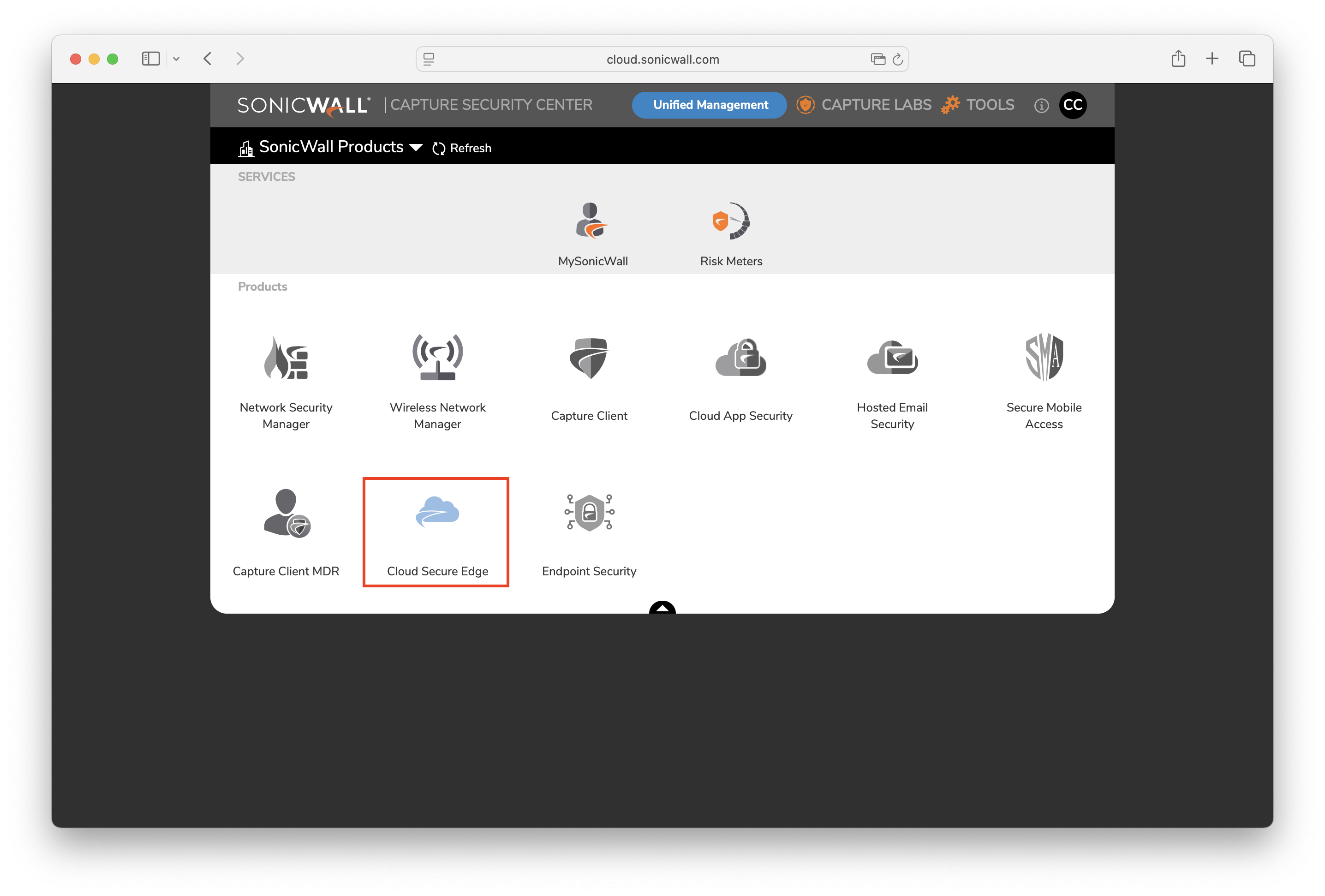
SonicWall Cloud Secure Edge (CSE) is a robust Secure Access Service Edge (SASE) solution, but it is often unnecessary for organizations with localized data, limited remote workforces, or existing investments in Microsoft Entra ID. For many businesses, a traditional Next-Generation Firewall (NGFW) or native cloud security tools provide sufficient protection without the added licensing costs and configuration complexity of a dedicated Zero Trust Network Access (ZTNA) platform.
As we navigate the cybersecurity landscape of 2026, the pressure to adopt "cloud-native" everything has reached a fever pitch. SonicWall Cloud Secure Edge—born from the integration of Banyan Security’s technology into the SonicWall ecosystem—is frequently marketed as the essential successor to the traditional Virtual Private Network (VPN). However, a technical audit of many small to mid-sized enterprise (SME) environments reveals that the jump to a full SASE model like CSE is often an architectural overreach.
Understanding why this technology might be redundant requires a deep look at existing infrastructure, the actual evolution of remote work patterns, and the hidden capabilities of the hardware many companies already have in their server racks.
The Architectural Overlap with Modern Firewalls
The primary argument for SonicWall Cloud Secure Edge is that it provides Zero Trust Network Access (ZTNA). ZTNA operates on the principle of "never trust, always verify," granting access only to specific applications rather than the entire network. While this is a significant security upgrade over legacy "flat" networks, modern SonicWall hardware (such as the TZ and NSa series) has evolved significantly by 2026.
Many organizations already own SonicWall Next-Generation Firewalls (NGFWs) that feature advanced security services. These appliances now handle deep packet inspection (DPI), integrated SD-WAN, and sophisticated SSL-VPN capabilities that can be configured with granular access controls. If your workforce is primarily office-based or uses a limited number of "on-prem" applications, the ZTNA capabilities of Cloud Secure Edge essentially duplicate the features already present in your firewall’s firmware.
Furthermore, the transition to Cloud Secure Edge requires a shift in management philosophy. Instead of managing a perimeter, you are managing a software-defined mesh. For IT teams that are already proficient in SonicOS, adding a second management plane for CSE introduces "swivel-chair management," where administrators must jump between the SonicWall Capture Security Center (CSC) and the CSE console. Unless the environment is complex enough to justify this, the added overhead often results in configuration drift and security gaps rather than improved safety.
The Dominance of Native Cloud Identity Providers
One of the most compelling reasons why SonicWall Cloud Secure Edge is often not needed is the maturity of identity providers (IdPs) like Microsoft Entra ID (formerly Azure AD) and Google Workspace. By 2026, these platforms have integrated their own "private access" features directly into their enterprise licensing tiers.
Microsoft, in particular, has made massive strides with Entra Private Access. For organizations already paying for Microsoft 365 E3 or E5 licenses, the ability to secure remote access to on-premises applications is often included or available as a minor add-on. Because Entra ID already holds the "source of truth" for user identities and device health, adding SonicWall CSE creates a redundant middleman.
When a user attempts to access a resource, Cloud Secure Edge checks their identity against the IdP. If the IdP (like Entra ID) can already perform conditional access checks—verifying device compliance, geographic location, and multi-factor authentication (MFA) status—the Cloud Secure Edge layer becomes a sophisticated, yet unnecessary, proxy. For many businesses, the goal is to reduce the number of vendors in the security stack, not add more.
Performance Considerations and the Latency Penalty
A common misconception is that moving to a cloud-based secure edge always improves performance. In reality, routing traffic through a SASE "Point of Presence" (PoP) can introduce latency that traditional direct-to-firewall connections avoid.
SonicWall Cloud Secure Edge relies on a network of global PoPs to intercept and inspect traffic. If your employees are located in a region that is geographically distant from the nearest CSE PoP, but close to your physical office or data center, their traffic must take a "scenic route." This hair-pinning of traffic can degrade the user experience for latency-sensitive applications like VoIP, video conferencing, or high-transaction databases.
In a traditional setup, a remote worker connects directly to the corporate firewall via an optimized VPN tunnel. With the hardware acceleration found in 2026-era SonicWall appliances, the encryption overhead is negligible. For organizations with a centralized or regionalized footprint, the direct path is often the fastest. Paying for a cloud edge to "optimize" traffic that was already fast can be a hard expense to justify.
Assessing the Financial Impact and TCO
The Total Cost of Ownership (TCO) for SonicWall Cloud Secure Edge is typically structured as a per-user, per-month subscription. While this OpEx model is attractive for some, it can quickly outpace the cost of maintaining existing hardware-based solutions.
| Feature | Traditional SonicWall NGFW (TZ/NSa) | SonicWall Cloud Secure Edge (CSE) | Native Cloud (Entra/M365) |
|---|---|---|---|
| Primary Access Method | Client-based or Clientless VPN | ZTNA / SASE Mesh | Identity-based Proxy |
| Cost Structure | CapEx (Hardware) + Annual Support | OpEx (Per-User Subscription) | Bundled with IdP License |
| Management Plane | SonicOS / On-prem or CSC | Cloud-native CSE Console | Entra Admin Center |
| Deployment Effort | Low (if already installed) | Moderate (requires agent/connector) | Low (uses existing agents) |
| Best Use Case | Single site / Hybrid with static staff | Global, decentralized remote fleets | M365-heavy environments |
For a company with 200 employees, a CSE subscription could cost thousands of dollars annually. If that same company already owns a SonicWall NSa firewall that is only at 30% utilization, they are effectively paying twice for the same "security throughput." In 2026, where IT budgets are under constant scrutiny, the "good enough" security provided by existing, fully-paid-for hardware often wins out over the "bleeding edge" features of a SASE subscription.
When "Cloud-Native" Doesn't Mean "Better Security"
There is a psychological push in the industry to view anything "cloud" as more secure. However, SonicWall CSE is a tool, not a strategy. Implementing a ZTNA solution without a properly segmented internal network is like putting a high-tech biometric lock on a screen door.
If your internal servers are not properly hardened and your VLANs are not segmented, Cloud Secure Edge will only protect the "entrance." Once a user (or an attacker with stolen credentials) is past the CSE gateway, they may still have lateral movement capabilities within your network if your internal firewall policies are weak. Many organizations find that their time and money are better spent refining their existing firewall rules and implementing internal micro-segmentation rather than layering a cloud proxy over a messy internal architecture.
Legacy Application Compatibility
Despite the push toward web-based SaaS applications, many industries—manufacturing, healthcare, and logistics—still rely on legacy client-server applications that do not communicate over standard HTTP/HTTPS ports.
SonicWall Cloud Secure Edge is highly optimized for web-traffic and modern protocols. While it can handle legacy traffic through various "connectors" and "tunnels," the configuration is often brittle. Traditional VPNs operate at the network layer (Layer 3), making them essentially "dumb pipes" that can carry any type of traffic without issue.
If your organization relies on specialized software that uses non-standard ports or requires a constant, low-level heartbeat to an on-site server, you may find that CSE introduces more troubleshooting tickets than it solves. In these scenarios, the "old" way of connecting is often the more stable and reliable way.
Operational Complexity and the Skill Gap
The 2026 job market for cybersecurity professionals is highly competitive. Managing a SASE environment requires a specific skillset that blends networking, cloud architecture, and identity management.
When a company adopts SonicWall Cloud Secure Edge, they are asking their IT team to master a new platform. If the team is already stretched thin managing firewalls, wireless access points, and endpoint security, adding a complex ZTNA policy engine can lead to "alert fatigue" or, worse, misconfigurations. A misconfigured cloud edge can be more dangerous than a traditional VPN, as it might inadvertently expose internal resources to the public internet if the "connectors" are not properly scoped.
For many SMEs, keeping the security stack simple is a security feature in itself. If the current team can manage the physical SonicWall firewall with their eyes closed, sticking with that platform reduces the risk of human error.
Frequently Asked Questions
Does SonicWall Cloud Secure Edge replace my physical firewall?
No, it does not. CSE is designed to secure access to applications, but it does not provide the localized threat protection, Wi-Fi management, or physical port security that a hardware firewall offers. Even with CSE, you still need a firewall to protect your local office network and manage your internet breakout.
Can I use CSE and a traditional VPN at the same time?
Technically, yes. Many organizations use a "hybrid" approach where high-risk remote users use CSE for ZTNA, while office-to-office connections use traditional Site-to-Site VPNs. However, this increases complexity and costs, which is why many organizations eventually choose one or the other.
Is CSE better for compliance (like SOC2 or HIPAA)?
CSE can make compliance easier by providing very detailed logs of "who accessed what application and when." However, you can achieve the same level of logging with a properly configured SonicWall NGFW and a centralized logging tool like SonicWall Analytics. Compliance depends on your policies, not just the brand of software you use.
What is the biggest sign that I don't need Cloud Secure Edge?
If more than 80% of your workforce is in the office five days a week and your primary applications are either SaaS (like Salesforce) or hosted on a single local server, CSE is likely overkill. You are paying for a "mobile-first" solution for a "desk-first" workforce.
Does CSE improve internet speed for remote workers?
Not necessarily. While it can optimize paths to certain cloud resources, it adds an extra "hop" for every request. If a user has a poor home internet connection, no amount of cloud-edge technology will fix their local latency or packet loss.
Strategic Recommendation
Before committing to SonicWall Cloud Secure Edge in 2026, perform a Resource-to-User Mapping. Identify exactly where your data lives and how your users access it.
If your data is predominantly in SaaS applications (Microsoft 365, Zoom, Slack), your users are already "at the edge," and you should focus on Identity Security (MFA and Conditional Access) rather than a SASE product. If your data is on-premises and your users are mostly local, stick with your SonicWall NGFW and optimize your existing VPN for the occasional remote need.
Only consider SonicWall CSE if you have a highly distributed global workforce, a "cloud-first" mandate that includes moving private data centers to the cloud, and a budget that allows for the per-user subscription model without compromising other areas of your security stack.
Image Gallery
Select an image to open it in a new tab.


Akira Tanaka
International Academic Trends Correspondent
