Capital Needs Analysis for Life Insurance: A Strategic Approach to Assessing Financial Protection

Capital needs analysis is a comprehensive financial methodology used to determine the exact amount of life insurance required to ensure a household or business can meet its future financial obligations. By calculating the difference between total projected financial requirements—such as debt repayment, income replacement, and education costs—and currently available assets, this process provides a data-driven roadmap for adequate financial protection.
Understanding Capital Needs Analysis in 2026
In 2026, the complexity of personal finance requires a more nuanced approach than the "ten times salary" rule of thumb used in decades past. Capital needs analysis (CNA) stands as the professional standard for financial planners and insurance specialists. Unlike simpler methods, a CNA accounts for the time value of money, fluctuating inflation rates, and the specific, non-linear goals of a modern family or enterprise.
The primary objective of a capital needs analysis is to identify the "capital gap." This gap represents the shortfall between what your survivors will need to maintain their standard of living and what you currently have in the form of savings, investments, and existing insurance policies. By conducting this analysis, you move from guesswork to a mathematical certainty that your beneficiaries will not face a financial crisis following a loss of income.
Financial protection is not a static target. It evolves as you pay down mortgages, as children grow closer to university age, and as tax laws surrounding estates and inheritances shift. In the current economic landscape of 2026, where interest rates and cost-of-living adjustments are more volatile than in previous eras, a periodic reassessment using the CNA method is essential for maintaining a robust safety net.
The Core Components of a Comprehensive CNA
To conduct a thorough capital needs analysis, one must categorize financial requirements into two distinct phases: immediate cash needs and long-term income needs. A failure to account for both can result in an insurance policy that is either unnecessarily expensive or dangerously insufficient.
Immediate Cash Needs (Lump Sum Obligations)
Immediate needs are the expenses that must be settled shortly after a person’s passing. These are often one-time costs that can rapidly deplete a family’s liquid savings if not properly insured.
- Final Expenses: This includes funeral costs, burial or cremation services, and immediate medical bills. In 2026, the average cost for these services continues to rise, often ranging between $12,000 and $20,000 depending on the region and preferences.
- Debt Liquidation: To ensure survivors can remain in their homes, a CNA typically prioritizes the payoff of a mortgage. Other debts, such as auto loans, personal lines of credit, and credit card balances, should also be factored in.
- Estate Settlement and Taxes: For high-net-worth individuals, estate taxes and legal probate fees can significantly reduce the value of an inheritance. Life insurance provides the liquidity needed to pay these costs without forcing the sale of assets like real estate or family businesses.
- Emergency Fund Seeding: A comprehensive plan ensures that the surviving spouse or dependents are left with a liquid emergency fund (typically 6–12 months of expenses) to handle unforeseen repairs or medical issues during the transition period.
Long-Term Income Replacement
This is the most critical and complex part of the analysis. It calculates the present value of the income stream required to support dependents for a specific duration—often until the youngest child reaches adulthood or until the surviving spouse reaches retirement age.
The analysis must account for the Social Security Blackout Period. This is the timeframe when a surviving spouse is no longer eligible for Social Security survivor benefits (because the children have grown) but is not yet old enough to claim their own retirement or survivor benefits. Life insurance must bridge this gap to prevent a standard-of-living collapse during these middle years.
Special Funding Goals
Beyond basic survival and debt repayment, many individuals want their life insurance to provide for specific future milestones.
- Education Funding: Estimating the future cost of college or vocational training for children.
- Legacy and Charitable Giving: Providing a specific lump sum to a non-profit or as a multi-generational inheritance.
- Business Continuity: For business owners, the capital need might include the funds required for a "buy-sell agreement," allowing surviving partners to buy out the deceased’s share of the business at a fair market price.
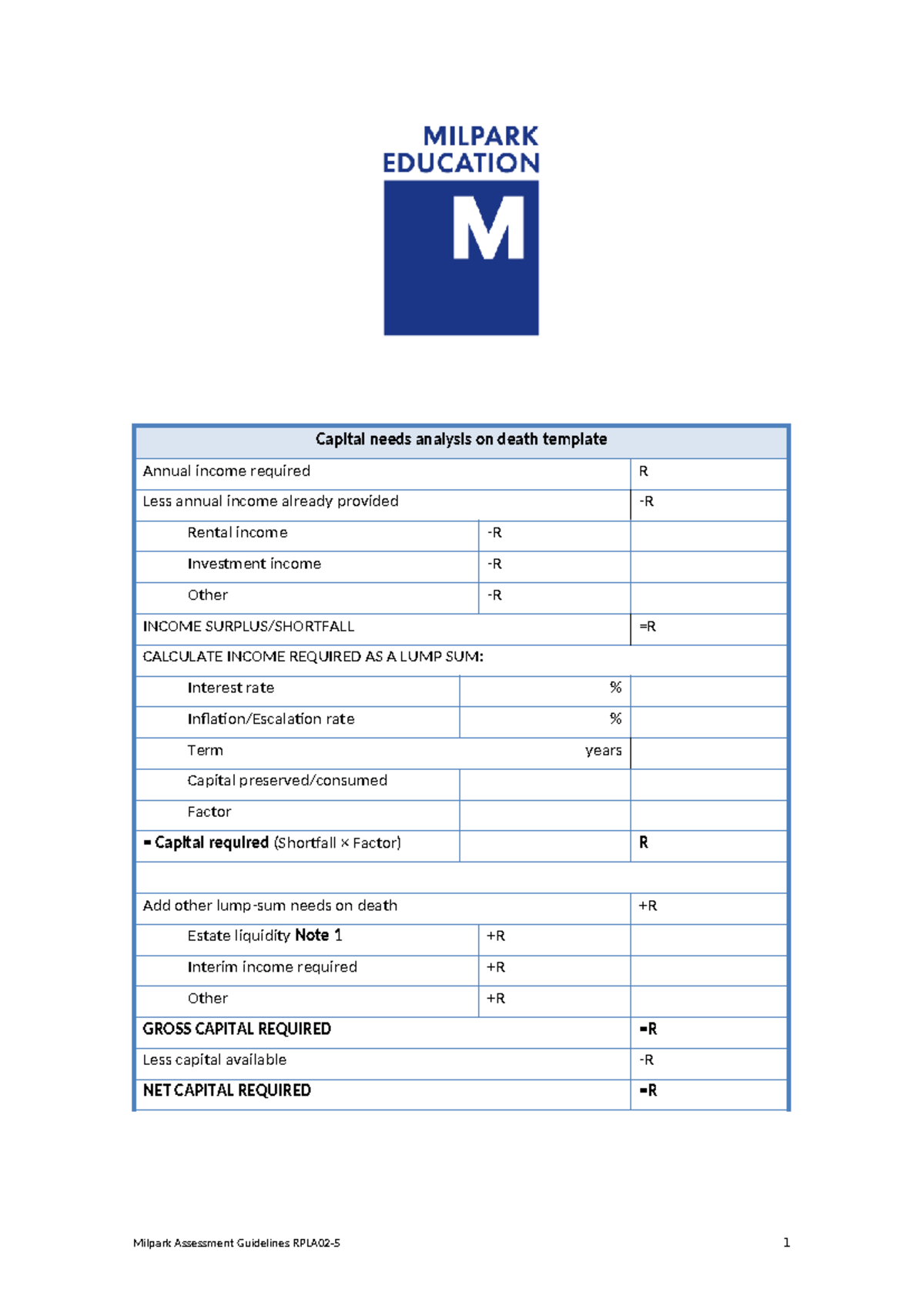
Step-by-Step Guide to Conducting Your Analysis
Performing a capital needs analysis requires gathering specific financial data and making educated assumptions about future economic conditions. Follow these steps to determine your required coverage.
1. Identify Total Immediate Needs
List every debt and immediate expense. Do not just look at the current balance; consider any prepayment penalties on mortgages or loans. Sum these figures to find your "Cash Needs" total.
2. Calculate Annual Living Expenses
Determine the annual budget required for your family to live comfortably. Subtract the expenses that would disappear (such as the deceased person’s personal spending or certain work-related costs). What remains is the "Income Requirement."
3. Account for Existing Income Sources
Identify income that will continue after a breadwinner passes away. This may include a surviving spouse's salary, social security survivor benefits, or rental income. Subtract this from the "Income Requirement" to find the "Annual Income Gap."
4. Determine the Capital Needed for Income Replacement
There are two ways to calculate this:
- Capital Liquidation: You buy enough insurance so that the family spends both the interest and the principal over a set number of years, ending with zero. This requires less insurance but leaves no "safety net" if the spouse outlives the projected timeframe.
- Capital Retention: You buy enough insurance so that the family can live off the interest generated by the death benefit, leaving the principal intact. This provides much greater security but requires a significantly higher policy amount.
5. Deduct Current Assets and Existing Insurance
Subtract your current liquid assets (savings, brokerage accounts, 401ks) and any existing life insurance policies (such as group life provided by an employer) from the total sum of needs. The resulting figure is your Net Insurance Need.
Comparing Valuation Methods for Financial Protection
Not all life insurance calculations are created equal. Depending on your life stage and financial complexity, different methods might yield vastly different results.
| Method | Primary Focus | Complexity | Best Use Case |
|---|---|---|---|
| Capital Needs Analysis | Specific financial goals and liabilities | High | Families with debt, children, or complex estates. |
| Human Life Value (HLV) | Replacement of future earnings | Medium | Young professionals with high earning potential but few assets. |
| DIME Formula | Debt, Income, Mortgage, Education | Low | Quick estimates for individuals with simple finances. |
| Rule of Thumb (10x) | Simple multiple of gross salary | Very Low | A starting point, but often results in under-insurance. |
| Capital Retention | Preserving principal for perpetual income | High | High-net-worth individuals focused on legacy. |
Advanced Considerations: Inflation and Interest Rates in 2026
When assessing financial protection in 2026, two variables carry more weight than ever: the inflation rate and the assumed rate of return on insurance proceeds.
If you calculate a need for $5,000 a month in income replacement today, that same $5,000 will have significantly less purchasing power in fifteen years. A professional capital needs analysis uses an "inflation-adjusted discount rate." For example, if you expect insurance proceeds to earn 5% in a diversified portfolio, but inflation is at 3%, your "real" rate of return is only 2%. Using this 2% figure to calculate your needs ensures that the income stream maintains its purchasing power over decades.
Furthermore, tax considerations are paramount. While life insurance death benefits are generally received income-tax-free under Internal Revenue Code Section 101(a), the earnings on those proceeds (if invested by the beneficiary) are taxable. A comprehensive analysis must account for the tax "drag" on invested proceeds to ensure the net amount remains sufficient for the family's needs.
Common Pitfalls in Estimating Insurance Needs
Even with a structured approach, several common errors can undermine the effectiveness of a capital needs analysis.
- Underestimating "Hidden" Costs: Many people forget to factor in the cost of replacing the services provided by a non-income-earning spouse, such as childcare, household management, and transportation. A "stay-at-home" parent has a high "human capital" value that must be insured.
- Over-Reliance on Employer-Provided Life Insurance: Group life insurance is a fantastic benefit, but it is rarely enough. Furthermore, these policies are usually not portable; if you lose your job or change careers, you lose your coverage. A CNA should treat group life as a "supplement," not the foundation of the plan.
- Failing to Account for Future Lifestyle Creep: As careers progress, spending often increases. If your analysis is based on your lifestyle at age 25, it will be woefully inadequate by age 40.
- Ignoring the Impact of Shifting Tax Laws: In 2026, estate tax exemptions and brackets may differ from previous years. Failing to consult with a tax professional during the CNA process can lead to an unexpected tax burden for beneficiaries.
Frequently Asked Questions
What is the difference between Capital Needs Analysis and Human Life Value?
The Human Life Value (HLV) method calculates the total amount of money an individual is expected to earn over their remaining working years, discounted to present value. It focuses entirely on "earning power." Capital Needs Analysis is more holistic; it focuses on the specific "financial objectives" of the survivors, such as paying off a specific mortgage or funding a specific college degree, rather than just replacing a paycheck.
How often should a capital needs analysis be updated?
A capital needs analysis should be revisited every three years, or whenever a "major life event" occurs. These events include marriage, divorce, the birth of a child, the purchase of a home, a significant promotion, or the starting of a business. In the fast-moving economy of 2026, waiting longer than three years can result in a significant "protection gap."
Does a capital needs analysis account for Social Security?
Yes, a professional analysis must include Social Security Survivor Benefits. These benefits can provide a substantial monthly income to a surviving spouse with minor children. However, the analysis must also account for the "Blackout Period," during which these benefits cease until the spouse reaches age 60 (or 50 if disabled).
Can I perform a capital needs analysis myself?
While basic calculators are available online, a truly accurate analysis involves complex present-value calculations and tax considerations. It is highly recommended to work with a Certified Financial Planner (CFP) or a qualified insurance professional who uses professional-grade software to ensure no variables are missed.
Is term or permanent insurance better for a capital needs plan?
This depends on the nature of the need. "Temporary" needs (like a mortgage or raising children) are often best covered by low-cost term insurance. "Permanent" needs (like estate taxes, final expenses, or providing for a special-needs dependent) usually require permanent insurance (Whole Life or Universal Life). Often, the best solution is a "laddered" approach using both.
Practical Recommendation
To achieve true financial protection, begin by gathering your most recent mortgage statements, investment account balances, and current insurance policy documents. Utilize a capital needs analysis to establish your baseline requirement. Once you have determined your "Net Insurance Need," prioritize securing a policy that offers guaranteed renewability and a convertibility rider, allowing you to adapt your coverage as your financial landscape changes through 2026 and beyond.
Disclaimer: This article provides general information regarding financial planning concepts and does not constitute specific legal, tax, or investment advice. Always consult with a licensed professional regarding your individual situation.
Image Gallery
Select an image to open it in a new tab.


Declan O'Connor
Higher Education and Campus Culture Reporter
