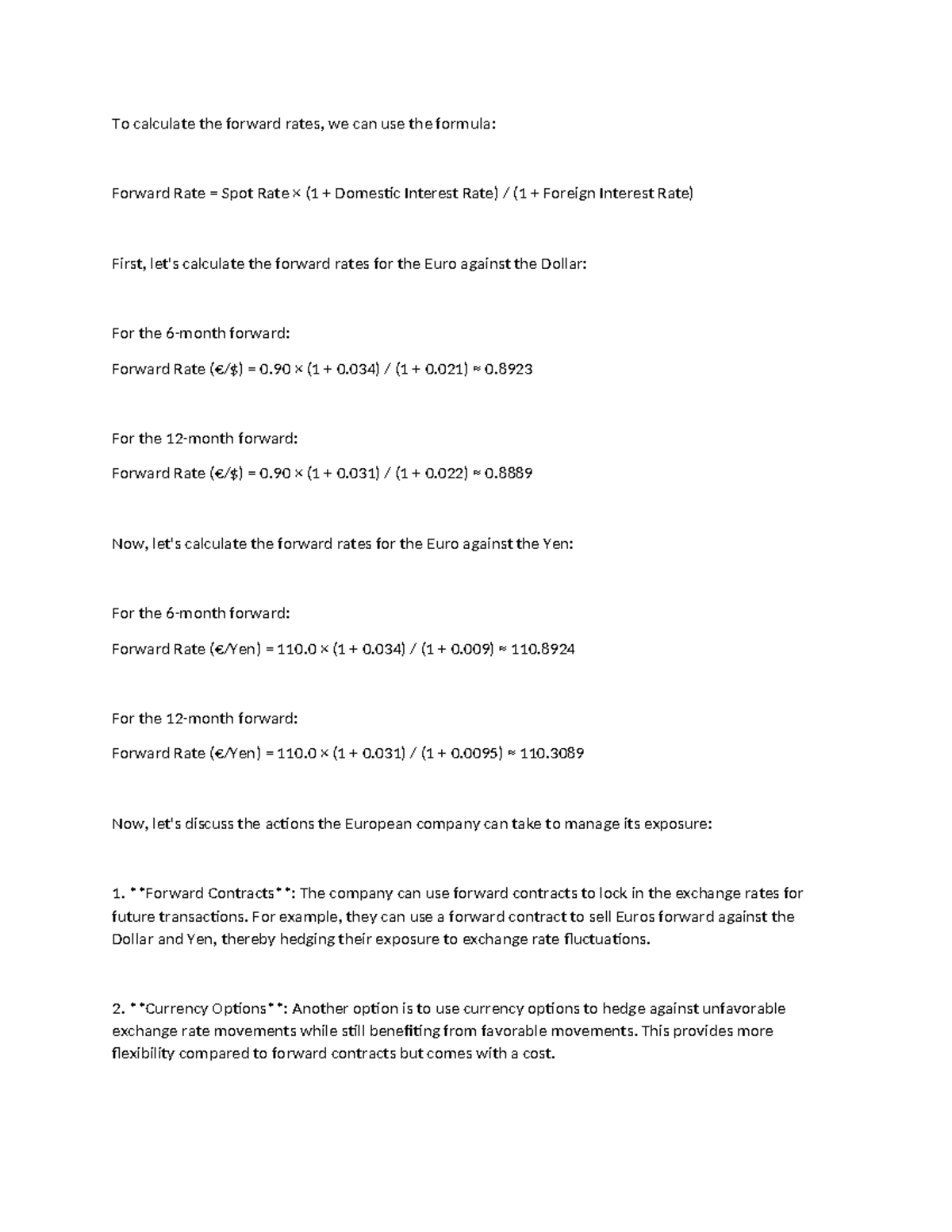
In practice, using the forward rates formula involves calculating the "break-even" interest rate for a future period based on current spot rates. By applying the formula $f_{t_1, t_2} = [(1+s_2)^{t_2} / (1+s_1)^{t_1}]^{1/(t_2-t_1)} - 1$, financial professionals price derivatives, hedge interest rate risk, and identify arbitrage opportunities within the yield curve.
Understanding the Theoretical Foundation of Forward Rates
Before applying the forward rates formula in a 2026 market environment, one must distinguish between spot rates and forward rates. A spot rate is the yield to maturity on a zero-coupon bond for a specific period starting today. Conversely, a forward rate is a contractual or implied interest rate for a period that begins at a future date.
The practical utility of forward rates rests on the Pure Expectations Hypothesis and the No-Arbitrage Principle. In a frictionless market, an investor should be indifferent between investing in a long-term bond for two years or investing in a one-year bond and rolling that investment into a second one-year bond a year from now. If the two strategies yielded different results, traders would exploit the difference until the prices realigned. Therefore, the forward rate is the mathematical necessity that equilibrates these two paths.
In the current 2026 financial landscape, where Risk-Free Rates (RFRs) like SOFR (Secured Overnight Financing Rate) and €STR (Euro Short-Term Rate) have fully replaced legacy benchmarks like LIBOR, the forward rates formula remains the primary tool for term structure analysis. Analysts use it to "read" what the market expects central banks—such as the Federal Reserve or the European Central Bank—to do with interest rates in the coming months or years.
The Forward Rates Formula: Discrete vs. Continuous
Depending on the financial instrument and the market convention, the forward rates formula can take several forms. Understanding which version to use is the first step in practical application.
1. The Annual Compounding Formula
This is the most common version used for bonds and long-term capital projections. It assumes interest is compounded once per year.
$$f_{n, m} = \left[ \frac{(1 + s_m)^m}{(1 + s_n)^n} \right]^{\frac{1}{m-n}} - 1$$
Where:
- $f_{n, m}$: The forward rate for the period starting at year $n$ and ending at year $m$.
- $s_m$: The spot rate for the longer period (up to year $m$).
- $s_n$: The spot rate for the shorter period (up to year $n$).
2. The Continuous Compounding Formula
In quantitative finance and derivatives pricing (such as Black-Scholes modeling or complex swaps), continuous compounding is preferred for its mathematical elegance.
$$f_{t_1, t_2} = \frac{s_2 t_2 - s_1 t_1}{t_2 - t_1}$$
In this version, the forward rate is essentially the weighted difference between two spot rates. Practitioners prefer this for rapid calculations because it avoids the complexity of exponents.
Step-by-Step Practical Calculation
To see how this works in a real-world scenario, imagine a corporate treasurer in early 2026 looking to hedge a loan that will be taken out one year from today for a duration of one year.
Step 1: Identify the Relevant Spot Rates
The treasurer looks at the current yield curve for high-quality government bonds (zeros).
- 1-Year Spot Rate ($s_1$): 4.0%
- 2-Year Spot Rate ($s_2$): 4.5%
Step 2: Apply the Formula
The goal is to find the 1-year forward rate, one year from now ($f_{1, 2}$).
$$f_{1, 2} = \frac{(1 + 0.045)^2}{(1 + 0.040)^1} - 1$$
Step 3: Perform the Arithmetic
- Calculate $(1.045)^2 = 1.092025$
- Divide by $(1.040)^1 = 1.050024$ (approx)
- $1.092025 / 1.04 = 1.050024$
- Subtract 1 = $0.050024$ or 5.002%
Step 4: Interpretation
The market is pricing in a 1-year rate of approximately 5% for next year. If the treasurer believes the actual 1-year spot rate a year from now will be 5.5%, they should lock in a Forward Rate Agreement (FRA) at the current 5% rate to save on interest costs.
Key Practical Applications in 2026
The use of forward rates extends far beyond simple classroom exercises. It is a critical component of institutional finance.
Pricing Forward Rate Agreements (FRAs)
An FRA is a cash-settled forward contract on an interest rate. In practice, a bank will use the forward rate formula to determine the "fixed" rate it offers to a client. If the bank calculates the forward rate as 5.002%, it will likely quote the client a slightly higher rate (e.g., 5.05%) to include a profit margin. The client pays or receives the difference between this fixed rate and the actual reference rate (like SOFR) at maturity.
Valuing Interest Rate Swaps
Interest rate swaps are essentially a series of forward contracts strung together. To value a swap where one party pays fixed and receives floating, the analyst must project future floating rates using the forward rate formula. By calculating the forward rate for each payment period (e.g., every six months for five years), the analyst can determine the Present Value (PV) of the floating leg and set the fixed rate so that the swap has an initial value of zero.
Yield Curve Analysis and Investment Strategy
Investors use forward rates to determine if a bond is "fairly priced." If the calculated forward rate is significantly higher than what the investor expects future spot rates to be, the long-term bond might be undervalued. This is known as the "Roll-down" strategy. As time passes, if the yield curve remains stable, the bond’s maturity shortens, and its yield "rolls down" the curve toward lower spot rates, resulting in capital gains.
Corporate Budgeting and Debt Issuance
For CFOs, forward rates act as a forecasting tool. If the forward curve is steeply upward-sloping (meaning forward rates are much higher than current spot rates), it suggests that the market expects significant inflation or central bank tightening. A corporation might choose to issue long-term fixed-rate debt now rather than waiting and risking higher costs later.
Comparison of Interest Rate Types
Understanding the nuances between different rate types is vital for accurate financial modeling.
| Rate Type | Start Date | Duration | Primary Use Case |
|---|---|---|---|
| Spot Rate | Today | Variable (e.g., 2yr, 5yr) | Pricing zero-coupon bonds; baseline for the yield curve. |
| Forward Rate | Future Date | Variable | Hedging future borrowing; pricing FRAs and Swaps. |
| Short Rate | Today | Overnight / Instantaneous | Theoretical modeling (e.g., Hull-White model); central bank targets. |
| Futures Rate | Future Date | Standardized (3 months) | Exchange-traded hedging; highly liquid speculation. |
Limitations and Practical Obstacles
While the formula is mathematically sound, several real-world factors can complicate its application.
1. The Liquidity Premium
In practice, long-term spot rates often include a liquidity premium. Investors typically demand a higher yield for tying up their money for longer periods. This means that the forward rate calculated from the formula might be higher than the actual expected future spot rate because it includes compensation for risk and lack of liquidity, not just expectations of future rate hikes.
2. Transaction Costs and Bid-Ask Spreads
The formula assumes you can trade at the mid-market spot rate. In reality, there is a spread. If you are calculating a forward rate to find an arbitrage opportunity, you must account for the fact that you buy at the "ask" and sell at the "bid." Often, the transaction costs are large enough to wipe out the theoretical arbitrage profit.
3. Credit Risk Disparities
When using government bond yields to calculate forward rates, the resulting rate is "risk-free." If a practitioner applies this rate to a corporate project without adjusting for the credit spread of the specific company, the valuation will be significantly flawed. The "Forward Rate + Credit Spread" approach is necessary for corporate finance applications.
4. Convexity Bias
For longer maturities, the relationship between bond prices and yields is not linear (convexity). This creates a "convexity bias" in forward rates derived from futures markets. Practitioners in 2026 must use convexity adjustments when moving between Eurodollar-style futures and forward rates to ensure accuracy.
Bootstrapping: Obtaining the Spot Rates
A common hurdle is that spot rates for every maturity are not always directly observable. Most liquid bonds pay coupons, meaning their yield to maturity is not a "pure" spot rate. Practitioners use a technique called bootstrapping to derive spot rates from a series of coupon-bearing bonds.
- Take the 6-month bond (usually zero-coupon) as the first spot rate.
- Use that rate to discount the first coupon of a 1-year bond.
- Solve for the discount rate of the 1-year bond's final payment to find the 1-year spot rate.
- Repeat this iteratively for 2-year, 3-year, and 10-year maturities.
Only after bootstrapping the spot curve can the forward rates formula be applied with precision.
Frequently Asked Questions
What is the difference between a forward rate and a futures rate?
While both represent rates for future periods, forward rates are customized, private contracts (over-the-counter) calculated via formula, whereas futures rates are standardized contracts traded on exchanges (like the CME). Futures rates are subject to daily margin calls, which can cause them to deviate slightly from theoretical forward rates due to the "convexity adjustment."
Why do banks use forward rates instead of just forecasting?
Banks and institutions rely on forward rates because they represent the market's consensus. Forecasting is subjective and prone to error, whereas the forward rate is the "no-arbitrage" price at which the market is willing to transact today. It is a more reliable benchmark for pricing risk than any single economist's prediction.
Does the forward rate formula work for currency exchange rates?
Yes, but it is modified into the Interest Rate Parity formula. For currencies, the forward exchange rate is a function of the spot exchange rate and the difference between the interest rates of the two countries. The logic remains the same: preventing risk-free profit through arbitrage.
Can forward rates be negative?
Technically, yes. If the spot curve is deeply inverted (meaning long-term rates are much lower than short-term rates), the calculated forward rate can be lower than current rates or even negative if the underlying spot rates are near zero. This occurred in several European markets in the early 2020s and remains a mathematical possibility in 2026 if economic contraction is expected.
How often should I update my forward rate calculations?
In a trading environment, these are updated in real-time as spot yields change. For corporate budgeting or long-term planning, updating calculations monthly or quarterly is usually sufficient, unless there is a significant central bank policy shift or a major economic event.
Recommendation for Implementation
When implementing the forward rates formula in your financial workflow, always start by verifying the quality of your input data. Ensure that the spot rates you are using are for zero-coupon instruments or have been properly bootstrapped from coupon bonds.
If you are using these rates for hedging, consult with a treasury advisor to account for the bid-ask spread and liquidity premiums, which can cause the effective rate you receive to differ from the theoretical calculation. For those building automated models, the continuous compounding method is highly recommended for its computational efficiency and ease of integration into larger risk-management frameworks.
Image Gallery
Select an image to open it in a new tab.
Lars Thomsen
Global Labor Markets and Economic Strategy Editor
