Exploring the F Major Blues Scale on Piano: Theory, Fingering, and Improvisation

The F major blues scale consists of the notes F, G, Ab, A, C, and D. It is constructed by adding a flattened third (the "blue note," Ab) to the F major pentatonic scale. This six-note scale is a fundamental tool for pianists to create soulful, bright, and country-inflected improvisations over F major or F7 chords.
Exploring the F major blues scale on the piano is a transformative step for any intermediate player. While many beginners gravitate toward the minor blues scale because of its "gritty" and "dark" quality, the major blues scale offers a sophisticated, "sweet," and optimistic sound frequently heard in jazz, gospel, country, and early rock and roll. As we navigate the musical landscape of 2026, understanding this scale remains a cornerstone of modern keyboard pedagogy, bridging the gap between basic pentatonics and complex modal jazz.
The Theoretical Foundation of the F Major Blues Scale
To master the F major blues scale, one must first understand its DNA. Unlike the standard major scale, which has seven notes, or the pentatonic scale, which has five, the blues scale is a hexatonic (six-note) scale.
Construction and Intervals
The F major blues scale is derived directly from the F major pentatonic scale. The F major pentatonic scale consists of the 1st, 2nd, 3rd, 5th, and 6th degrees of the F major scale: F, G, A, C, and D.
To turn this into the "blues" version, we add a chromatic passing tone between the 2nd (G) and the 3rd (A). This note is the flattened third (b3), which in the key of F is Ab.
The resulting interval structure, measured in half steps (semitones) from the root, is:
- Root (F)
- Major Second (G) – 2 half steps from root.
- Minor Third (Ab) – 1 half step from G (The "Blue Note").
- Major Third (A) – 1 half step from Ab.
- Perfect Fifth (C) – 3 half steps from A.
- Major Sixth (D) – 2 half steps from C.
- Octave (F) – 3 half steps from D.
This specific sequence creates a unique tension and release. The transition from G to Ab to A is a chromatic "cell" that provides the characteristic "slide" or "crushed note" sound essential to the blues piano style.
The "Sweet" vs. "Salty" Sound
In piano pedagogy, teachers often distinguish between the "salty" sound of the F minor blues scale (F, Ab, Bb, B, C, Eb) and the "sweet" sound of the F major blues scale. The F major blues scale feels more upbeat because it retains the major third (A) and the major sixth (D), intervals that are inherently more stable and bright. This makes it the preferred choice for New Orleans-style piano, boogie-woogie, and "happy" blues.
F Major Blues Scale Fingering for Piano
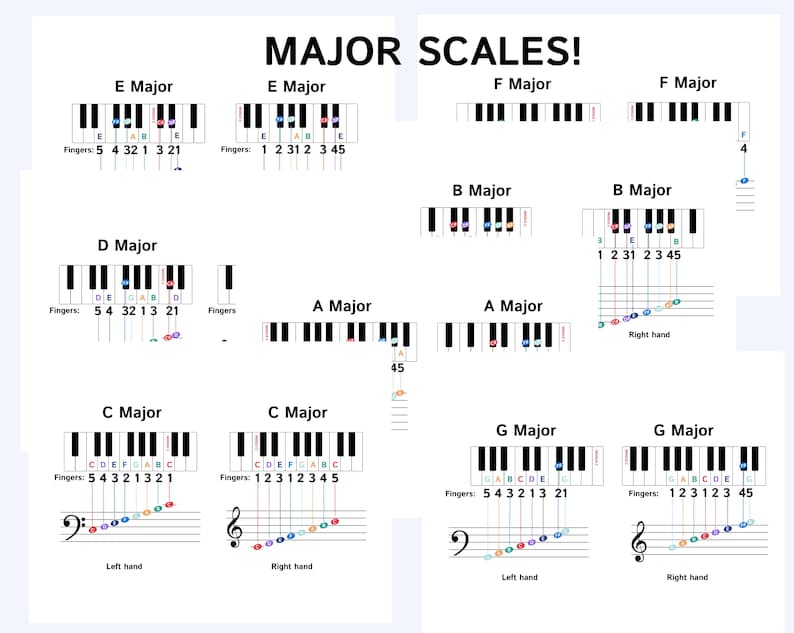
Developing fluid technique requires consistent fingering. Because the F major blues scale involves three consecutive notes (G, Ab, A) that occupy both white and black keys, your fingering must accommodate the "thumb tuck" or "finger cross" efficiently.
Right Hand (RH) Fingering
For a single octave, the most common and ergonomic fingering for the right hand is:
- F: 1 (Thumb)
- G: 2 (Index)
- Ab: 3 (Middle)
- A: 1 (Thumb tucks under to hit the A)
- C: 2 (Index)
- D: 3 (Middle)
- F: 4 (Ring) or 1 (if continuing to the next octave)
Technical Note: Some pianists prefer to play the Ab and A with fingers 3 and 4, then tuck the thumb under to C. However, tucking the thumb under the A (a white key) after playing the Ab (a black key) is generally more stable for fast, fluid runs.
Left Hand (LH) Fingering
The left hand often plays the scale in a lower register, perhaps as a bass line or a melodic fill:
- F: 3 (Middle) or 4 (Ring)
- G: 2 (Index)
- Ab: 1 (Thumb)
- A: 3 (Middle crosses over)
- C: 2 (Index)
- D: 1 (Thumb)
- F: 2 (Index)
Two-Octave Practice
When ascending two octaves in the right hand, use the following pattern: 1 - 2 - 3 - 1 - 2 - 3 - 1 - 2 - 3 - 1 - 2 - 3 - 4 (ending on F). The key is to use the thumb as an anchor on the F and A notes. This allows the hand to stay in a compact, relaxed position.
Comparison: F Major Blues vs. Other Scales
It is vital to distinguish the F major blues scale from its neighbors to avoid harmonic clashing during a performance.
| Feature | F Major Blues Scale | F Minor Blues Scale | F Major Pentatonic |
|---|---|---|---|
| Notes | F, G, Ab, A, C, D | F, Ab, Bb, B, C, Eb | F, G, A, C, D |
| Blue Note | Ab (b3) | B (b5) | None |
| Mood | Bright, Soulful, Country | Dark, Gritty, Aggressive | Clean, Open, Simple |
| Primary Chord | F Major, F7, F6 | F Minor, F7 | F Major, Fmaj7 |
| Key Intervals | 1, 2, b3, 3, 5, 6 | 1, b3, 4, b5, 5, b7 | 1, 2, 3, 5, 6 |
The Relative Connection: D Minor Blues
An advanced insight for 2026 pianists is the "Relative" relationship. The F major blues scale contains the exact same notes as the D minor blues scale (D, F, G, Ab, A, C).
- If you start on D, you are playing D minor blues (Relative Minor).
- If you start on F, you are playing F major blues (Relative Major).
This means that if you have already mastered the D minor blues scale, you technically already know the notes for F major blues. The difference lies entirely in the tonal center—where your phrases begin and end.
Practical Application: Improvising with the F Major Blues Scale
Knowing the scale is only half the battle; knowing where to use it is where the music happens.
1. The "Crushed" Note Technique
One of the most iconic sounds in blues piano is the "grace note" or "crush." In the F major blues scale, you can "flick" the Ab into the A.
- How to do it: Use your second or third finger to strike the Ab and immediately slide off onto the A.
- Why it works: This mimics the "blue notes" of a singer or a guitar player who can bend strings. Since the piano has fixed pitches, this slide creates the illusion of a pitch bend.
2. Playing Over the 12-Bar Blues
In a standard 12-bar blues in the key of F, the chords are usually F7 (I), Bb7 (IV), and C7 (V).
- Over the F7: Use the F major blues scale freely. It sounds "at home" here.
- Over the Bb7: Be careful. The note A (the major third of F) can clash with the Ab (the minor seventh of Bb7). When the chord changes to Bb7, many pianists switch to the F minor blues scale or the Bb major blues scale to better fit the harmony.
- Over the C7: The notes of the F major blues scale generally work, but emphasize the G and C to align with the C7 chord tones.
3. Combining with the F Minor Blues Scale
In professional jazz and blues, players rarely stick to just one scale. A common technique is to mix the F major and F minor blues scales.
- F Major Blues: Use for a "home base" or a country/gospel feel.
- F Minor Blues: Use to add "grit" or "tension," especially during the "turnaround" (the last two bars of a 12-bar cycle).
Practicing the Scale for Fluency
To move beyond robotic up-and-down practice, incorporate these 2026-standard pedagogical exercises:
- The Swing Feel: Instead of playing even eighth notes, play them in a "long-short" rhythm (triplet feel). This is the heartbeat of blues and jazz.
- Sequence Groups of Three: Play F-G-Ab, then G-Ab-A, then Ab-A-C, and so on. This builds finger independence and helps you find melodic cells within the scale.
- Left-Hand Accompaniment: While your right hand explores the F major blues scale, keep a steady "walking bass" or a "shuffle" pattern in the left hand using the F7 chord (F, A, C, Eb).
- Octave Doubling: Practice playing the scale in octaves with both hands. This is a classic "power move" in blues piano used by greats like Oscar Peterson or Otis Spann.
Common Pitfalls to Avoid
Even experienced players can stumble when applying the F major blues scale. Here are the most common mistakes:
- Overusing the Blue Note: The Ab is a "spice." If you play it on every beat, it loses its impact. Use it to lead into the A or as a passing tone.
- Ignoring the 6th (D): The D is what gives the major blues scale its "sweetness." Many players forget it and stick to the first four notes. The 6th is a great note to land on for a "country" resolution.
- Stiff Phrasing: The blues is vocal. If your scale sounds like a Hanon exercise, it isn't blues. Incorporate dynamics, pauses, and syncopation.
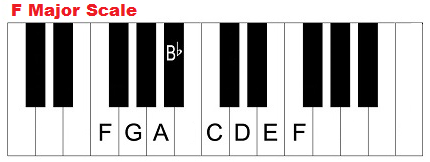
- Confusing with F Major: Remember that the F major scale has a Bb, but the F major blues scale does not. Using a Bb in an F major blues run can make it sound like a standard F major scale, stripping away the "bluesy" character.
Summary Table: F Major Blues Scale Quick Reference
| Attribute | Data |
|---|---|
| Scale Notes | F, G, Ab, A, C, D |
| Scale Degrees | 1, 2, b3, 3, 5, 6 |
| Primary "Blue" Note | Ab (Minor Third) |
| Relative Minor Blues | D Minor Blues |
| Key Signature (F Major) | 1 Flat (Bb) - Note: The scale uses Ab instead |
| Recommended RH Fingering | 1-2-3-1-2-3-4 |
| Best Used Over | F Major, F7, F6, Dm7 |
Frequently Asked Questions
What is the difference between F major pentatonic and F major blues?
The F major pentatonic scale has five notes: F, G, A, C, and D. The F major blues scale adds a sixth note, the Ab (flattened third), which acts as a chromatic passing tone between G and A. This additional note provides the "bluesy" tension that the standard pentatonic scale lacks.
Can I use the F major blues scale over an F minor chord?
Generally, no. The F major blues scale contains a major third (A). Playing a major third over a minor chord (which has an Ab/G# as its third) creates a very sharp dissonance that usually sounds like a mistake rather than a stylistic choice. For F minor chords, use the F minor blues scale instead.
Why is the Ab called the "blue note" in this scale?
In the context of a major key, the minor third (Ab) is an "outside" note. Historically, blues singers would sing a note somewhere between the minor and major third. On a piano, we cannot play "between" keys, so we use the Ab as a representation of that microtonal tension, resolving it quickly to the A.
Is the F major blues scale the same as the "Gospel Scale"?
Yes, in many piano circles, the major blues scale is referred to as the "Gospel Scale." Its bright, triumphant, yet soulful intervals are the foundation of traditional and contemporary gospel piano accompaniment.
How do I make the scale sound more "professional"?
The secret lies in articulation and rhythm. Instead of playing the notes cleanly, try "crushing" the Ab into the A. Also, emphasize the 6th (D) and the 2nd (G) to give your lines a more melodic, less scale-like quality. Using "tremolos" (rapidly alternating between two notes, like F and A) can also add a professional blues texture.
Next Steps for Mastery
To fully integrate the F major blues scale into your playing, your next action should be to apply it to a static F7 groove. Set a metronome to a slow swing tempo (around 80 BPM) and play a simple shell voicing in your left hand (F and Eb). With your right hand, explore the F major blues scale, focusing specifically on the transition between G, Ab, and A.
Once you feel comfortable, attempt to transition between the F major blues scale and the F minor blues scale within the same improvisation. This "intermodal" playing is the hallmark of advanced blues and jazz piano, allowing you to control the emotional temperature of your performance. For further study, listen to recordings of piano legends like Gene Harris or Ramsey Lewis, who were masters of utilizing the "sweet" major blues sound in a jazz context.
Image Gallery
Select an image to open it in a new tab.

Zara El-Hashem
Sociocultural Dynamics and Academics Writer
