
The true shape of the phosphate ion ($PO_4^{3-}$) is tetrahedral, characterized by a central phosphorus atom bonded to four oxygen atoms positioned at the corners of a regular tetrahedron. While Lewis structures often depict a mix of single and double bonds to satisfy formal charge requirements, resonance ensures all four P-O bonds are identical in length and strength.
To understand the phosphate ion, one must look beyond a simple two-dimensional drawing. In the study of molecular chemistry, phosphate serves as a primary example of how the octet rule, formal charge, and valence shell electron pair repulsion (VSEPR) theory converge to define the behavior of hypervalent molecules. As of 2026, the scientific consensus remains that while we use specific Lewis notations for pedagogical clarity, the "true" nature of the ion is a resonance hybrid that results in a perfectly symmetrical geometric solid.
The Fundamentals of the Phosphate Ion ($PO_4^{3-}$)
Before diving into the complexities of its electronic structure, it is essential to define the components of the phosphate ion. Phosphate is a polyatomic ion consisting of one phosphorus atom and four oxygen atoms, carrying a net charge of -3. It is a critical component in biological systems, forming the backbone of DNA and RNA, and playing a central role in energy transfer via Adenosine Triphosphate (ATP).
In a laboratory or educational setting in 2026, determining the Lewis structure is the first step toward predicting the ion's reactivity and physical properties. Phosphorus, located in the third period of the periodic table, possesses the unique ability to "expand" its octet. This means it can accommodate more than eight electrons in its valence shell, a characteristic that is central to the debate over the "correct" Lewis structure for $PO_4^{3-}$.
Calculating Valence Electrons
The construction of any Lewis structure begins with a precise count of valence electrons. For the phosphate ion, the calculation is as follows:
- Phosphorus (P): Being in Group 15 (or VA), phosphorus contributes 5 valence electrons.
- Oxygen (O): There are four oxygen atoms, each in Group 16, contributing 6 electrons. $4 \times 6 = \mathbf{24}$ valence electrons.
- Ionic Charge: The -3 charge indicates that the ion has gained 3 additional electrons.
Total Valence Electrons: $5 + 24 + 3 = \mathbf{32}$ electrons.
These 32 electrons must be distributed to form bonds and lone pairs such that the stability of the ion is maximized.
Constructing the Lewis Structure: Two Competing Models
When drawing the Lewis structure for phosphate, chemists generally encounter two variations: the "Octet Rule" structure and the "Formal Charge Optimized" (Expanded Octet) structure. Understanding the difference between these is key to identifying the "true" representation used in modern chemistry.
The Standard Octet Structure
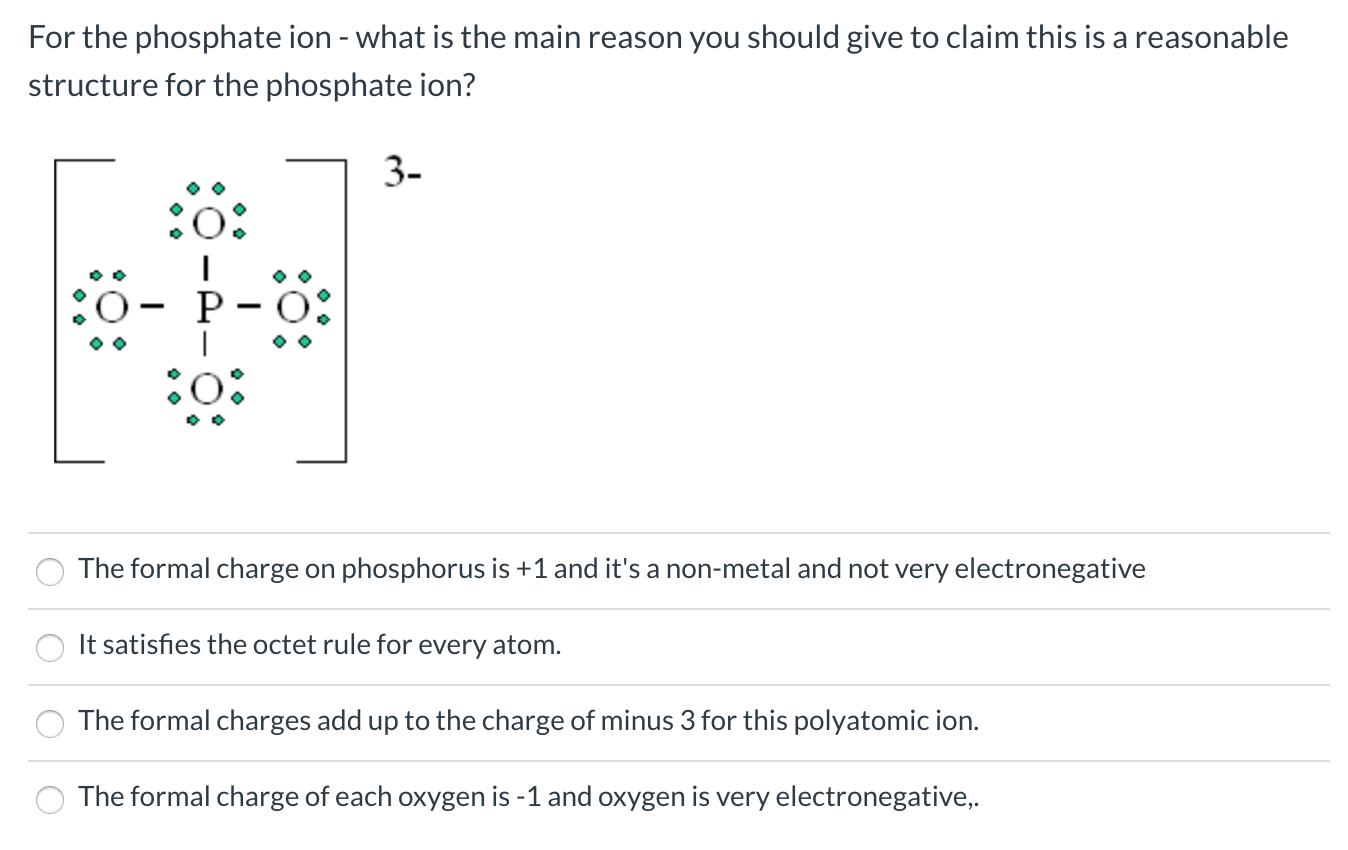
In the simplest model, phosphorus acts as the central atom connected to four oxygen atoms by four single bonds. To complete the octet for each oxygen, three lone pairs are added to each O atom.
- Bonding: 4 single bonds (8 electrons).
- Lone Pairs: 3 pairs on each of the 4 oxygens (24 electrons).
- Total: 32 electrons.
In this model, all atoms satisfy the octet rule. However, a formal charge analysis reveals a significant drawback. The phosphorus atom ends up with a formal charge of +1, and each oxygen atom has a formal charge of -1. While the sum equals -3, the presence of a positive charge on the central atom in an ion that is overall highly negative is often seen as less than ideal in traditional bonding theory.
The Expanded Octet (Formal Charge Optimization)
To minimize the formal charges, one of the lone pairs from an oxygen atom can be moved to form a double bond with phosphorus. Because phosphorus is in the third period, it has access to d-orbitals (in classical theory) or can otherwise accommodate an expanded valence shell of 10 electrons.
- Structure: 1 double bond (P=O) and 3 single bonds (P-O).
- Formal Charge of P: $5 - (0 \text{ lone electrons} + 5 \text{ bonds}) = 0$.
- Formal Charge of Double-Bonded O: $6 - (4 \text{ lone electrons} + 2 \text{ bonds}) = 0$.
- Formal Charge of Single-Bonded O atoms: $6 - (6 \text{ lone electrons} + 1 \text{ bond}) = -1$.
By introducing one double bond, the formal charge on the central phosphorus atom is reduced to zero. Most 2026 chemistry curricula prefer this expanded octet version because it adheres to the principle that structures with formal charges closest to zero are generally more stable and better representations of the molecule's state.
Resonance: The Bridge to Reality
If the expanded octet structure were "fixed," the phosphate ion would be asymmetrical, having one bond shorter than the other three (since double bonds are shorter and stronger than single bonds). However, experimental data, such as X-ray crystallography, consistently shows that all four phosphorus-oxygen bonds are exactly the same length (approximately 1.53 Å).
This is explained by resonance. The double bond does not stay between phosphorus and a specific oxygen atom. Instead, it is delocalized across all four oxygen atoms. The "true" Lewis structure is a resonance hybrid—an average of four equivalent structures where the double bond occupies a different position in each.
In this hybrid state:
- Each P-O bond is roughly a "1.25 bond" (one and a quarter bond).
- The negative charge is distributed equally across all four oxygen atoms.
- The symmetry of the molecule is perfectly preserved.
Molecular Geometry: The VSEPR Perspective
While Lewis structures tell us about electron distribution, VSEPR (Valence Shell Electron Pair Repulsion) theory tells us about the physical shape in three-dimensional space. According to VSEPR theory, electron pairs around a central atom will arrange themselves as far apart as possible to minimize repulsion.
For the phosphate ion, the central phosphorus atom is surrounded by four "electron domains" (the four oxygen atoms). In VSEPR notation, this is an AX4 molecule.
- Electron Geometry: With four domains, the electron geometry is tetrahedral.
- Molecular Geometry: Since there are no lone pairs on the central phosphorus atom to distort the angles, the molecular geometry is also tetrahedral.
- Bond Angles: The ideal bond angle for a regular tetrahedron is 109.5°. Because of the symmetry provided by resonance, the actual bond angles in a phosphate ion are remarkably close to this ideal value.
| Feature | Octet-Rule Structure | Expanded Octet (Resonance Hybrid) |
|---|---|---|
| Central Atom Valence | 8 electrons | 10 electrons |
| Formal Charge (P) | +1 | 0 |
| Formal Charge (O) | -1 (all four) | -0.75 (average) |
| Bond Order | 1.0 (Single bonds) | 1.25 (Partial double bonds) |
| Symmetry | High | Perfect |
| Experimental Accuracy | Low (does not explain bond length) | High (matches bond length data) |
| 3D Shape | Tetrahedral | Tetrahedral |
Technical Depth: The d-Orbital Controversy in 2026
It is worth noting a nuance often discussed in advanced inorganic chemistry. For decades, the expanded octet in phosphorus was explained by the "promotion" of electrons into empty 3d-orbitals. However, modern quantum mechanical calculations (Natural Bond Orbital analysis) suggest that d-orbitals do not participate in bonding to the extent previously thought.
Instead, the "double bond" character is better described by the back-donation of electron density from the lone pairs of the oxygen atoms into the antibonding orbitals ($\sigma^*$) of the P-O single bonds. While this is a high-level distinction, it reinforces the idea that the "true shape" is a result of complex electron delocalization that a 2D Lewis diagram can only approximate. Regardless of the mathematical model used—whether it is p-pi/d-pi bonding or hyperconjugation—the physical result remains a symmetrical tetrahedron.
Step-by-Step Guide to Drawing the Correct Phosphate Structure
If you are tasked with drawing the phosphate Lewis structure for an exam or report, follow these verified steps to ensure accuracy:
- Identify the Center: Place Phosphorus in the center as it is the least electronegative atom (excluding hydrogen, which is not present here).
- Connect the Atoms: Draw four single bonds connecting the P to the four O atoms.
- Distribute Remaining Electrons: Place lone pairs around the oxygen atoms until each has an octet. At this stage, you will have used all 32 valence electrons.
- Evaluate Formal Charges: Calculate the formal charges. You will find P is +1 and all O's are -1.
- Optimize: Move one lone pair from any oxygen atom to form a double bond with phosphorus. This reduces the formal charge of P to 0 and that O to 0.
- Show Resonance: Draw brackets around the entire structure and add a "3-" superscript outside the top right. To be fully accurate, draw the other three resonance structures with double bonds at different positions, connected by double-headed arrows.
- Identify the Shape: State clearly that the shape is tetrahedral with $sp^3$ hybridization on the phosphorus atom.
Frequently Asked Questions
Why does phosphate have a -3 charge?
The -3 charge comes from the balance of protons and electrons. In the Lewis structure, after accounting for the valence electrons of one phosphorus and four oxygens (29 total), the ion requires three additional electrons to achieve its most stable electronic configuration (completing the octets and optimizing formal charges), resulting in 32 valence electrons and a net charge of -3.
Is phosphorus an exception to the octet rule in $PO_4^{3-}$?
Yes. Phosphorus is a period 3 element, meaning it has an expanded valence shell. While it can exist in an octet-satisfying state, it is more stable in the phosphate ion when it forms five bonds (one double, three single), resulting in 10 valence electrons.
What is the hybridization of phosphorus in phosphate?
The phosphorus atom undergoes $sp^3$ hybridization. Even though one of the bonds is a double bond (in the resonance contributors), the VSEPR theory counts the four oxygen "regions" as four equivalent $sp^3$ hybrid orbitals, which creates the tetrahedral geometry.
Are all bonds in phosphate the same length?
Yes. Due to resonance, the double bond is not localized. Each of the four P-O bonds is identical, with a bond order of 1.25. In 2026, high-resolution imaging and spectroscopic data confirm that there is no measurable difference between any of the four bonds in an isolated phosphate ion.
How do bond angles in phosphate compare to water?
The bond angles in phosphate are approximately 109.5°, which is the ideal tetrahedral angle. In contrast, water ($H_2O$) has bond angles of about 104.5°. This is because water has two lone pairs on the central oxygen atom that exert greater repulsion, squeezing the H-O-H bond angle. Phosphate has no lone pairs on the central phosphorus atom, allowing it to maintain perfect tetrahedral symmetry.
Summary and Final Recommendations
The true shape of the phosphate ion is an unbiased tetrahedron. When representing this in a Lewis structure, the most accurate approach is to utilize the expanded octet model featuring one double bond and three single bonds, while acknowledging the resonance that makes all bonds equivalent.
For students and professionals, it is recommended to always check the specific requirements of your field. While most chemical engineering and general chemistry contexts prioritize the formal charge-optimized structure (10 electrons on P), some introductory biology courses may still teach the octet-only version to avoid confusion regarding expanded valency. However, for a 2026 standard of technical accuracy, the resonance hybrid of the expanded octet is the definitive model.
Image Gallery
Select an image to open it in a new tab.



Declan O'Connor
Higher Education and Campus Culture Reporter
