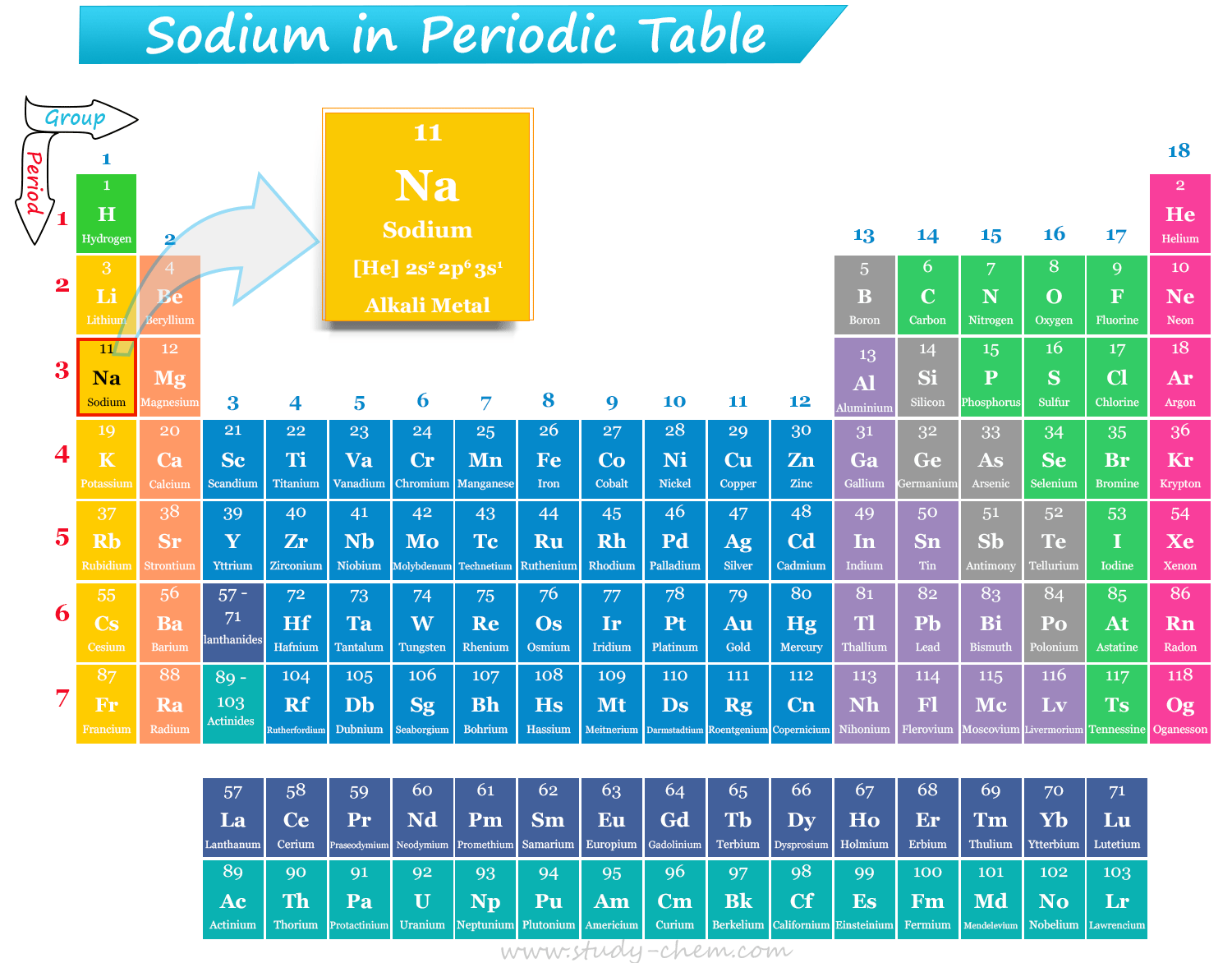
In chemistry, Na is the chemical symbol for sodium, a soft, silvery-white, and highly reactive alkali metal. It is the 11th element on the periodic table, characterized by its single valence electron, which makes it incredibly prone to forming compounds rather than existing as a pure metal in nature.
The presence of sodium is ubiquitous in our daily lives, though we rarely see it in its elemental metallic form. Most people recognize it as a primary component of common table salt (sodium chloride) or as an essential electrolyte in the human body. However, the science behind "Na" extends far beyond the kitchen. From its violent reaction with water to its emerging role in the next generation of battery technology, sodium is a cornerstone of both biological life and industrial progress.
The Origin of the Symbol Na: Why Not "So"?
One of the most frequent questions students ask is why the symbol for sodium is "Na" instead of "S" or "So." The answer lies in the historical development of chemical nomenclature and the linguistic roots of element names.
From Natrium to Sodium
The symbol Na is derived from the Latin word natrium. This term itself evolved from the Greek word nitron, which referred to "natron," a naturally occurring mineral salt (primarily hydrated sodium carbonate) used by ancient Egyptians for mummification and as a cleaning agent.
When the Swedish chemist Jöns Jacob Berzelius established the system of chemical symbols in the early 19th century, he prioritized Latin names to ensure a universal "language of science" that transcended local dialects. While English speakers adopted the name "sodium"—derived from the word "soda"—the scientific community retained the symbol Na to maintain consistency with Berzelius’s Latin-based system.
The Discovery by Humphry Davy
In 1807, Sir Humphry Davy became the first person to isolate pure sodium. He achieved this through the electrolysis of molten caustic soda (sodium hydroxide). Prior to this, scientists knew that substances like sea salt contained a specific metallic base, but the high reactivity of sodium made it impossible to isolate using standard chemical heating methods. Davy's use of electricity provided the necessary energy to break the strong chemical bonds, revealing a metal that was so soft it could be cut with a dull knife and so light it would float on water—before violently reacting with it.
Atomic Structure and the Periodic Table
To understand what Na is in a chemical context, we must look at its position on the periodic table and its internal atomic architecture.
The Alkali Metal Group
Sodium is located in Group 1 (the alkali metals) and Period 3 of the periodic table. As an alkali metal, it shares specific characteristics with elements like lithium (Li) and potassium (K). These elements are defined by having exactly one electron in their outermost shell (valence shell).
Electron Configuration
The atomic number of sodium is 11, meaning it has 11 protons and, in a neutral state, 11 electrons. Its electron configuration is written as [Ne] 3s¹.
- Inner Shells: 10 electrons are arranged in a stable, "closed" configuration resembling the noble gas neon.
- Valence Shell: The 11th electron sits alone in the 3s orbital.
In chemistry, stability is often achieved when an atom has a full outer shell (the octet rule). Because it is much easier for sodium to lose its single outer electron than to gain seven more, sodium is highly "electropositive." It almost always loses that electron to become a sodium cation (Na⁺) with a +1 charge.

Physical Properties of Elemental Sodium
While most of us interact with sodium ions in compounds, the physical properties of the pure metal are fascinating and provide insight into its chemical behavior.
- Appearance and Texture: In its pure form, sodium is a bright, silvery metal. It is remarkably soft; at room temperature, it has a consistency similar to cold butter or wax.
- Density: Sodium has a density of 0.97 g/cm³, which is slightly less than that of water (1.0 g/cm³). This means it will float on the surface of water until the resulting chemical reaction consumes it.
- Conductivity: Like most metals, sodium is an excellent conductor of electricity and heat. This property has led to its use in specialized industrial applications, such as heat transfer fluids in certain types of nuclear reactors.
- Melting and Boiling Points: Sodium has a relatively low melting point for a metal, at approximately 97.8°C (208°F), and boils at 883°C (1,621°F).
Chemical Reactivity: The "Violent" Side of Na
The most famous characteristic of sodium is its extreme reactivity. Because it is so eager to lose its valence electron, it reacts with almost anything that can accept an electron.
Reaction with Water
If a piece of pure sodium is dropped into water, the reaction is immediate and energetic: $2Na(s) + 2H_2O(l) \rightarrow 2NaOH(aq) + H_2(g) + heat$
The reaction produces sodium hydroxide (a strong base) and hydrogen gas. The heat generated is often enough to ignite the hydrogen, causing a fire or an explosion. Because of this, pure sodium must be stored under mineral oil or an inert gas like argon to prevent it from reacting with the moisture in the air.
Reaction with Air
When a fresh surface of sodium is exposed to the atmosphere, it tarnishes almost instantly. It reacts with oxygen to form sodium oxide ($Na_2O$), sodium peroxide ($Na_2O_2$), and eventually reacts with moisture to form a layer of sodium hydroxide. Within minutes, a shiny silver piece of sodium will turn dull white or gray.
Ionic Bond Formation
Sodium's reactivity makes it a perfect partner for the halogens (Group 17), such as chlorine. When sodium (which wants to lose an electron) meets chlorine (which wants to gain one), they undergo a vigorous reaction to form sodium chloride (NaCl). This is a classic example of an ionic bond, where the transfer of an electron creates two oppositely charged ions that are held together by electrostatic forces.
Sodium vs. Other Alkali Metals
The following table compares sodium with its closest "relatives" in Group 1 to illustrate how properties change as you move down the periodic table.
| Property | Lithium (Li) | Sodium (Na) | Potassium (K) |
|---|---|---|---|
| Atomic Number | 3 | 11 | 19 |
| Atomic Mass (u) | 6.94 | 22.99 | 39.10 |
| Melting Point (°C) | 180.5 | 97.8 | 63.5 |
| Density (g/cm³) | 0.53 | 0.97 | 0.86 |
| Reactivity with Water | Moderate (fizzing) | Vigorous (melting/fire) | Violent (instant explosion) |
| Flame Test Color | Crimson Red | Bright Yellow | Lilac/Purple |
As shown, as we move from Lithium to Potassium, the elements generally become more reactive and their melting points decrease. This is because the valence electron is further from the nucleus in heavier elements, making it even easier to "strip away."
Biological Importance: Why We Need Na+
In the biological sciences, "Na" usually refers to the sodium ion ($Na^+$). Sodium is an essential mineral for almost all multicellular life. It is the primary cation in the extracellular fluid (the fluid outside of cells).
Nerve Impulse Transmission
One of the most critical roles of sodium is facilitating nerve impulses. Through the sodium-potassium pump, cells maintain a concentration gradient where sodium is high outside the cell and potassium is high inside. When a nerve fires, channels open, allowing sodium to rush into the cell. This change in electrical charge, known as depolarization, is how signals travel from your brain to your muscles.
Fluid Balance and Blood Pressure
Sodium plays a key role in osmosis—the movement of water across membranes. "Water follows salt." By regulating sodium levels, the kidneys manage the volume of blood in the body. If sodium levels are too high, the body retains more water to dilute it, which increases blood volume and, consequently, blood pressure. This is why medical professionals often recommend low-sodium diets for individuals with hypertension.
Industrial and Modern Applications
Beyond its biological and basic chemical roles, sodium is a powerhouse in modern industry.
The Chlor-Alkali Process
A massive portion of global sodium demand is driven by the production of sodium hydroxide (caustic soda) and chlorine gas. By running an electric current through a brine (saltwater) solution, industries produce these chemicals, which are essential for manufacturing paper, soap, detergents, and aluminum.
Sodium-Ion Batteries (The 2026 Perspective)
As of 2026, sodium-ion batteries have transitioned from a laboratory curiosity to a viable competitor for lithium-ion batteries. While lithium is more energy-dense, it is also more expensive and geographically scarce. Sodium, being one of the most abundant elements on Earth (found in every ocean), offers a much cheaper and more sustainable alternative for stationary energy storage and low-cost electric vehicles. Researchers have overcome earlier hurdles regarding cycle life and charging speeds, making "Na-ion" a buzzword in the green energy sector.
Sodium Vapor Lamps
You may have noticed streetlights that emit a distinct, warm yellow glow. These are often high-pressure sodium vapor lamps. When sodium atoms are excited by electricity, they emit light at a specific wavelength (approximately 589 nanometers). This "sodium D-line" is so distinct that it is used by astronomers to identify the presence of sodium in the atmospheres of distant stars.
Safety and Handling of Sodium
Because of its reactivity, handling elemental sodium requires specialized training and equipment. It is classified as a hazardous material (specifically a water-reactive flammable solid).
- Storage: Sodium must be kept in airtight containers, submerged in an inert liquid like mineral oil or kerosene.
- Fire Suppression: Standard water-based fire extinguishers are deadly when used on a sodium fire. They will only cause an explosion. Instead, "Class D" dry powder extinguishers (typically containing sodium chloride or graphite) must be used to smother the flames.
- Personal Protection: When working with sodium in a lab, high-grade eye protection and moisture-free gloves are mandatory. Any contact with the skin can result in "caustic burns" as the metal reacts with the moisture in the skin to produce sodium hydroxide.
Frequently Asked Questions
1. Is sodium the same thing as salt?
No. Sodium (Na) is a highly reactive metal, while salt (Sodium Chloride, NaCl) is a stable ionic compound. Salt is 39.3% sodium by weight, with the rest being chlorine. When people talk about "sodium in their diet," they are usually referring to the sodium ions found in salt.
2. Can you find pure sodium in nature?
No. Because sodium is so reactive, it is never found in its elemental form in nature. It is always bound to other elements in compounds like halite (rock salt), trona, or sylvite.
3. Why does sodium turn yellow in a flame?
This is due to the excitation of its electrons. When sodium is heated, its outer electron jumps to a higher energy level. When it falls back down to its "ground state," it releases energy in the form of light. For sodium, this energy corresponds exactly to the yellow-orange part of the visible spectrum.
4. What happens if a human body has too little sodium?
This condition is called hyponatremia. It can lead to headaches, confusion, seizures, and in extreme cases, it can be fatal. It often occurs due to excessive sweating, overhydration with plain water during intense exercise, or certain kidney conditions.
5. Why is sodium used in nuclear reactors?
Liquid sodium is used as a coolant in "fast breeder" reactors because it has a high thermal conductivity and a high boiling point. This allows the reactor to operate at high temperatures without needing high-pressure systems, which can be a safety advantage in specific designs.
Final Recommendation
For students and educators, the best way to master the concept of "Na" is to bridge the gap between its atomic theory and its physical reality. Understand that its position in Group 1 dictates its reactivity, and its reactivity explains why we only find it in compounds like NaCl. If you are a laboratory professional or an enthusiast, always prioritize safety protocols: never handle sodium with bare hands and always ensure your storage oil is free of moisture. As we move further into 2026, keep an eye on sodium-ion battery developments, as this "ancient" element is poised to solve many of our modern energy storage challenges.
Image Gallery
Select an image to open it in a new tab.

Declan O'Connor
Higher Education and Campus Culture Reporter
