
A program of study is a comprehensive, structured sequence of academic and career-technical courses designed to transition a student from secondary education into post-secondary education and the workforce. It outlines specific required courses, electives, industry-recognized certifications, and degree pathways to ensure students meet specific career and educational goals efficiently.
The Foundational Definition of a Program of Study
In the landscape of modern education in 2026, a Program of Study (POS) is far more than a simple list of classes. It represents a coordinated effort between high schools, colleges, and industry partners to create a seamless roadmap for student success. While often associated with Career and Technical Education (CTE), the principles of a POS apply to any disciplined academic pursuit.
At its core, a program of study serves as a visual and functional guide. It bridges the gap between different levels of education, ensuring that a student does not repeat coursework unnecessarily and that every class taken contributes toward a final credential, such as an Associate degree, a Bachelor’s degree, or a professional certification. Under the federal guidelines of the Perkins V Act (Strengthening Career and Technical Education for the 21st Century Act), a POS must be non-duplicative, include challenging academic and technical standards, and lead to an industry-recognized credential or a post-secondary degree.
For a student, a program of study answers the question: "What do I need to do now to get the job I want later?" For an administrator, it provides the framework for curriculum alignment and resource allocation. By 2026, these documents have become increasingly digital and interactive, often linked to real-time labor market data to ensure the pathways offered lead to high-wage, high-demand careers.
The Essential Components of a Professional Program of Study
To be effective, a program of study must contain specific elements that guide the user through their educational journey. Without these components, a document is merely a course catalog, which lacks the intentional sequencing required for a true POS.
1. Secondary Course Sequences
The secondary portion of a POS typically covers grades 9 through 12. It includes the standard core academic requirements—such as English, Mathematics, Science, and Social Studies—but weaves in technical electives that begin as early as the freshman year. These electives are sequenced; they start with introductory "foundation" courses and progress to advanced "capstone" courses.
2. Post-Secondary Alignment
One of the most critical features of a POS is the explicit link to post-secondary education. This might include community colleges, technical institutes, or four-year universities. The document should clearly state which courses at the high school level qualify for articulated credit or dual enrollment, allowing students to earn college credits before they even graduate high school.
3. Industry-Recognized Credentials
In 2026, the value of a degree is often supplemented by specific certifications. A high-quality program of study identifies exactly which certifications a student can earn at various stages. For example, in an Information Technology POS, a student might earn a CompTIA A+ certification in 11th grade and a Cisco Certified Network Associate (CCNA) certification by the end of their first year of college.
4. Work-Based Learning Opportunities
A program of study is not limited to the classroom. It incorporates practical experiences such as internships, apprenticeships, and job shadowing. These opportunities are mapped to the curriculum so that the "real-world" experience reinforces the theoretical knowledge gained in school.
5. Labor Market Justification
Modern programs of study are frequently accompanied by data showing the projected growth and average salary of the targeted career field. This ensures that students are not being funneled into "dead-end" pathways but are instead preparing for roles that will exist and pay well upon their graduation.
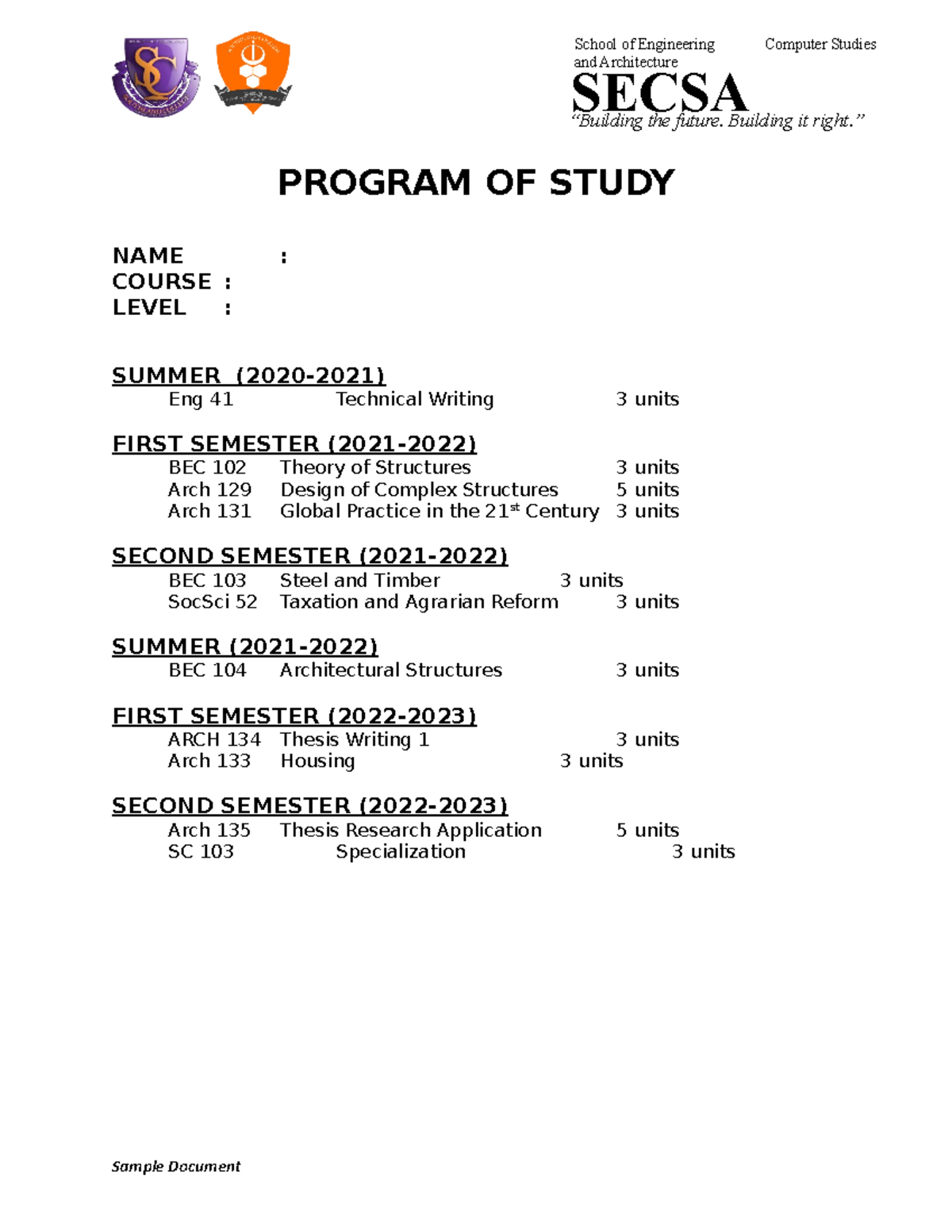
A Program of Study Sample Explained: Information Technology (Cybersecurity)
To understand how these components work in practice, let’s analyze a sample program of study for a student interested in Cybersecurity. This pathway is particularly relevant in 2026 as digital infrastructure protection remains a top national priority.
The Secondary Phase (Grades 9–12)
In the first two years (9th and 10th grades), the student focuses on "Foundation" courses. This includes Computer Science Essentials and Introduction to Networking. These classes satisfy elective requirements while building the technical vocabulary needed for advanced study.
In the 11th and 12th grades, the sequence becomes more specialized. The student takes Cybersecurity I and Cybersecurity II. During the senior year, the program might include a Capstone Project where the student conducts a vulnerability assessment for a local small business. Simultaneously, the student is taking Advanced Placement (AP) Statistics, as data analysis is a core component of modern security.
The Post-Secondary Transition
The sample POS clearly indicates that the "Cybersecurity II" high school course is articulated with "CYS 101: Introduction to Cyber Defense" at the local community college. This means the student enters college with 3 credits already completed. The document then maps out the remaining courses for an Associate of Applied Science (AAS) in Cybersecurity, leading eventually to a Bachelor of Science (BS) at a partner university.
Credentialing Milestones
The roadmap highlights three specific milestones:
- Grade 11: Test for CompTIA Security+ certification.
- Grade 12: Test for Certified Ethical Hacker (CEH) Associate.
- Post-Secondary Year 2: Test for CISSP (Certified Information Systems Security Professional) Associate.
Comparative Analysis: Program of Study vs. Traditional Academic Track
| Feature | Traditional Academic Track | Structured Program of Study (POS) |
|---|---|---|
| Focus | General education and college prep | Career-themed integrated education |
| Course Sequencing | Disconnected electives | Intentional, non-duplicative sequence |
| College Credit | AP or IB exams primarily | Articulated credit, Dual Enrollment, and AP |
| Industry Relevance | Theoretical knowledge | Direct alignment with industry standards |
| Outcome | High school diploma | Diploma + Certification + College Credit |
| Work Experience | Often absent or unrelated | Integrated work-based learning/internships |
How to Read and Evaluate a Program of Study Document
When a student or parent is presented with a program of study sample, it can be overwhelming. To evaluate the document effectively, one must look beyond the names of the classes and investigate the underlying "why" and "how."
Check for Seamless Transition
Look at the transition point between 12th grade and the first year of college. Is there a gap? A well-designed POS will have a clear "bridge." If the high school offers a course in "Advanced Welding" but the local college requires "Welding 101" without credit for the high school work, the program of study is poorly aligned. A high-quality sample will show that the student moves forward, not backward.
Verify the "High-Demand" Claim
In 2026, educational institutions must justify their programs with economic data. Does the program of study mention the Standard Occupational Classification (SOC) codes or provide links to the Bureau of Labor Statistics (BLS)? A sample that lacks this context may be preparing students for a field that is shrinking or automated.
Analyze the Academic Rigor
A common misconception is that programs of study, especially in CTE, are "easier" than traditional tracks. A valid sample should prove otherwise. It should show that the student is taking rigorous math and science courses that complement their technical training. For instance, a Health Sciences POS should require Chemistry and Anatomy, not just "Introduction to Healthcare."
Common Mistakes When Developing or Choosing a POS
Even with a clear sample, errors in implementation can lead to wasted time and resources. Understanding these pitfalls is essential for students, counselors, and administrators.
1. Over-Specializing Too Early
While a POS is designed to provide a path, it shouldn't be a cage. A mistake often seen in early versions of these documents was forcing a 14-year-old to commit to a highly specific niche (like "Underwater Welding") without providing the broader skills needed to pivot to a related field (like "General Structural Welding") if their interests change.
2. Failing to Update for Technology Shifts
In a 2026 context, technology evolves faster than curriculum. A program of study sample for "Automotive Technology" that doesn't heavily feature Electric Vehicle (EV) diagnostics and software management is outdated. Users must ensure the POS is reviewed annually by an Industry Advisory Committee.
3. Ignoring Soft Skills (Employability Skills)
Technical prowess is only half the battle. A program of study that does not explicitly include "Professionalism," "Communication," or "Ethics" in its curriculum is doing a disservice to the student. The best samples include these "soft skills" within the capstone experiences or as integrated parts of the technical courses.
The Role of Articulation Agreements in a Program of Study
An Articulation Agreement is the legal backbone of a program of study. It is a formal contract between two educational institutions (typically a secondary school and a college) that defines how credits will transfer.
When reviewing a sample POS, look for a section or a footnote regarding these agreements. There are two main types:
- Standard Articulation: The student must provide a transcript, and the college evaluates the courses one-by-one.
- Advanced Standing / Transcripted Credit: The student takes a college-level course taught at the high school, and the grade appears directly on a college transcript.
The presence of transcripted credit is a hallmark of a "Gold Standard" program of study. It provides the student with immediate, portable evidence of college-level mastery, which significantly reduces the cost of a degree. In 2026, many states have moved toward "Statewide Articulation Agreements," where any student completing a state-approved POS is guaranteed credit at any public college within that state.
Strategic Benefits for Different Stakeholders
For Students and Parents
The primary benefit is clarity and cost-reduction. By following a sample program of study, a family can calculate exactly how many college credits will be earned for free or at a reduced rate during high school. This can often shave an entire semester or even a year off a four-year degree, saving thousands of dollars in 2026 tuition rates.
For Educators and Counselors
A POS simplifies the advisement process. Instead of picking random electives, counselors can help students choose a "major" early on. This leads to higher student engagement because the student sees the direct relevance of their schoolwork to their future career.
For Industry and Employers
Employers benefit from a pipeline of graduates who possess the exact skills the industry needs. In many regions, local businesses help write the program of study to ensure that the equipment and software used in the classroom match what is used in the field. This reduces "onboarding" time for new hires.
Frequently Asked Questions
What is the difference between a Program of Study and a Career Pathway?
While the terms are often used interchangeably, a Career Pathway is the broader concept of an industry sector (e.g., "Health Sciences"). A Program of Study is the specific, localized document that lists the exact courses and credits a student takes within that pathway at their specific school and college.
Can a student change their Program of Study once they start?
Yes. A well-designed system allows for "on-ramps" and "off-ramps." The foundation courses in the 9th and 10th grades are often similar across related pathways, allowing students to switch specialties without losing all their progress.
Does a Program of Study lead only to vocational jobs?
No. While POS is a cornerstone of Career and Technical Education, it is used for high-level professional careers including Engineering, Biomedical Research, and Law. The goal is to provide a path to any career that requires a structured educational sequence.
Are programs of study only for high school students?
While they often start in high school, a POS can begin in adult education centers or at the post-secondary level for "non-traditional" students returning to school to re-skill for the 2026 economy.
How do I find the Program of Study for my local school?
Most schools publish their "Program of Study" or "CTE Pathways" on their website under the "Academics" or "Guidance" section. You can also look for your state’s Department of Education CTE portal, which usually hosts templates for state-approved programs.
Practical Recommendation for Next Actions
If you are a student or parent, your first step should be to request a meeting with a school counselor specifically to ask for the "Program of Study" maps available at your institution. Do not simply look at a list of available classes; ask for the document that shows the 9-14 or 9-16 sequence (High School through College).
Once you have the sample, verify the articulation agreements. Contact the admissions office of the college listed on the POS to confirm that they still honor the credits described in the document. Finally, look at the required industry certifications and research their current value on job boards like LinkedIn or Indeed to ensure that the pathway aligns with the current 2026 labor market needs. By taking these steps, you ensure that the time spent in the classroom is an investment that will yield a measurable professional return.
Image Gallery
Select an image to open it in a new tab.
Omar Farooq
EdTech Innovation and Virtual Pedagogy Journalist
