Riba is an Arabic term that translates literally to "increase," "growth," or "excess." In Islamic jurisprudence (Sharia), it refers to the exploitative gain made in trade or business under Islamic law. It is most commonly equated with interest charged on loans or the unlawful excess in the exchange of specific commodities.
The prohibition of riba is one of the most significant aspects of Islamic economics. Unlike conventional financial systems where interest is a fundamental pillar, Islam views riba as a mechanism of social and economic injustice. By 2026, the global Islamic finance market has expanded significantly, driven by a growing demand for ethical, interest-free alternatives that align with these foundational religious principles.
The Linguistic and Technical Definition of Riba
To understand riba, one must distinguish between its linguistic meaning and its technical application in Sharia. Linguistically, the root word r-b-w implies to grow or rise. However, in a legal context, riba is defined as an unjustified increase in capital for which no "equal counter-value" is provided to the other party.
In Islamic tradition, money is not considered a commodity. Instead, it is a medium of exchange and a measure of value. Because money itself has no intrinsic utility, it cannot be sold for more money (interest) unless it is backed by a productive economic activity or trade. This distinction is vital: Islam permits profit from trade (al-bay’) but strictly forbids profit from lending (riba).
The Philosophical Basis of Prohibition
The prohibition of riba is rooted in the pursuit of adl (justice) and ihsan (benevolence). In an interest-based system, the lender is guaranteed a return regardless of whether the borrower succeeds or fails in their venture. This creates an imbalance of risk. Islamic finance seeks to distribute risk more equitably between the capital provider and the entrepreneur, ensuring that wealth is generated through effort and shared risk rather than through the mere passage of time.
The Two Primary Categories of Riba
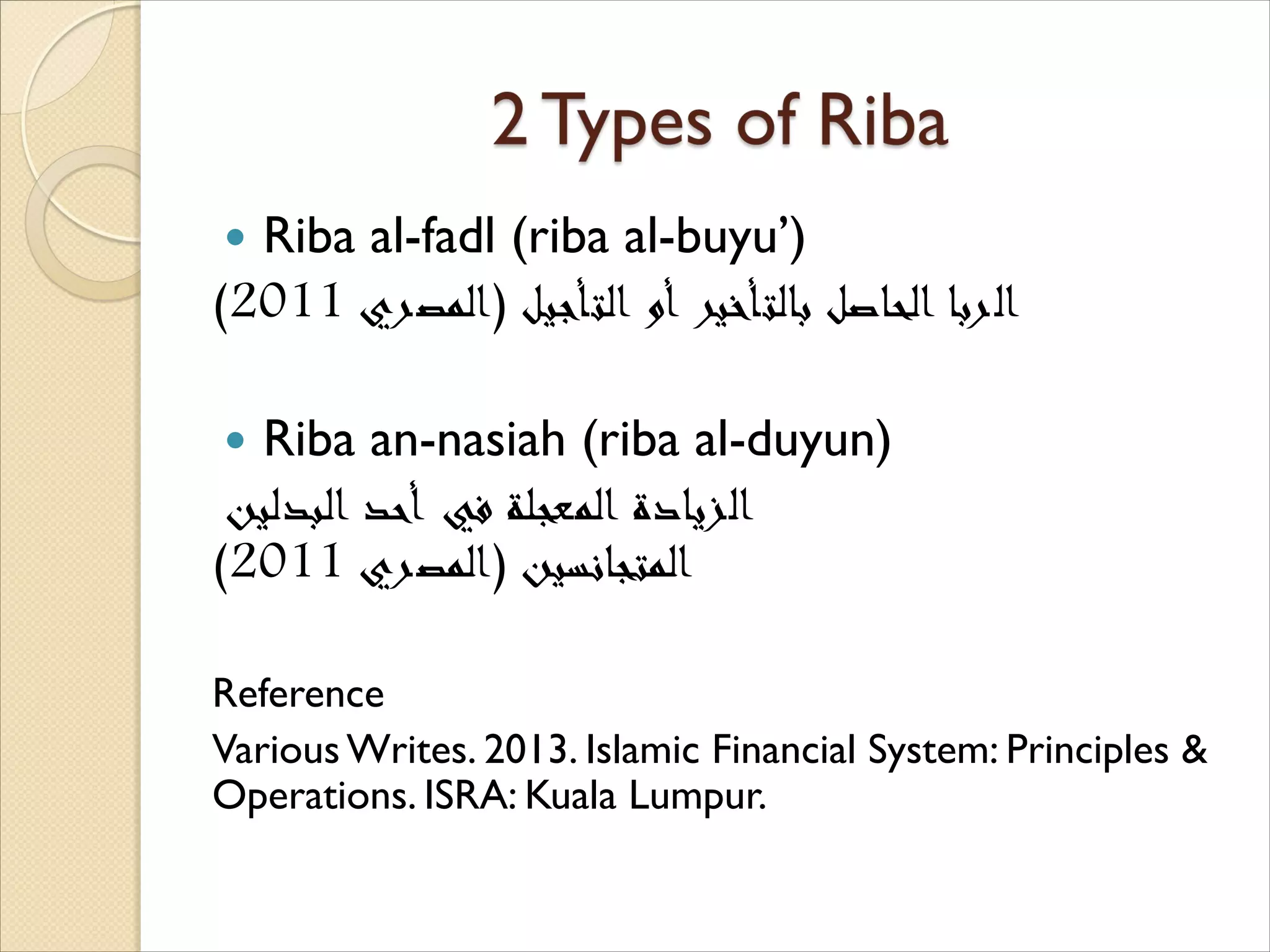
Classical Islamic scholars have categorized riba into two main types: Riba al-Nasi'ah and Riba al-Fadl. Understanding the difference between these is essential for anyone navigating Sharia-compliant financial transactions in 2026.
1. Riba al-Nasi'ah (Riba of Delay)
This is the primary form of riba mentioned in the Quran and is often referred to as Riba al-Quran. It occurs in a loan transaction where an "excess" is charged over the principal amount in exchange for the time or delay allowed for repayment.
- Mechanism: If an individual borrows $1,000 and is required to pay back $1,100 after one year, the $100 "excess" is Riba al-Nasi'ah.
- Modern Equivalence: This includes almost all forms of interest found in conventional banking, such as personal loans, credit card interest, and traditional mortgages.
- The Problem: It exploits the borrower's need and allows the lender to accumulate wealth without engaging in a productive or risk-bearing economic activity.
2. Riba al-Fadl (Riba of Surplus)
This type of riba occurs during the simultaneous exchange of certain commodities. It is also known as Riba al-Hadith because its prohibition is primarily derived from the sayings and traditions of the Prophet Muhammad (PBUH).
The Prophet (PBUH) identified six specific commodities (Ribawi goods):
- Gold
- Silver
- Wheat
- Barley
- Dates
- Salt
The rule is that if these items are exchanged for the same kind (e.g., gold for gold), they must be equal in weight/measure and the exchange must be hand-to-hand (instantaneous). If one party gives 10 grams of high-quality gold for 12 grams of lower-quality gold, the extra 2 grams is Riba al-Fadl.
- The Rationale: This rule prevents "back-door" interest. It ensures that transactions are transparent and that quality differences are reflected in price (selling the gold for cash and then buying the other gold) rather than through unequal direct exchange.
Riba vs. Trade: A Critical Distinction
A common argument encountered by scholars is that "trade is just like riba" because both result in a profit. The Quran explicitly addresses this in Surah Al-Baqarah (2:275), stating: "Allah has permitted trade and has forbidden riba."
| Feature | Trade (Al-Bay’) | Riba (Interest) |
|---|---|---|
| Risk Factor | The seller assumes the risk of the asset losing value or not being sold. | The lender assumes no risk of the borrower’s business failure. |
| Asset Base | Must involve a tangible asset or service. | Involves the exchange of money for money. |
| Profit Generation | Profit is earned through value addition or market movement. | Profit is earned through the passage of time. |
| Social Impact | Encourages investment in productive sectors. | Can lead to debt traps and wealth concentration. |
| Contractual Nature | Exchange of ownership. | A debt obligation with a fixed growth. |
In trade, the buyer and seller enter an agreement where the price is fixed for the transfer of goods. If the merchant buys a product for $10 and sells it for $15, the $5 profit is a reward for the merchant's effort, risk, and the service of making the product available. In riba, the money "grows" simply by being absent from the owner's pocket, which is seen as an unnatural and exploitative function of currency.
The Quranic Stages of Prohibition
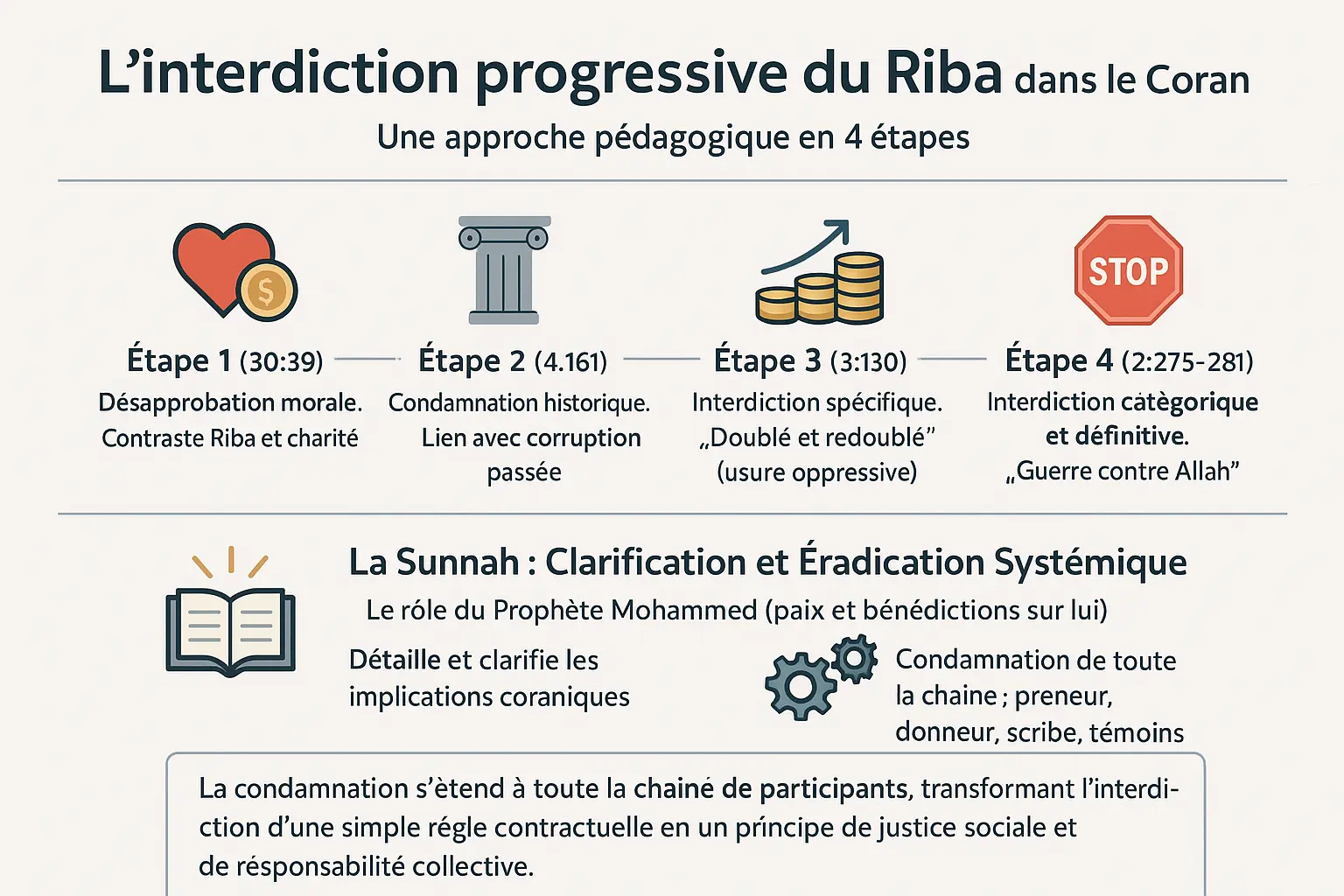
The prohibition of riba was not revealed in a single instance but was introduced in stages, similar to the prohibition of intoxicants. This allowed the early Muslim community to gradually restructure their economy.
- First Stage (Surah Ar-Rum, 30:39): This verse noted that while riba might seem to increase wealth, it has no blessing with God, whereas Zakat (charity) brings true growth.
- Second Stage (Surah An-Nisa, 4:161): Riba was condemned as a practice of previous communities who were punished for wrongfully consuming the wealth of others.
- Third Stage (Surah Al-Imran, 3:130): This stage prohibited "doubled and multiplied" riba, which was common in pre-Islamic Arabia where debts would double if not paid on time.
- Fourth Stage (Surah Al-Baqarah, 2:275-281): The final and most severe prohibition. It declared riba to be a "war against Allah and His Messenger" and commanded believers to give up all outstanding interest.
Modern Financial Challenges and Sharia Alternatives
In the globalized economy of 2026, avoiding riba requires a proactive approach. Traditional banking systems are built on interest-based lending, which creates a significant challenge for Muslims seeking to remain compliant with their faith. To address this, Islamic Finance has developed several structures that provide the same utility as conventional products without the element of riba.
Islamic Mortgages (Murabaha and Ijarah)
Instead of lending money at interest to buy a house, an Islamic bank might use a Murabaha (cost-plus-profit) structure. The bank buys the house and sells it to the client at a higher price, which is paid in installments. Because the bank owns the asset momentarily and assumes the risk of purchase, the profit is considered legitimate trade. Alternatively, Ijarah (lease-to-own) allows the bank to rent the property to the client until the client eventually buys out the bank's share.
Profit and Loss Sharing (Mudarabah and Musharakah)
These are the "ideal" forms of Islamic finance. In a Musharakah (partnership), both the bank and the client contribute capital to a project and share profits based on a pre-agreed ratio, while losses are shared according to the capital contribution. This ensures that the financier is an active participant in the economic outcome, rather than a passive recipient of interest.
The Role of Sukuk (Islamic Bonds)
While conventional bonds represent a debt obligation with interest, Sukuk represent a partial ownership in a tangible asset or project. The "interest" paid to Sukuk holders is actually a share of the profit generated by the underlying asset.
Common Misconceptions About Riba
As the world moves deeper into 2026, certain myths about riba persist. It is important to clarify these using established Islamic scholarship.
1. Is Riba only "excessive" interest (Usury)? Some argue that the Quran only forbids predatory interest rates. However, the consensus of the majority of Islamic scholars throughout history—and reaffirmed by modern bodies like the International Islamic Fiqh Academy—is that any amount of interest, regardless of the rate, is considered riba.
2. Does inflation justify interest? A frequent question is whether a lender can charge interest to cover the loss of purchasing power due to inflation. While this is a real economic concern, most Sharia boards argue that money is fungible. If you lend 1,000 units of currency, you are entitled to 1,000 units back. To mitigate inflation, scholars recommend using gold-backed transactions or commodity-based contracts rather than adding an interest percentage.
3. Is interest on business loans allowed? Some suggest that riba only applies to "consumption" loans (like buying food) and not "production" loans (business investment). This distinction is not found in the primary sources of Sharia. The prohibition is universal, regardless of the purpose of the loan.
Legal and Regulatory Landscape in 2026
The regulation of riba-free finance has become highly sophisticated. Organizations like the Accounting and Auditing Organization for Islamic Financial Institutions (AAOIFI) set international standards that ensure Islamic banks are not merely "rebranding" interest. In 2026, many non-Muslim-majority countries, including the UK and Singapore, have established legal frameworks to accommodate Sharia-compliant finance, recognizing its resilience during global financial crises.
The focus on Environmental, Social, and Governance (ESG) criteria in 2026 has further aligned Islamic finance with global ethical investing trends. Since riba is viewed as socially corrosive, its exclusion naturally pushes investors toward more sustainable and socially responsible ventures.
Frequently Asked Questions
What is the difference between riba and profit?
Profit is the result of a trade or investment where risk is involved and value is added. Riba is a fixed return on a loan of money where the lender bears no risk of the borrower's loss. In Islam, the entitlement to profit is linked to the liability for loss.
Are credit cards allowed in Islam?
Credit cards are permissible only if the balance is paid in full before any interest is charged. Most Islamic scholars advise caution, as the contract itself contains a clause agreeing to pay riba if a payment is missed. Many now opt for "Islamic Credit Cards" which use a fee-based structure instead of interest.
Can a Muslim work in a conventional bank?
This is a complex issue. Generally, many scholars consider working in departments directly involved in calculating or promoting interest (like loan processing) to be prohibited. However, roles in maintenance, security, or non-interest-related sectors are often viewed with more leniency, though seeking employment in a Sharia-compliant institution is always the recommended path.
Is interest from a savings account haram?
Yes, the interest generated in a conventional savings account is considered riba. Many Muslims donate this interest to charity to "purify" their wealth, though they cannot claim any spiritual reward for the donation itself, as the money was not rightfully earned.
Is student loan interest considered riba?
Yes, student loans that accrue interest fall under the definition of Riba al-Nasi'ah. In many jurisdictions, Islamic organizations have worked to create "Qard al-Hasan" (benevolent loan) funds or Sharia-compliant alternative student finance to help students avoid interest-bearing debt.
Practical Recommendations for 2026
For individuals and businesses looking to navigate the modern economy without engaging in riba, several practical steps are available:
- Audit Your Finances: Review all bank accounts, mortgages, and insurance policies. Identify any interest-bearing components and research Sharia-compliant alternatives.
- Utilize Islamic Banking: Switch to Islamic banks or "windows" of conventional banks that are certified by a reputable Sharia board.
- Invest Ethically: Use Sharia-compliant investment platforms that screen for riba and prohibited industries (like gambling or alcohol). In 2026, many robo-advisors offer "Halal" portfolios.
- Consult Experts: Islamic finance is a technical field. If you are unsure about a contract or investment, consult a qualified scholar who specializes in Muamalat (Islamic transactions).
- Focus on Equity, Not Debt: When starting a business, look for equity partners or venture capital rather than traditional bank loans. This not only avoids riba but often provides better long-term support for the business.
By understanding the deep moral and economic underpinnings of the prohibition of riba, individuals can make informed choices that contribute to a more just and equitable financial system.
Image Gallery
Select an image to open it in a new tab.



Vivian Cho
Executive IT and Emerging Technologies Reporter
