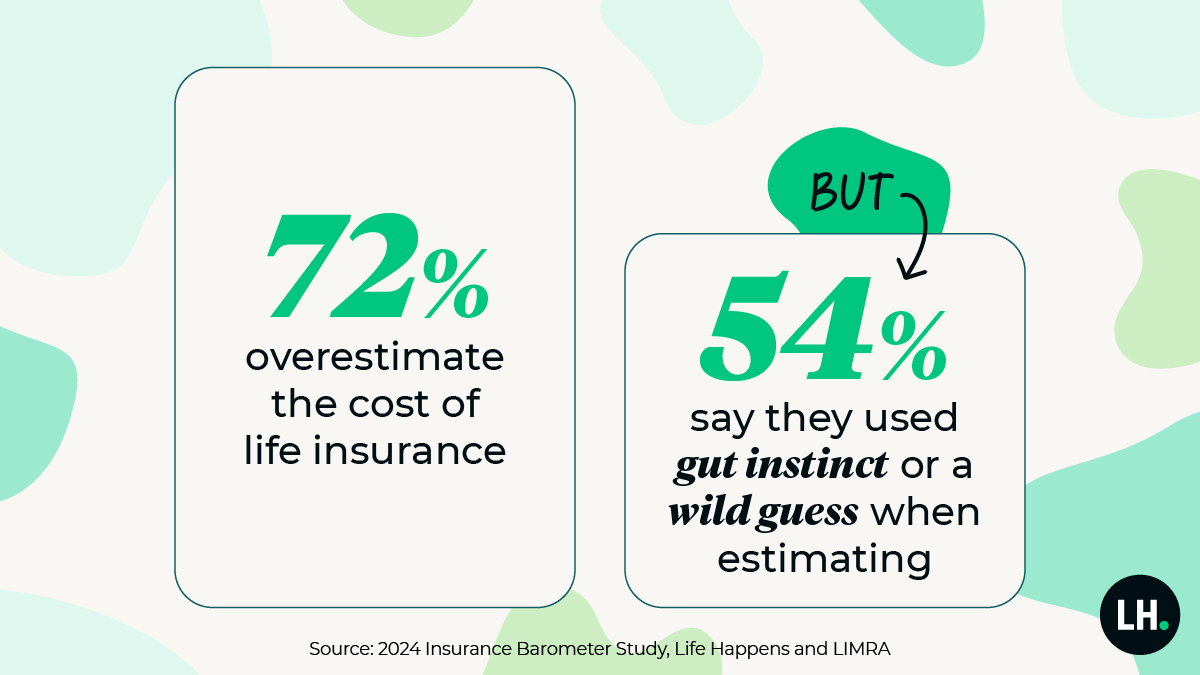
Many individuals overestimate life insurance costs because they frequently confuse affordable term policies with more expensive permanent options. Consumer research consistently shows that people guess premiums are three times higher than actual market rates. This gap stems from a lack of exposure to modern underwriting, confusion over product types, and historical marketing that focused on high-premium investment-linked coverage.
The Magnitude of the Perception Gap
The discrepancy between what life insurance actually costs and what the public perceives it to cost is one of the most persistent hurdles in financial planning. According to longitudinal studies from organizations like LIMRA and Life Happens, which have continued to track these trends into 2026, approximately half of the population believes life insurance is too expensive to fit into their monthly budget. However, when asked to estimate the annual premium for a $250,000 term life policy for a healthy 30-year-old, the median guess is often $1,000 or more, while the actual cost is frequently closer to $160 to $200 per year.
This "perception gap" is not merely a statistical curiosity; it has real-world consequences for family financial security. When individuals believe a product is out of financial reach, they stop researching it entirely. This avoidance behavior prevents them from discovering the competitive nature of the 2026 insurance market, where digital-first providers and algorithmic underwriting have significantly driven down the administrative costs of issuing policies.
Confusion Between Term and Permanent Life Insurance
One of the primary drivers of cost overestimation is the failure to distinguish between term life insurance and permanent (whole or universal) life insurance. These products serve different financial goals and carry vastly different price tags.
Term Life Insurance: Pure Protection
Term life insurance is designed to provide coverage for a specific period, such as 10, 20, or 30 years. It does not have a cash value component; it is "pure" insurance. Because the insurer only pays a benefit if the insured passes away during the term, the premiums are exceptionally low. For most young families, term insurance is the most logical choice to cover "decreasing liabilities" like a mortgage or the years until children reach adulthood.
Permanent Life Insurance: Protection Plus Investment
Permanent life insurance, including whole life and variable universal life, is designed to last the insured's entire lifetime and includes a "cash value" accumulation component. A portion of the premium goes toward the insurance cost, while another portion is invested. Because these policies are guaranteed to pay out eventually (provided premiums are paid) and include an investment vehicle, they can be 5 to 15 times more expensive than term insurance for the same death benefit.
When people hear a "life insurance quote" from a neighbor or a television advertisement for "final expense" or "whole life" coverage, they often apply that high price point to all insurance products. They assume that if a $50,000 whole life policy costs $100 a month, a $500,000 policy must be unaffordable, not realizing that a $500,000 term policy might actually cost less than the smaller whole life plan.

The Role of Anchoring Bias and Historical Marketing
Cognitive psychology plays a significant role in how insurance costs are perceived. Anchoring bias occurs when an individual relies too heavily on an initial piece of information—the "anchor"—when making decisions. Historically, the life insurance industry relied heavily on "captive agents" who were incentivized to sell high-commission permanent policies. Decades of marketing focused on life insurance as a "savings vehicle" or "retirement supplement" created a public anchor of high cost.
Even as the market shifted toward lower-cost term products in the late 20th and early 21st centuries, the cultural memory of life insurance as a significant monthly expense remained. Furthermore, many people associate life insurance with "Final Expense" plans marketed to seniors. These plans have high premiums relative to their small death benefits because they are often "guaranteed issue" (no medical exam required) for high-risk age groups. A young adult seeing an ad for a $10,000 policy costing $50 a month for a 70-year-old may incorrectly scale that cost up for their own $1,000,000 coverage needs.
Misunderstanding the Modern Underwriting Process
In 2026, the process of determining an individual's risk—known as underwriting—has undergone a radical transformation. Many people still believe that getting life insurance requires a "paramedical exam," involving blood draws, urine samples, and an invasive physical. This perception creates a mental barrier that associates the product with high-effort, high-cost medical services.
Accelerated and Algorithmic Underwriting
Modern insurers now utilize Accelerated Underwriting (AU). By leveraging vast data sets, including prescription drug histories, motor vehicle records, and even credit-based insurance scores, companies can often approve a policy in minutes without a medical exam.
This shift has two effects on cost:
- Operational Efficiency: Insurers save hundreds of dollars per application by not sending nurses to homes. These savings are passed to the consumer.
- Risk Accuracy: Better data allows for more "Preferred Plus" ratings, which offer the lowest possible premiums to healthy individuals.
People who have not checked prices in the last five to ten years are often unaware that their "perceived" health risks might not be as detrimental to their premiums as they once were. For example, individuals with well-managed hypertension or mild anxiety may now qualify for standard or even preferred rates that were previously unavailable.
The Impact of Age and Health on Perceived Barriers
There is a common misconception that life insurance is only for the "perfectly healthy." This leads many people to assume that any minor health issue—such as being slightly overweight or having high cholesterol—will double or triple their premiums. In reality, the insurance industry categorizes risk into various "tables."
Most people overestimate how much a "Standard" rating costs compared to a "Preferred" rating. While there is a difference, it is rarely the deal-breaker that consumers imagine. Additionally, people tend to procrastinate getting coverage, thinking they will wait until they "lose weight" or "get healthy." This delay is counterproductive, as age is a primary driver of cost. Every year an individual waits, the base premium increases by approximately 5% to 8%. By overestimating the current cost, people delay purchase, which eventually makes the insurance as expensive as they initially feared—a self-fulfilling prophecy.
Comparison of Estimated Annual Premiums (2026 Market Data)
The following table illustrates the difference between what people often think life insurance costs and the actual estimated market rates for a 20-year term policy versus a whole life policy. These figures assume a non-smoking individual in "Standard Plus" health.
| Age | Coverage Amount | Perceived Annual Cost (Public Guess) | Actual Term Life Annual Premium (Est.) | Actual Whole Life Annual Premium (Est.) |
|---|---|---|---|---|
| 25 | $500,000 | $1,200+ | $185 - $225 | $2,800 - $3,500 |
| 35 | $500,000 | $1,500+ | $240 - $310 | $4,200 - $5,500 |
| 45 | $500,000 | $2,000+ | $550 - $700 | $7,500 - $9,000 |
| 55 | $500,000 | $3,500+ | $1,300 - $1,700 | $12,000 - $15,000 |
Note: Premiums are estimates based on 2026 market trends. Actual rates depend on individual underwriting results, specific carrier tables, and jurisdiction.
The "Subscription" Mindset and Value Comparison
Another reason for overestimation is that consumers do not compare life insurance to other "subscription" services they already pay for. In 2026, the average household spends more on streaming services, gym memberships, or specialized coffee than the cost of a substantial term life insurance policy.
When life insurance is framed as a $25-a-month expense (the cost of a premium Netflix or Spotify family plan), it becomes manageable. However, because it is usually discussed in terms of "annual premiums" or "death benefits" in the hundreds of thousands, the human brain struggles to scale the cost down to a daily or monthly impact. The sheer size of the "payout" ($500,000 or $1,000,000) makes people feel that the "input" (the premium) must be proportionally large.
The Lack of Employer-Provided Coverage Education
Many employees receive "Group Life Insurance" through their workplace, often at no cost for a benefit equal to one year's salary. Because this is a "set it and forget it" benefit, many people never look at the actual cost breakdown. If they do want to increase their coverage through their employer, they might see "supplemental" rates that are actually higher than what they could find on the open market, because group policies must account for the fact that they are "guaranteed issue" for all employees, including the unhealthy.
Seeing a high supplemental rate at work can lead an employee to conclude that private insurance would be even more expensive, when the opposite is often true for those in relatively good health.
Frequently Asked Questions
Why do people think life insurance costs $100+ per month when it often costs $25?
This is primarily due to confusion between Term Life and Whole Life insurance. Most people see advertisements for Whole Life or "Final Expense" insurance, which are significantly more expensive because they include a savings component and cover the insured for their entire life. Term insurance, which only covers a specific period, is much cheaper but is less aggressively marketed by traditional commissioned agents.
Does having a pre-existing condition automatically make life insurance unaffordable?
No. In 2026, many chronic conditions like well-managed type 2 diabetes, treated high blood pressure, or mild depression are considered manageable risks. While these conditions might prevent you from getting the absolute lowest "Preferred" rate, "Standard" rates remain very affordable for the average person.
How has technology changed the cost of life insurance in 2026?
Technology has introduced "algorithmic underwriting," which uses data from medical databases and lifestyle records to price policies instantly. This reduces the need for expensive medical exams and manual labor, allowing insurance companies to lower their overhead and offer more competitive pricing directly to consumers via mobile apps and websites.
Can I get an accurate quote without giving away my personal information?
Many modern insurance platforms offer "quick quotes" based only on your age, gender, zip code, and a general health self-assessment. While the final price may change after a full application, these quick quotes are usually very accurate and can help dispel the myth that coverage is unaffordable.
Is it better to buy life insurance through an agent or online?
Buying online is often faster and allows for easy comparison of multiple carriers, which can lead to lower costs. However, an independent agent can be valuable if you have complex medical issues or need to coordinate insurance with a larger estate plan. Both methods currently offer access to the same low-cost term products.
Strategic Recommendation for Consumers
To avoid the pitfalls of overestimation, consumers should utilize independent comparison tools that aggregate rates from multiple carriers. Instead of assuming a price based on general perception, obtain a quote based on your specific age and health status.
For the majority of families, a laddering strategy is the most cost-effective approach. This involves buying multiple term policies of different lengths (e.g., a 10-year and a 20-year policy) to match coverage with specific financial milestones, such as the duration of a mortgage or the years until children graduate college. This ensures you are not overpaying for coverage you no longer need in later years, further driving down the long-term cost of protection. By shifting the focus from "investment" to "protection," most people will find that life insurance is one of the most affordable components of a 2026 financial plan.
Image Gallery
Select an image to open it in a new tab.
Vivian Cho
Executive IT and Emerging Technologies Reporter
