Alexandra Daddario in The White Lotus: A Deep Dive into Rachel Patton’s Arc

Alexandra Daddario’s portrayal of Rachel Patton in the first season of HBO’s The White Lotus remains a career-defining performance that explores themes of identity, social mobility, and the disillusionment of the American elite. As a newlywed journalist navigating a fraught honeymoon, her character serves as a critical lens through which the show’s central themes of privilege and power are examined.
The Evolution of Alexandra Daddario’s Career Through The White Lotus
By the time 2026 arrived, the landscape of prestige television had undergone significant shifts, but the impact of the first season of The White Lotus—and Alexandra Daddario’s role within it—retained its status as a cultural touchstone. Before her casting as Rachel Patton, Daddario was primarily recognized for her work in large-scale studio films such as Percy Jackson & The Olympians, San Andreas, and the 2017 Baywatch reboot. While these roles established her as a global star, they often leaned into her physical presence rather than the psychological complexity she was capable of delivering.
The shift toward Mike White’s satirical anthology series represented a deliberate pivot. In The White Lotus, Daddario was tasked with a role that required subtlety, vulnerability, and a quiet, simmering anxiety. This was not a character defined by action sequences, but by internal conflict. Her performance earned her an Emmy nomination for Outstanding Supporting Actress in a Limited or Anthology Series, signaling her arrival as a formidable dramatic talent in the eyes of critics and industry peers alike.
Understanding Rachel Patton: The Outsider Within
Rachel Patton is perhaps the most relatable character in the first season of The White Lotus because she is the only person who seems to recognize that the environment she has entered is inherently absurd. Unlike the Mossbachers or the Pattons (her new in-laws), Rachel does not come from generational wealth. She is a freelance journalist—a profession that, even in the fictional world of the show, is depicted as precarious and increasingly undervalued.
The Conflict of Social Mobility
Rachel’s primary struggle is the realization that her marriage to Shane Patton (played by Jake Lacy) has fundamentally altered her social standing in a way she isn't prepared for. She is no longer just "Rachel," the independent worker; she is now "Mrs. Patton," a decorative accessory to a man whose primary concern is the size of his hotel suite.
This transition creates a deep sense of cognitive dissonance. Rachel attempts to maintain her professional identity by working on a "clickbait" profile during her honeymoon, a move that Shane mocks. This conflict highlights the "Why" behind her unhappiness: she realizes that in Shane’s world, her work is not just secondary—it is an embarrassing hobby that interferes with his leisure.
The "Trophy Wife" Paradigm
Throughout the six episodes, Rachel grapples with the terrifying possibility that she has been "bought." The show utilizes Daddario’s real-world image as a Hollywood beauty to subvert the "trophy wife" trope. By giving Rachel an internal life filled with doubt and a desire for meritocratic success, Mike White forces the audience to confront how wealth consumes individual identity. Rachel’s realization isn't just about a bad husband; it's about the erasure of her selfhood in exchange for financial security.

The Dynamics of the Patton Marriage
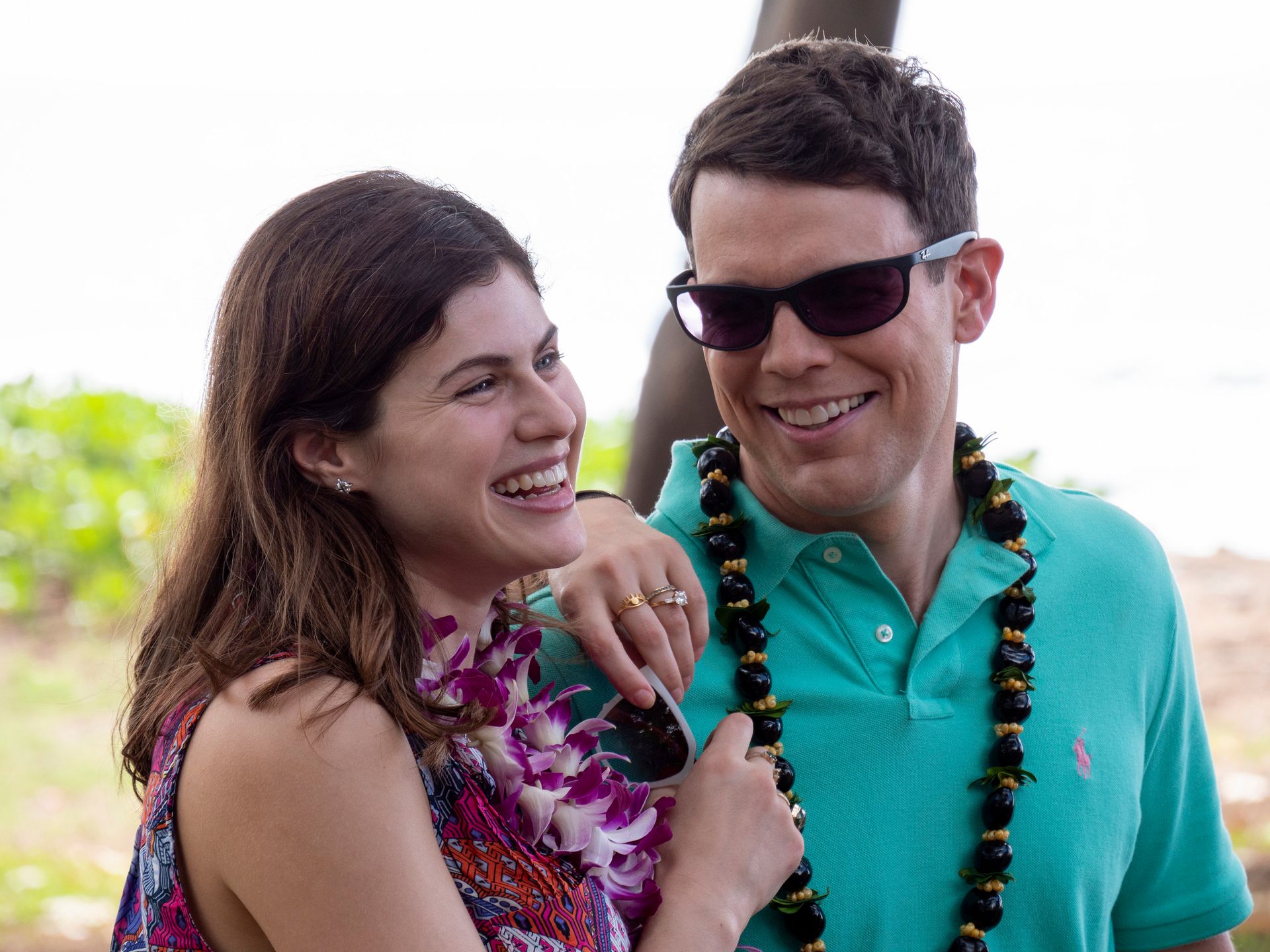
The chemistry—or lack thereof—between Alexandra Daddario and Jake Lacy is the engine that drives the season’s most uncomfortable scenes. While Shane Patton is a walking personification of "incel-adjacent" entitlement and "rich-boy" fragility, Rachel is the audience's surrogate, reacting to his outbursts with a mixture of confusion and growing horror.
The Honeymoon from Hell
The plot is famously kickstarted by a dispute over the "Pineapple Suite." Shane’s obsession with being slighted by the hotel management becomes a metaphor for his entire personality: he cannot enjoy his immense privilege if he feels someone else is getting a better deal. Rachel’s attempts to de-escalate these situations show her initial willingness to adapt to his world, but as the season progresses, her silence turns into a desperate search for an exit.
The Influence of Kitty Patton
A pivotal moment in Rachel’s arc occurs when her mother-in-law, Kitty (played by Molly Shannon), arrives unannounced. This encounter provides Rachel with a glimpse into her future. Kitty is well-meaning but utterly vapid, viewing Rachel as a "lovely" addition to the family brand. This interaction solidifies Rachel’s fear: she isn't joining a family; she is being absorbed into a corporate-like structure where her only value is her appearance and her ability to provide heirs.
Technical Analysis of Daddario’s Performance
Daddario’s acting in The White Lotus is a masterclass in "reactive acting." Because Rachel is often being talked at rather than talked to, much of Daddario’s work happens in her eyes and her body language.
- The Use of Close-Ups: Director Mike White frequently utilizes tight shots on Daddario’s face. Her large, expressive eyes become a barometer for the show's tension. When she smiles at Shane, it rarely reaches her eyes, conveying a sense of "performance" that mirrors the performance of the wealthy guests.
- Vocal Control: Daddario employs a softer, more hesitant vocal register for Rachel than in her previous roles. This choice emphasizes Rachel’s lack of power in her new environment. She often starts sentences that she doesn't finish, illustrating her stifled agency.
- Physicality: In the early episodes, Rachel is physically close to Shane. By the finale, she maintains a visible distance, often appearing small or cornered in the frame of their massive hotel suite.
Comparing Rachel to Other Guests
To understand Rachel’s position, it is helpful to compare her to the other women at the resort. The following table illustrates the different "tiers" of privilege and power represented in Season 1.
| Character | Social Status | Primary Conflict | Relationship to Wealth |
|---|---|---|---|
| Rachel Patton | Aspiring Middle Class | Identity Crisis / Loss of Agency | Newly acquired via marriage; feels unearned and trapping. |
| Nicole Mossbacher | Ultra-Wealthy (CFO) | Maintaining Control / Family Image | Earned via corporate success; uses it as a shield and a weapon. |
| Tanya McQuoid | Generational Wealth | Emotional Instability / Loneliness | Inherited; wealth is a tool for manipulation and seeking affection. |
| Olivia Mossbacher | Wealthy (Gen Z) | Performative Activism / Boredom | Born into it; cynical of it but entirely dependent on it. |
| Paula | Middle Class (Guest) | Guilt / Class Conflict | Temporary access; recognizes the exploitation required for such luxury. |
The Ending: Why Rachel Stayed
The most debated aspect of Alexandra Daddario’s role in The White Lotus is the series finale. After a season of build-up where Rachel finally confronts Shane and tells him she made a mistake, the final scene shows them reuniting at the airport. She tells him, "I'll be happy. I promise."
The Reality of Compromise
This ending is intentionally unsatisfying and tragic. It suggests that Rachel, despite her moral qualms and her desire for independence, chose the "golden handcuffs." In 2026, critics still point to this moment as one of the most honest depictions of class in modern television. Rachel stays not because she loves Shane, but because the alternative—returning to a precarious life as a struggling freelancer in an expensive city—is too frightening.
The Death of the Independent Self
By returning to Shane, Rachel completes her transformation into a "White Lotus" guest. She chooses the comfort of the resort lifestyle over the hardship of personal integrity. Daddario’s performance in that final airport scene is haunting; her smile is vacant, signaling that the "Rachel" who wanted to write meaningful journalism has effectively been suppressed.
Impact on the Television Landscape
The White Lotus ushered in a new era of "eat the rich" satire, and Daddario’s performance was central to its success. The show demonstrated that audiences were hungry for complex, character-driven narratives that didn't rely on traditional heroism. Rachel Patton was a "heroine" who failed to save herself, which resonated deeply with a public facing economic uncertainty.
For Daddario, this role served as a bridge to more prestigious projects. It proved she could anchor a high-concept drama and hold her own against veteran character actors. The "Daddario Effect" in The White Lotus was the realization that her most powerful tool as an actress was her ability to convey the quiet desperation of someone realizing their life has become a beautiful, expensive cage.
Frequently Asked Questions
Did Alexandra Daddario win an Emmy for The White Lotus?
She was nominated for Outstanding Supporting Actress in a Limited or Anthology Series in 2022. While she did not win (the award went to her co-star Jennifer Coolidge), the nomination significantly elevated her status in the industry and led to a wider variety of dramatic roles in the years following.
Is Rachel Patton in Season 2 or 3 of The White Lotus?
As of 2026, the series has maintained its anthology format, with each season focusing on a mostly new cast at a different White Lotus property. While some characters (like Tanya McQuoid) appeared in multiple seasons, Rachel Patton’s story was contained within Season 1. This focus allows her character arc to remain a complete, albeit tragic, study of a specific moment in time.
Why was Rachel’s character so controversial?
The controversy stems from her decision to stay with Shane at the end of the season. Many viewers wanted her to leave him and find her own path. However, Mike White’s writing aimed for realism rather than "wish-fulfillment." The controversy actually highlights the effectiveness of Daddario’s performance; viewers were so invested in Rachel’s plight that they felt a personal sense of betrayal when she chose security over freedom.
How did Daddario prepare for the role of Rachel?
Daddario has mentioned in various interviews that she drew upon her own experiences in the entertainment industry—feeling like an outsider or feeling judged based solely on her appearance. She also researched the specific anxieties of freelance journalists and the "hustle culture" that Rachel was trying to escape, which helped ground the character's professional frustrations.
What is the significance of the "clickbait" articles Rachel writes?
The articles Rachel wrote (such as a profile on Nicole Mossbacher) represent the "hollow" nature of modern media. Nicole’s dismissal of Rachel’s work as "not a real profile" serves to undermine Rachel’s self-worth. This specific detail reinforces the theme that in the world of the ultra-wealthy, the labor of the middle class is viewed as trivial or purely service-oriented.
Final Recommendation: A Must-Watch Performance
For those exploring the evolution of 2020s television, Alexandra Daddario’s performance in The White Lotus is essential viewing. It is more than just a career pivot; it is a nuanced exploration of the cost of social mobility. If you are a fan of psychological dramas or social satires, pay close attention to the scenes between Rachel and Shane. They offer a masterclass in how power dynamics operate in private spaces and how the promise of financial security can silence the loudest of internal alarms.
Watching the series again in 2026, one can see how Daddario’s work paved the way for a more thoughtful, character-centric approach to the "trophy wife" archetype in media. To truly appreciate the performance, focus on her non-verbal cues and the gradual decline of her character's spirit across the six episodes.
Image Gallery
Select an image to open it in a new tab.


Mateo Castillo
Decentralized Finance and E-Payments Strategist
