
The Volkswagen Golf GTI convertible—officially marketed as the Golf Cabriolet GTI across various global markets—represents a unique intersection of hot-hatch performance and open-air motoring. While Volkswagen never offered a factory convertible version of the GTI in the North American market, European enthusiasts enjoyed multiple iterations of the drop-top hot hatch, spanning the classic Golf Mk1 era through the modern Mk6 generation, combining lightweight chassis dynamics with turbocharged engine performance.
Origins and Evolution of the Open-Top Hot Hatch
The concept of a convertible Volkswagen Golf began long before the GTI badge was officially applied to a drop-top variant. When Volkswagen introduced the Golf Mk1 in the 1970s, it created a massive cultural shift. Following the success of the hardtop GTI hot hatch in 1976, enthusiasts and coachbuilders immediately began imagining an open-air version.
Volkswagen officially launched the Golf Cabriolet in 1979, built by the coachbuilder Karmann in Osnabrück, Germany. However, it took several years for the full GTI recipe to trickle down to the convertible line. The early Cabriolets relied on naturally aspirated engines, but as the hot-hatch market expanded, Volkswagen recognized the demand for a performance-oriented soft-top.
In overseas markets, the Golf Cabriolet received official GTI trim packages and engine upgrades, most notably during the Mk1 facelift era and later with the modern Mk6 generation. These models preserved the core mechanical DNA of their hardtop siblings—including upgraded suspension geometry, beefier anti-roll bars, and distinct exterior styling cues like red grille trim and sport seats—while substituting the steel roof for a folding fabric top and reinforcing the chassis to compensate for the missing structural element.
Key Generations: Mk1 vs. Mk6 Cabriolet GTI
Understanding the Volkswagen GTI convertible requires examining the two distinct eras where the factory hot hatch and the drop-top body style truly intersected. While the Mk1 laid the cultural foundation, the Mk6 brought modern turbocharging, safety standards, and dual-clutch transmissions to the platform.
The Classic Era: Golf Mk1 Cabriolet GTI (1984–1993)
The Mk1 Cabriolet remained in production long after the standard hatchback was replaced by the Mk2 and Mk3. To keep it competitive, Volkswagen eventually introduced sport trims, and many owners converted standard Cabriolets to GTI specification using the 1.8-liter fuel-injected engine (JH or DX codes depending on the market).
- Chassis Reinforcement: Because removing the roof compromises structural rigidity, the Mk1 Cabriolet famously featured a fixed roll-over bar, often dubbed the "strawberry basket" by enthusiasts. This hoop housed the interior B-pillar structural supports and added much-needed torsional rigidity.
- Performance Output: Early European GTI-spec engines produced around 110 to 112 horsepower, which, paired with the lightweight Mk1 chassis, delivered a nimble and engaging driving experience despite the extra weight added by the Karmann structural reinforcements.
The Modern Era: Golf Mk6 Cabriolet GTI (2012–2016)
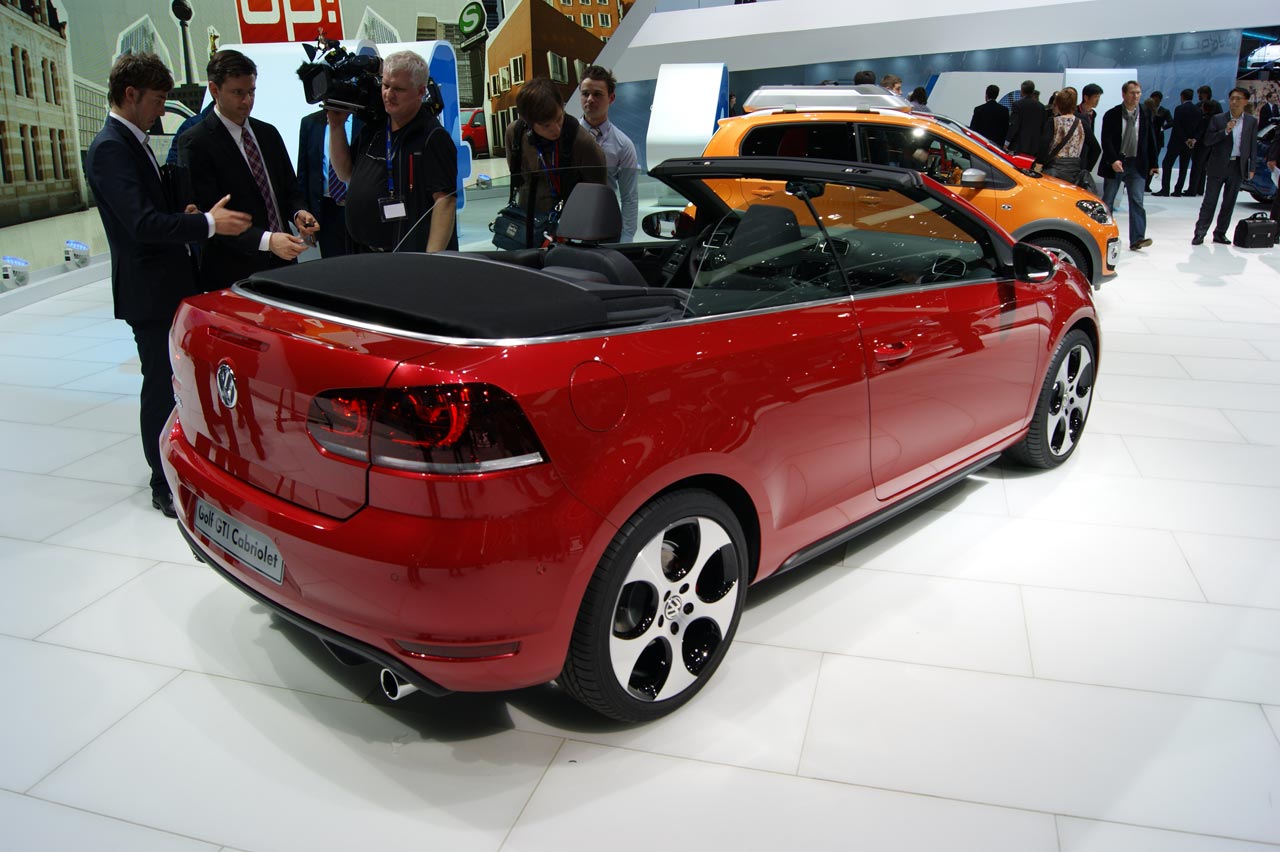
After a long hiatus without a true Golf convertible, Volkswagen introduced the Golf Mk6 Cabriolet in 2011 and finally added an official GTI variant in 2012. This version brought the iconic hot hatch into the twenty-first century.
- Powertrain: It utilized the EA888 2.0-liter turbocharged inline-four engine, generating approximately 210 horsepower (and later 220 horsepower in performance pack variants). Power was routed through either a 6-speed manual transmission or a 6-speed DSG dual-clutch automatic transmission.
- Top Mechanism: Unlike the manual latches of the Mk1, the Mk6 featured a fully automatic fabric soft top that could open or close in just 9.5 seconds, even while driving at speeds up to 18 mph (30 km/h).
- Structural Integration: Advanced high-strength steels and invisible pop-up rollover protection systems hidden behind the rear seats allowed the Mk6 to maintain clean exterior lines without a fixed roll bar.
Technical Specifications and Performance Comparison
Comparing the hardtop GTI variants to their convertible counterparts highlights the engineering compromises required for open-top motoring. Weight increases, aerodynamic changes, and chassis adjustments all alter the vehicle's driving dynamics.
| Generation | Engine Type | Horsepower | Transmission Options | 0–60 mph (approx.) | Top Speed |
|---|---|---|---|---|---|
| Mk1 GTI (Hardtop) | 1.8L I4 (Naturally Aspirated) | 112 hp | 5-speed manual | ~8.5 seconds | 115 mph |
| Mk1 Cabriolet (GTI Spec) | 1.8L I4 (Naturally Aspirated) | 98–112 hp (market dependent) | 5-speed manual / 3-speed auto | ~9.5 seconds | 108 mph |
| Mk6 GTI (Hardtop) | 2.0L Turbo I4 (EA888) | 207 hp | 6-speed manual / 6-speed DSG | ~6.8 seconds | 150 mph |
| Mk6 Golf GTI Cabriolet | 2.0L Turbo I4 (EA888) | 210 hp | 6-speed manual / 6-speed DSG | ~7.3 seconds | 147 mph |
As seen in the data, the addition of structural reinforcement adds weight—roughly 100 to 150 kilograms depending on the generation—which slightly blunts acceleration times compared to the rigid steel hardtop variants. However, straight-line speed was never the primary mission of the GTI convertible.
Driving Dynamics and Chassis Rigidity
When evaluating a convertible sports car, torsional rigidity is the primary engineering hurdle. When a hardtop roof is removed, the vehicle's body tends to flex over mid-corner bumps and rough asphalt, leading to cowl shake (vibrations traveling through the steering column and floorboards).
- Karmann Engineering (Mk1): The inclusion of the fixed B-pillar roll bar and reinforced floor panals on the Mk1 mitigated a significant amount of chassis flex, though cowl shake remains a known characteristic for enthusiasts driving older examples.
- Modern Laser-Welded Chassis (Mk6): The Mk6 benefited from decades of advances in computer-aided engineering and high-strength hot-formed steel. While it still exhibited slightly more chassis flex than the rigid Mk6 hatchback, electronic stability control systems and upgraded front-axle differential simulation (XDS) helped maintain sharp cornering lines and predictable understeer limits.
Market Availability and Global Import Realities
One of the most common points of confusion for automotive enthusiasts is vehicle availability. Volkswagen structured its regional product portfolios differently across North America and Europe, creating distinct market realities for the GTI convertible.
- North America: Volkswagen of America never officially imported the Golf Cabriolet GTI for the Mk6 generation, nor did they offer an official factory GTI convertible for the Mk1 era (though standard Karmann-built Cabriolets were sold in high volumes stateside through the 1980s and early 1990s). Enthusiasts in the United States and Canada looking for a drop-top GTI typically must rely on importing a classic Mk1 or building a custom project car by swapping GTI drivetrains and interior components into a standard North American Golf Cabriolet.
- Europe and Select Markets: European buyers enjoyed steady access to the open-top variants. The Mk6 Golf GTI Cabriolet was produced in Germany and sold across the European Union, the United Kingdom, and select global markets until production wound down around 2016 as consumer preferences shifted heavily toward compact SUVs and crossovers.
Ownership Considerations, Maintenance, and Common Issues
Owning a vintage or modern-classic Volkswagen GTI convertible requires attention to specific mechanical and cosmetic maintenance items that do not apply to standard hardtop hatchbacks.
- Soft Top Condition: Fabric tops require regular cleaning and conditioning to prevent water penetration, dry rot, and shrinkage. For Mk1 models, finding OEM-quality replacement vinyl or cloth tops from specialized manufacturers like Sonnenland is critical. For Mk6 models, electronic top motors and hydraulic lines must be inspected for fluid leaks and alignment binding.
- Water Leaks and Seals: Rubber weatherstripping around the doors, windows, and top seals degrades over time due to UV exposure and temperature fluctuations. Clearing the cowl and roof drainage channels prevents water from pooling in the footwells and damaging interior electronics.
- Rust and Structural Integrity: Particularly relevant for Mk1 models, rust in the rocker panels, floor pans, and lower fender arches can compromise the structural safety of a convertible chassis. Pre-purchase inspections should always involve putting the car on a lift to examine the structural sub-frame reinforcement plates.
Frequently Asked Questions
Did Volkswagen ever sell a GTI convertible in the United States?
No, Volkswagen never officially offered a factory-spec GTI convertible for the North American market. While standard Golf Cabriolet models were sold in the U.S. during the 1980s and 1990s, enthusiasts wanting a true drop-top GTI must either import an eligible European model or perform a custom powertrain and cosmetic conversion.
How does the GTI convertible differ mechanically from the standard Golf Cabriolet?
The GTI convertible features performance upgrades borrowed from its hardtop sibling, including a more powerful turbocharged or fuel-injected engine, sport-tuned suspension with lower ride height, larger brakes, distinct interior sport seats (often featuring classic tartan plaid upholstery), and exterior styling accents like red grille piping and unique alloy wheels.
Is the chassis flex noticeable when driving a VW GTI convertible?
Yes, to varying degrees depending on the generation. Older Mk1 models exhibit notable cowl shake over rough road surfaces due to the limitations of 1980s chassis engineering. The Mk6 generation benefits significantly from modern high-strength steels and structural adhesives, resulting in a much stiffer chassis, though it remains marginally less rigid than the closed-roof hatchback.
Are replacement soft tops difficult to source?
For classic Mk1 models, replacement tops are readily available through aftermarket suppliers and specialized upholstery shops, often offering upgraded cloth materials compared to the original vinyl. For Mk6 models, replacement must be sourced through Volkswagen dealership networks or specialized European automotive parts distributors.
What is the fuel economy of a VW GTI convertible?
Fuel economy varies significantly by generation. The classic fuel-injected Mk1 models achieve respectable efficiency for their era, typically ranging from 24 to 30 mpg depending on driving style and transmission. The turbocharged Mk6 models generally average around 21 to 31 mpg (city/highway) under standard driving conditions, closely mirroring their hardtop counterparts despite the minor weight penalty.
Next Actions and Recommendations
For prospective buyers or automotive historians researching the Volkswagen GTI convertible, the best path forward depends on your target generation and geographical location. If you reside in Europe, inspecting a well-maintained Mk6 Golf GTI Cabriolet offers a blend of modern daily-drivetrain reliability and open-air performance. If you reside in North America, focus your search on clean, rust-free imported Mk1 Cabriolets or professionally built engine-swap projects, ensuring you verify structural rail integrity and roof seal condition before finalizing any acquisition.
Image Gallery
Select an image to open it in a new tab.
Ingrid Bjornson
Global Cyber Policy and Regulation Analyst
