
Commercial general liability (CGL) insurance in Colorado Springs protects businesses from financial loss resulting from third-party claims of bodily injury, property damage, and personal or advertising injury occurring on business premises or during operations. While Colorado state law does not mandate general liability for every business, commercial landlords, municipal licensing authorities, and project contracts across El Paso County strictly require active coverage.
What Is Commercial General Liability Insurance?
Commercial General Liability insurance serves as the foundational layer of business protection. It is designed to defend a business against third-party lawsuits and cover the financial obligations if the business is found legally responsible for harm to individuals or property. In Colorado Springs, where commercial activity spans defense contracting, construction, retail, outdoor hospitality, and technology, maintaining an adequate CGL policy mitigates operational risks that could otherwise jeopardize a company's financial viability.
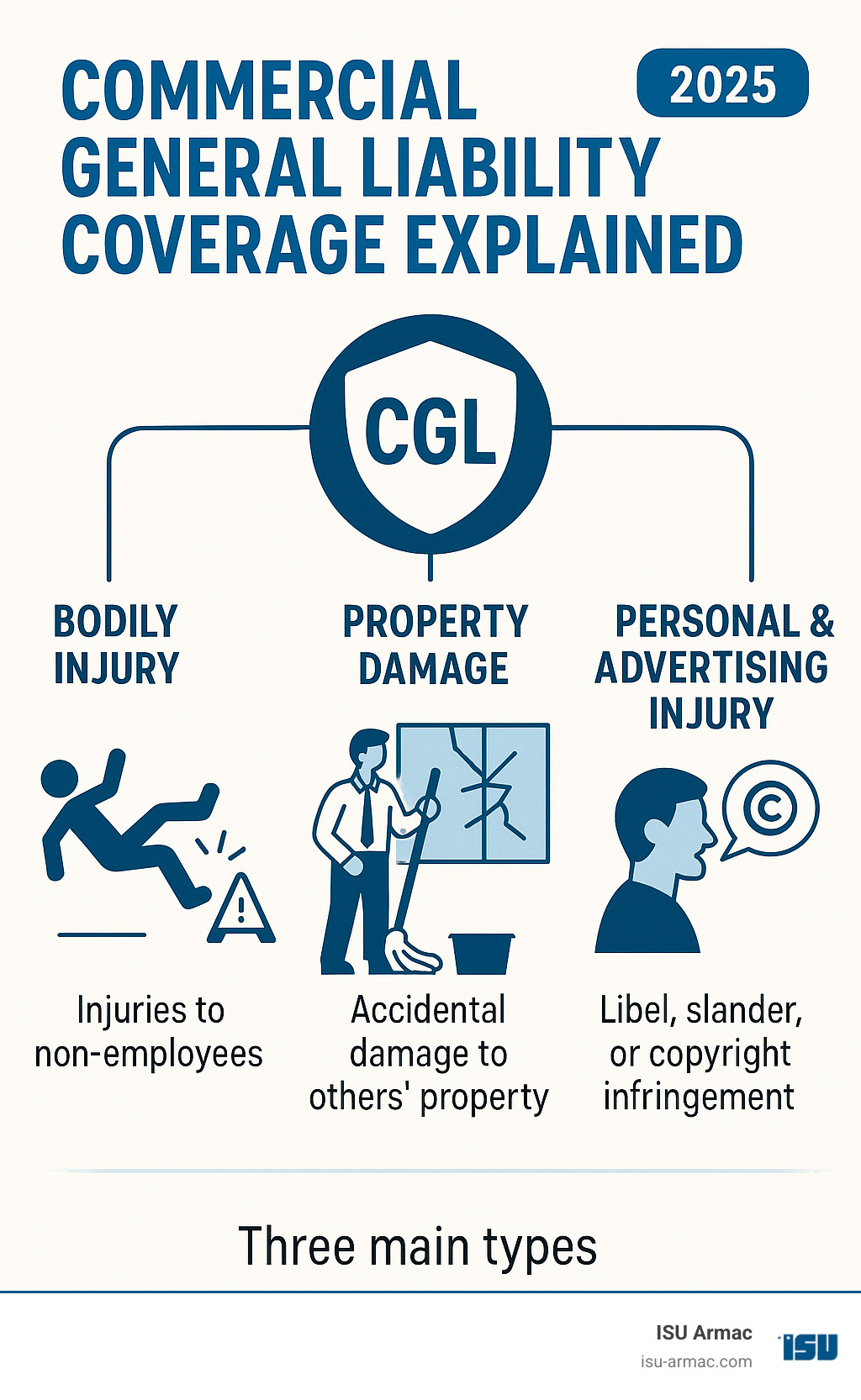
- COMMERCIAL GENERAL LIABILITY (CGL)
- COVERAGE A: Bodily Injury & Property Damage
- COVERAGE B: Personal & Advertising Injury
- COVERAGE C: Medical Payments (No-Fault Baseline)
Core Coverages Included in standard CGL Policies
A standard ISO (Insurance Services Office) Commercial General Liability form provides three primary coverage sections:
Coverage A: Bodily Injury and Property Damage LiabilityThis section covers physical injury, sickness, or disease sustained by a non-employee (such as a customer, vendor, or passerby), as well as physical damage to or loss of use of tangible property belonging to third parties. If a client slips on an icy walkway outside a office building on Nevada Avenue or a contractor damages a homeowner's plumbing infrastructure during a remodel, Coverage A responds to defense costs and negotiated settlements or court judgments.
Coverage B: Personal and Advertising Injury LiabilityThis section protects against non-physical injuries resulting from specific offenses committed during business operations or marketing campaigns. Covered offenses typically include false arrest, malicious prosecution, wrongful eviction, libel, slander, disparagement of a competitor’s products, misappropriation of advertising ideas, or infringement of copyright or trade dress in promotional materials.
Coverage C: Medical PaymentsMedical Payments (MedPay) provides prompt, no-fault coverage for minor medical expenses incurred by a non-employee injured on the business premises or due to business operations. MedPay pays out regardless of legal liability up to a lower specified limit (typically $5,000 to $10,000 per person), offering a quick mechanism to settle minor incidents before they escalate into formal litigation.
The Insurer's Duty to Defend vs. Duty to Indemnify
A critical aspect of CGL policies is the insurer's dual obligation:
- Duty to Defend: The insurance company must appoint and pay for legal counsel to defend the insured business against any lawsuit alleging damages that potentially fall within the policy's coverage scope. Defense costs are typically covered in addition to policy limits, meaning legal fees do not deplete the underlying policy limits available for settlements or judgments.
- Duty to Indemnify: The insurer pays covered settlements or judgments awarded against the business, up to the maximum policy limits stated in the declarations page.
Key Exclusions Standard in CGL Contracts
General liability is comprehensive, but it is not all-inclusive. Standard CGL policies explicitly exclude specific risks that require specialized coverage:
- Employee Injuries: Covered exclusively under Workers' Compensation insurance.
- Professional Errors and Omissions: Claims alleging financial harm due to bad professional advice, faulty software, engineering errors, or design flaws require Professional Liability (E&O) insurance.
- Commercial Auto Accidents: Vehicles owned or operated for business purposes require a separate Commercial Auto policy.
- First-Party Property Damage: Damage to the business's own building, inventory, tools, or equipment requires Commercial Property or Inland Marine insurance.
- Pollution and Environmental Liabilities: Gradual environmental contamination requires specialized Environmental Impairment Liability policies.
Colorado Legal Framework and Local Requirements
Operating a business in Colorado Springs requires compliance with both statewide statutes and local municipality guidelines. Understanding the legal landscape helps business owners structure policies that comply with regional liability standards.
Disclaimer: The regulatory and legal details presented below are for informational purposes and do not constitute formal legal counsel. Business owners should consult a licensed insurance broker or attorney admitted to practice in Colorado for specific legal compliance.
Is CGL Legally Mandated in Colorado?
Colorado state law does not maintain a universal statute requiring all corporate entities or sole proprietorships to carry General Liability insurance purely to exist. However, operational realities create mandatory insurance thresholds:
- Pikes Peak Regional Building Department (PPRBD): Contractors, trade specialists, plumbers, electricians, and builders operating within El Paso County and the City of Colorado Springs must show proof of active CGL coverage before obtaining or renewing trade licenses and pulling construction permits. Required coverage minimums vary by license class (often ranging from $1,000,000 to $2,000,000 in aggregate coverage).
- Commercial Leases: Real estate developers and commercial property owners across Colorado Springs standardly mandate that commercial tenants maintain a minimum of $1,000,000 per occurrence in general liability coverage, naming the landlord as an Additional Insured.
- Government and Military Defense Contracts: With major military installations in the region—including Fort Carson, Peterson Space Force Base, Schriever Space Force Base, and the U.S. Air Force Academy—defense contractors and subcontractors must maintain rigorous liability limits defined by Federal Acquisition Regulation (FAR) standards and local contract mandates.
The Colorado Premises Liability Act (C.R.S. § 13-21-115)
In Colorado, business owner liability for injuries occurring on their physical property is governed strictly by the Colorado Premises Liability Act (PLA) (Colorado Revised Statutes § 13-21-115). The PLA establishes precise legal standards of care based on the legal status of the visitor:
- Invitees: Individuals entering the property for business transactions (e.g., customers shopping at a retail store in Downtown Colorado Springs or eating at a restaurant in Northgate). Landowners owe the highest duty of care to invitees and are liable for damages caused by a failure to exercise reasonable care regarding dangers created by the landowner or dangers of which the landowner actually knew or should have known.
- Licensees: Individuals entering the property for their own convenience or social purposes with the owner’s consent. Landowners are liable for failures to exercise reasonable care concerning known dangers created by the landowner or known hazards not ordinarily present.
- Trespassers: Individuals entering the property without consent. Landowners are liable only for damages willfully or deliberately caused.
Because Colorado courts strictly apply C.R.S. § 13-21-115, commercial property owners and commercial tenants must maintain CGL coverage designed to satisfy defense obligations under this statute.
Construction Defect Action Reform Act (CDARA)
For residential and commercial contractors operating in Colorado Springs, the Construction Defect Action Reform Act (CDARA) (C.R.S. § 13-20-801 et seq.) governs construction defect claims. Contractors must ensure their CGL policies contain proper endorsements (such as completed operations coverage) without severe exclusions for multi-family residential developments or soil movement, which are heavily scrutinized under CDARA litigation.

Specific Risk Factors for Colorado Springs Businesses
Colorado Springs presents unique physical, economic, and environmental exposure profiles that directly influence commercial risk assessments and policy endorsements.
- COLORADO SPRINGS LOCAL RISK PROFILE
- WEATHER & ELEVATION
- Rapid Freeze-Thaw Cycles
- Extreme Hail Activity
- Wildfire Interface Risks
- GEOGRAPHIC & INDUSTRIAL
- High-Altitude Roofing/Construction Exposures
- Defense/Aerospace Subcontracting Mandates
- Outdoor Tourism & Recreation Exposures
- WEATHER & ELEVATION
Weather and Elevation Exposures
Sitting at an elevation of over 6,000 feet along the Front Range of the Rocky Mountains, Colorado Springs experiences severe weather phenomena that increase general liability claims:
- Slip-and-Fall Incidents (Freeze-Thaw Cycles): The region experiences frequent winter sun followed by freezing night temperatures. Snowmelt running across parking lots and sidewalks refreezes into black ice. Business owners are frequently sued under the Premises Liability Act for failing to properly clear, salt, or mitigate ice hazards outside commercial entryways.
- Hail and Storm Events: The Front Range is situated in "Hail Alley." Hail damages commercial structures, outdoor seating areas, and customer vehicles parked on business grounds, triggering third-party property damage disputes.
- Wildfire Urban Interface (WUI): Businesses operating on the western margins of Colorado Springs (e.g., near Manitou Springs, Westside, or Rockrimmon) face heightened wildfire risks, which can complicate liability claims involving hot-work operations or land management.
Regional Economic Drivers
Different business sectors within El Paso County require distinct policy structures to address industry-specific risks:
- Construction and Specialty Trades: Rapid commercial and residential growth in eastern El Paso County (e.g., Falcon, Peyton, and Marksheffel corridors) demands robust Products-Completed Operations Liability to protect against claims arising after job completion.
- Defense and Technology Contracting: Subcontractors supporting military command structures need liability policies with tailored contractual liability coverage and clear definitions regarding working on government installations.
- Tourism, Hospitality, and Recreation: Outdoormen guides, tour operators, craft breweries, and hospitality venues in historic areas like Old Colorado City encounter higher foot traffic and physical activity risks, necessitating higher Medical Payments (MedPay) limits and broad form premises coverage.
Policy Architecture: Limits, Deductibles, and Structure
Structuring a Commercial General Liability policy requires balancing policy limits against potential litigation exposure in Colorado courts.
Policy Limits Structure
CGL policies are written with two distinct limits:
- Per Occurrence Limit: The maximum amount the insurance company will pay for a single accident or legal event. Standard commercial policies typically start at $1,000,000.
- General Aggregate Limit: The maximum total amount the insurer will pay for all claims combined during the one-year policy period. Standard policies typically feature a $2,000,000 aggregate limit.
- Products-Completed Operations Aggregate Limit: A separate aggregate limit applying exclusively to claims arising from completed work or manufactured goods.
Example Policy Structure: $1,000,000 / $2,000,000
- Max Payment per Single Event (Occurrence): $1,000,000
- Max Total Payment per Policy Term (Aggregate): $2,000,000
Occurrence-Based vs. Claims-Made Formats
When purchasing general liability insurance in Colorado Springs, business owners must select between two structural policy formats:
- Occurrence Policies: Cover injuries or damage that occur during the policy period, regardless of when the claim or lawsuit is actually filed. Even if a claim is filed three years after the policy expires, the carrier that was on the risk at the time the incident occurred handles the claim. This is the standard choice for trade contractors and retail businesses.
- Claims-Made Policies: Cover claims only if both the alleged incident occurred and the claim is reported while the policy remains active (or during an Extended Reporting Period / "Tail Coverage"). Claims-made policies are less common in standard CGL insurance but frequent in specialized liability coverages.
Essential Endorsements for Colorado Businesses
Standard off-the-shelf CGL policies often require endorsements (policy add-ons) to meet contractual demands:
- Additional Insured Endorsement (CG 20 10 / CG 20 37): Frequently required by commercial landlords and general contractors. It extends coverage to a named third party for liability arising from the primary policyholder's work or tenancy.
- Waiver of Subrogation: Prevents the policyholder’s insurance carrier from seeking reimbursement from a designated third party (such as a project owner) after paying out a claim.
- Primary and Non-Contributory Wording: Ensures that the policyholder's insurance pays out first before any other insurance policy available to an Additional Insured is triggered.
Commercial Coverage Comparison
General liability forms only one part of a standard commercial risk management program. Understanding how CGL interacts with other primary business policies prevents coverage gaps.
| Coverage Type | Primary Protection Scope | Exclusions / Limits | Typical Need in Colorado Springs |
|---|---|---|---|
| Commercial General Liability (CGL) | Third-party bodily injury, physical property damage, advertising injury. | First-party property, employee injuries, professional errors, vehicle accidents. | Essential: Required by commercial leases, municipal licenses, and client contracts. |
| Commercial Property Insurance | First-party business structure, inventory, office furnishings, and tools. | Third-party injuries, systemic flood, earth movement, wear-and-tear. | High: Critical for physical retail space, manufacturing, and owned office spaces. |
| Workers' Compensation | Statutory employee medical expenses and lost wages for job-related injuries. | Third-party injuries, non-work-related illness, intentional employee harm. | Mandatory: Required by Colorado state law for all businesses with 1+ employees. |
| Professional Liability (E&O) | Financial losses caused by professional errors, negligence, or failed deliverables. | Physical bodily injury, property damage, intentional fraud. | High for Service Firms: Consultants, software firms, engineers, and accountants. |
| Commercial Auto Insurance | Vehicle liability, collision, and comprehensive coverage for business transport. | Personal auto use outside business scope, general premises liability. | Mandatory: Required for any company owned, hired, or operated vehicles. |
| Cyber Liability Insurance | Data breaches, ransomware attacks, network security failures, and notification costs. | Physical property destruction, standard bodily injury. | Growing: Critical for technology, defense, and healthcare contractors handling sensitive data. |
Evaluating Insurance Carriers in El Paso County
Selecting an insurance carrier involves evaluating financial stability, market presence, and legal authority to issue policies within the state of Colorado.
Admitted vs. Non-Admitted Carriers in Colorado
The Colorado Department of Regulatory Agencies (DORA) Division of Insurance regulates insurance companies operating within the state:
- Admitted Carriers: Authorized by the Colorado Division of Insurance to conduct business in the state. They must comply with state rating rules and policy form regulations. In the event of insurance company insolvency, admitted carriers are backed by the Colorado Guaranty Association, which helps pay outstanding claims.
- Non-Admitted (Surplus Lines) Carriers: Not licensed directly by the state of Colorado, but permitted to write policies for high-risk or specialized operations that admitted markets decline (e.g., roofing contractors, high-risk manufacturing, or specialized outdoor recreation). Non-admitted carriers offer flexible policy forms, but claims are not backed by the state guaranty fund.
Checking Carrier Financial Ratings
Before purchasing coverage, business owners should review independent financial rating agency scores for prospective carriers:
- AM Best Rating: Look for carriers rated A- (Excellent) or higher with a Financial Size Category of VII or greater. This ensures the carrier maintains sufficient capital liquidity to manage systemic disaster events or large jury awards.
Cost Factors and Premium Calculation
Insurance carriers assess risk profiles to determine general liability premiums. Understanding these variables helps business owners manage operating overhead.
Key Factors Influencing Premiums
- Industry Classification (NAICS / SIC Codes): High-hazard trades (e.g., structural steel erection or tree trimming) pay significantly higher rates per $1,000 of payroll than low-hazard services (e.g., accounting or software development).
- Gross Annual Revenue & Payroll: CGL premiums are frequently audited at the end of the policy year. Higher sales volumes and larger workforces increase exposure to third-party interactions, raising base premiums.
- Claims History (Experience Loss Runs): Insurers request 3 to 5 years of loss runs. A clean claims history results in favorable underwriting discounts, while prior loss records incur surcharges.
- Location and Physical Premises: Operating in high-foot-traffic commercial zones (such as the Promenade Shops at Briargate or downtown retail districts) increases premises liability exposures compared to remote offices.
- Deductible Selection: Choosing a per-occurrence property damage deductible (e.g., $1,000 to $5,000) reduces overall annual premium costs by shifting initial loss burdens onto the business.
Estimating Annual CGL Premium Ranges
While rates vary based on operational variables, baseline ranges for small-to-medium businesses in Colorado Springs typically align with the following estimates:
- Low-Risk Commercial Services (Consultants, Tech Startups): $400 to $800 annually for standard $1M/$2M limits.
- Retail, Restaurants, and Hospitality: $1,200 to $3,500 annually, depending on square footage, alcohol service (which requires separate Liquor Liability), and foot traffic.
- Specialty Trade Contractors (Plumbers, Electricians): $1,500 to $5,000+ annually, subject to payroll volume and subcontractor exposure.
- High-Risk Trades (Roofers, Excavators, Framing Contractors): $5,000 to $15,000+ annually due to height, structural, and severe injury risks.
Common Misconceptions and Costly Coverage Gaps
Navigating business insurance requires avoiding misunderstandings about policy terms and legal protections.
Misconception 1: "CGL Protects My Personal and Business Property"
- Reality: CGL exclusively covers third-party damage. If a fire burns down your warehouse or a thief steals tools from your work vehicle, CGL pays zero dollars. First-party assets require Commercial Property, Business Personal Property, or Inland Marine (Equipment Floater) coverage.
Misconception 2: "Independent Contractors Provide Their Own Coverage, So My CGL Is Safe"
- Reality: If an uninsured subcontractor causes an injury on your job site in Colorado Springs, the injured party will sue you as the general business owner. CGL policies require you to collect Certificates of Insurance (COIs) showing equal or higher liability limits from all subcontractors. Failing to verify subcontractor insurance leads to audit penalties and unbacked claims against your primary policy.
Misconception 3: "An LLC or Corporation Fully Protects My Personal Assets from Business Lawsuits"
- Reality: While corporate structures provide a legal shield, courts can "pierce the corporate veil" in cases of personal negligence, inadequate capitalization, or commingling of funds. Furthermore, defending against frivolous lawsuits costs tens of thousands of dollars in legal fees. CGL insurance pays defense costs regardless of whether the business entity status holds.
Step-by-Step Guide to Securing General Liability Insurance
Securing an effective CGL policy involves a systematic approach to risk evaluation, broker selection, and policy placement.
- Step 1: Conduct Internal Exposure Audit
- Step 2: Assemble Business Documentation & Loss History
- Step 3: Partner with an Independent Colorado Broker
- Step 4: Compare Quotes & Verify Policy Endorsements
- Step 5: Bind Policy & Distribute COIs
Step 1: Conduct an Internal Exposure Audit
Document all business activities, services performed, physical premises, customer foot traffic, and contractual insurance requirements imposed by lease agreements or client contracts.
Step 2: Assemble Business Documentation
Gather the essential documentation required by insurance underwriters:
- 3 to 5 years of official loss runs (claims history) from prior carriers.
- Projected gross revenue and total payroll for the upcoming 12 months.
- Detailed breakdown of subcontractor expenses and current Certificate of Insurance (COI) tracking protocols.
- Copy of standard customer contracts and lease agreements.
Step 3: Partner with an Independent Insurance Broker
Work with an independent broker licensed by the Colorado Division of Insurance who has direct access to multiple admitted and surplus lines markets. Independent brokers can shop multiple insurance carriers simultaneously to find competitive pricing and broad coverage terms.
Step 4: Evaluate Quotes and Endorsement Language
Review received insurance proposals beyond the baseline premium cost:
- Confirm that policy limits satisfy all landlord and licensing requirements ($1M/$2M minimum standard).
- Verify specific endorsements: Ensure Additional Insured, Waiver of Subrogation, and Primary & Non-Contributory language is present if required by active contracts.
- Check for restrictive exclusions, such as residential work exclusions, height-restriction limitations, or absolute pollution exclusions.
Step 5: Bind Policy and Issue Certificates of Insurance (COIs)
Once a policy is selected, bind coverage and request formal Certificates of Insurance (ACORD 25 forms) for your commercial landlord, the Pikes Peak Regional Building Department (if applicable), and major business clients. Store policy documents securely and set automated calendar reminders 60 days prior to policy renewal to review operational changes.
Frequently Asked Questions
Is General Liability insurance required to get a business license in Colorado Springs?
The City of Colorado Springs does not mandate CGL for basic sales tax licenses. However, trade contractors, specialty builders, and businesses requiring permits through the Pikes Peak Regional Building Department (PPRBD) must submit proof of general liability insurance meeting specific coverage thresholds before licenses or permits are issued.
Does a CGL policy cover injuries to my employees?
No. CGL explicitly excludes injuries sustained by employees arising out of and in the course of their employment. Employee injuries are covered under Workers' Compensation insurance, which is legally mandatory for Colorado businesses employing one or more individuals under C.R.S. § 8-40-101.
What is the difference between per-occurrence and aggregate limits?
The per-occurrence limit is the maximum amount the insurer will pay for a single claim or event. The aggregate limit is the absolute maximum total amount the insurer will pay for all combined claims occurring within a single one-year policy period. Once the aggregate limit is exhausted by paid claims, the insurer has no further obligation to defend or indemnify the business for the remainder of that policy year.
How does Colorado's climate affect commercial general liability risks?
Colorado Springs experiences severe winter weather, including frequent freeze-thaw cycles that create black ice on walkways, parking lots, and outdoor entryways. Under the Colorado Premises Liability Act (C.R.S. § 13-21-115), business owners owe a high duty of care to invitees. Property owners can be held legally liable for slip-and-fall injuries if they fail to maintain, clear, or salt icy commercial entryways.
Can I bundle General Liability with physical property insurance?
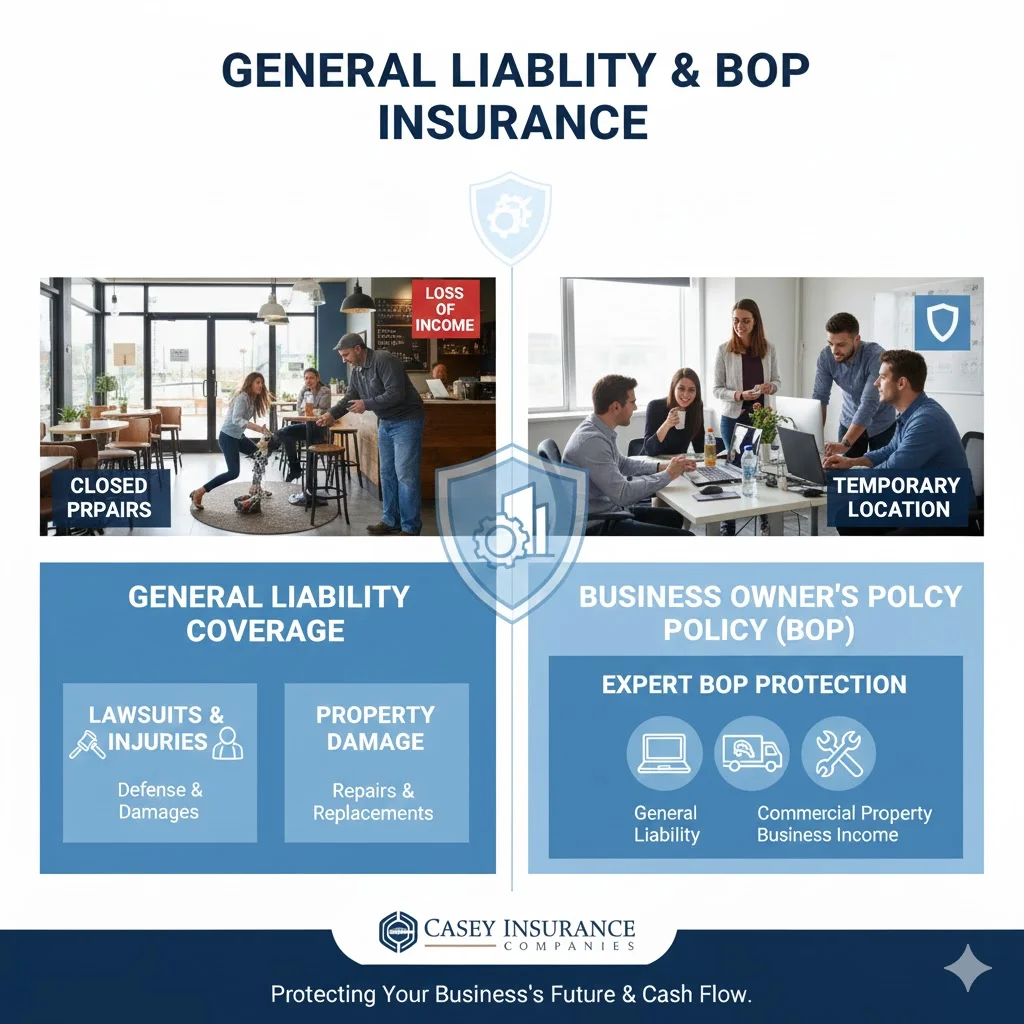
Yes. Small and medium-sized businesses often bundle CGL and Commercial Property insurance into a unified policy called a Business Owner’s Policy (BOP). Packaging these coverages together is generally more cost-effective than purchasing separate standalone policies, provided the business meets the underwriting eligibility requirements of a BOP.
Strategic Recommendation for Business Owners
Business owners in Colorado Springs should treat Commercial General Liability insurance not merely as a regulatory requirement, but as an essential risk mitigation strategy. Start by conducting a comprehensive audit of your operations, lease contracts, and vendor agreements to determine your actual liability exposures.
Engage an independent insurance broker licensed in Colorado to quote coverage across multiple admitted carriers. Ensure your policy includes necessary contractual endorsements—such as Additional Insured status and Waiver of Subrogation—and verify that your policy limits adequately protect both your business reserves and personal assets under Colorado's Premises Liability Act. Review your policy architecture annually or whenever expanding operations across El Paso County.
Image Gallery
Select an image to open it in a new tab.

Akira Tanaka
International Academic Trends Correspondent
