Presidential and Parliamentary Systems Explained

Democracies globally organize their executive and legislative powers through distinct institutional structures, primarily the presidential and parliamentary systems. A presidential system features a separately elected executive who operates independently of the legislature, whereas a parliamentary system fuses these branches, with the executive branch drawn directly from the legislative body. Understanding these frameworks clarifies how different nations govern, form coalitions, pass legislation, and ensure accountability.
Foundational Concepts of Democratic Governance
Democratic governments universally strive to balance popular sovereignty with institutional stability. To achieve this, constitutional designers establish frameworks that dictate how leaders are chosen, how laws are enacted, and how power is checked. The two primary models—presidential and parliamentary—offer contrasting solutions to these fundamental governance challenges.
At the heart of both systems lies the separation of powers or the lack thereof. The separation of powers typically divides government into three core branches: the legislature (which makes laws), the executive (which enforces laws), and the judiciary (which interprets laws). While parliamentary systems intentionally blur the lines between the executive and legislative branches to promote coordination, presidential systems erect strict structural barriers between them to enforce mutual oversight.
Before examining the mechanics of these systems, it is essential to recognize that hybrid models also exist. For instance, semi-presidential systems, such as that of France, combine a directly elected president with a prime minister responsible to the legislature. However, examining the pure presidential and parliamentary archetypes reveals the distinct operational logic that influences constitutional design across the globe.
The Mechanics of a Presidential System
In a presidential system of government, the executive branch is constitutionally independent of the legislative branch. The defining characteristic of this model is the election of the chief executive—the president—through a process separate from the election of the legislature.
Structure and Separation of Powers
The president serves as both the head of state and the head of government. In this dual capacity, the president embodies the nation during ceremonial occasions while also directing day-to-day executive administration, commanding the armed forces, and executing foreign policy. Because the president derives a personal mandate directly from the electorate (either through a direct popular vote or an electoral college), the executive does not depend on the legislative assembly for continued tenure.
The legislature, often known as a congress or parliament, consists of representatives elected separately by the voters. This structural independence means that a president can belong to one political party while the opposition party holds a majority in one or both houses of the legislature—a common condition known as divided government.
Checks, Balances, and Deadlock
To prevent tyranny, presidential constitutions embed robust checks and balances. The president typically holds veto power over legislation passed by the congress, while the legislature possesses the authority to override that veto with a supermajority vote. Furthermore, the legislature must confirm major presidential appointments, such as cabinet ministers and judges, and ratify treaties.
While these checks prevent unilateral executive action, they can also lead to severe political gridlock. When the executive and legislative branches disagree, legislation can stall entirely. Unlike parliamentary systems, presidential systems lack a built-in mechanism to dissolve the government and call early elections to resolve policy stalemates. Presidents serve fixed terms of office, meaning political conflict must generally be resolved within the existing institutional timeline.

The Mechanics of a Parliamentary System
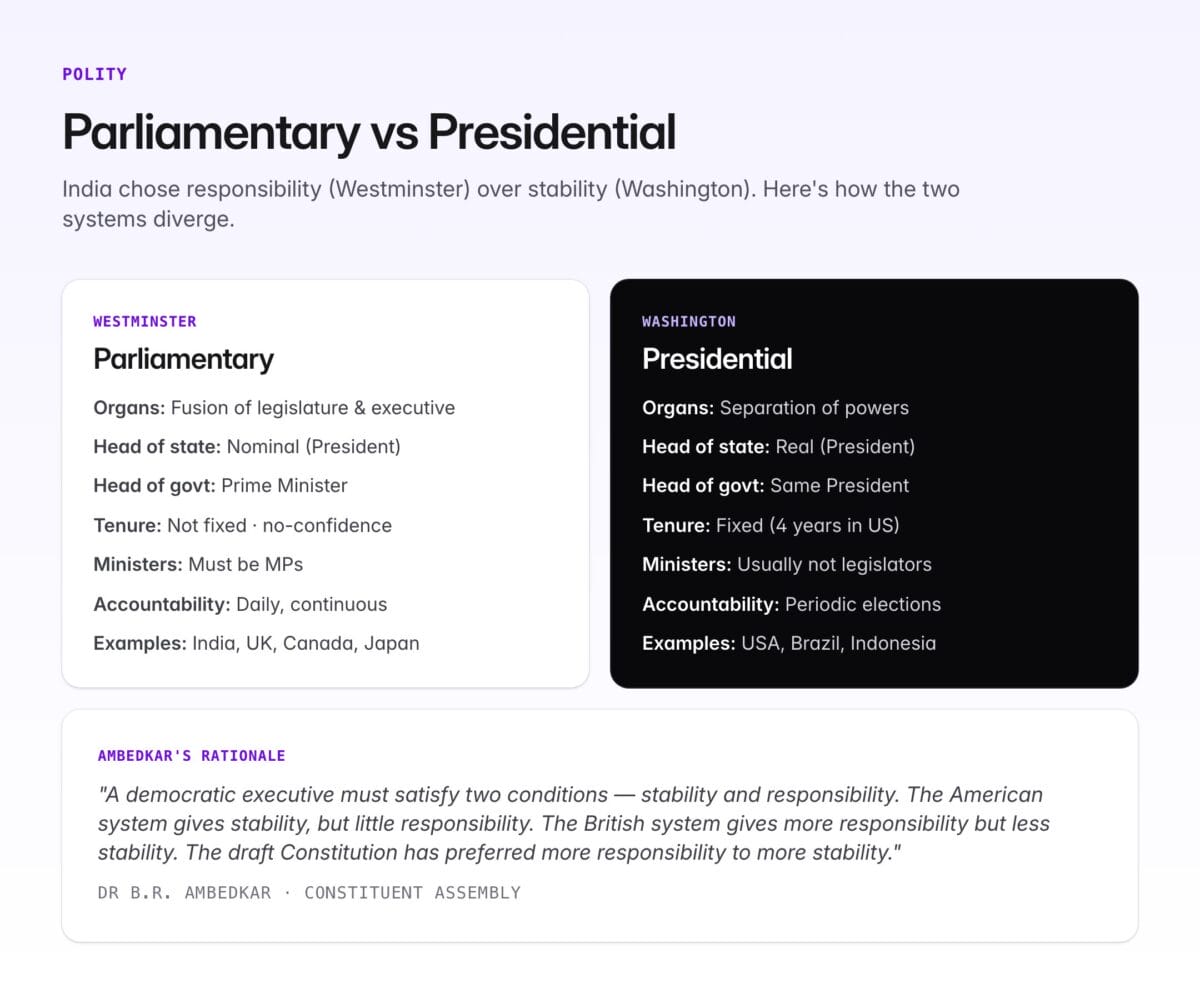
In a parliamentary system, the executive and legislative branches are fused. The head of government—usually called a prime minister, premier, or chancellor—emerges from and is accountable to the parliament, which is the supreme legislative body.
Fusion of Powers and Executive Leadership
Citizens in a parliamentary system vote for members of parliament rather than directly for the chief executive. Once the legislature convenes, the political party or coalition of parties holding a majority (or commanding a majority of confidence) selects the prime minister. The prime minister then appoints cabinet ministers, almost exclusively from sitting members of parliament.
This structural fusion means the executive branch relies on legislative support to govern. The head of state in a parliamentary system is often a separate, ceremonial figure—such as a monarch (in constitutional monarchies like the United Kingdom or Japan) or a ceremonial president (in republics like Germany or India)—who performs symbolic duties while holding little active political power.
Votes of Confidence and Accountability
The hallmark of a parliamentary system is the vote of confidence and its counterpart, the vote of no confidence. Because the government's survival depends on legislative backing, the parliament can dismiss the prime minister and cabinet at any time by passing a motion of no confidence. Conversely, if a major government bill fails to pass, it is often treated implicitly or explicitly as a question of confidence, triggering the resignation of the government.
This mechanism ensures immense political flexibility. If a governing coalition collapses or policy paralysis occurs, the prime minister can advise the head of state to dissolve parliament and call snap elections. This allows voters to resolve political crises at the ballot box well before a fixed term expires, contrasting sharply with the rigid timelines of presidential regimes.
Comparative Analysis of Governance Models
Evaluating presidential and parliamentary systems requires looking beyond structural definitions to examine how each model performs in practice. Each system shapes party discipline, executive stability, and representation in distinct ways.
| Feature | Presidential System | Parliamentary System |
|---|---|---|
| Executive Selection | Elected separately from the legislature | Chosen from within the legislative body |
| Branch Relationship | Strict separation of powers | Fusion of executive and legislative branches |
| Term Stability | Fixed terms; difficult to remove mid-term | Flexible terms; removable via no-confidence votes |
| Party Discipline | Generally lower; legislators vote independently | Typically high; party loyalty is vital to survival |
| Resolution of Deadlock | Difficult; relies on negotiation or fixed elections | Easy; resolved via snap elections or cabinet replacement |
| Examples | United States, Brazil, Mexico | United Kingdom, Germany, Canada, India |
Party Discipline and Cohesion
Party discipline differs markedly between the two systems. In parliamentary systems, party discipline is exceptionally strong. A member of parliament who votes against their party leadership on critical legislation risks expulsion from the party and the collapse of the government, threatening their own political career. Consequently, parliamentary votes often proceed predictably along strict party lines.
In presidential systems, legislators enjoy greater independence from the executive. Because a lawmaker's seat does not depend on the president's political survival, members of congress frequently break with their party's executive branch to address local constituent concerns or appeal to specific interest groups. This dynamic encourages coalition-building on a bill-by-bill basis rather than through strict ideological bloc voting.
Executive Stability vs. Flexibility
Presidential systems provide high executive stability. A president remains in office for a predetermined number of years regardless of shifting public opinion or legislative resistance, ensuring policy continuity. However, this rigidity becomes a liability if an incompetent or deeply unpopular president refuses to resign, as impeachment is typically reserved for severe legal misconduct rather than poor policy performance.
Parliamentary systems offer the opposite trade-off: high flexibility but potential instability. Prime ministers can be unseated overnight if they lose the backing of their parliamentary majority or coalition partners. While this allows nations to swiftly remove failing leaders, countries with fragmented multi-party legislatures—such as Israel or Italy historically—have sometimes suffered from frequent government collapses and short-lived administrations.
Semi-Presidential and Hybrid Systems
Recognizing the strengths and weaknesses of both pure models, many nations have adopted hybrid architectures, most notably the semi-presidential (or premier-presidential) system. Popularized by the French Fifth Republic established in 1958, this framework attempts to blend direct executive leadership with legislative accountability.
In a semi-presidential system, voters directly elect a president who wields significant executive powers, particularly in foreign policy, defense, and emergency management. Simultaneously, the system features a prime minister appointed by the president who must maintain the confidence of the national assembly to manage domestic administration and day-to-day governance.
This dual executive structure introduces a unique political dynamic known as "cohabitation." If the legislative majority belongs to a political party opposed to the sitting president, the president is forced to appoint a prime minister from the opposition. Under cohabitation, the president retains control over foreign affairs while the prime minister dominates domestic policy. While this requires high levels of political pragmatism, it demonstrates how constitutional designers adapt core democratic principles to navigate complex political landscapes.
Frequently Asked Questions
What is the main difference between a presidential and parliamentary system?
The main difference lies in the relationship between the executive and legislative branches. In a presidential system, the executive is elected independently of the legislature and operates separately. In a parliamentary system, the executive (prime minister and cabinet) is drawn from the legislature and remains accountable to it.
Can a parliamentary system have a president?
Yes. Many parliamentary republics, such as India, Germany, and Italy, have a president who serves as the formal head of state. However, unlike a president in a presidential system, this official holds primarily ceremonial duties, while the active executive power rests with the prime minister and cabinet.
Which system is more stable?
Stability manifests differently in each model. Presidential systems offer fixed-term stability, ensuring the executive cannot be easily removed by political whims. Parliamentary systems offer political flexibility, allowing nations to dissolve paralyzed governments and hold early elections, preventing long-term executive-legislative stalemates.
What happens during a stalemate in a presidential system?
When the executive and legislative branches clash in a presidential system, legislation often stalls, resulting in a government shutdown or budget impasse. Because terms are fixed, these disputes must generally be resolved through inter-branch negotiation, judicial review, or waiting until the next scheduled election.
Why do some countries choose semi-presidential systems?
Nations often choose semi-presidential systems to combine the strong, decisive leadership of a directly elected president with the democratic accountability and flexibility of a parliamentary cabinet, making it useful in transitional democracies or nations with fragmented political parties.
Conclusion and Next Steps
Choosing between presidential and parliamentary systems profoundly impacts a nation's legislative efficiency, party politics, and crisis management. When analyzing global governance or constitutional reform, examine how executive power is legitimized, how legislative conflicts are resolved, and where ultimate accountability rests. To deepen your understanding, review the constitutional histories of specific democratic nations, such as the United States for presidential mechanics or the United Kingdom for parliamentary traditions, observing how these structural rules influence contemporary political outcomes.
Image Gallery
Select an image to open it in a new tab.



Celine Dubois
Contemporary Living and Global Arts Columnist
