Choosing an Anchor for Most Recreational Boats: A Comprehensive Guide to Holding Power, Design Types, and Sizing

Choosing an anchor for most recreational boats requires balancing seabed conditions, hull displacement, windage, and modern anchor design innovations to ensure reliable holding power in varying marine environments.
Selecting the right anchor for a recreational boat is one of the most critical safety and seamanship decisions a captain can make. Whether you are anchoring for a quick lunch in a protected cove, waiting out a sudden squall, or spending the night in an exposed anchorage, your peace of mind depends entirely on the metal sitting at the end of your rode. Modern marine hardware has evolved far beyond the traditional stockless anchors of the past, offering generational improvements in holding efficiency, setting reliability, and weight-to-performance ratios.
However, no single anchor performs universally across all bottom types, and boaters often fall into the trap of using undersized hardware or outdated designs. To make an informed choice, you must understand how bottom conditions dictate anchor mechanics, how boat dimensions and windage translate into holding requirements, and how modern "new generation" anchor geometries compare to legacy standards. This comprehensive guide examines the core factors involved in choosing, sizing, and deploying an anchor for typical recreational vessels.
Understanding Anchor Mechanics and Holding Power
An anchor does not hold a boat simply through dead weight; it functions by burying itself into the seabed and using the shear strength of the sediment to resist horizontal pull. When a boat experiences wind, current, or wave action, it exerts a force on the anchor rode. This force should ideally be transmitted to the anchor as a horizontal pull along the seabed, which is why proper scope (the ratio of rode length to water depth) and chain weight are vital.
When an anchor lands on the bottom, its roll stability, shank geometry, and fluke surface area determine whether it will tip upright, penetrate the substrate, and bury deeply. If an anchor lacks roll-stability mechanisms—such as a roll bar or ballast distribution—it can drag across the bottom on its side without catching. Once upright, the sharpness and angle of the tip initiate penetration. As tension increases, the flukes or scoop shape drive deeper into the sediment, mobilizing a wedge of seabed material that provides the ultimate holding resistance.
The Role of Bottom Types
Different seabeds present distinct engineering challenges for marine hardware. A design that excels in soft mud may struggle to penetrate hard-packed sand or weed, while an anchor optimized for coral or rock relies on hooking rather than burying.
- Soft Mud and Silt: These substrates offer very little initial resistance. Anchors require large surface areas (fluke area) to prevent pulling straight through the mud without setting.
- Sand: Generally considered the ideal holding ground, sand allows anchors to bury deeply and efficiently. Most modern designs perform exceptionally well in clean sand.
- Clay and Hard Mud: Highly cohesive soils require sharp tips and high penetration force to break through the surface crust before burying.
- Gravel and Shells: Similar to coarse sand, these bottoms require robust construction and positive setting geometries to navigate around larger stones.
- Weed and Grass: Dense vegetation prevents anchors from reaching the underlying sediment. Specialized designs or weighted tips are necessary to slice through weed and catch the earth beneath.
- Rock and Coral: These bottoms preclude burying entirely. Holding relies on mechanical obstruction—snagging or wedging into crevices—making breakaway systems or stout traditional hooks essential.
Modern Anchor Design Categories
The recreational marine market features several distinct anchor geometries. Understanding how each design type operates helps clarify why certain models dominate modern cruising and day-boating while others remain legacy choices.
| Anchor Category | Primary Strengths | Common Limitations |
|---|---|---|
| New Generation (Scoop/Roll-Bar) | Rapid set, high holding power, reliability across diverse bottoms | Bulkier storage profiles, higher initial cost |
| Plow / CQR | Articulated hinge, durable steel construction | Lower holding-to-weight ratio, slow to reset on wind shifts |
| Danforth / Fluke | Exceptional holding in sand/mud, flat storage profile | Poor performance in weeds, rolls out during 360-degree shifts |
| Claw / Bruce | Sets easily in multiple positions, rugged cast construction | Lower holding power per pound, struggles in hard weed |
New Generation Anchors (Scoop and Roll-Bar Designs)
Represented by modern benchmarks such as the Rocna, Spade, Excel, and Manson Supreme, new-generation anchors have revolutionized recreational anchoring over the last three decades. These designs feature concave scoop blades or advanced ballasted shanks combined with roll bars or weighted tips.
They are engineered to self-right immediately upon hitting the seabed, regardless of how they land. Their high holding-to-weight ratios and aggressive setting characteristics make them the gold standard for cruising sailors and powerboaters alike. They excel in sand, mud, and grass, and they reset quickly when a vessel swings 180 degrees due to tidal or wind shifts.
Plow Anchors (CQR and Delta)
The CQR (Coastal Quick Release) is a hinged plow anchor designed in the mid-20th century. While its articulating joint allows it to pivot as the boat moves around the anchor, modern testing has shown that the hinge can introduce a weak point and sometimes prevent the anchor from resetting cleanly after a major wind shift.
The Delta anchor, a fixed-shank plow design, is widely used as factory equipment by boat builders. It offers solid construction and good performance in sand and mud, though it generally requires a heavier weight to achieve the same holding power as a newer scoop-style anchor.
Fluke Anchors (Danforth and Fortress)
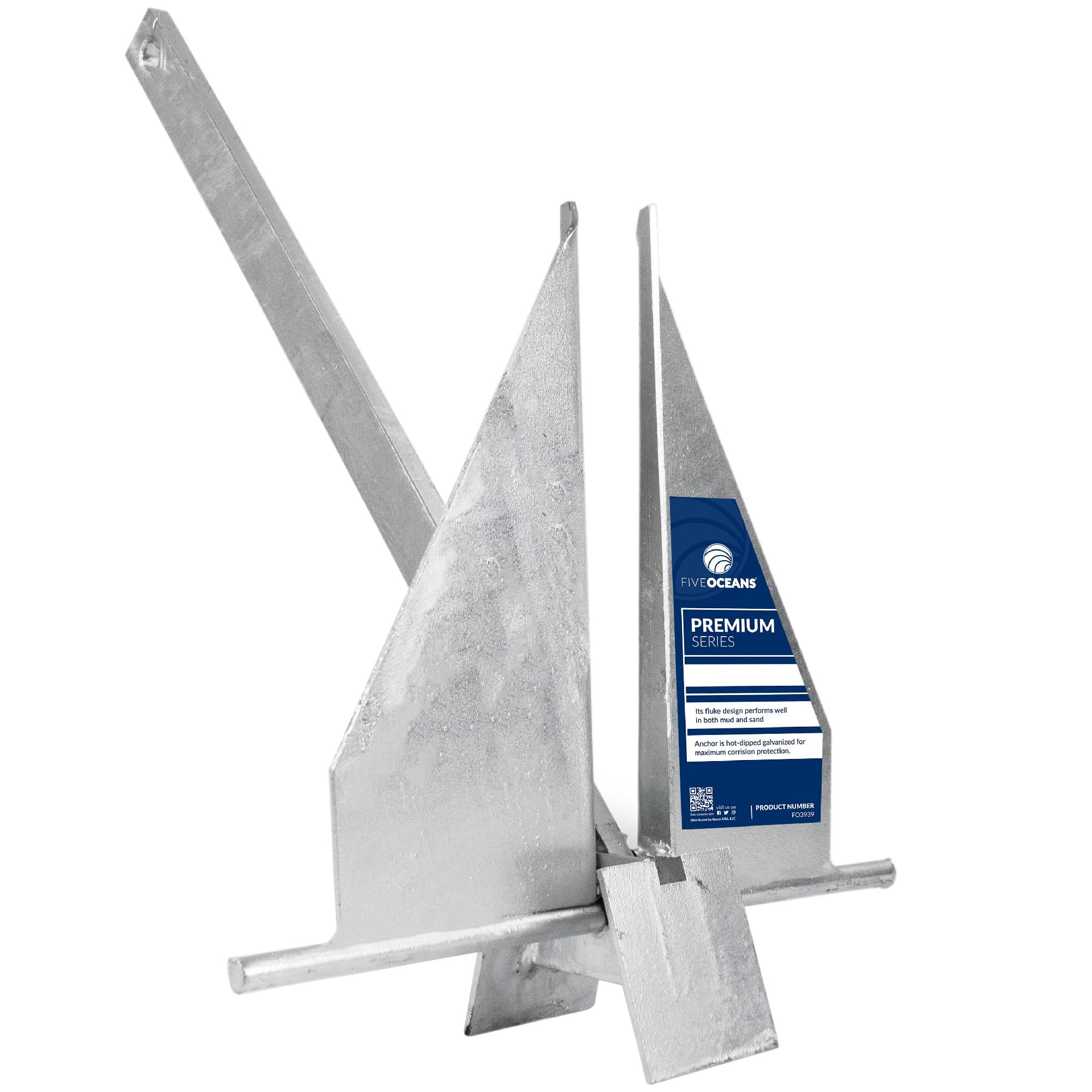
Fluke anchors feature large, flat triangular blades hinged to a stock with a crossbar at the crown. They offer exceptional holding power relative to their weight in sand and mud because their large surface area acts like a buried wall.
The Fortress anchor, manufactured from high-tensile aluminum-magnesium alloy, combines the Danforth geometry with lightweight construction and adjustable fluke angles (for soft mud versus hard sand). While unmatched as a lightweight stern anchor or storm backup, fluke anchors tend to struggle in heavy weed and can break out and fail to reset if the boat swings through a complete circle.
Claw Anchors (Bruce Style)
Originally designed for oil rig handling and scaled down for recreational use, the claw anchor features a multi-tine, cast-metal design that resembles the paw of an animal. Claw anchors are renowned for their ability to set reliably in almost any bottom type, including coral and hard sand, and they rarely fail to reset during wind shifts. However, because their holding power is distributed across a broader, less aggressive profile, they require a size larger than a scoop-style anchor to achieve equivalent holding security in high winds.
Sizing Metrics: Weight, Windage, and Vessel Displacement
Choosing the correct anchor size is not a matter of picking a model that matches your boat's length overall (LOA) in feet. Vessel displacement, hull profile, superstructure windage, and wind exposure are far more critical engineering variables. A lightweight, low-profile sportboat requires vastly different holding power than a heavy cruising sailboat or a high-sided flybridge motor yacht of the exact same length.
Calculating Displacement and Windage
When consulting manufacturer sizing charts, you will notice that anchors are recommended based on boat length and displacement ranges. Always size up if your boat falls near the upper limit of a displacement category, or if your vessel features high freeboard, a large flybridge, or enclosed canvas structures that act like sails in a strong breeze.
- Displacement Weight: A heavy, full-keel displacement boat generates significantly more momentum when pulled by waves and wind than a lightweight planing hull. The anchor must be heavy enough to keep the rode angle low and strong enough to resist peak dynamic loads.
- Windage Factor: Wind creates exponentially more drag than water at comparable velocities. A motor yacht with significant cabin profile will place severe cyclic loads on the ground tackle, requiring a larger anchor to prevent the boat from sailing around its anchor and breaking the set.
Sizing Up: The Golden Rule of Anchoring
In the recreational boating community, a common adage states: "Buy the largest anchor that will comfortably fit on your bow roller and locker."
Manufacturers' sizing charts are typically calculated for moderate conditions (winds up to 30 knots in good holding grounds). If you plan to cruise extensively, anchor out in remote locations, or face severe weather, stepping up one or even two sizes larger than the minimum recommendation provides an invaluable safety margin with very little downside beyond a minor increase in physical lifting effort.
The Complete Ground Tackle System
An anchor is only as strong as the weakest link in the ground tackle system. Choosing the right anchor must be paired with an appropriately engineered rode, chain, and connection hardware.
Rode Composition: Chain vs. Rope
A proper recreational rode consists of a combination of galvanized chain and multi-pleat nylon line (or all-chain for larger vessels).
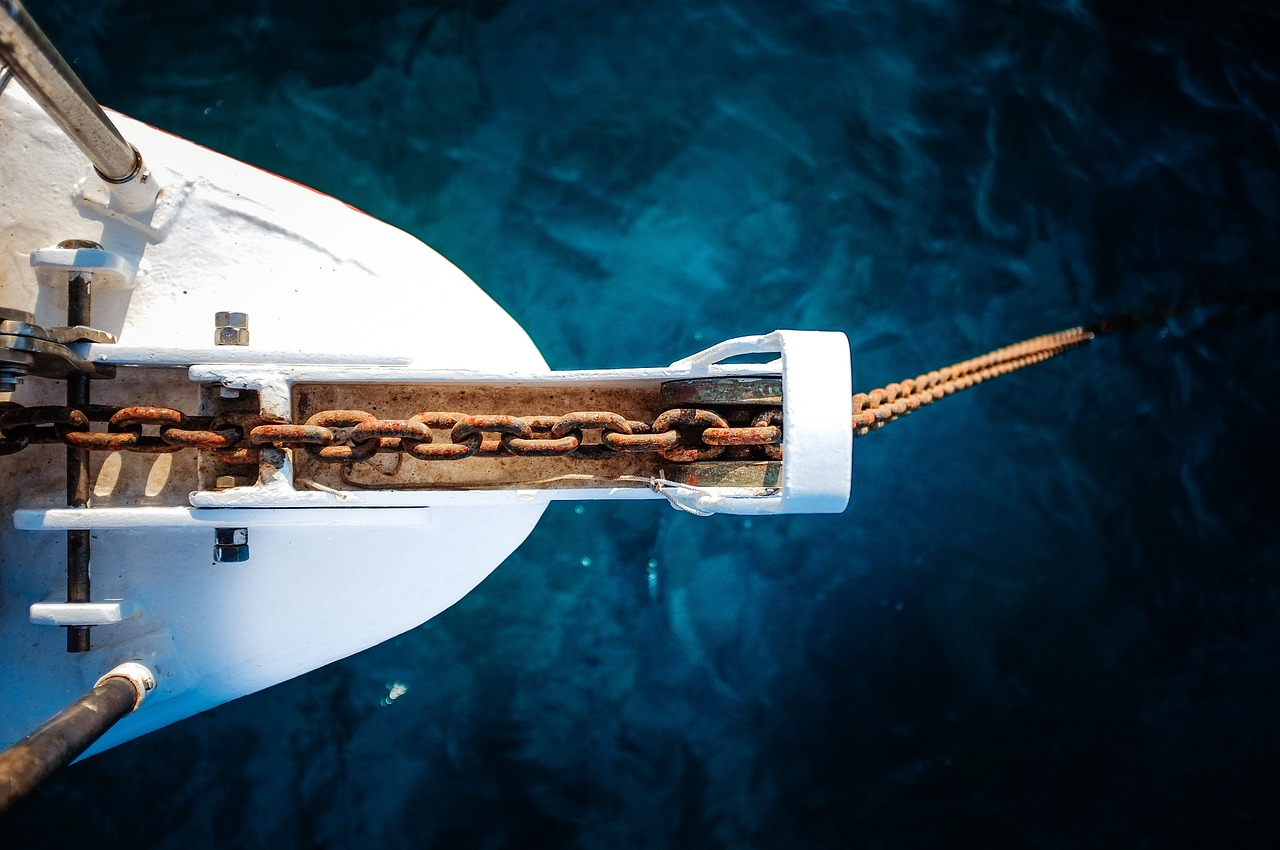
- All-Chain Rode: Essential for heavy cruising boats, chain provides abrasion resistance against coral and rock, and its weight creates a catenary curve. This downward sag acts as a shock absorber, dampening the sudden shock loads transmitted from waves up to the deck cleat.
- Combination Rode: For most smaller trailered boats and coastal cruisers, a lead of chain equal to the boat's length (or a minimum of 20 to 30 feet) attached to the anchor, followed by high-stretch nylon three-strand or eight-plait rope, provides an optimal balance of shock absorption and manageable weight.
Connectors, Shackles, and Swivels
Every component between the anchor shank and the rode must match the working load limit of the system.
- Shackles: Use hot-dipped galvanized steel shackles sized correctly to fit the anchor shank and chain links. Always mouse the shackle pin (using stainless steel safety wire or heavy zip ties) to prevent it from unscrewing under cyclic vibration.
- Swivels: While anchor swivels help prevent the rode from twisting as the boat swings, poorly designed swivels can fail under side loads if the anchor gets pinned in rocks. If using a swivel, ensure it is rated for high breaking strength and connected via a short shackle to allow articulation.
Practical Deployment and Retrieval Strategies
Choosing the right anchor is only half the battle; proper deployment technique ensures the hardware performs as engineered.
- Assess the Anchorage: Check charts, bottom soundings, and weather forecasts to verify holding ground and potential wind shifts.
- Calculate Scope: Deploy a minimum scope of 5:1 in calm conditions with all-chain rode (7:1 with rope), and increase to 7:1 or 10:1 when winds pick up or when anchoring overnight. Scope is calculated as the ratio of rode length paid out to the maximum depth of water plus the distance from the waterline to the bow roller.
- Set the Anchor: Bring the boat to a complete stop, lower the anchor under control while drifting backward slowly, and pay out scope as the boat moves astern. Once the target scope is reached, take a turn on the cleat or windlass and gently reverse the engine at idle speed to verify the set. Increase throttle gradually to confirm the anchor digs deep.
- Weighing Anchor: Motortorque forward directly over the anchor until the rode is vertical ("up and down"). If the anchor is fouled, snub the rode tightly on a cleat and drive slowly forward; the forward motion of the hull will usually break the anchor out of the bottom.
Common Anchoring Mistakes to Avoid
Even experienced boaters occasionally fall into habits that compromise their security at anchor. Recognizing these pitfalls helps prevent dragging incidents.
- Undersizing for Weight Savings: Selecting a lighter anchor to make manual retrieval easier on the back often results in dragging when conditions deteriorate unexpectedly.
- Insufficient Scope: Letting out too little rode changes the pull angle from horizontal to vertical, lifting the anchor's nose and causing it to skip across the bottom.
- Ignoring Swing Room: Failing to calculate the 360-degree turning circle of your boat—and accounting for neighboring boats that may have different rode lengths or hull types—frequently leads to collisions.
- Relying Solely on GPS Alarms: While electronic anchor drag alarms are helpful, they should supplement, not replace, visual cross-bearings and shore transit checks when setting the boat for the night.
Frequently Asked Questions
What size anchor do I need for a 25-foot recreational boat?
For a typical 25-foot recreational boat displacing around 5,000 to 7,000 pounds, a modern scoop-style anchor weighing between 15 to 22 pounds (or a traditional fluke anchor like a Danforth #13) is generally recommended. Always check the specific manufacturer's displacement guidelines and step up in size if your boat has high windage or a heavy displacement hull.
Are all-chain rodes necessary for coastal day-boating?
No. For day-boating and coastal cruising where you anchor primarily in moderate weather during daylight hours, a combination rode consisting of 20 to 30 feet of galvanized chain connected to high-stretch nylon line is ideal. It keeps bow weight manageable while offering sufficient abrasion resistance and shock absorption.
How much scope should I put out when anchoring?
In normal conditions with a mixed rope-and-chain rode, aim for a 7:1 scope ratio (seven feet of rode for every one foot of water depth at high tide). With an all-chain rode, the heavy catenary curve allows you to safely reduce scope to 5:1 in calm conditions, though 7:1 or greater is always safer when winds strengthen.
Why does my anchor drag even after I set it?
Dragging usually results from three factors: insufficient scope (causing a vertical pull that yanks the anchor out), inadequate setting technique (failing to back down firmly with the engine to bury the flukes), or choosing an anchor design unsuited to the bottom substrate (such as using a smooth-bottom claw in dense weed).
Can I use the same anchor for sand, mud, and rocky bottoms?
Modern new-generation scoop anchors offer the closest thing to a universal design, performing exceptionally well in sand, mud, and weed. However, in pure rock or coral bottoms where burying is impossible, even the best scoop anchor will struggle, requiring either a dedicated rocky-bottom hook or careful wedging techniques.
Conclusion and Next Action
Choosing an anchor for most recreational boats requires looking past marketing claims and matching the physical realities of your vessel to proven hardware designs. Prioritize modern scoop-style anchors for maximum holding security across varied seabeds, never skimp on scope or chain lead, and always back down hard on your anchor to verify the set before relaxing on deck.
Your immediate next step is to inspect your current ground tackle system, verify that your anchor's weight and design match your vessel's actual displacement and windage profile, and upgrade any worn shackles or undersized rodes before your next on-water excursion.
Image Gallery
Select an image to open it in a new tab.


Mateo Castillo
Decentralized Finance and E-Payments Strategist
