Understanding the Federal and Unitary Systems: A Comparative Analysis of State Power

Understanding the federal and unitary systems requires examining how political power is distributed between a central government and regional administrative units. In a federal system, authority is constitutionally shared between the national government and constituent states or provinces, whereas in a unitary system, all supreme power rests with a single central government that may delegate limited administrative duties to local bodies.
Political organization dictates how laws are made, how resources are distributed, and how citizens interact with their governance structures. Across the globe, nations have designed their foundational documents to manage diversity, geographic scale, and administrative efficiency.
Grasping the mechanics, benefits, and drawbacks of these distinct governance architectures is essential for students of political science, legal scholars, and anyone seeking to understand modern constitutional frameworks. This guide explores the core definitions, structural mechanics, operational differences, and real-world implications of federal and unitary systems.
Defining the Core Concepts of State Architecture
To analyze how governments function, one must first define the institutional frameworks that organize public power. The architecture of a state shapes its legislative processes, executive capabilities, and judicial independence.
What is a Unitary System?
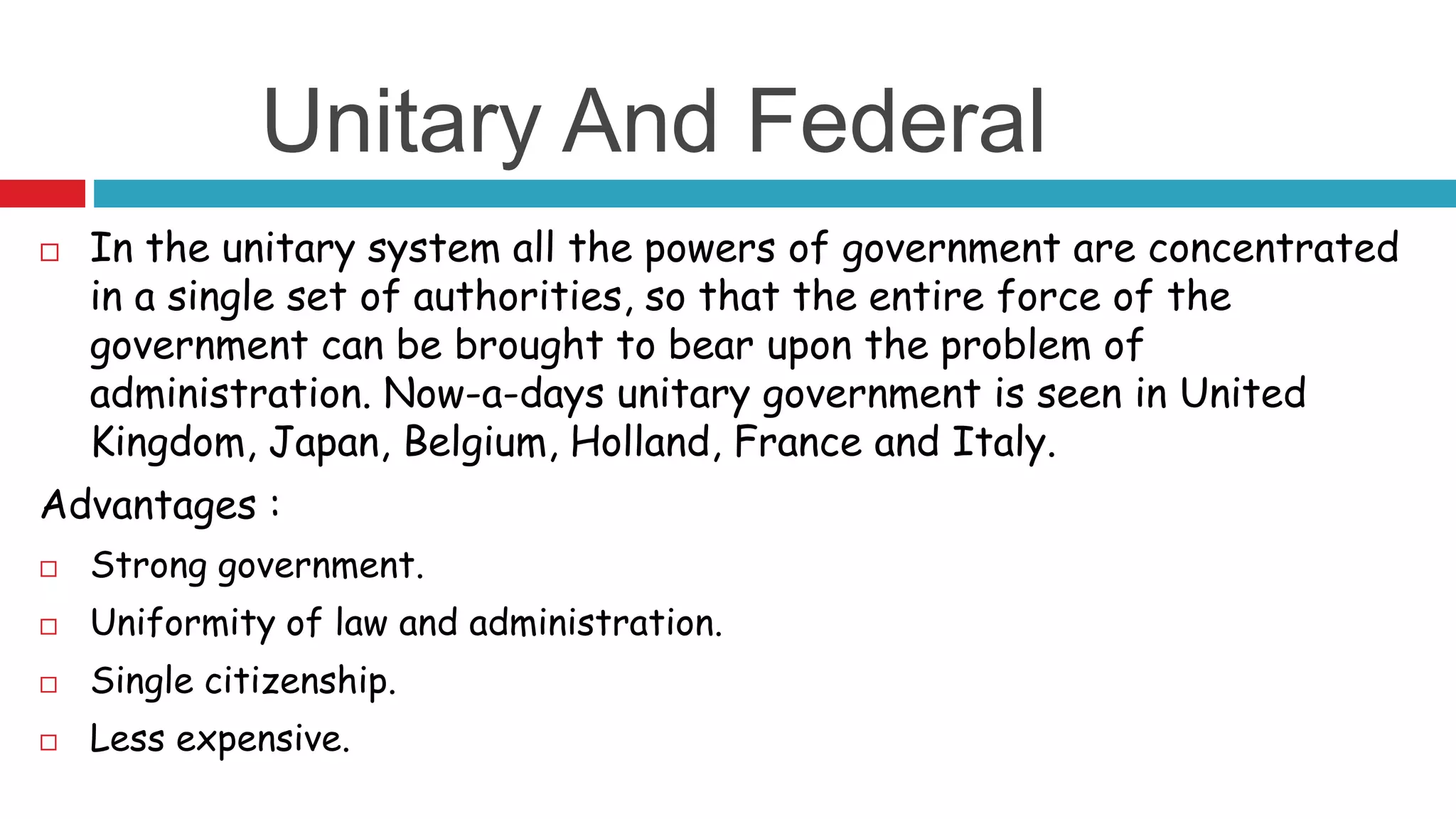
A unitary system is a system of political organization in which most or all governing authority resides in a centralized national government. In this model, the central government holds absolute sovereignty over the entire national territory.
While subnational entities—such as provinces, regions, counties, or municipalities—frequently exist, they operate entirely as administrative extensions of the central authority. These local units possess only the powers expressly granted to them by the national legislature, and those powers can be modified, expanded, or revoked at any time through ordinary legislation.
Key structural features of a unitary system include:
- Single Source of Legal Authority: The national constitution or central parliament is the ultimate fountain of all legal power.
- Uniformity of Laws: Legal codes, criminal laws, and administrative regulations tend to be uniform across the entire country, ensuring that citizens experience identical legal treatment regardless of geographic location.
- Flexible Subnational Boundaries: The central government can redraw local administrative districts, dissolve municipal councils, or alter regional jurisdictions without requiring constitutional amendments.
Prominent examples of unitary states include the United Kingdom, France, Japan, Italy, and New Zealand. While countries like the United Kingdom have introduced forms of devolution—granting regional assemblies in Scotland, Wales, and Northern Ireland varying degrees of legislative competence—ultimate sovereignty remains vested in the Westminster Parliament, which retains the theoretical legal authority to revoke those devolved powers at will.
What is a Federal System?
A federal system, or federalism, is a compound mode of government that combines a general government (the central or federal government) with regional governments (provincial, state, or territorial governments) in a single political system. The defining characteristic of federalism is that neither level of government is entirely subordinate to the other; instead, power is divided and protected by a foundational constitutional document.
In a true federal arrangement, the constitution explicitly enumerates the powers of the national government while reserving all other powers—often referred to as residual powers—to the regional units, or vice versa. Because this division is entrenched in a supreme constitution, neither the central government nor a regional government can unilaterally alter the fundamental distribution of power.
Key structural features of a federal system include:
- Constitutional Dualism: Two distinct levels of government exercise direct authority over the same geographic area and the same citizenry.
- Rigid Amendment Process: Altering the division of power typically requires a complex constitutional amendment process that involves consent from both the national legislature and a supermajority of regional states or provinces.
- Independent Judiciary: A specialized constitutional court or supreme court typically acts as an arbiter, resolving jurisdictional disputes and conflicts between the federal government and regional units.
Prominent examples of federal systems include the United States, Canada, Germany, Australia, India, and Brazil. In these nations, regional states or provinces maintain their own distinct constitutions, legislatures, executives, and court systems, operating concurrently with federal institutions.
Structural Comparison: Federal vs. Unitary Systems
Evaluating the functional differences between federal and unitary states reveals how constitutional design directly influences public policy, legislative efficiency, and citizen representation.
| Feature | Unitary System | Federal System |
|---|---|---|
| Sovereignty | Vested entirely in the central national government. | Divided constitutionally between national and regional governments. |
| Subnational Power | Delegated by the center; can be revoked or altered at will. | Constitutionally protected; cannot be unilaterally revoked by the center. |
| Legal Uniformity | High; laws, regulations, and public policies are largely uniform nationwide. | Low to Moderate; regional states enact distinct laws, taxes, and social policies. |
| Constitutional Amendment | Managed by the central legislature through standard or slightly elevated legislative processes. | Requires complex, multi-tiered consent involving both central and regional bodies. |
| Conflict Resolution | Handled through administrative oversight or parliamentary supremacy. | Handled by an independent supreme court or constitutional tribunal. |
| Responsiveness to Diversity | Can struggle to accommodate deep regional, linguistic, or cultural differences. | Specifically engineered to manage distinct regional identities and minority populations. |
Operational Dynamics and Governance Implications
The structural differences between federal and unitary models generate profound operational consequences. Governments must balance administrative coherence against regional autonomy, and each system handles this tension differently.
Legislative Efficiency and Policy Implementation
Unitary systems typically exhibit high legislative efficiency. Because a single national parliament holds supreme power, laws can be passed, amended, and implemented quickly without needing complex negotiations between central and regional authorities. This allows unitary governments to respond swiftly to national crises, economic emergencies, or shifting public policy priorities.
Conversely, federal systems often experience legislative gridlock and jurisdictional disputes. Because power is divided, policy implementation can vary widely across regional borders. For example, in a federal nation like the United States, healthcare regulations, environmental standards, and criminal sentencing laws can differ dramatically from one state to another. This decentralization fosters what political scientists describe as "laboratories of democracy"—where individual states can test innovative public policies—but it also creates administrative complexity, regulatory fragmentation, and inequality in citizen experiences.
Managing Diversity and National Unity
Geographic, linguistic, cultural, and religious diversity heavily influences a nation's choice of governance system.
Unitary systems function most effectively in culturally homogeneous nations where a unified national identity predominates. When applied to deeply divided societies, strict unitary centralization can alienate regional minorities, fuel separatist movements, and provoke civil unrest. To mitigate this, some unitary states adopt decentralized administrative frameworks, such as regional autonomy statutes, to satisfy local populations without abandoning ultimate central sovereignty.
Federal systems are explicitly designed to hold diverse populations together under a single sovereign umbrella. By granting regional groups self-governance over local affairs—such as education, language policies, and cultural preservation—federalism accommodates distinct regional identities while maintaining national defense, economic integration, and foreign policy at the center. Nations like India and Canada utilize federalism precisely to manage vast linguistic, religious, and cultural pluralism across immense territories.
Fiscal Federalism and Economic Resource Allocation
Financial governance represents one of the most critical operational challenges in both systems.
In a unitary state, the central government controls taxation, public revenue collection, and national budget allocation. It can redistribute wealth from economically prosperous regions to impoverished areas directly, ensuring relatively uniform public services, infrastructure development, and social welfare programs nationwide.
In a federal state, fiscal responsibilities are divided between federal and regional tax authorities. This division frequently produces "vertical fiscal imbalance," where regional governments bear the responsibility for costly public services (such as healthcare, education, and policing) but lack sufficient independent revenue streams to fund them. Consequently, federal systems rely on complex intergovernmental transfer payments, federal grants-in-aid, and equalization formulas to balance regional disparities, which can become major sources of political friction.
Common Misconceptions and Nuances in Comparative Politics
When studying comparative constitutional law, observers frequently encounter misconceptions regarding how federal and unitary states actually operate.
- Misconception 1: Federal systems are always more democratic than unitary systems. Democracy is defined by citizen participation, free and fair elections, and the protection of human rights, not by the distribution of territorial power. Many thriving democracies—such as New Zealand, Sweden, and Japan—are unitary states with robust civil liberties, while some federal nations have historically struggled with authoritarian central intervention in regional affairs.
- Misconception 2: Unitary states have no local self-governance. While ultimate legal sovereignty rests with the central government in a unitary state, local municipal governments almost universally exist to manage day-to-day community services, zoning, and local policing. The distinction is that these local bodies exist at the legislative pleasure of the central government, not by constitutional right.
- Misconception 3: Federalism guarantees protection against tyranny. While federalism introduces checks and balances by dividing power between multiple levels of government, it can also create jurisdictional dead zones during crises, impede civil rights protections when regional majorities suppress minority populations, and complicate national accountability.
Frequently Asked Questions
Can a unitary system become a federal system?
Yes, a unitary system can transition into a federal system through constitutional reform. This typically occurs when a nation faces intense regional pressures, separatist movements, or demands for self-governance. For example, Belgium transitioned from a unitary state into a federal state through successive constitutional reforms designed to accommodate its Dutch-speaking and French-speaking communities.
Is devolution the same thing as federalism?
No. Devolution involves the central government delegating legislative or executive powers to regional assemblies while retaining ultimate legal sovereignty. The central parliament can unilaterally amend or revoke devolved powers. In federalism, regional powers are constitutionally entrenched and cannot be unilaterally revoked by the central government.
Why do large countries tend to choose federal systems?
Geographic size correlates with regional diversity, varied economic interests, and logistical challenges in centralized administration. Federalism allows large nations—such as the United States, Brazil, and India—to manage vast territories by decentralizing day-to-day governance while maintaining a unified national market, defense posture, and foreign policy.
Which system is better for economic development?
Neither system inherently guarantees superior economic performance. Unitary systems often streamline infrastructure development and economic policy implementation through centralized planning. Federal systems foster inter-jurisdictional competition and policy experimentation, which can drive economic innovation, provided that regulatory fragmentation does not impede interstate commerce.
Conclusion and Next Actions
Selecting or evaluating a political architecture requires balancing administrative unity against regional autonomy. Unitary systems offer centralized legislative efficiency, uniform legal codes, and streamlined public administration, making them well-suited for homogeneous or geographically compact nations. Federal systems provide constitutional protections for regional diversity, prevent the over-concentration of central power, and allow localized policy experimentation, making them effective for large, pluralistic societies.
To deepen your understanding of comparative governance, examine the foundational constitutions of specific nations, analyze recent constitutional court rulings on jurisdictional disputes, and research how intergovernmental fiscal transfers operate in contemporary federal democracies.
Image Gallery
Select an image to open it in a new tab.

Celine Dubois
Contemporary Living and Global Arts Columnist
