Statue of Liberty vs. Statue of Freedom: Key Differences, History, and Symbolism

While both monuments represent foundational American ideals, the Statue of Liberty and the Statue of Freedom are two distinct, historic statues located in different cities. The Statue of Liberty stands 305 feet tall in New York Harbor as a copper gift from France dedicated in 1886, while the Statue of Freedom is a 19.5-foot bronze sculpture installed atop the U.S. Capitol dome in Washington, D.C., in 1863.
Though often confused by visitors and students of American history, these monuments differ significantly in their artistic origin, physical dimensions, material construction, and symbolic representation. Understanding their unique histories reveals how national concepts of liberty, sovereignty, and emancipation evolved during the 19th century.
Historical Context and Origins
The creation of each statue reflects a distinct period in American and international politics. The Statue of Freedom was conceived during the antebellum era as the U.S. Capitol underwent a major expansion, whereas the Statue of Liberty was designed following the American Civil War to commemorate the abolition of slavery and the alliance between France and the United States.
| Year | Event |
|---|---|
| 1854 | Thomas Crawford designs Statue of Freedom model in Rome. |
| 1860 | Philip Reid & Clark Mills cast Statue of Freedom in Maryland. |
| 1863 | Statue of Freedom installed atop U.S. Capitol Dome. |
| 1865 | Édouard René de Laboulaye proposes Statue of Liberty. |
| 1876 | Construction begins in Paris by Frédéric-Auguste Bartholdi. |
| 1886 | Statue of Liberty dedicated on Liberty Island, New York. |
The Statue of Freedom: Antebellum Debates and Civil War Installation
In 1854, Sculptor Thomas Crawford received a commission to design a grand figure to cap the new iron dome of the United States Capitol in Washington, D.C. Crawford, working from his studio in Rome, initially designed a female allegorical figure wearing a pileus—a soft felt cap historically given to freed slaves in ancient Rome.
This design choice triggered a major political controversy. Jefferson Davis, then serving as U.S. Secretary of War and supervisor of the Capitol construction project, strongly objected to the slave cap. Davis argued that including a symbol of manumission was inappropriate for a nation where chattel slavery remained legal. To resolve the dispute, Crawford modified the design, replacing the cap with a military helmet adorned with an eagle’s head and a crest of feathers.
The casting of the statue took place at a foundry outside Washington, D.C., run by bronze founder Clark Mills. Crucially, the complex process relied on the technical expertise of Philip Reid, an enslaved artisan who solved critical engineering challenges during the separation and casting of the plaster model. Reid gained his freedom during the casting process when the District of Columbia Compensated Emancipation Act took effect in April 1862.
On December 2, 1863, during the height of the American Civil War, the final section of the 19-foot-6-inch bronze monument was hoisted into place atop the Capitol dome to a 35-gun salute. Its official title, Freedom Triumphant in War and Peace, reflected the Union’s determination to preserve the nation.
The Statue of Liberty: A French Gift Celebrating Union Victory
The idea for the Statue of Liberty emerged in 1865 from Édouard René de Laboulaye, a French political thinker and abolitionist leader. Laboulaye proposed creating a joint monument with the American public to celebrate the Union victory in the Civil War, the passage of the 13th Amendment ending slavery, and the enduring friendship between France and the United States.
French sculptor Frédéric-Auguste Bartholdi was selected to design the statue, formally named Liberty Enlightening the World (La Liberté éclairant le monde). Bartholdi collaborated with structural engineer Gustave Eiffel, who designed an innovative internal iron skeletal frame capable of supporting heavy copper skin while accommodating thermal expansion and high harbor winds.
Fundraising was a joint effort: the French public financed the statue itself, while the American public raised funds to construct the massive stone pedestal inside Fort Wood on Bedloe’s Island (renamed Liberty Island in 1956). Publisher Joseph Pulitzer played a pivotal role by using his newspaper, The New York World, to rally micro-donations from working-class Americans.
The statue was completed in Paris in 1884, disassembled, shipped across the Atlantic in 214 crates, and reassembled atop its pedestal. President Grover Cleveland officially dedicated the Statue of Liberty on October 28, 1886.
Physical Specifications and Architectural Setting
Beyond their separate histories, the two statues differ dramatically in scale, engineering, materials, and settings.
| Statue | Scale | Components |
|---|---|---|
| Statue of Liberty | 305 ft Ground-to-Torch | Pedestal: 154 ft + Copper Statue: 151 ft |
| Statue of Freedom | 19.5 ft Statue Alone | Capitol Building/Dome: 288 ft + Bronze Statue: 19.5 ft |
Scale and Proportions
The Statue of Liberty is a monumental colossus designed to be visible to maritime traffic miles away in New York Harbor:
- Statue Height: 151 feet, 1 inch (305 feet, 1 inch from ground level to torch tip).
- Total Weight: Approximately 225 tons (450,000 pounds), including 31 tons of copper skin and 125 tons of structural steel/iron framework.
- Skin Thickness: 3/32 of an inch (roughly the thickness of two copper pennies stacked together).
In contrast, the Statue of Freedom is an architectural finial proportioned specifically to cap the U.S. Capitol dome:
- Statue Height: 19 feet, 6 inches.
- Total Weight: Approximately 15,000 pounds (7.5 tons).
- Elevation: Standing atop the Capitol dome, the top of the statue reaches 288 feet above the surrounding ground level.
Materiality and Patina
Material selection gives each statue a distinct visual appearance:
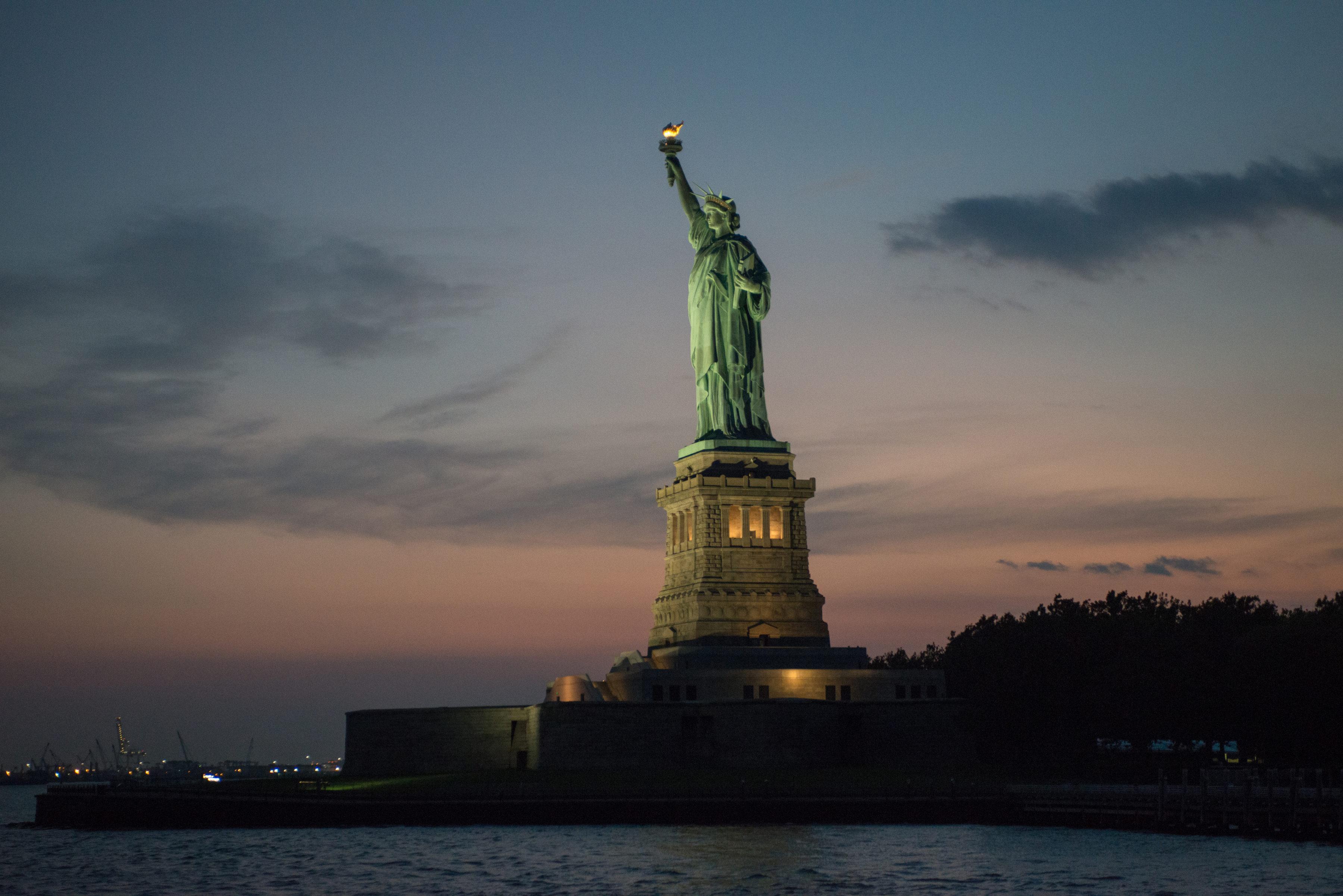
- Statue of Liberty: Constructed from hammered copper sheets using the repoussé technique. Over its first two decades in the moist, salt-rich air of New York Harbor, the copper underwent natural oxidation, forming a protective green coating called a verdigris patina. This layer shields the underlying copper from further corrosion.
- Statue of Freedom: Cast entirely in solid bronze. Its surface is finished with a dark bronze chemical patina. Because it sits high on the Capitol dome, the Architect of the Capitol periodically conducts restoration work, cleaning the bronze and applying protective wax coatings to prevent green copper carbonate staining.
Symbolism and Iconography
Both monuments use classical Roman and Greek allegorical figures, but their specific attributes communicate entirely different political messages.
| Statue of Liberty | Statue of Freedom |
|---|---|
| Crown with 7 Rays | Crested Military Helmet |
| Raised Torch (Enlightenment) | Sheathed Sword (Peace/Readiness) |
| Dated Tablet (July 4, 1776) | Shield & Laurel Wreath |
| Broken Shackles at Feet | Stars on Robe & Helmet |
Allegorical Features of the Statue of Liberty
Bartholdi drew heavily on the Roman goddess Libertas, but infused the work with modern republican symbols:
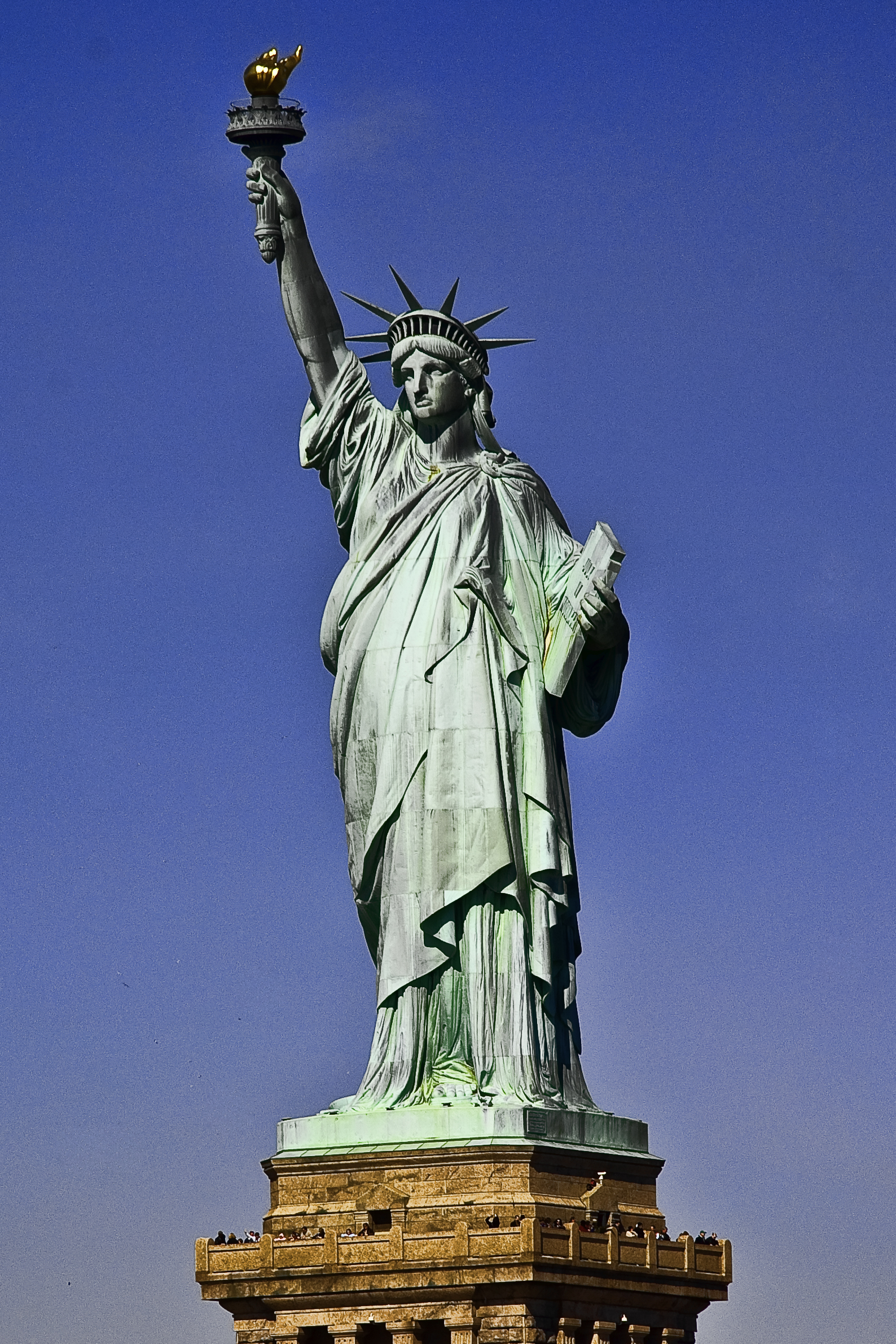
- The Radiant Crown: Features seven spikes, representing the seven continents and seven seas, symbolizing the global reach of universal liberty.
- The Raised Torch: Held aloft in her right hand, the torch represents enlightenment, illuminating the path to freedom and progress. The current flame is coated in 24-karat gold leaf, added during the 1986 restoration.
- The Keystone Tablet (Tabula Ansata): Held in her left hand, the tablet is inscribed with the date of the American Declaration of Independence in Roman numerals:
JULY IV MDCCLXXVI. It signifies that true liberty depends on the rule of law. - Broken Shackles and Chains: Positioned at her feet, the broken chain and shackle represent the abolition of slavery and liberation from oppressive control. Her raised right foot indicates forward movement, stepping away from tyranny.
Allegorical Features of the Statue of Freedom
Crawford designed Freedom as a defensive guardian of the American republic, blending Roman warrior motifs with national heraldry:
- The Military Helmet: Features a helmet surrounded by nine stars and topped with an eagle head and a feather crest, evoking American Indian headdresses while maintaining classical military framing.
- The Sword and Shield: Her right hand rests on the hilt of a sheathed sword, symbolizing that peace has been achieved through military triumph while remaining prepared to defend the Union. Her left hand holds a laurel wreath of victory alongside the U.S. shield.
- Drapery and Inscriptions: Her classical robe is secured by a brooch inscribed with the letters
U.S.The pedestal upon which she stands is a globe encircled with the motto E Pluribus Unum ("Out of many, one").
Direct Comparison Table
The following matrix highlights the key differences between the Statue of Liberty and the Statue of Freedom:
| Feature | Statue of Liberty (Liberty Enlightening the World) | Statue of Freedom (Freedom Triumphant in War and Peace) |
|---|---|---|
| Location | Liberty Island, New York City, NY | U.S. Capitol Dome, Washington, D.C. |
| Managing Agency | National Park Service (NPS) | Architect of the Capitol (AOC) |
| Year Installed / Dedicated | 1886 | 1863 |
| Primary Sculptor | Frédéric-Auguste Bartholdi | Thomas Crawford |
| Primary Material | Hammered Copper over Iron/Steel Framework | Cast Bronze |
| Height (Statue Only) | 151 feet, 1 inch | 19 feet, 6 inches |
| Total Height from Ground | 305 feet, 1 inch | 288 feet (to top of statue on dome) |
| Total Weight | 225 tons (450,000 lbs) | 7.5 tons (15,000 lbs) |
| Headgear | 7-Rayed Sunburst Crown | Feathered Eagle-Crest Helmet with Stars |
| Objects Held | Raised Torch, Inscribed Tablet (JULY IV MDCCLXXVI) |
Sheathed Sword, Laurel Wreath, U.S. Shield |
| Footwear / Base Feature | Sandals over Broken Shackles & Chains | Globe inscribed with E Pluribus Unum |
| Primary Symbolism | International Liberty, Emancipation, Enlightenment | National Sovereignty, Union Unity, Military Defense |
How to Visit and View Each Monument
Visiting rules, accessibility, and ticketing requirements differ substantially between New York City and Washington, D.C.
Visiting the Statue of Liberty (New York Harbor)
The Statue of Liberty is managed by the National Park Service. It is located on Liberty Island, accessible only by official ferry services departing from Lower Manhattan or Jersey City, New Jersey.
Ferry Operator: Authorized ferry transportation is provided exclusively by Statue City Cruises. Private boats cannot dock at Liberty Island.
Ticket Levels:
- General Admission: Includes ferry access to Liberty Island and Ellis Island, grounds admission, self-guided audio tours, and entry to the Statue of Liberty Museum.
- Pedestal Reserve: Includes access to Fort Wood and the outdoor viewing deck atop the stone pedestal (154 feet high).
- Crown Reserve: Allows visitors to climb the 162 narrow spiral steps from the top of the pedestal into the interior of the statue's crown. Crown tickets require advance reservations, often months prior to visiting.
Security Screening: Visitors undergo airport-grade security screening prior to boarding ferries at Castle Clinton (NYC) or Liberty State Park (NJ), with secondary screening before entering the pedestal or interior.
Crown Level: Very Limited Access (Advance Resv. Required)
- Pedestal Level: Medium Access (Includes Museum Deck)
- Grounds Level: Standard Ticket (Ferry Access + Island Grounds)
- Pedestal Level: Medium Access (Includes Museum Deck)
Visiting the Statue of Freedom (Washington, D.C.)
Because the Statue of Freedom stands on top of the U.S. Capitol dome, visitors cannot climb into or stand on the exterior structure of the statue itself. However, multiple viewing options are available:
- Exterior Viewing: The statue is clearly visible from the surrounding grounds of the National Mall, the East Front Plaza, and nearby elevated locations throughout Washington, D.C. Bringing binoculars provides the best view of the exterior bronze details.
- The Original Plaster Model: Visitors can examine the statue close up inside the Emancipation Hall of the U.S. Capitol Visitor Center. The original 19.5-foot full-scale plaster model—crafted by Thomas Crawford in Rome and shipped to America to make the bronze castings—is on permanent public display.
- Tour Booking: Access to the U.S. Capitol Visitor Center and guided Capitol building tours is free, though advance reservations are strongly recommended through the official Capitol Visitor Center portal.
Common Misconceptions
1. Are the Statue of Liberty and the Statue of Freedom the Same Monument?
No. They are entirely separate works created by different sculptors, made from different materials, dedicated decades apart, and located in different cities.
2. Is the Statue of Freedom a Smaller Replica of the Statue of Liberty?
No. The Statue of Freedom was designed in 1854 and installed in 1863—over two decades before the Statue of Liberty was dedicated in New York in 1886. Freedom was created independently as an architectural element for the Capitol expansion, whereas Liberty was conceived in France as a standalone colossus.
3. Does the Statue of Liberty Stand on Top of the U.S. Capitol Building?
No. The Statue of Liberty has always stood in New York Harbor. The figure on top of the U.S. Capitol dome in Washington, D.C., is the Statue of Freedom.
4. Was the Statue of Freedom Designed to Represent an Enslaved Person?
No, the figure represents the classical Roman allegory of Freedom (Libertas). However, its design history is deeply entwined with slavery: Jefferson Davis forced the removal of the freedman’s cap (pileus) to avoid anti-slavery connotations, and Philip Reid, an enslaved bronze founder, was crucial to its physical casting.
Key Takeaways for Travelers and Historians
When deciding which monument to explore, keep your travel goals and interests in mind:
- Choose the Statue of Liberty if you want an immersive island experience featuring harbor ferry rides, high-elevation lookouts, museum exhibits on immigration, and a look at 19th-century structural engineering.
- Choose the Statue of Freedom if you are visiting Washington, D.C., exploring the U.S. Capitol Complex, and seeking an up-close look at American antebellum art history via the original plaster model in Emancipation Hall.
Both statues remain vital symbols of the American narrative: one watching over the nation's democratic capital, and the other welcoming the world at its primary maritime gateway.
Frequently Asked Questions
Why is the Statue of Liberty green while the Statue of Freedom is dark brown?
The Statue of Liberty is green due to the natural oxidation of its outer copper skin, which formed a thin protective patina layer over time. The Statue of Freedom is made of solid cast bronze, which maintains a dark brown appearance through periodic cleaning and protective wax treatments applied by preservationists.
Which statue is taller?
The Statue of Liberty is far taller as a standalone figure, measuring 151 feet from feet to torch and 305 feet from ground level to torch. The Statue of Freedom measures 19.5 feet tall, though it rests atop the Capitol dome, elevating its tip 288 feet above ground level.
Who cast the Statue of Freedom, and why is Philip Reid famous?
The Statue of Freedom was cast by Clark Mills at his foundry in Maryland. Philip Reid, an enslaved artisan owned by Mills, played an indispensable role by developing the lifting method required to separate the plaster sections without damaging the model. Reid was freed in 1862 during the statue's construction.
Can you go inside the Statue of Freedom?
No. The Statue of Freedom is a solid bronze sculpture acting as a structural finial on top of the Capitol dome. It has no interior tourist chambers. Visitors can, however, view the full-scale plaster model up close inside the U.S. Capitol Visitor Center's Emancipation Hall.
Why does the Statue of Freedom wear a feathered helmet instead of a crown?
Sculptor Thomas Crawford originally intended to place a pileus (ancient Roman freedman cap) on the figure's head. Secretary of War Jefferson Davis rejected the cap because of its association with slave emancipation. Crawford compromised by designing a helmet decorated with stars and an American eagle feather crest.
Image Gallery
Select an image to open it in a new tab.




Simon Caldwell
Enterprise Technology and Systems Editor
