Understanding the Netherlands Politics: Structure, Governance, and the Polder Model

The Netherlands operates under a decentralized unitary constitutional monarchy with a parliamentary system, characterized by a multi-party landscape that requires coalition governments and consensus-driven policymaking known as the polder model. This political framework ensures proportional representation, meaning that absolute majorities are rare and cabinets nearly always consist of coalitions representing diverse ideological viewpoints.
Navigating the political architecture of the Netherlands requires looking past general democratic concepts to understand its distinct institutional traditions, electoral mechanisms, and historical compromises. From the role of the monarch to the mechanics of the Tweede Kamer (House of Representatives) and provincial governance, Dutch politics balances centuries-old traditions of decentralization with contemporary pressures of European integration and international diplomacy.
The Constitutional Framework and the Monarchy
At the pinnacle of the Dutch state sits the monarch, currently King Willem-Alexander, who serves as the head of state. However, the political power of the monarch is heavily circumscribed by the constitution. The King performs primarily ceremonial, representative, and symbolic duties. While he formally signs legislation, ratifies treaties, and receives foreign ambassadors, all royal decrees require the countersignature of a responsible government minister, rendering the monarch politically neutral and inviolable.
Executive power resides in the Council of Ministers, led by the Prime Minister (minister-president), who functions as the head of government. The Prime Minister coordinates national policy, chairs cabinet meetings, and represents the Netherlands on the European Council and international stages. Unlike presidential systems, the Dutch Prime Minister is essentially "first among equals" within the cabinet and must continuously manage coalition dynamics and party leadership within parliament.
The governance structure is further defined by its decentralized unitary nature. Power is distributed across three primary administrative tiers:
- National Government: Handles overarching national affairs, including defense, foreign policy, macro-economy, social security, and justice.
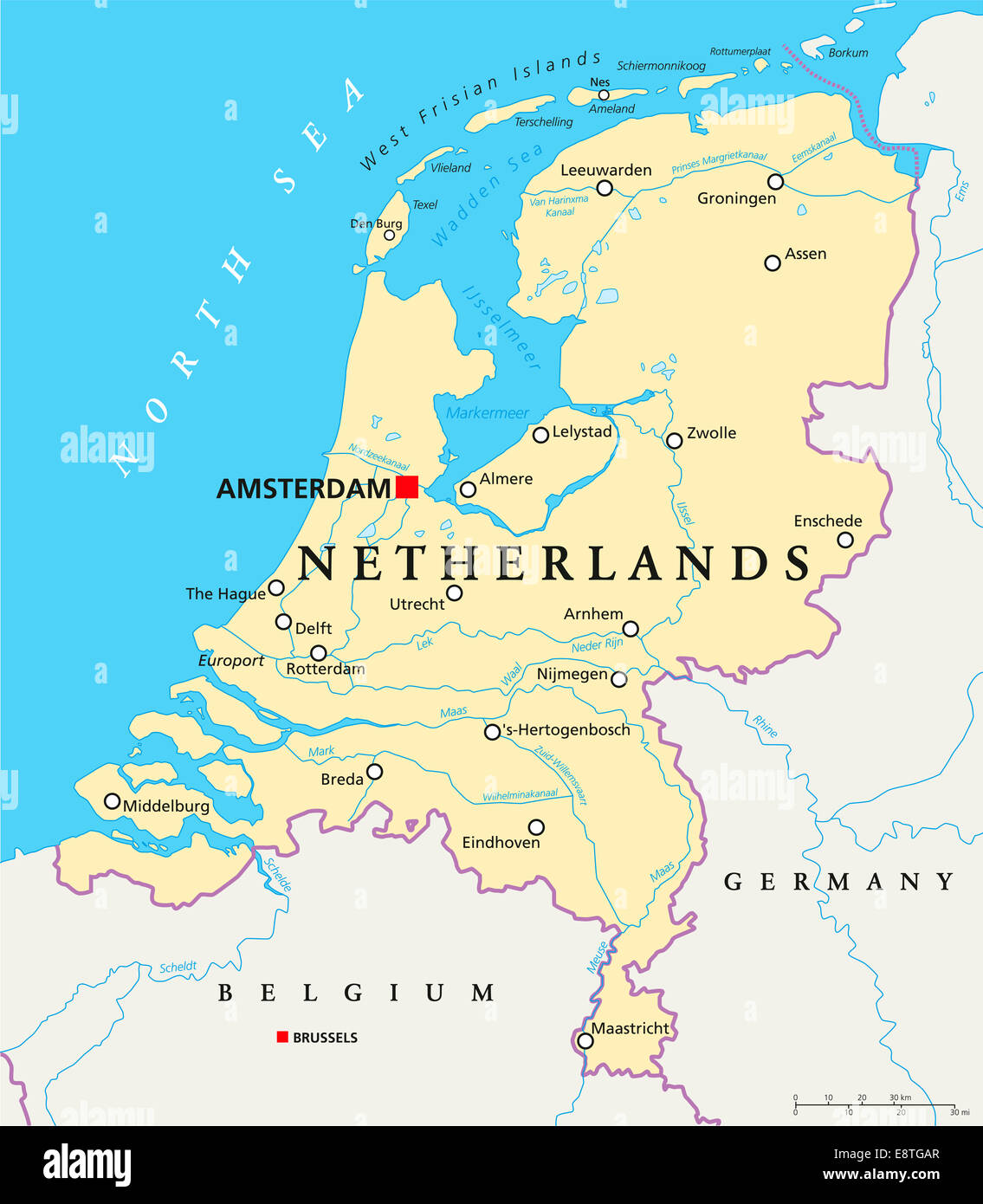
- Provinces (Provincies): There are 12 provinces responsible for regional spatial planning, environmental management, water management, and provincial infrastructure.
- Municipalities (Gemeenten): Local authorities responsible for primary public services, social support, local zoning, primary education infrastructure, and waste management.
The Electoral System and Proportional Representation
The bedrock of Dutch representative democracy is its electoral system of proportional representation (PR) applied to a single nationwide district. Voters cast their ballots for individual candidates on a party list rather than choosing a local representative for a specific geographic constituency.
To secure a seat in the Tweede Kamer, a party only needs to achieve votes equivalent to the "lectoral quotient"—the total number of valid votes cast divided by the 150 available seats in the house. This low threshold, roughly 0.67% of the national vote, prevents majoritarian dominance and ensures that fringe, single-issue, and minority groups find representation in parliament.
| Feature | Dutch House of Representatives (Tweede Kamer) | Dutch Senate (Eerste Kamer) |
|---|---|---|
| Number of Seats | 150 members | 75 members |
| Election Cycle | Every 4 years (unless a collapse occurs) | Every 4 years, shortly after provincial elections |
| Electorate | Direct universal suffrage by citizens aged 18+ | Indirectly elected by members of the 12 provincial states |
| Primary Function | Proposing, amending, and passing national legislation; holding cabinet accountable | Vetoing legislation passed by the Tweede Kamer (cannot amend bills) |
Because no single political party has ever commanded an outright majority of 76 seats in modern political history, the electoral outcome invariably triggers protracted coalition negotiations. These talks can take weeks or months as parties negotiate a detailed coalition agreement (regeerakkoord) that outlines the legislative agenda for the upcoming four-year parliamentary term.

The Polder Model: Consensus Politics in Action
A defining characteristic of Dutch political culture is the "polder model" (poldermodel), a term derived from the historical necessity of communities working together to build and maintain dikes and water management systems (polders) below sea level. In political science, this translates into a tradition of consensus-seeking, tripartite negotiation between the government, employers' organizations, and labor unions.
The Social and Economic Council (Sociaal-Economische Raad or SER) serves as the primary institutional manifestation of this model. Operating as an advisory body to the government, the SER brings together representatives of business life, employees, and independent crown-appointed experts to forge compromises on labor laws, pension reforms, taxation structures, and social welfare programs.
While the polder model has historically fostered deep social stability, economic resilience, and industrial peace, it faces contemporary strains. Critics argue that consensus governance can lead to protracted decision-making, excessive compromise, and a feeling among voters that fundamental political differences are papered over by technocratic elites. Despite these challenges, the instinct toward consultation remains a core pillar of the Dutch political ethos.
Legislative Process and Parliamentary Oversight
The legislative process in the Netherlands involves a careful interplay between the executive branch (the cabinet) and the legislative branch (the parliament). Most major bills originate within government ministries, vetted by the Council of State (Raad van State), an independent constitutional body that advises the government on the legality and feasibility of proposed legislation.
Once introduced to the Tweede Kamer, a bill undergoes extensive committee scrutiny, debate, and amendment phases. Members of parliament possess the right of initiative (recht van initiatief), allowing them to introduce their own private member bills, though executive bills remain the primary source of law.
After passing the Tweede Kamer, the bill moves to the Eerste Kamer (Senate). The Senate possesses limited constitutional powers: it can either approve or reject a bill in its entirety, but it cannot amend it. If approved, the bill is countersigned by the relevant minister and the monarch, officially entering into force upon publication in the Bulletin of Acts and Decrees (Staatsblad).
Parliamentary oversight (controlerende taak) is robust. MPs utilize several instruments to keep the executive branch accountable:
- Interpellations and Questions: MPs can submit written questions to ministers or call for emergency debates (interpellaties) to address sudden political crises or administrative failures.
- Motions of No Confidence: Parliament holds the ultimate constitutional lever to force the resignation of individual ministers or the entire cabinet by passing a motion of no confidence (motie van wantrouwen).
- Parliamentary Inquiries: In cases of severe government failure or public scandals, the Tweede Kamer can establish independent parliamentary inquiry committees with subpoena powers.
Evolution of the Multi-Party Landscape
The Dutch party system has undergone significant transformation over the past few decades. For much of the twentieth century, politics was dominated by pillarization (verzuiling), where society was vertically divided into distinct ideological and religious blocs (Protestant, Catholic, Socialist, and Liberal), each with its own schools, broadcasters, newspapers, and political parties.
As secularization accelerated in the 1960s and 1970s, pillarization dissolved, giving rise to a more fluid, volatile electorate. Traditional centrist parties—such as the Christian Democratic Appeal (CDA) and the Labour Party (PvdA)—have seen their historical dominance recede, replaced by a fragmented spectrum spanning the political axis:
- Center-Right and Liberal Parties: Historically anchored by the People's Party for Freedom and Democracy (VVD), focusing on free markets, deregulation, and fiscal conservatism.
- Green-Left Coalitions: Represented by parties such as GroenLinks and the Labour Party, emphasizing climate action, social equality, and public sector investment.
- Right-Wing Populism and Nationalist Parties: Led by formations such as the Party for Freedom (PVV) and the Farmer-Citizen Movement (BBB), prioritizing strict immigration controls, national sovereignty, and agrarian advocacy.
- Democrat and Centrist Reformers: Parties such as Democrats 66 (D66) advocating for progressive social policies, educational investment, and institutional electoral reform.
This dispersion has made forming stable majority coalitions increasingly complex, often requiring the coalition to stitch together four or more distinct parties to secure a working majority in the lower house.
Frequently Asked Questions About Netherlands Politics
How does the Dutch government get formed after an election?
Following an election, the Tweede Kamer appoints an "informateur" to explore potential coalition combinations and map out common ground between parties. Once potential partners are identified, a "formateur" (typically the designated Prime Minister) negotiates the formal coalition agreement and selects the cabinet ministers, who are then sworn in by the Monarch.
Can the Dutch Prime Minister dissolve parliament?
No. Unlike the British system where the Prime Minister can call snap elections at will, the Dutch Prime Minister does not have the constitutional authority to dissolve parliament. Elections occur on a fixed four-year cycle, or earlier only if a governing coalition collapses due to irreconcilable internal disputes and no alternative majority can be formed.
What is the role of the Council of State in Dutch politics?
The Council of State (Raad van State) is a constitutionally established advisory body chaired formally by the monarch. It evaluates all proposed legislation and royal decrees for legal compliance, constitutionality, and administrative practicality before they are submitted to parliament. It also functions as the highest administrative court in the Netherlands.
How do Dutch citizens participate in local versus national politics?
National politics centers on voting for nationwide party lists in Tweede Kamer elections. Conversely, local politics involves voting for municipal councils (gemeenteraad) every four years, where voters choose local candidates directly. Additionally, citizens can participate in municipal or national advisory referendums when initiated under specific statutory conditions.
What happens if a coalition government collapses mid-term?
If a coalition agreement fails and the cabinet falls, the government generally continues in a caretaker capacity (demissionair kabinet) handling day-to-day administrative affairs while refraining from making major, controversial policy decisions. Simultaneously, the monarch consults political leaders to either form an interim administration or schedule early general elections.
Conclusion and Next Actions
Understanding the political landscape of the Netherlands requires looking beyond surface headlines to appreciate its commitment to consensus-building, proportional representation, and institutional checks and balances. For researchers, journalists, and policy analysts tracking Dutch governance, the key is monitoring coalition dynamics within the Tweede Kamer, evaluating local and provincial electoral shifts, and observing how the polder model adapts to modern economic and environmental pressures.
Image Gallery
Select an image to open it in a new tab.

Lars Thomsen
Global Labor Markets and Economic Strategy Editor
