Who Was General Santa Anna? The Life and Legacy of Mexico’s Most Controversial Leader

Antonio López de Santa Anna was a central figure in 19th-century Mexican history, serving as a general and the President of Mexico on eleven separate occasions. A charismatic yet polarizing leader, he is best known for his roles in the Texas Revolution, particularly the Battle of the Alamo, and the Mexican-American War.
Across the vast and often turbulent landscape of 19th-century North American history, few figures loom as large or as controversially as Antonio López de Santa Anna. Often referred to by himself as the "Napoleon of the West," Santa Anna was a man of immense ambition, shifting political loyalties, and undeniable military influence. His life story is not merely a biography of a soldier or a politician; it is the story of Mexico’s struggle for identity, stability, and sovereignty following its independence from Spain. To understand the geopolitical map of North America as it stands in 2026, one must first understand the rise and fall of the man who led Mexico through some of its most defining—and devastating—conflicts.
The Early Military Career of Antonio López de Santa Anna
Born in 1794 in Jalapa, Veracruz, Antonio López de Santa Anna Pérez de Lebrón began his military career not as a Mexican revolutionary, but as a loyalist soldier for the Spanish Crown. In 1810, the same year Miguel Hidalgo y Costilla launched the Mexican War of Independence, the young Santa Anna joined the Fijo de Veracruz infantry regiment.
During these formative years, Santa Anna learned the art of warfare by suppressing the very insurgencies he would later lead or champion. He served under Colonel José Joaquín de Arredondo, whose brutal tactics in the Battle of Medina (1813) against Texas rebels left a lasting impression on the young officer. It was during this period that Santa Anna developed his understanding of military discipline, the use of decisive force, and the political power inherent in a military commission.
However, Santa Anna’s primary trait was his political fluidity. In 1821, as the tide of the war turned, he shifted his allegiance to Agustín de Iturbide and the Plan of Iguala, which sought Mexican independence. His ability to sense the changing political winds allowed him to rise rapidly through the ranks, eventually helping to overthrow Iturbide himself when the latter declared himself Emperor. This pattern of shifting loyalties would define his entire career, as he moved between supporting federalists and centralists whenever it suited his personal or political survival.
The "Napoleon of the West" and the Rise to Power
Santa Anna’s ascent to the presidency in 1833 marked the beginning of a decades-long era in which he would dominate Mexican politics. Initially elected as a federalist, he soon abandoned his vice president, Valentín Gómez Farías, and the liberal reforms being enacted. Santa Anna realized that the powerful interests in Mexico—the Catholic Church and the military—favored a strong, centralized government.
By 1834, he had dissolved Congress and abolished the Federalist Constitution of 1824, replacing it with the "Siete Leyes" (Seven Laws). This move consolidated power in Mexico City and stripped individual states of their autonomy. This shift was the primary catalyst for several rebellions across Mexico, most notably in the departments of Zacatecas and Coahuila y Tejas. Santa Anna’s response to these rebellions was swift and uncompromising, earning him a reputation for ruthlessness that would follow him to the gates of the Alamo.

Santa Anna and the Texas Revolution
The Texas Revolution remains the most famous chapter of Santa Anna’s life in the English-speaking world. When American settlers in Texas (Texians) and Tejanos revolted against the centralist government, Santa Anna personally led the "Army of Operations" north to quell the uprising. He viewed the Texians not as legitimate combatants, but as "land pirates" and rebels who deserved no quarter.
The Battle of the Alamo and Goliad
The Siege of the Alamo in February and March of 1836 became a symbol of Santa Anna's military resolve and his tactical limitations. While he won a decisive victory, the 13-day siege delayed his pursuit of the main Texian army and served as a powerful rallying cry. Shortly after the Alamo, the execution of over 300 prisoners at Goliad under Santa Anna's orders further galvanized the opposition and drew international condemnation.
The Disaster at San Jacinto
Santa Anna’s overconfidence led to his eventual undoing at the Battle of San Jacinto in April 1836. Believing the Texian forces under Sam Houston were in full retreat, Santa Anna allowed his troops to take a siesta without adequate sentries. In a surprise attack that lasted less than 20 minutes, his army was routed. Santa Anna himself was captured the following day while dressed as a common soldier. To secure his release, he signed the Treaties of Velasco, which effectively granted Texas its independence—a move the Mexican government later refused to recognize, claiming Santa Anna had no authority to sign them while a prisoner.
The Pastry War and the Loss of a Leg
Returning to Mexico in disgrace, Santa Anna’s political career seemed finished. However, a bizarre conflict known as the "Pastry War" (1838) with France provided him a chance for redemption. When the French Navy blockaded Veracruz over unpaid debts (including a claim from a French pastry chef), Santa Anna took command of the defense.
During the fighting, he was wounded by French grapeshot, resulting in the amputation of his left leg. In a display of his flair for the dramatic, he held a full military funeral for his severed limb years later, burying it with honors in Mexico City. This "sacrifice" for his country helped him regain his popularity and paved the way for his return to the presidency. The image of the wounded hero who had lost a limb for the fatherland was a powerful propaganda tool that he utilized effectively for years.
The Mexican-American War (1846–1848)
The annexation of Texas by the United States in 1845 set the stage for the Mexican-American War. At the time the conflict began, Santa Anna was in exile in Cuba. In a brilliant bit of deception, he contacted U.S. President James K. Polk, promising that if he were allowed to return to Mexico, he would negotiate a peace favorable to the United States.
Polk agreed, and the U.S. Navy allowed Santa Anna to slip through the blockade. Upon arriving in Mexico, however, Santa Anna immediately betrayed Polk and took command of the Mexican defense. Despite his charisma and ability to raise large armies, his military leadership during the war was marred by tactical errors and internal political strife.
- Battle of Buena Vista: Santa Anna led a massive force against Zachary Taylor’s troops. Despite having the advantage, he withdrew, claiming victory but failing to destroy the American army.
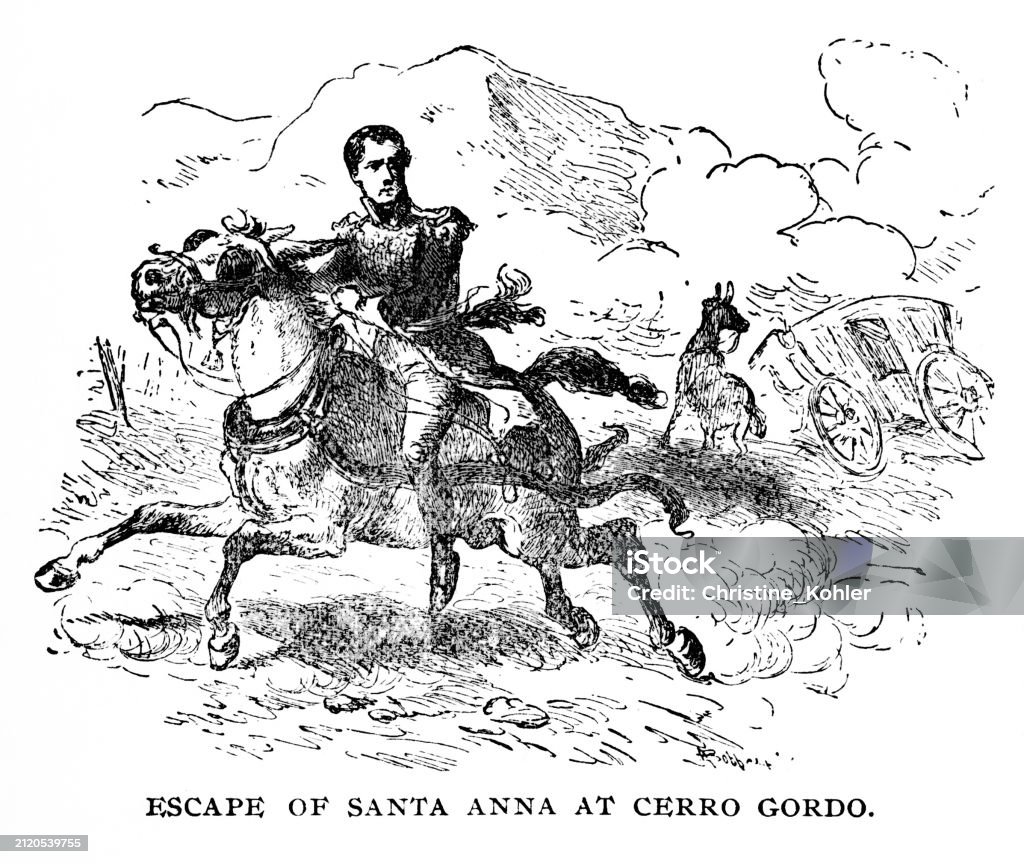
- Battle of Cerro Gordo: Santa Anna’s forces were outmaneuvered by Winfield Scott’s troops, who found a path through the mountains that Santa Anna believed was impassable.
- The Fall of Mexico City: Following the American victory at the Battle of Chapultepec, Santa Anna was forced into exile once again as the Treaty of Guadalupe Hidalgo was signed, resulting in the loss of half of Mexico’s territory to the United States.
Key Military Engagements of General Santa Anna
The following table summarizes the major military conflicts that defined Santa Anna’s career and their ultimate outcomes for Mexico.
| Conflict | Year(s) | Role | Outcome |
|---|---|---|---|
| Mexican War of Independence | 1810–1821 | Officer (Spain/Mexico) | Mexican Independence achieved |
| Revolt against Iturbide | 1822–1823 | Rebel Leader | Overthrow of the First Mexican Empire |
| Battle of Tampico | 1829 | Commander | Defeat of Spanish attempt to reconquer Mexico |
| Texas Revolution | 1835–1836 | Commander-in-Chief | Loss of Texas; Santa Anna captured |
| The Pastry War | 1838 | Defense Commander | Santa Anna wounded; loss of left leg |
| Mexican-American War | 1846–1848 | Commander-in-Chief | Loss of over 50% of Mexican territory |
| Revolution of Ayutla | 1854–1855 | Dictator | Final ousting of Santa Anna from power |
"His Most Serene Highness" and the Final Exile
In 1853, Santa Anna was invited back to Mexico one last time by conservatives who sought stability. This period, known as his final dictatorship, saw him assume the title "Su Alteza Serenísima" (His Most Serene Highness). He ruled as an absolute autocrat, suppressing dissent and taxing everything from windows to dogs to fund his lavish lifestyle and the military.
One of his most controversial acts during this final term was the Gadsden Purchase (known in Mexico as the Sale of La Mesilla). In 1854, he sold a portion of land in present-day southern Arizona and New Mexico to the United States for $10 million. While the sale provided much-needed funds for the treasury, it was seen by many Mexicans as a final betrayal of national sovereignty.
The Revolution of Ayutla in 1855 finally drove him from power for the last time. He spent the next two decades in exile, living in various locations including the United States, Cuba, and the Bahamas. During his time in Staten Island, New York, he is famously credited with introducing chicle to the United States. He hoped it could be used as a rubber substitute; while that failed, his associate Thomas Adams eventually used it to create the modern chewing gum industry.
The Death and Legacy of Santa Anna
Santa Anna was eventually allowed to return to Mexico in 1874 under a general amnesty. He was old, blind from cataracts, and largely ignored by the government and the public. He died in Mexico City on June 21, 1876, in relative obscurity.
His legacy is deeply complex. In the United States, he is often viewed as the "villain" of the Alamo—a cruel dictator who stood in the way of Manifest Destiny. In Mexico, the view is more nuanced but generally negative. He is often blamed for the loss of Mexico's northern territories and for the chronic political instability that plagued the nation during the mid-19th century. Yet, he was also a man who could raise an army from nothing, who was genuinely beloved by his soldiers at various points, and who stepped into the vacuum of power when no one else could.
Why Santa Anna Switched Sides So Often
One of the most frequent questions regarding Santa Anna is his lack of a consistent political ideology. Historians generally agree that Santa Anna was a quintessential caudillo—a military-landowner who exercised political power through personal charisma and patronage. His loyalty was not to the "Federalist" or "Centralist" cause, but to his own survival and his vision of a Mexico that required a strongman to prevent chaos. When liberals were in power and the country seemed disorganized, he moved toward the conservatives. When he was out of favor with the elite, he would retreat to his estate, Manga de Clavo, and wait for the inevitable call to return and "save" the nation.
Frequently Asked Questions
How many times was Santa Anna President of Mexico?
Santa Anna is officially credited with serving as President of Mexico 11 times. However, the exact number can be debated because some of his terms were extremely short—lasting only weeks or even days—and he frequently took leaves of absence to lead military campaigns, leaving a vice president or acting president in charge.
What happened to Santa Anna’s leg?
After his leg was amputated following the Pastry War in 1838, it was buried at his estate. In 1842, he had it exhumed and moved to Mexico City for a formal state funeral with full military honors. Later, during a period of political unrest in 1844, a mob dug up the leg and dragged it through the streets of Mexico City to show their disdain for his rule. During the Mexican-American War, a separate prosthetic leg was captured by Illinois soldiers; it currently resides in the Illinois State Military Museum.
Did Santa Anna actually win the Battle of the Alamo?
Technically, yes. Santa Anna achieved his military objective by wiping out the Texian garrison and taking the fort. However, the victory was a strategic "Pyrrhic victory." He lost a significant number of experienced soldiers (estimated between 400 and 600), and the brutality of the execution of survivors turned public opinion in the United States and abroad heavily against him, ensuring that the "Texas cause" received more support than it otherwise might have.
Was Santa Anna responsible for modern chewing gum?
Indirectly, yes. While in exile on Staten Island in the 1860s, Santa Anna brought a supply of chicle (dried sap from the sapodilla tree) with him. He met with inventor Thomas Adams and suggested chicle might be a cheap alternative to rubber for carriage tires. The rubber experiment failed, but Adams noticed that Santa Anna liked to chew the chicle. Adams eventually added sugar and flavorings to the chicle, leading to the creation of the commercial chewing gum industry.
Why is Santa Anna called the "Napoleon of the West"?
Santa Anna gave himself this nickname because of his immense admiration for Napoleon Bonaparte. He studied Napoleon’s tactics, collected Napoleonic memorabilia, and attempted to emulate the French Emperor’s style of autocratic rule and grand military maneuvers. Like Napoleon, he experienced a meteoric rise, a series of dramatic returns from exile, and a final, permanent downfall.
A Practical Summary of His Impact
If you are researching General Santa Anna for academic or historical purposes, it is essential to look past the "villain" trope found in many 20th-century Western films. His life illustrates the fragility of post-colonial states and the dangers of a political system reliant on personality rather than institutions. For modern readers in 2026, Santa Anna serves as a primary example of how one individual's ego and shifting allegiances can alter the borders and destiny of multiple nations for centuries. To truly understand the history of the American West and the Mexican Republic, one must confront the complicated, often contradictory actions of Antonio López de Santa Anna.
Image Gallery
Select an image to open it in a new tab.
Zara El-Hashem
Sociocultural Dynamics and Academics Writer
