
For the vast majority of employees in the United States, federal "work from home" tax deductions for unreimbursed business expenses were eliminated by the Tax Cuts and Jobs Act of 2017. As of 2026, standard W-2 employees cannot claim home office deductions on their federal tax returns. However, self-employed individuals, independent contractors, and business owners may still qualify for specific home office tax deductions if they meet stringent IRS requirements regarding exclusive and regular use of a designated workspace.
The Evolution of Home Office Deductions
To navigate the current landscape of tax planning, it is essential to distinguish between the two primary categories of workers: W-2 employees and the self-employed. Prior to 2018, many employees could deduct "unreimbursed employee expenses" as a miscellaneous itemized deduction if those expenses exceeded 2% of their adjusted gross income. The Tax Cuts and Jobs Act (TCJA) suspended these miscellaneous itemized deductions for the 2018 through 2025 tax years.
As of 2026, this rule remains in effect. Consequently, if you are a traditional employee—even if your employer requires you to work from home—you are generally not eligible to claim a federal tax deduction for office equipment, internet services, utilities, or home office furniture. While some individual states may have their own distinct tax codes that allow for such deductions, the federal IRS stance is firm.
Conversely, for those who are self-employed or operate a sole proprietorship, the home office deduction remains a viable strategy. The IRS recognizes that maintaining a place of business at home is a legitimate cost of doing business. Understanding whether you qualify requires a deep dive into the specific "exclusive and regular use" tests mandated by federal tax law.
Eligibility Criteria for the Self-Employed
If you are a business owner or independent contractor, you may qualify for the home office deduction. Eligibility is not determined by the nature of your job, but rather by how you utilize the physical space within your home. The IRS employs two foundational tests that must be met simultaneously.
The Exclusive Use Test
This is often the most significant hurdle for taxpayers. To meet this requirement, the portion of your home used for business must be used exclusively for your trade or business. If you use your home office to perform administrative tasks for your business but also use that same space for personal activities—such as a dining room table used for payroll but also for family dinners, or a guest bedroom that doubles as a workspace—you fail the exclusive use test. The space does not necessarily need to be a separate room; it can be a clearly defined area, but it cannot serve a dual personal purpose.
The Regular Use Test
The home office must be used as your principal place of business. This means you use your home office regularly and exclusively for administrative or management activities of your trade or business, and you have no other fixed location where you conduct these activities. If you have a separate office building or shop elsewhere where you conduct the majority of your work, your home office may not qualify as the "principal" location.
Exceptions to the "principal place of business" rule exist for:
- Storage of inventory: If you use a part of your home to store inventory or product samples for your business, and your home is the only fixed location of your trade.
- Daycare facilities: Specific rules apply to those who provide daycare services in their home.
- Separate structures: If you work in a detached garage, studio, or barn that is not attached to your dwelling unit, the exclusive and regular use rules are slightly more lenient, provided the structure is used exclusively for business.

Calculating Your Deduction: Simplified vs. Actual Expenses
Once you confirm eligibility, you must choose between two methods for calculating your deduction: the Simplified Option or the Actual Expenses Method.
The Simplified Option
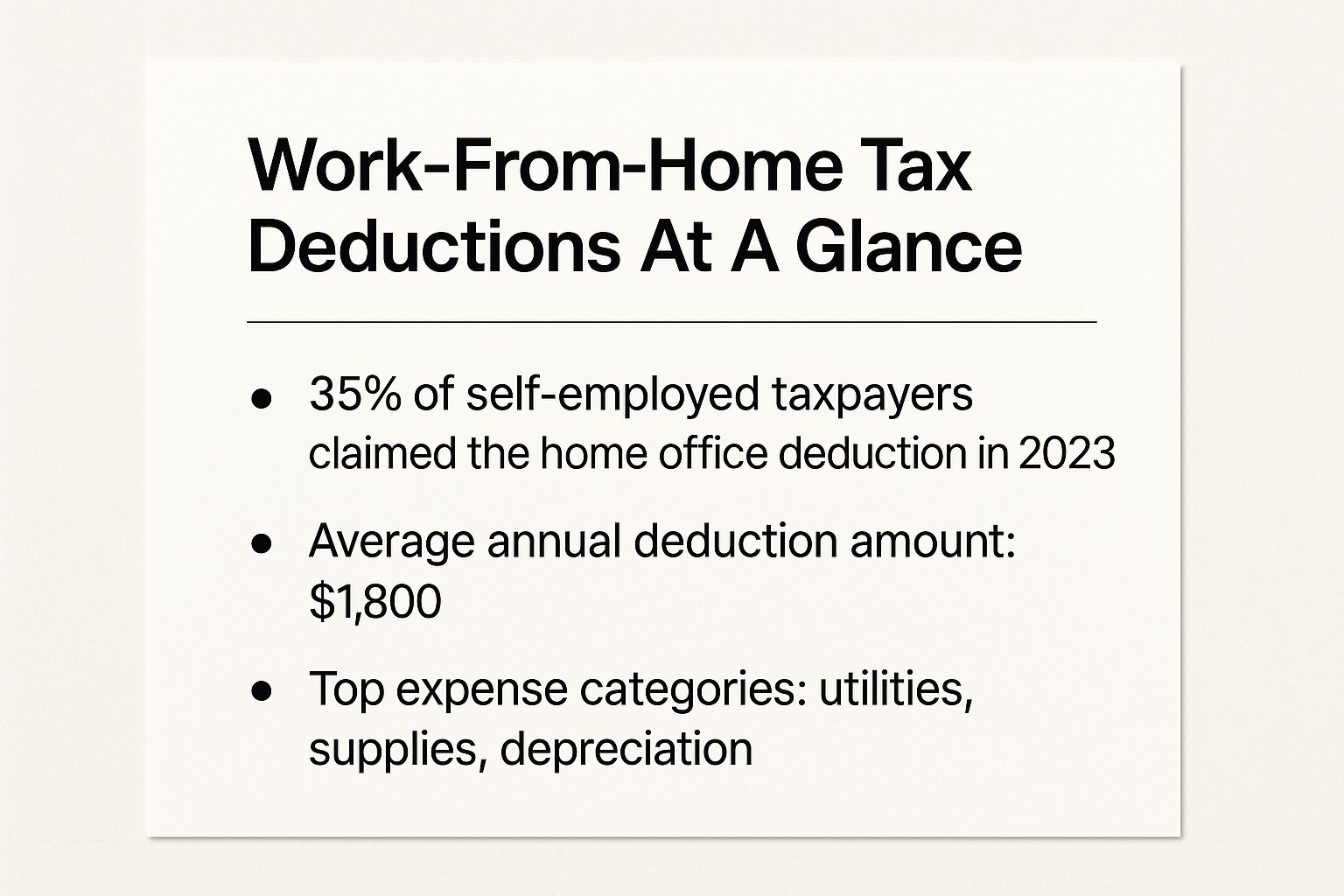
Introduced by the IRS to reduce the administrative burden on small business owners, this method allows you to claim a flat rate based on the square footage of your office space. As of 2026, the rate is $5 per square foot, with a maximum of 300 square feet. This results in a maximum annual deduction of $1,500. While this method is significantly easier to track, it does not allow for the depreciation of your home or the carryover of excess expenses to future tax years.
The Actual Expenses Method
This method requires detailed record-keeping. You calculate the percentage of your home used for business and apply that percentage to your total housing costs. This includes:
- Mortgage interest or rent
- Property taxes
- Utilities (electricity, gas, water)
- Homeowners insurance
- Repairs and maintenance
- Homeowners association fees
The primary advantage of the Actual Expenses Method is that for many taxpayers, the resulting deduction may significantly exceed $1,500, especially if the home is located in a high-cost area. However, it requires meticulous documentation of all expenditures and a clear calculation of the business-use percentage of your home.
| Feature | Simplified Option | Actual Expenses Method |
|---|---|---|
| Calculation | $5 per sq. ft. (max 300 sq. ft.) | Percentage of total home costs |
| Documentation | Minimal; square footage proof | Receipts, utility bills, tax forms |
| Depreciation | No | Yes |
| Record Keeping | Simple | Complex/High |
| Max Deduction | $1,500 | Variable (often higher) |
Important Considerations for Homeowners and Renters
Regardless of the method chosen, you must be aware of the "business-use percentage." This is usually determined by dividing the square footage of the home office by the total square footage of the entire home. For example, if your home is 2,000 square feet and your office is 200 square feet, your business-use percentage is 10%. You would apply this 10% to your total qualifying housing expenses under the Actual Expenses Method.
It is also important to note the impact on capital gains. If you sell your home, the portion of the home that was claimed as a business office may be subject to depreciation recapture. This is a tax on the depreciation you claimed while using the office, which is taxed at a maximum rate of 25%. Consulting with a tax professional before selling a home that was used for a home office deduction is highly recommended to understand the long-term tax implications.
Frequently Asked Questions
Can I deduct my internet bill if I am a W-2 employee? No. Under current federal tax laws, W-2 employees cannot deduct home internet, phone lines, or office equipment. These are considered unreimbursed employee expenses, which are not currently deductible at the federal level. You should check if your employer offers a stipend or reimbursement program for these costs.
Does a corner of my living room count as an office? Generally, no. Because the space must be used exclusively for business, a corner of a shared living space fails the exclusive use test. The IRS requires the space to be defined in a way that excludes personal use. A dedicated office, even if small, is safer for compliance.
What happens if I stop working from home mid-year? If you no longer meet the exclusive and regular use requirements, you simply stop claiming the deduction for that tax year. You only claim the deduction for the portion of the year during which you satisfied the IRS requirements.
Are there state-level tax breaks for W-2 employees? Some states allow for specific deductions on your state income tax return that the federal government does not. However, these are highly variable. You must consult your specific state’s Department of Revenue guidelines to determine if they allow a deduction for unreimbursed employee expenses.
Does claiming the home office deduction increase my audit risk? While the IRS does not publish data specifically confirming that claiming a home office deduction triggers audits, it is a line item that requires clear documentation. If you claim the deduction, ensure you have a floor plan, photographs of the space, and organized financial records to substantiate your claim.
Next Actions for Tax Preparation
To effectively manage your potential tax deductions, start by assessing your employment status. If you are a W-2 employee, refocus your efforts on negotiating a reimbursement policy with your employer, as this is the most effective way to recover business-related costs. If you are self-employed, create a dedicated folder for receipts and utilities starting January 1st of the tax year. Measure your office space accurately and keep a clear log of business activities conducted in that room. Given the complexity of depreciation recapture and the nuances of the Actual Expenses Method, engaging a licensed CPA or tax advisor for your 2026 filings is a prudent step to ensure both compliance and maximum benefit.
Image Gallery
Select an image to open it in a new tab.






Declan O'Connor
Higher Education and Campus Culture Reporter
