What Are Pips in Forex?

A pip is the smallest standard unit of price movement in the foreign exchange market, typically representing a change of one basis point, or 0.0001, for most major currency pairs. This standardized measurement allows traders to calculate profits, losses, and market spreads uniformly across different brokerage platforms.
Understanding the Foundation of Foreign Exchange Measurement
The foreign exchange (forex) market operates on vast volumes of capital traded continuously across global financial centers. Because currencies derive their value relative to one another, exchange rates fluctuate constantly. To measure these fluctuations accurately, traders and institutions require a standardized unit of incremental change. This unit is known as a pip, which historically stands for "percentage in point" or "price interest point."
Without a standardized unit like the pip, quantifying gains or losses across diverse currency pairs—such as the euro against the U.S. dollar or the Japanese yen against the British pound—would be cumbersome and prone to calculation errors. A pip provides a universal language for market participants, enabling them to communicate price changes precisely. Whether a trader is managing a personal retail account or executing institutional hedging strategies, understanding how pips function is fundamental to evaluating market volatility and managing financial exposure.
Defining Pips and Pipettes
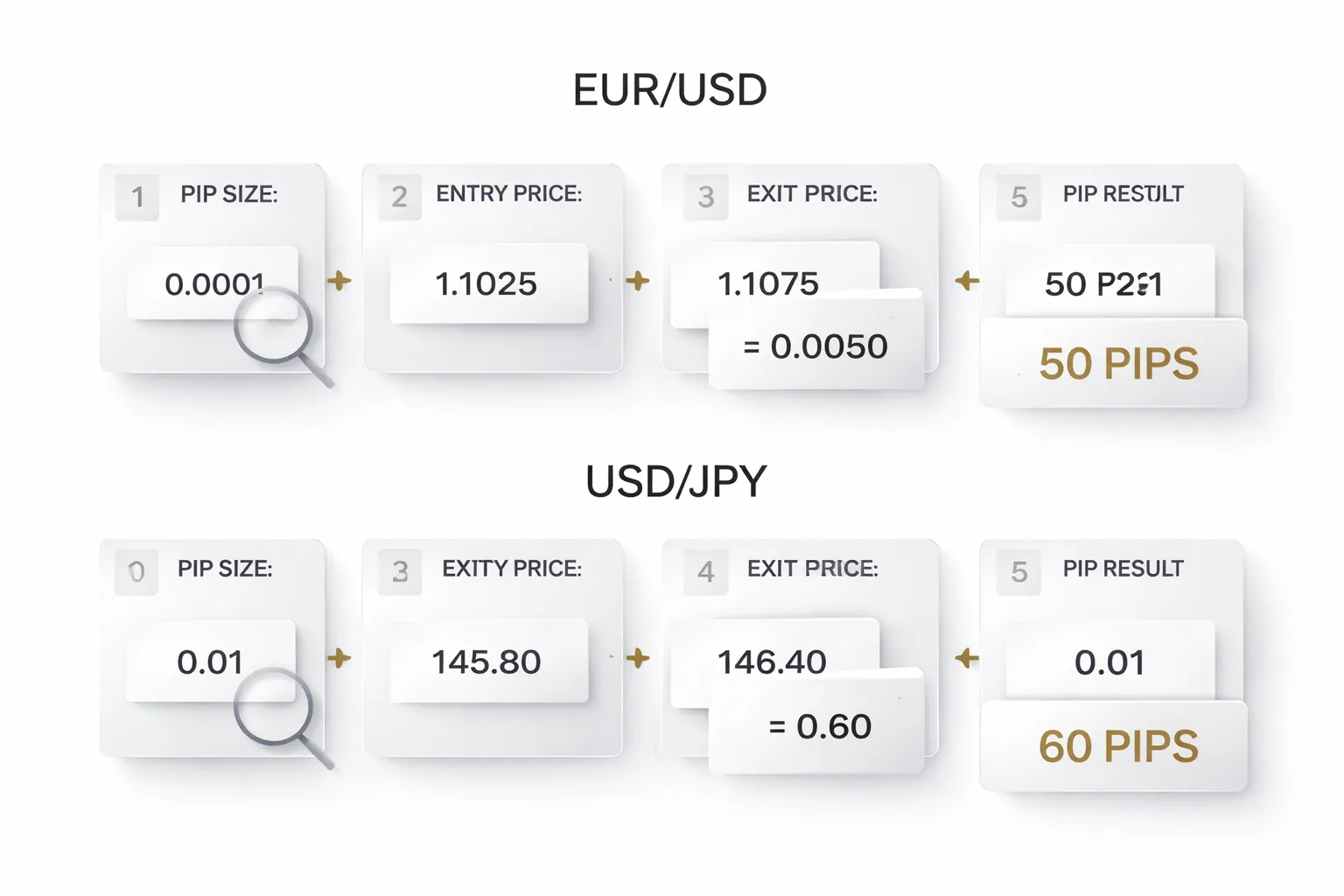
To understand what a pip is in practical terms, one must examine how forex quotes are displayed. Most currency pairs are priced out to four decimal places. For example, if the EUR/USD pair moves from 1.0850 to 1.0851, that upward shift of 0.0001 is exactly one pip. The fourth decimal place from the decimal separator represents the standard pip position.
However, modern electronic trading platforms and liquidity providers have refined price precision by introducing fractional pips, commonly referred to as pipettes. A pipette represents one-tenth of a standard pip, or the fifth decimal place (0.00001).
Currency pairs involving the Japanese yen (JPY) represent a notable exception to the four-decimal standard. Because the yen trades at a lower nominal value relative to the U.S. dollar and other major currencies, USD/JPY quotes are traditionally displayed to only two decimal places. For a JPY pair, a single pip is represented by the second decimal place (0.01), while a pipette occupies the third decimal place (0.001).
The following table illustrates how pips and pipettes are structured across different categories of currency pairs:
| Currency Pair Type | Example Pair | Standard Quote Format | 1 Pip Value Position | 1 Pipette Value Position |
|---|---|---|---|---|
| Major / Minor (Non-JPY) | EUR/USD | 1.08504 | 4th decimal (0.0001) | 5th decimal (0.00001) |
| Japanese Yen Pairs | USD/JPY | 154.253 | 2nd decimal (0.01) | 3rd decimal (0.001) |
| Commodity Pairs | AUD/USD | 0.65201 | 4th decimal (0.0001) | 5th decimal (0.00001) |

How Pip Values Are Calculated
Knowing the number of pips a market has moved is only half the equation; a trader must also calculate the monetary value of those pips. The financial value of a pip depends directly on three variables: the currency pair being traded, the exchange rate at the time of the trade, and the lot size (volume) of the position.
Lot sizes in retail forex trading are categorized into four standard tiers:
- Standard Lot: Represents 100,000 units of the base currency.
- Mini Lot: Represents 10,000 units of the base currency.
- Micro Lot: Represents 1,000 units of the base currency.
- Nano Lot: Represents 100 units of the base currency.
When the account currency matches the counter currency (the second currency in the pair, such as USD in EUR/USD), calculating pip value is straightforward. For a standard lot of a U.S. dollar-denominated counter pair, one pip is always equal to $10. For a mini lot, one pip equals $1, and for a micro lot, one pip equals $0.10.
If the account currency differs from the counter currency, the pip value must be converted into the trader's base account currency using the current exchange rate. This conversion ensures that risk management calculations remain accurate regardless of geographic location or account denomination.
The Role of Leverage in Pip Exposure
Leverage amplifies both potential profits and potential losses by allowing traders to control larger positions with a smaller initial deposit of capital. When leverage is applied, the monetary value of a single pip does not change, but the financial impact of that pip relative to the trader's account balance increases significantly.
For instance, trading a standard lot (100,000 units) means that every pip movement equates to $10. If a trader operates with a high leverage ratio, a modest account balance can control this standard lot. However, if the market moves against the position by just 50 pips, the trader incurs a $500 loss. Conversely, trading the same 50-pip move using a micro lot (1,000 units) results in a $5 loss per standard pip increment.
Understanding this dynamic is essential for sound risk management. Professional traders calculate their maximum acceptable drawdown in pips and lot sizes before opening any position, ensuring that a sudden market reversal does not exceed predetermined capital preservation limits.
Spreads and Transaction Costs Measured in Pips
Pips are also used to measure transaction costs in the forex market, most notably the spread. The spread is the difference between the bid price (the price at which a broker buys) and the ask price (the price at which a broker sells).
Brokers typically quote spreads in pips or fractional pips. For example, if EUR/USD has a bid price of 1.0850 and an ask price of 1.0852, the spread is 2 pips. When a trader opens a market order on this pair, the position instantly begins in negative equity equal to the value of that 2-pip spread.
Understanding spread costs helps traders evaluate broker competitiveness and formulate effective trading strategies. Scalp traders, who target small price movements of 5 to 10 pips, must pay close attention to tight spreads to ensure transaction fees do not consume their profit margins. Longer-term swing traders or position traders are less affected by minor spread variations, though transaction costs remain an important consideration for overall performance.
Common Mistakes When Interpreting Pips
Beginner traders frequently encounter pitfalls when calculating pip movements and position sizing. Recognizing these common errors helps prevent unintended financial exposure and mismanaged trades.
- Ignoring JPY Decimal Placement: Applying four-decimal calculations to Japanese yen pairs results in severe calculation errors regarding pip value and risk exposure.
- Confusing Pips with Pipettes: Misinterpreting a five-decimal platform quote can lead traders to overestimate or underestimate the scale of a breakout or retracement.
- Neglecting Currency Conversion: Failing to account for exchange rate conversions when the trading account currency differs from the counter currency leads to inaccurate risk-to-reward metrics.
- Overlooking Spread Impact: Entering low-volatility markets with wide spreads can cause positions to close prematurely or struggle to achieve profitability.
Frequently Asked Questions
What is a pip in simple terms?
A pip is the smallest standard unit of price measurement in the forex market. For most major currency pairs, it represents the fourth decimal place (0.0001) of an exchange rate. It functions similarly to a cent or a basis point in other financial markets, allowing traders to quantify price changes accurately.
How do I calculate the monetary value of a pip?
The monetary value of a pip depends on the currency pair, the exchange rate, and the trade size (lot size). For standard lots (100,000 units) where the U.S. dollar is the counter currency, one pip equals $10. For mini lots (10,000 units), one pip equals $1, and for micro lots (1,000 units), one pip equals $0.10.
Why do Japanese yen pairs have different pip values?
Japanese yen pairs have lower nominal exchange rates compared to other major currencies. Consequently, USD/JPY and related crosses are traditionally quoted to two decimal places rather than four. For these pairs, a single pip is represented by the second decimal place (0.01).
What is the difference between a pip and a pipette?
A pipette is a fractional pip, representing one-tenth of a standard pip. It occupies the fifth decimal place for most major currency pairs (0.00001) and the third decimal place for Japanese yen pairs (0.001). Pipettes allow brokers to offer tighter, more precise pricing increments.
How do spreads relate to pips?
The spread—the difference between a currency pair's bid and ask price—is measured in pips. If a broker quotes a spread of 1.5 pips on EUR/USD, the market price must move at least 1.5 pips in the trader's favor before the position breaks even, accounting for the initial transaction cost.
Can pip values change while a trade is open?
Yes, if the trading account is denominated in a currency that differs from the counter currency of the traded pair, the monetary value of a pip will fluctuate in real-time as the exchange rate between the account currency and the counter currency changes.
Next Actions for Forex Traders
To apply this knowledge effectively, begin by reviewing your trading platform's symbol specifications to identify how pips and pipettes are displayed for your target currency pairs. Practice calculating pip values manually across different lot sizes before committing capital. Integrate pip-based risk management rules into your trading plan, ensuring that every position size aligns with your account tolerance and capital preservation goals.
Image Gallery
Select an image to open it in a new tab.



Akira Tanaka
International Academic Trends Correspondent
