
Third-party workers' compensation claims matter because they provide injured employees a pathway to recover full financial compensation that standard workers' compensation insurance does not cover. While workers' comp provides "no-fault" benefits for medical bills and partial wages, a third-party claim allows for the recovery of non-economic damages like pain, suffering, and full future earnings.
In the complex landscape of employment law as of 2026, the distinction between a standard workers' compensation claim and a third-party liability lawsuit is one of the most critical factors in an injured worker’s financial recovery. For decades, the "exclusive remedy" rule has protected employers from being sued by their employees in exchange for providing guaranteed, no-fault insurance coverage. However, this safety net is often insufficient for catastrophic or life-altering injuries.
When a party other than the employer—such as a contractor, a manufacturer, or a negligent driver—contributes to a workplace accident, the legal door opens to a third-party claim. Understanding why these claims matter involves looking at the limitations of the administrative system and the opportunities provided by civil litigation to make a victim truly whole.
The Limitation of the "Exclusive Remedy" Rule
To understand the importance of third-party claims, one must first understand the limitations of the traditional workers’ compensation system. Workers’ compensation was designed as a "grand bargain." Employees waived their right to sue their employers for negligence, and in return, employers agreed to pay for medical expenses and a portion of lost wages regardless of who was at fault for the accident.
While this system provides immediate relief without the need to prove negligence, the benefits are strictly capped by state statutes. In 2026, most jurisdictions still limit wage replacement to roughly two-thirds of an employee's average weekly wage, often subject to a maximum state-wide cap. Furthermore, workers' compensation does not pay for "general damages," which include the physical pain, emotional distress, and loss of enjoyment of life that accompany serious injuries.
Third-party claims matter because they bypass these statutory caps. If a delivery driver is hit by a distracted motorist while on the clock, or a factory worker is injured by a defectively designed machine, the injured party can pursue the negligent third party in civil court. This allows the worker to seek 100% of their lost wages and significant compensation for their suffering—amounts that frequently dwarf the standard workers' comp payout.
Expanding Financial Recovery Beyond Medical Bills
The financial stakes in a third-party claim are significantly higher than in a standard claim. In a third-party lawsuit, the burden of proof shifts; the plaintiff must prove that the third party was negligent. However, the potential reward justifies the legal rigor.
Non-Economic Damages
This is perhaps the most significant reason these claims matter. Standard insurance adjusters do not cut checks for the trauma of a crushed limb or the ongoing depression following a permanent disability. Civil juries and settlements, however, specifically account for these factors. In 2026, as medical costs for long-term psychological care and physical rehabilitation continue to rise, the ability to secure funds for "pain and suffering" is often the only way a family can maintain their quality of life.
Full Wage Replacement and Earning Capacity
Workers' compensation typically ends when a worker reaches "maximum medical improvement" or is assigned a permanent disability rating. A third-party claim looks further into the future. It considers the total loss of future earning capacity, adjusted for inflation and career progression. If a 30-year-old skilled tradesperson can no longer work in their field, a third-party claim can seek the total value of what that person would have earned until retirement age—a figure that can easily reach millions of dollars.
Common Scenarios for Third-Party Liability
Identifying a third-party claim requires a detailed investigation of the accident scene. Many workers incorrectly assume that because they were "at work," their only recourse is through their employer. However, multi-employer worksites and the use of external equipment create numerous opportunities for third-party involvement.
- Construction Site Accidents: These are the most common environments for third-party claims. A general contractor, a subcontractor from a different firm, or a scaffolding company may be responsible for a safety violation that led to an injury. Under OSHA safety standards, multiple entities can be held liable for maintaining a safe environment.
- Product Liability: If a piece of heavy machinery, a power tool, or even a piece of safety gear (like a harness or respirator) fails due to a design or manufacturing defect, the manufacturer can be sued. These "strict liability" cases are vital because they hold corporations accountable for the safety of the products they put into the stream of commerce.
- Motor Vehicle Accidents: Any employee who drives as part of their job—truck drivers, sales reps, or delivery personnel—is at risk. If an accident is caused by another driver, the injured worker has a personal injury claim against that driver’s insurance in addition to their workers' comp claim.
- Premises Liability: If a worker is injured while performing duties on property owned by someone other than their employer (e.g., a technician repairing an HVAC system at a retail mall), the property owner may be liable for dangerous conditions like poor lighting, uneven flooring, or structural hazards.
The Intersection of Workers’ Comp Liens and Subrogation
A critical and often misunderstood aspect of why these claims matter is the concept of subrogation. When an insurance company pays out workers' compensation benefits, they technically hold a "lien" against any future recovery the worker gets from a third party.
This means that if you win a $500,000 settlement from a third-party manufacturer, the workers' compensation insurer will want to be reimbursed for the $100,000 they already paid in medical bills and disability checks. While this sounds like a disadvantage, it is actually a crucial part of the legal ecosystem.
A skilled attorney can often negotiate these liens down, ensuring the worker keeps the majority of the settlement. Furthermore, the existence of a third-party claim can sometimes provide leverage in settling the underlying workers' compensation case itself. In 2026, the complexity of these "interlocking" settlements requires a sophisticated understanding of state-specific subrogation laws, such as those detailed in the Cornell Law School Legal Information Institute regarding insurance rights.
Comparative Analysis: Workers' Comp vs. Third-Party Claims
| Feature | Workers' Compensation Claim | Third-Party Personal Injury Claim |
|---|---|---|
| Fault Requirement | No-fault; regardless of who caused it. | Must prove negligence/fault of the third party. |
| Parties Involved | Employer and their insurance carrier. | External entities (contractors, manufacturers). |
| Wage Benefits | Partial (usually ~66%) capped by state. | Full 100% of past and future lost wages. |
| Medical Coverage | All "reasonable and necessary" care. | All care, including specialized/uncovered costs. |
| Pain and Suffering | Not available. | Fully compensable. |
| Legal Process | Administrative hearing / Commission. | Civil court trial or private settlement. |
| Attorney Fees | Usually statutory (capped by state law). | Contingency fee (percentage of total recovery). |
Proving Liability in the 2026 Industrial Landscape
As we move through 2026, the nature of workplace accidents is shifting toward technological and automated failures. Proving a third-party claim today often involves "black box" data from industrial robotics, telematics from fleet vehicles, or digital logs from smart PPE (Personal Protective Equipment).
These claims matter because they force a forensic look at safety protocols. When an automated warehouse picker malfunctions and injures a floor manager, a third-party claim against the software developer or the robotics manufacturer uncovers whether the "fail-safes" were truly adequate. This serves a broader social purpose: it creates a financial incentive for third-party vendors to maintain high safety standards, ultimately making the workplace safer for everyone.
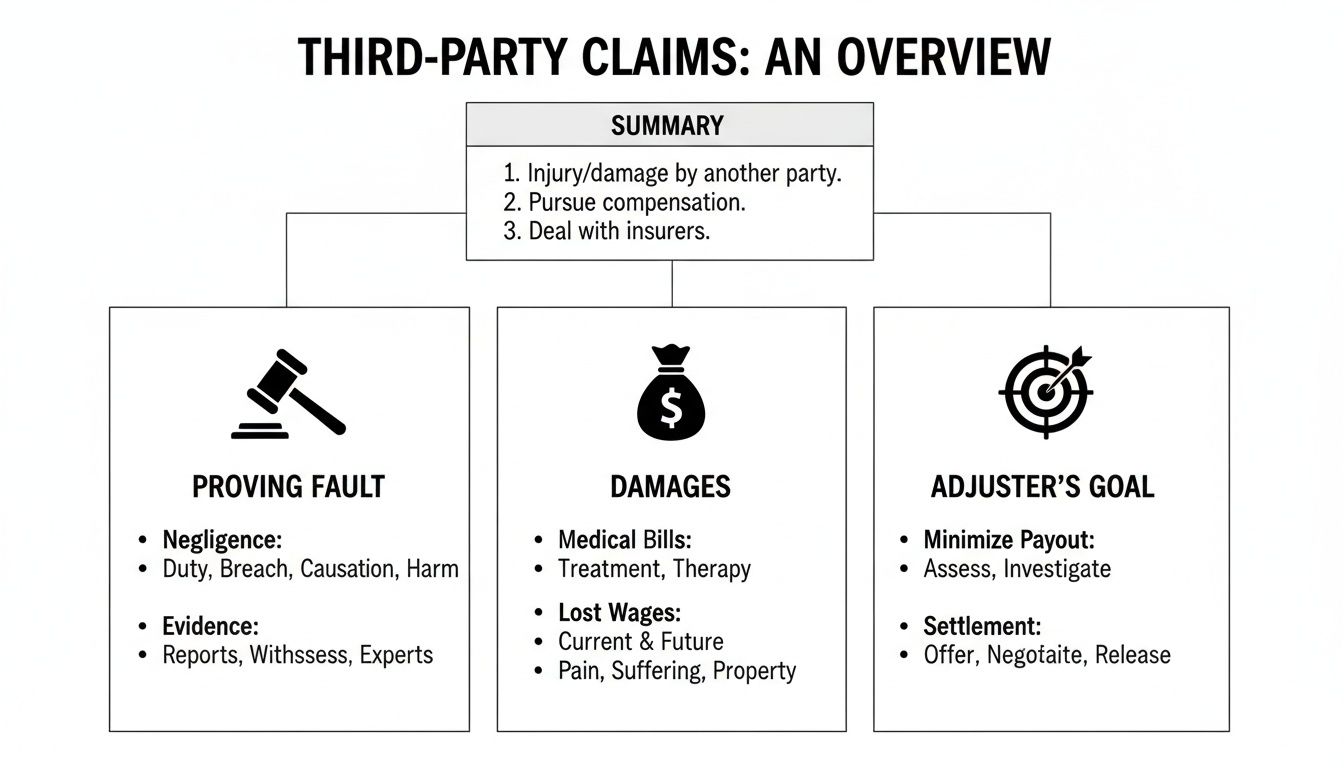
The burden of proof remains the "preponderance of the evidence." The plaintiff must show:
- The third party owed the worker a duty of care.
- The third party breached that duty (through negligence or a product defect).
- The breach was the proximate cause of the injury.
- The worker suffered actual damages.
Statutory Deadlines and the "Discovery" Rule
Timing is another reason why immediate attention to third-party claims is essential. While workers' compensation reporting deadlines are often very short (sometimes 30 days or less), the statute of limitations for a third-party personal injury lawsuit is typically longer—often two to three years depending on the state.
However, waiting is dangerous. Evidence at a construction site can be cleared within hours. Surveillance footage from a third-party parking lot might be overwritten in days. Identifying the correct third-party entity—which might be a parent company or a foreign manufacturer—takes time. Failing to initiate the third-party investigation alongside the workers' comp claim can result in the permanent loss of the right to seek full compensation.
Frequently Asked Questions
Can I sue my boss and file a third-party claim at the same time?
Generally, no. The "exclusive remedy" rule prevents you from suing your employer or a direct co-worker in most circumstances. However, you can—and often should—pursue a workers' compensation claim against your employer and a separate personal injury lawsuit against a third party simultaneously. These are parallel tracks of recovery for the same accident.
Will filing a third-party claim affect my workers' comp checks?
It will not stop your workers' comp benefits. You are entitled to your workers' comp benefits as the case progresses. However, if you win your third-party case, the workers' comp insurer is usually entitled to be reimbursed for the benefits they paid you out of your settlement or award. This is the "lien" process mentioned earlier.
What happens if I am partially at fault for the accident?
In many states, "comparative negligence" rules apply to third-party claims. If you were 20% at fault and the third party was 80% at fault, your total award may be reduced by 20%. This is a major difference from workers' comp, which pays out 100% of its scheduled benefits even if you were partially at fault (unless the injury was intentional or due to intoxication).
Who counts as a "third party"?
A third party is any person or company that is not your employer or a co-employee. This includes manufacturers of equipment, drivers of other vehicles, owners of the premises where you were working, independent contractors, or maintenance companies responsible for servicing machinery at your workplace.
Is it worth hiring a lawyer for a third-party claim?
Because third-party claims involve proving negligence, dealing with subrogation liens, and navigating civil court procedures, they are significantly more complex than standard workers' comp filings. Most personal injury attorneys work on a contingency fee basis, meaning they only get paid if you win, which makes professional representation accessible for most workers.
Final Recommendation for Injured Workers
If you have been injured on the job, do not assume that workers' compensation is your only source of recovery. The importance of third-party claims cannot be overstated: they are often the only way to bridge the gap between "subsistence" benefits and the "full" compensation required to recover from a serious accident.
Next Steps:
- Report the injury to your employer immediately to secure your workers' comp benefits.
- Document everything at the scene, including the brand names of machinery involved and the names of any non-coworker witnesses.
- Consult a specialized attorney who handles both workers' compensation and personal injury. They can perform a "liability sweep" to identify any potential third parties that may be responsible for your injury.
- Preserve the evidence. If a tool or product caused the injury, ensure it is not altered or destroyed, as it is the primary evidence in a product liability action.
Disclaimer: This article provides general information and does not constitute legal advice. Laws regarding workers' compensation and third-party liability vary significantly by jurisdiction. Consult with a licensed attorney in your area to discuss the specifics of your case.
Image Gallery
Select an image to open it in a new tab.

Celine Dubois
Contemporary Living and Global Arts Columnist
