Qualifications for Selling Your Term Life Insurance Policy: What You Need to Know

Selling a term life insurance policy is a financial transaction where a policyholder transfers ownership and beneficiary rights to a third party in exchange for an immediate cash payout that is higher than the policy's cash surrender value. While permanent life policies are widely bought and sold through life settlements, selling a term life policy involves distinct qualifications, conversion requirements, and market constraints that every policyholder must understand before proceeding.
Understanding the Market for Selling Life Insurance
Life insurance is legally recognized as personal property in most jurisdictions. Just as an individual can sell a home, a car, or an investment portfolio, a policyholder can generally sell their life insurance policy to a third-party investor. This transaction is formally known as a life settlement. When the insured individual is older and faces chronic health issues, the secondary market often finds value in acquiring the contract.
However, term life insurance operates differently than whole life or universal life insurance. Because term insurance provides coverage for a specific period—such as 10, 20, or 30 years—and typically does not accumulate cash value, it cannot usually be sold in its raw form on the secondary market. Investors require policies that offer permanent protection or policies that can be structurally modified to provide long-term viability. Consequently, understanding the foundational mechanics of term insurance disposition requires looking closely at policy provisions, age thresholds, and health criteria.
The Core Qualification: Policy Conversion Privileges
The single most critical qualification for selling a term life insurance policy is whether the policy contains a conversion rider or conversion privilege. Without this feature, a pure term life insurance policy has virtually no value to a secondary market investor because the coverage will eventually expire, and there is no permanent death benefit to secure.
A conversion provision allows the policyholder to convert their term life insurance policy into a permanent life insurance policy—such as whole life or universal life—without undergoing a new medical exam or proving insurability. This is a vital bridge. Once the term policy is converted into a permanent policy, that new permanent policy can then be evaluated for a life settlement or a viatical settlement.
- Check the Contract: Review the original policy documents or contact the insurance carrier directly to verify if a conversion option exists.
- Note the Deadline: Most conversion riders have strict expiration timelines, often tied to a specific age (e.g., age 65 or 70) or a specific number of years into the policy term.
- Understand Premium Increases: Converting to a permanent policy will significantly increase the ongoing premium payments. Policyholders must determine who will pay these higher premiums during the interim period before the sale is completed.

Age, Health, and Policy Size Requirements
Even if a term policy is successfully converted into a permanent policy, brokers and institutional investors impose strict underwriting criteria before purchasing the contract. These qualifications ensure that the investment math makes sense for the buyer, who will be paying the ongoing premiums and waiting to collect the death benefit.
Age and Life Expectancy
Secondary market buyers generally look for insured individuals who meet specific demographic parameters. While exact criteria vary by provider and market conditions, common benchmarks include:
- Minimum Age: The insured is typically at least 65 to 70 years old, though individuals with severe, life-limiting medical diagnoses may qualify at younger ages.
- Life Expectancy: Actuarial assessments generally look for a life expectancy between 2 and 15 years. If the insured is exceptionally healthy and has a very long life expectancy, investors may calculate that the cost of paying ongoing premiums outweighs the eventual return.
Health Status Changes
Ironically, while people buy life insurance when they are healthy, they are generally qualified to sell life insurance policies when their health has declined since the policy was first issued. A decline in health—such as a diagnosis of heart disease, cancer, diabetes, or other chronic conditions—reduces the expected lifespan of the insured, which increases the potential financial return for a secondary market investor.
Policy Face Value Thresholds
Life settlement transactions involve legal, administrative, and brokerage costs. Because of these overhead expenses, buyers and brokers rarely handle small policies.
- Most life settlement companies require a minimum face value of $100,000 to $250,000.
- Policies with lower face values often generate transaction costs that consume the majority of the payout, making the sale economically unviable for the policyholder.
Comparison of Life Settlement Eligibility Factors
The following table outlines the key differences in qualification criteria between standard term policies, converted policies, and permanent life insurance policies when evaluated by secondary market buyers.
| Policy Type | Conversion Required? | Minimum Face Value | Typical Age Threshold | Health Status Impact |
|---|---|---|---|---|
| Pure Term Policy | Not Applicable | Varies | N/A | Cannot be sold directly without conversion. |
| Convertible Term Policy | Yes (Must convert first) | Usually $100,000+ | Generally 65+ | Declines in health improve investor interest post-conversion. |
| Whole / Universal Life | No | Usually $100,000+ | Generally 65+ | Declines in health or advanced age are preferred. |
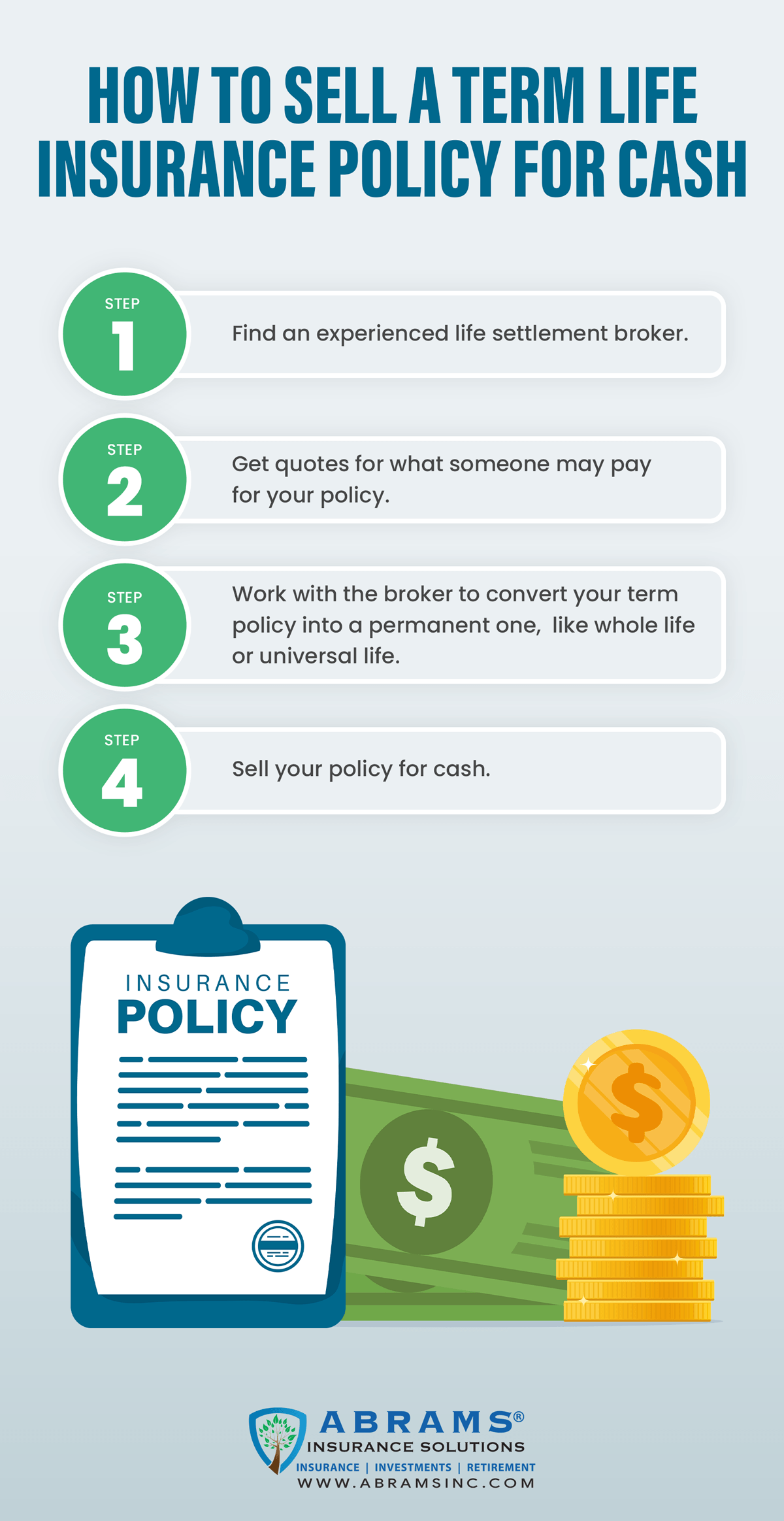
The Step-by-Step Process of Selling a Converted Policy
Once a policyholder confirms that their term policy is convertible and that they meet the age and health criteria, navigating the transaction requires a structured approach. Working with licensed professionals helps protect the consumer's interests in a specialized financial market.
- Verify and Convert the Policy: Execute the conversion option with the original insurance carrier to transform the term policy into a permanent policy. Ensure all new premium obligations are met during the transition.
- Consult a Life Settlement Broker: Engage an independent, licensed life settlement broker rather than working exclusively with a single buyer. Brokers have a fiduciary duty to shop the policy across multiple institutional buyers to secure the highest possible competitive offer.
- Gather Documentation: Prepare medical records, policy statements, and illustration documents requested by the broker or settlement provider. Independent medical underwriters will review these records to estimate life expectancy.
- Evaluate Offers: Review the offers generated from the secondary market. The cash payout will be higher than the cash surrender value offered by the insurance company, but lower than the policy's full face value.
- Complete the Transaction: Sign the formal assignment paperwork, transfer ownership of the policy to the buyer, and receive the tax-reported cash payout.
Financial and Tax Implications to Consider
Selling a life insurance policy is a major financial transaction with direct tax and economic consequences. Policyholders must weigh these factors carefully before finalizing an agreement.
- Tax Consequences: The proceeds from a life settlement are not entirely tax-free. The portion of the payout up to the total amount of premiums paid is typically considered a tax-free return of basis. Amounts received above the basis up to the policy's cash surrender value may be treated as ordinary income, while any excess above the cash surrender value can sometimes be treated as capital gains. Consulting a certified public accountant or tax professional is strongly recommended.
- Loss of Coverage: Once the policy is sold, the original beneficiaries will no longer receive the death benefit when the insured passes away. Families should ensure that losing this financial safety net will not leave surviving dependents unprotected.
- Alternative Options: Before pursuing a life settlement, policyholders should evaluate whether a policy loan, an accelerated death benefit rider (if terminally ill), or simply surrendering the policy for its cash value (if applicable) better suits their financial needs.
Common Pitfalls and Regulatory Protections
The life settlement industry is heavily regulated at the state level by departments of insurance to protect consumers from predatory practices, hidden fees, and undervalued policy sales.
- Working with Unlicensed Entities: Always verify that brokers and settlement providers hold active licenses in your state of residence. State insurance commissioners maintain public databases to check credentials.
- Ignoring Ongoing Costs: If a term policy requires conversion, the policyholder must continue paying the higher permanent insurance premiums until the transaction closes. Failing to maintain these payments can cause the policy to lapse, resulting in the total loss of coverage and potential sale value.
- Transparency of Fees: Understand how brokers are compensated. Most brokers operate on a commission basis, taking a percentage of the final purchase price. Ensure all fee structures are fully disclosed in writing before signing any representation agreements.
Frequently Asked Questions
Can I sell a term life insurance policy without converting it first?
No. Pure term life insurance policies do not build cash value and expire at the end of the term. Secondary market investors will not purchase a term policy that lacks permanent guarantees unless it is first converted into a permanent policy via a policy rider.
What is the minimum age required to qualify for a life settlement?
Most institutional buyers and brokers require the insured individual to be at least 65 years old. However, exceptions can sometimes be made for younger individuals who have been diagnosed with a serious, life-limiting medical condition.
How much money will I get when I sell my policy?
The payout depends on the policy's face value, the age and health of the insured, and the ongoing cost of maintaining the premiums. While a life settlement will almost always offer more than the insurance carrier's cash surrender value, it will be significantly less than the total death benefit.
Are life settlement proceeds taxable?
Partially. The IRS taxes life settlement proceeds based on the policyholder's cost basis. Payouts up to the total premiums paid are generally tax-free, while portions representing gains or income relative to the cash surrender value may be subject to ordinary income or capital gains taxes.
What is the difference between a life settlement and a viatical settlement?
A life settlement generally applies to seniors aged 65 or older who may or may not have chronic health conditions. A viatical settlement specifically applies to individuals who are terminally or chronically ill, regardless of age, where life expectancy is typically two years or less.
Next Actions for Policyholders
If you are considering liquidating your term life policy, start by reviewing your original contract to verify the presence and expiration date of a conversion rider. Next, request an in-force illustration from your insurance carrier to understand the exact premium costs required to convert the policy. Finally, reach out to multiple licensed life settlement brokers to obtain independent appraisals and competitive market offers before making a final commitment.
Image Gallery
Select an image to open it in a new tab.



Ingrid Bjornson
Global Cyber Policy and Regulation Analyst
