The BMW M3 CS Top Speed Compared to the Standard M3

The BMW M3 CS reaches an electronically limited top speed of 188 mph (302 km/h) as standard, utilizing the M Driver’s Package. In contrast, the standard BMW M3 achieves a base top speed of 155 mph (250 km/h), which can be raised to 180 mph (290 km/h) only when the optional M Driver’s Package is specified.
Introduction to the BMW M3 Lineup and the CS Philosophy
The BMW M3 has long stood as the benchmark for high-performance sports sedans, balancing daily usability with track-ready capability. Within this illustrious lineage, special editions bearing the "Competition Sport" or CS moniker represent a focused evolution. Positioned above the standard M3 and the M3 Competition, the CS variants are engineered for drivers seeking sharper dynamics, reduced weight, and elevated powertrain performance. Understanding how the BMW M3 CS top speed compares to the standard M3 requires examining not just the numbers on a spec sheet, but the aerodynamic engineering, powertrain calibrations, and factory packages that dictate these velocities.
Evaluating high-performance vehicles involves looking past baseline marketing claims to understand the hardware enabling such capabilities. While both the standard M3 and the M3 CS share BMW’s versatile S58 twin-turbocharged inline-six engine, their power outputs, cooling strategies, and chassis tunings diverge significantly. This analysis breaks down the performance metrics, engineering differences, and real-world implications of the top speeds achieved by both variants.
Powertrain Specifications and Output Differences
At the heart of both the standard BMW M3 and the M3 CS lies the S58 3.0-liter twin-turbocharged inline-six engine. However, the similarities in output end there.
The standard BMW M3 (in non-competition guise) produces 473 horsepower and 406 lb-ft of torque, channeled through a six-speed manual transmission in rear-wheel-drive format. Stepping up to the M3 Competition variants increases output to 503 horsepower (and up to 523 horsepower in the modern M3 Competition xDrive variants), paired exclusively with an eight-speed M Steptronic transmission.
The BMW M3 CS, by contrast, pushes the envelope further by adopting a powerplant tuned to generate 543 horsepower while maintaining 479 lb-ft of torque. This output is identical to the track-focused M4 CSL. The extra horsepower is unlocked primarily through increased turbocharger boost pressure—ramped up from 24.7 psi in the standard Competition models to 30.5 psi in the CS—alongside recalibrated engine management software.
| Feature / Metric | Standard BMW M3 (Manual) | BMW M3 Competition xDrive | BMW M3 CS |
|---|---|---|---|
| Engine | 3.0L Twin-Turbo Inline-6 (S58) | 3.0L Twin-Turbo Inline-6 (S58) | 3.0L Twin-Turbo Inline-6 (S58) |
| Horsepower | 473 hp | 503 hp (or 523 hp post-refresh) | 543 hp |
| Torque | 406 lb-ft (550 Nm) | 479 lb-ft (650 Nm) | 479 lb-ft (650 Nm) |
| Drivetrain | Rear-Wheel Drive (RWD) | M xDrive All-Wheel Drive | M xDrive All-Wheel Drive |
| Transmission | 6-Speed Manual | 8-Speed M Steptronic | 8-Speed M Steptronic |
| Base Top Speed | 155 mph (250 km/h) | 155 mph (250 km/h) | 188 mph (302 km/h) |
| Max Top Speed (Optional/Standard) | 180 mph (290 km/h w/ Package) | 180 mph (290 km/h w/ Package) | 188 mph (302 km/h standard) |
Aerodynamics, Weight Reduction, and High-Speed Stability
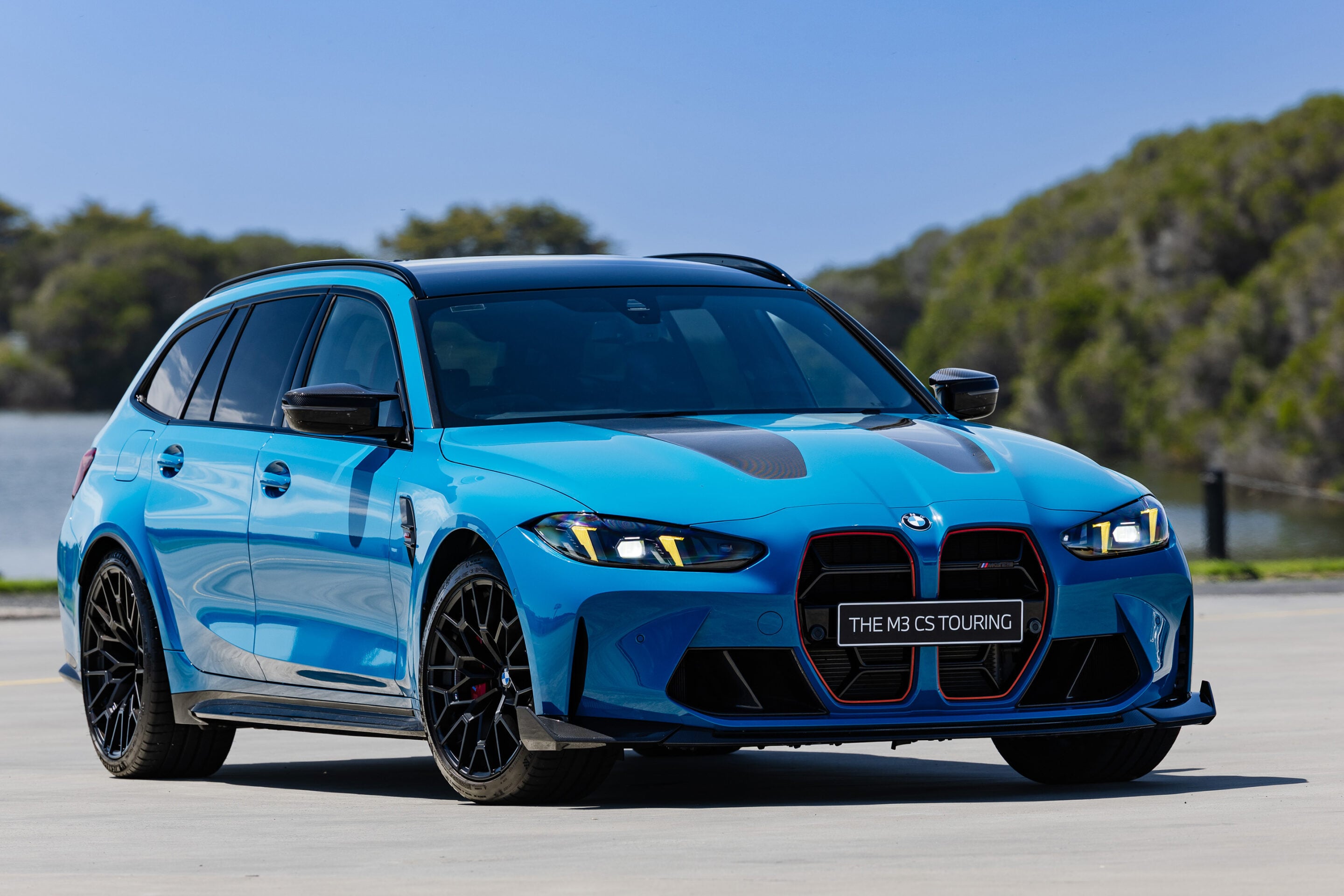
Achieving speeds approaching 190 mph requires more than raw engine power; it demands rigorous aerodynamic stability and thermal management. The BMW M3 CS incorporates extensive use of carbon fiber-reinforced plastic (CFRP) to shed approximately 75 pounds compared to the standard M3 Competition xDrive.
Exposed carbon fiber is utilized on the roof, hood, front splitter, front air intakes, exterior mirror caps, rear diffuser, and rear spoiler. Beyond reducing overall mass and lowering the center of gravity, these components work in tandem to optimize downflow and minimize aerodynamic lift at triple-digit velocities. The prominent front splitter and rear carbon gurney flap generate specific aerodynamic loads that keep the front tires planted and the rear stable during high-speed directional changes.
By comparison, the standard BMW M3 relies on a more subdued aerodynamic profile. While high-performance versions can be optioned with M Performance carbon accessories, standard models feature a steel or aluminum roof (depending on specifications like the moonroof) and standard fascias. This setup creates slightly higher drag coefficients and less aggressive downforce profiles, making the inclusion of the optional M Driver’s Package a prerequisite for safe, stable high-speed running on closed tracks or unrestricted sections of the German Autobahn.
Transmission and Drivetrain Dynamics at High Speeds
The transmission and power delivery systems dictate how efficiently an engine's output translates into terminal velocity.
The standard BMW M3 offers a purist's manual transmission for rear-wheel-drive variants, which provides engaging tactile feedback but results in slower acceleration times and lower baseline thermal limits during sustained high-load operations. When moving to the M3 Competition, the ZF eight-speed torque-converter automatic transmission delivers lightning-fast gear changes, optimizing power delivery across the rev range.
The M3 CS exclusively utilizes the intelligent M xDrive all-wheel-drive system paired with the eight-speed M Steptronic transmission. At speeds exceeding 150 mph, all-wheel-drive traction offers exceptional straight-line stability, neutralizing minor road imperfections, crosswinds, or surface dampness that might upset a rear-wheel-drive platform. The active M differential at the rear axle continuously adjusts lock-up percentages from 0 to 100 percent, ensuring that power is distributed precisely where traction is greatest when approaching the 188 mph ceiling.
The Role of Factory Packages in Determining Top Speed
For decades, German manufacturers have adhered to a gentleman's agreement limiting production road cars to an electronically restricted top speed of 250 km/h (155 mph). Both the standard BMW M3 and the M3 Competition respect this baseline limit in standard form.
To bypass this restriction, buyers of the standard M3 must purchase the optional M Driver’s Package. This factory upgrade recalibrates the electronic governor, raising the top speed limit to 180 mph (290 km/h). Furthermore, purchasing the M Driver’s Package usually includes a voucher for a high-performance driver training session at a BMW Performance Center, ensuring that owners understand vehicle dynamics at elevated velocities.
The BMW M3 CS treats the high-speed limiter differently. Because it is built as an ultra-exclusive, track-capable flagship, the M Driver’s Package comes standard. The electronic governor is preset directly to 188 mph (302 km/h) straight from the factory floor, requiring no additional packages or post-delivery coding to unlock its maximum potential.
Frequently Asked Questions
What is the exact top speed of the standard BMW M3?
The standard BMW M3 has an electronically limited top speed of 155 mph (250 km/h) out of the box. However, if equipped with the optional M Driver’s Package from the factory, that limit is increased to 180 mph (290 km/h).
Can the standard BMW M3 reach the same top speed as the M3 CS?
No, even with the M Driver's Package installed, the standard M3 maxes out at 180 mph, whereas the M3 CS reaches 188 mph. The difference stems from the CS model's higher horsepower output (543 hp versus 503/523 hp) and optimized aerodynamic drag profile.
Does the BMW M3 CS require special tires to achieve its top speed?
Yes. Vehicles capable of sustaining speeds near 190 mph require tires with specific speed ratings (typically Y-rated or higher) designed to handle extreme centrifugal forces and heat buildup. The M3 CS is typically delivered on track-focused Michelin Pilot Sport Cup 2 tires or high-performance summer performance tires capable of handling these loads safely.
Is the BMW M3 CS top speed electronically restricted?
Yes, the 188 mph top speed of the M3 CS is electronically governed. Without this factory limitation, aerodynamic drag and engine redline parameters would dictate a slightly different natural terminal velocity, but BMW implements the cap to protect powertrain components and factory tire ratings.
How does weight reduction affect the top speed of the M3 CS?
While weight reduction primarily improves acceleration, cornering agility, and braking performance rather than absolute top speed, shedding 75 pounds reduces the rolling resistance and overall load on the chassis and tires at high velocities, contributing to overall stability.
Conclusion and Final Recommendation
The BMW M3 CS represents the pinnacle of current-generation M3 performance, offering a higher factory-unlocked top speed of 188 mph compared to the standard M3’s baseline 155 mph (or 180 mph with the M Driver's Package). This velocity advantage is supported by a 543-horsepower output, aggressive carbon-fiber aerodynamics, and standard inclusion of the M Driver's Package. For drivers prioritizing everyday compliance and standard track-day capability, the standard M3 or M3 Competition provides ample performance. For enthusiasts seeking uncompromising track focus, exclusivity, and unrestricted high-speed delivery, the M3 CS justifies its elevated positioning in the hierarchy of modern performance sedans.
Image Gallery
Select an image to open it in a new tab.


Omar Farooq
EdTech Innovation and Virtual Pedagogy Journalist
