
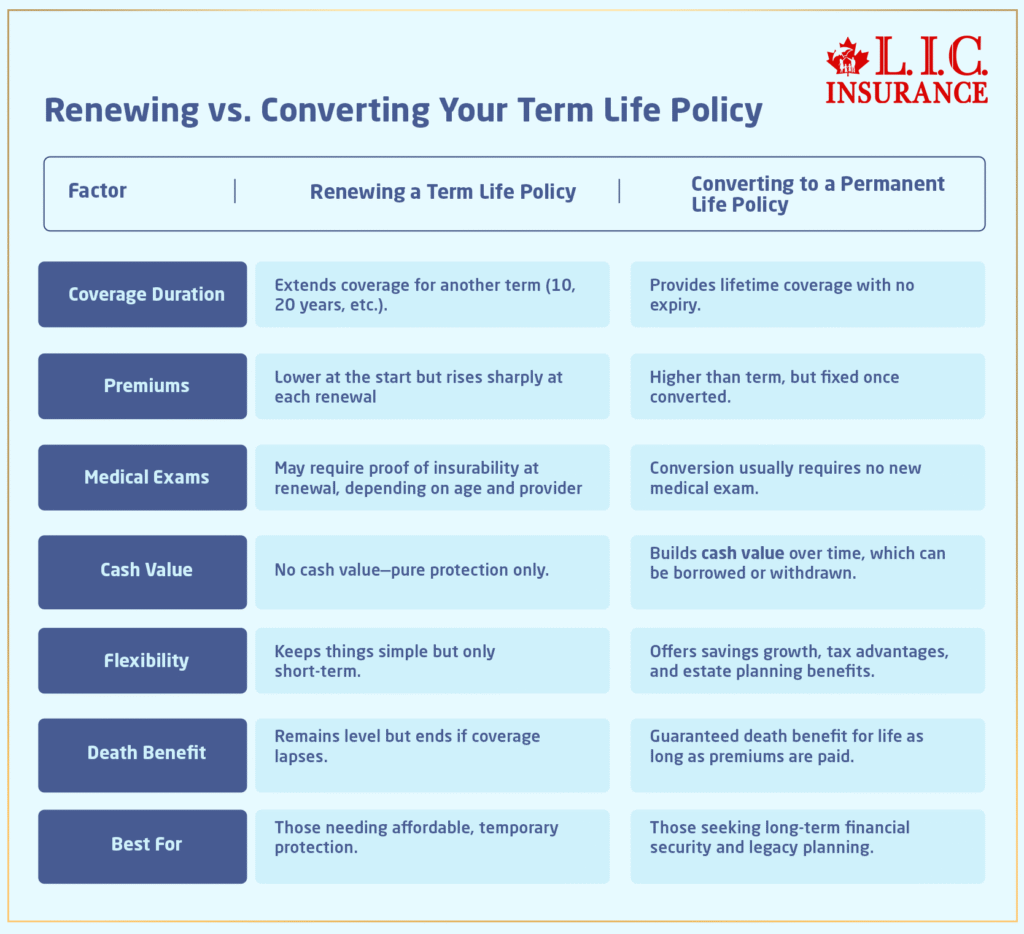
Converting to permanent life insurance allows a policyholder to exchange a temporary term life insurance policy for a permanent one, such as whole or universal life, without undergoing a new medical exam. This mechanism preserves insurability, provides lifetime protection, and accumulates cash value, though it usually results in significantly higher premium payments.
Navigating the transition from term life insurance to permanent coverage is a pivotal financial decision that requires a thorough understanding of policy mechanics, contractual timelines, cost structures, and long-term implications. Many individuals purchase term life insurance during their peak earning years to cover temporary liabilities like mortgages and raising children. However, as policyholders age or their financial goals evolve, the temporary nature of term insurance may no longer align with their estate planning or end-of-life needs.
Understanding how to execute this conversion successfully requires looking closely at contract provisions, financial trade-offs, and administrative requirements. While the promise of lifetime coverage without proving current health status is attractive, the financial commitments demand careful evaluation.
Understanding Term vs. Permanent Life Insurance
Before initiating a conversion, it is essential to understand the structural differences between the policy you currently hold and the policy you intend to acquire. Term life insurance provides pure protection for a specified period, such as 10, 20, or 30 years. If the insured passes away during this window, the beneficiaries receive the death benefit. If the term expires, the coverage terminates unless renewed at substantially higher rates, and no cash value is returned.
Permanent life insurance, by contrast, is designed to last the entire lifetime of the insured as long as premiums are paid. It consists of two main types:
- Whole Life Insurance: Features fixed premiums, a guaranteed death benefit, and a cash value account that grows at a guaranteed minimum interest rate.
- Universal Life Insurance: Offers flexible premiums and adjustable death benefits, with cash value tied to interest crediting rates or equity indices, depending on the specific design.
The primary advantage of permanent insurance is longevity of coverage and the accumulation of tax-deferred cash value, which can be borrowed against or withdrawn in the future. The primary disadvantage is cost; permanent policies are substantially more expensive than term policies for the same amount of death benefit because they are engineered to pay out eventually and build cash value.
The Conversion Privilege Explained
The cornerstone of transitioning from a temporary policy to a permanent one is the conversion privilege (often referred to as a conversion rider or option). This contractual provision is typically embedded in most standard term life insurance policies. It grants the policyholder the explicit right to convert all or a portion of their term coverage into an eligible permanent policy offered by the same insurance carrier.
Crucially, this conversion can be executed without evidence of insurability. This means that if you have developed chronic health conditions, survived a major illness, or simply aged significantly since purchasing the original policy, the insurer cannot deny the conversion, raise your rates based on your current health status, or require a medical exam.
However, the conversion privilege is governed by strict contractual rules:
- Time Limits: Policies specify a window during which conversion is permitted. This is often capped at a certain age (e.g., age 65 or 70) or a specific number of years into the policy term (e.g., the first 10 years of a 20-year term).
- Partial Conversions: Most contracts allow you to convert only a portion of your term face amount. For example, if you hold a $1,000,000 term policy, you might choose to convert $250,000 to permanent insurance and drop or keep the remaining $750,000 as term coverage.
- Product Restrictions: Insurers generally limit conversions to a specific subset of their permanent product portfolio. You may not have access to every permanent product the company offers.

Eligibility and Prerequisites for Conversion
Evaluating your eligibility for conversion involves reviewing your original policy contract and assessing your current administrative standing with the insurance carrier.
First, examine your policy schedule and rider pages to verify that a conversion rider is active. Some low-cost or specialized term policies—such as yearly renewable term or certain group life policies—may lack a conversion option entirely.
Second, verify your timeline. Missing the conversion deadline by even a single day usually voids the right to convert. Insurers enforce these deadlines strictly.
Third, ensure your current term policy is in good standing. Premium payments must be fully up to date. If a policy has lapsed or entered a grace period, you must reinstate it before any conversion request can be processed.
Finally, review the age limits set by the carrier. Even if you are within the allowed duration of the term (such as year 8 of a 20-year term), the contract may stipulate that conversion privileges expire when the insured turns a specified age, such as 65.
| Feature | Term Life Insurance | Permanent Life Insurance |
|---|---|---|
| Duration | Specified period (10, 20, 30 years) | Lifetime (as long as premiums are paid) |
| Cash Value | None | Accumulates tax-deferred cash value |
| Premium Cost | Lower initial cost | Significantly higher cost |
| Insurability at Renewal | Often requires new underwriting or increases | Fixed based on initial purchase or conversion terms |
| Primary Purpose | Income replacement, temporary debts | Estate planning, lifetime protection, cash accumulation |
Steps to Execute a Policy Conversion
Executing a life insurance conversion is an administrative process that requires coordination with your insurance agent or the carrier's customer service department. While it avoids medical underwriting, paperwork is still required.
1. Review and Select Your Permanent Product
Request a conversion catalog from your insurer to review the eligible permanent products. Compare the premium structures, cash value growth guarantees, and policy fees of the available options. Determine whether whole life or universal life better fits your long-term financial strategy.
2. Calculate the Financial Impact
Ask the insurer or your financial professional for a formal conversion quote. This document will show the exact new premium you will pay based on your attained age. Compare this new cost against your household budget to ensure long-term affordability.
3. Determine the Face Amount
Decide whether to convert the full face amount of your term policy or execute a partial conversion. Keep in mind that converting a smaller amount can help manage the shock of higher permanent premiums.
4. Complete the Conversion Application
Fill out the carrier’s specific conversion application form. This document captures basic administrative information, desired policy specifications, and beneficiary designations. Because medical underwriting is bypassed, you generally do not need to answer detailed health history questions or submit to blood and urine tests.
5. Pay the Initial Premium and Acknowledge Delivery
Upon approval of the administrative paperwork, the insurer will issue the new permanent policy. You will need to pay the first modal premium (monthly, quarterly, or annually) for the permanent policy. Simultaneously, the corresponding amount of term coverage will be terminated.
Cost Considerations and Financial Impact
The most immediate and profound impact of converting to permanent life insurance is the change in premium costs. Permanent insurance premiums are often multiples higher than term insurance premiums for the identical death benefit.
For example, a healthy 35-year-old might pay $30 a month for a $500,000 term policy. By age 50, converting that policy to a whole life product could cause the monthly premium to jump to $400 or more. This sticker shock causes many policyholders to hesitate or drop the conversion altogether.
To manage this financial transition, consider the following strategies:
- Partial Conversion: Convert only a slice of the total coverage. Maintaining a portion of term coverage while building a core of permanent coverage can bridge the gap.
- Dividend Offsets: If you select a participating whole life policy, you may be able to use policy dividends to offset premium payments over time.
- Premium Class Carryover: Some insurance companies permit the original underwriting rating (such as "Preferred Plus") to transfer to the new permanent policy, which can mitigate some of the rate increases driven solely by your attained age.
Common Mistakes to Avoid
Navigating life insurance conversions without professional guidance or careful reading of the contract can lead to costly errors. Avoid these frequent pitfalls:
- Missing the Expiration Window: Waiting until the final year of a term policy without checking the conversion deadline can result in losing the right to convert entirely.
- Failing to Budget for Premium Spikes: Underestimating the long-term cash flow requirements of permanent insurance can lead to a newly converted policy lapsing due to non-payment.
- Ignoring Tax Implications: While life insurance cash value grows tax-deferred, withdrawing or borrowing against that cash value incorrectly in the future can trigger unexpected tax liabilities.
- Assuming All Policies are Convertible: Never assume a term policy has a conversion rider. Always verify this feature in the contract documents before making financial plans based on conversion.
Frequently Asked Questions
Can I convert my term policy if my health has declined significantly?
Yes. The primary benefit of a conversion rider is that it guarantees your right to switch to a permanent policy regardless of changes in your health status. The insurer cannot deny the conversion or charge higher rates due to medical conditions developed after you purchased the original term policy.
Will I need to take a medical exam to convert my policy?
No medical exam or invasive health testing is required for a standard contractual conversion. The insurer relies on your original underwriting file and your attained age to issue the new permanent policy.
Can I convert only a portion of my term life insurance?
Yes. Most insurance carriers permit partial conversions. If you hold a $1,000,000 term policy, you can convert $300,000 into a permanent policy and retain the remaining $700,000 as term coverage until its expiration date.
When is the best time to execute a conversion?
While conversion can happen at any point during the allowable window, many financial professionals suggest evaluating conversion midway through a term policy. This balances the benefit of lower attained-age rates against the need to secure permanent coverage before health or age limitations increase costs further.
What happens to my original term policy after I convert?
If you convert the entire face amount, the original term policy is terminated and replaced by the new permanent policy. If you execute a partial conversion, the original term policy remains active, but its face amount is reduced by the converted amount.
Next Actions
If you are considering converting your term life insurance to a permanent policy, begin by locating your original policy contract and reviewing the conversion rider provisions and deadlines. Contact your insurance carrier or a licensed, independent financial professional to request a formal conversion illustration. Compare the projected costs and cash value growth of the permanent options against your current budget and long-term estate planning goals before submitting your administrative paperwork.
Image Gallery
Select an image to open it in a new tab.
Akira Tanaka
International Academic Trends Correspondent
