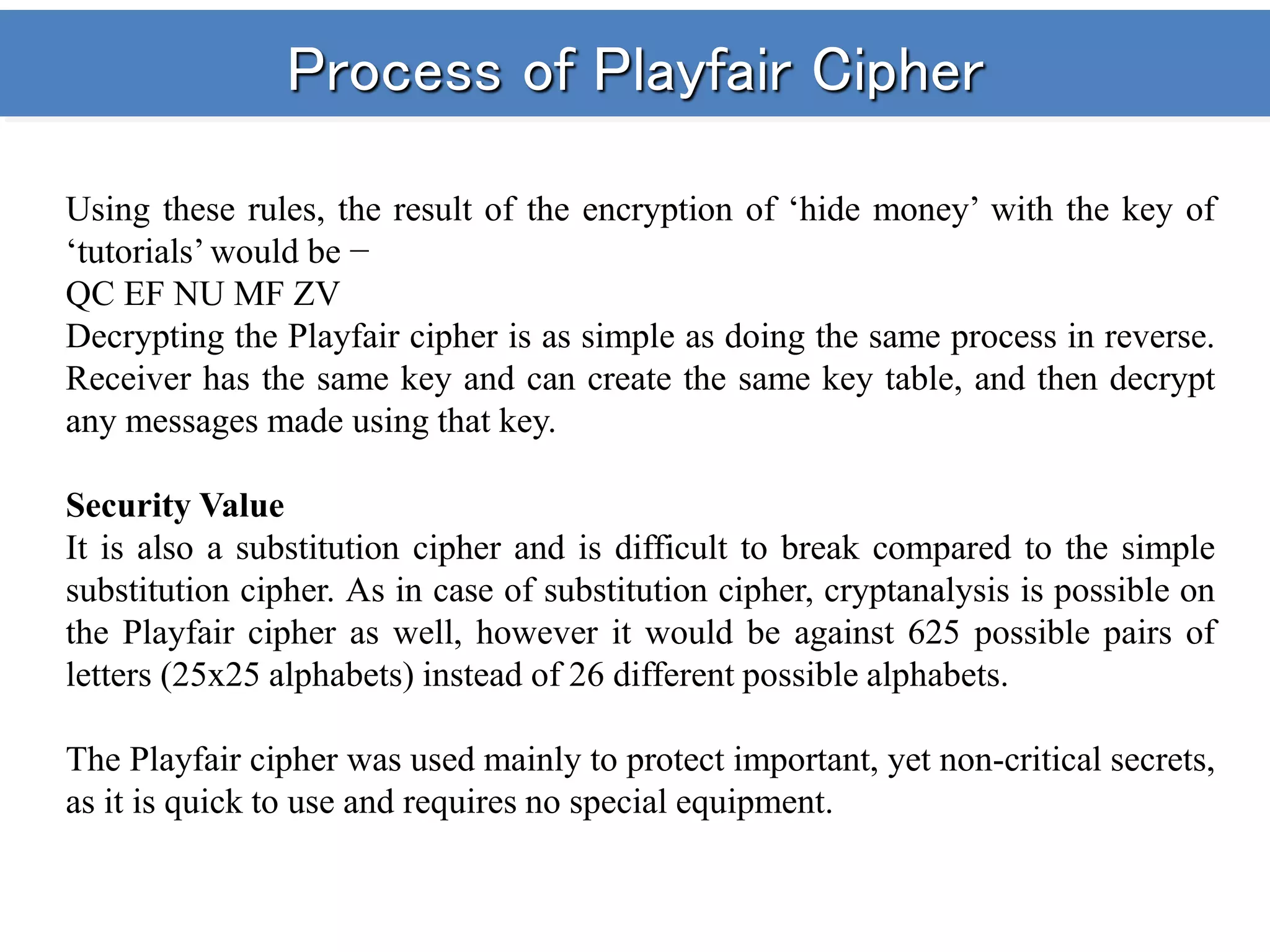
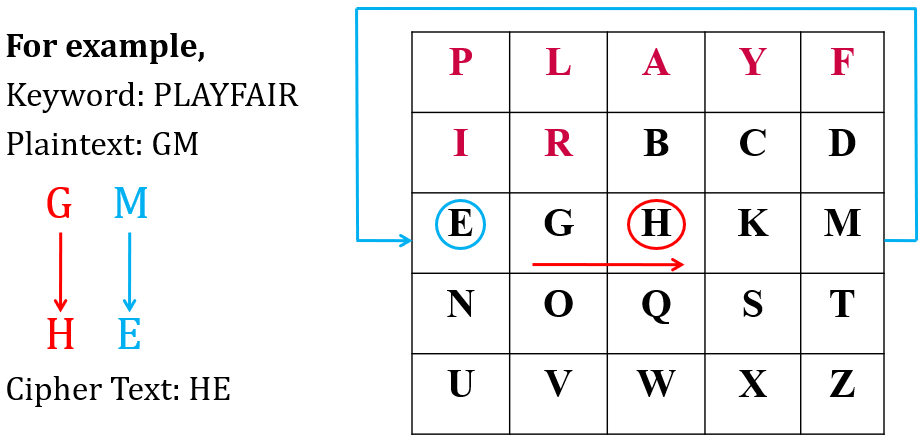
The Playfair cipher is a manual symmetric encryption technique that uses a 5x5 grid of letters to encrypt pairs of characters, known as bigrams. Decrypting a Playfair cipher involves reconstructing this grid using a specific keyword and then reversing the movement rules—shifting left for rows, up for columns, and swapping corners for rectangles—to recover the original plaintext.
The Foundation of Playfair Decryption: The 5x5 Key Square
Before you can decrypt any message, you must understand the structure of the Playfair matrix (also known as a Playfair square). Unlike simpler substitution ciphers that replace one letter with another, the Playfair cipher operates on two letters at once. This significantly increases the complexity for potential codebreakers because there are 600 possible bigrams (letter pairs) in the English language, compared to only 26 single letters.
Constructing the Grid
As of 2026, the standard method for constructing the Playfair grid remains unchanged from its historical roots. The grid is a 5x5 matrix containing 25 letters of the alphabet. Since the English alphabet has 26 letters, one letter is typically omitted or combined with another. Most commonly, I and J share a single cell.
To build the grid:
- Select a Keyword: Choose a secret word or phrase (e.g., "KRYPTOS").
- Remove Duplicates: Strip any repeating letters from the keyword. "KRYPTOS" remains "KRYPTOS," but "APPLE" would become "APLE."
- Fill the Matrix: Place the unique letters of the keyword into the 5x5 grid starting from the top-left corner, moving left to right, row by row.
- Complete the Alphabet: Fill the remaining empty cells with the rest of the alphabet in order (skipping letters already in the keyword and treating I/J as one).
Example Grid with Keyword "CIPHER":
| 1 | 2 | 3 | 4 | 5 | |
|---|---|---|---|---|---|
| 1 | C | I/J | P | H | E |
| 2 | R | A | B | D | F |
| 3 | G | K | L | M | N |
| 4 | O | Q | S | T | U |
| 5 | V | W | X | Y | Z |
Prerequisites for Decryption
To successfully decrypt a Playfair message, you must satisfy three primary requirements:
- The Correct Keyword: Without the exact keyword, the matrix configuration will be wrong, leading to gibberish.
- The Standard Alphabet Rule: You must know which letters were combined (usually I and J).
- Ciphertext Integrity: The ciphertext must consist of an even number of characters. If it is odd, there has been a transmission error or a specific padding rule was used that you must account for.

The Step-by-Step Decryption Rules
Once the grid is established, you break the ciphertext into pairs (bigrams). If the ciphertext is "BMNDZBOX," the pairs are BM, ND, ZB, and OX. For each pair, apply one of the following three rules based on their position in the matrix.
Rule 1: The Rectangle Rule (Opposite Corners)
If the two letters in the bigram occupy different rows and different columns, they form the corners of a rectangle within the grid.
- Action: Find the other two corners of the rectangle.
- Substitution: Replace each letter with the letter in the same row but in the column of the other letter.
- Note: The order matters. The first decrypted letter is the one on the same row as the first ciphertext letter.
Rule 2: The Row Rule (Shift Left)
If both letters in the bigram appear in the same row of the matrix:
- Action: Move each letter one position to the left.
- Wrap-around: If a letter is at the beginning of the row (far left), it wraps around to the far right of the same row.
- Why left? During encryption, we shift right; therefore, decryption requires a leftward shift to reverse the process.
Rule 3: The Column Rule (Shift Up)
If both letters in the bigram appear in the same column of the matrix:
- Action: Move each letter one position up.
- Wrap-around: If a letter is at the top of the column, it wraps around to the bottom of the same column.
- Why up? Encryption involves shifting down, so decryption shifts up.
Comparative Summary of Playfair Movements
| Scenario | Encryption Movement | Decryption Movement |
|---|---|---|
| Same Row | Shift Right (Circular) | Shift Left (Circular) |
| Same Column | Shift Down (Circular) | Shift Up (Circular) |
| Different Row & Column | Swap with Horizontal Corner | Swap with Horizontal Corner |
Practical Example: Decrypting a Message
Let’s walk through a manual decryption using the "CIPHER" grid we built earlier. Suppose we receive the ciphertext bigram "DB".
- Locate "D" and "B" in the grid:
- "D" is at Row 2, Column 4.
- "B" is at Row 2, Column 3.
- Identify the Rule: Both letters are in Row 2. This invokes the Row Rule.
- Apply Decryption: Shift each letter one position to the left.
- Moving left from "D" (Row 2, Col 4) gives us "B" (Row 2, Col 3).
- Moving left from "B" (Row 2, Col 3) gives us "A" (Row 2, Col 2).
- Result: The decrypted bigram is "BA".
Now, let’s try the bigram "HE":
- Locate "H" and "E": Both are in Row 1.
- Apply Row Rule (Left Shift):
- Left of "H" is "P".
- Left of "E" (at the end of the row) wraps to the start: "C".
- Result: The decrypted bigram is "PC".
Finally, consider the bigram "QC":
- Locate "Q" and "C":
- "Q" is at (4, 2).
- "C" is at (1, 1).
- Identify the Rule: They are in different rows and different columns. This invokes the Rectangle Rule.
- Apply Decryption:
- The letter in the same row as "Q" (Row 4) but the same column as "C" (Column 1) is "O".
- The letter in the same row as "C" (Row 1) but the same column as "Q" (Column 2) is "I".
- Result: The decrypted bigram is "OI".
Handling Filler Characters and Post-Decryption Cleanup
One of the quirks of the Playfair cipher is the use of "nulls" or filler characters. When you finish decrypting all bigrams, the resulting text might look slightly strange. Common anomalies include:
The "X" and "Q" Fillers
In Playfair encryption, double letters (like "LL" in "BALLOON") cannot be in the same bigram. To fix this, a filler (usually 'X') is inserted: "BA LX LO ON." Additionally, if the total message length is odd, an 'X' is added to the end.
When decrypting:
- If you see an 'X' between two identical letters (e.g., "HE L X L O"), you should remove it to restore the original "HELLO."
- If the message ends in a trailing 'X', 'Q', or 'Z', and the word makes sense without it, it is likely a padding character used to complete the final bigram.
The I/J Ambiguity
Since I and J share a cell, you must use context to determine which letter is correct. For example, if you decrypt a word as "ORANGI," it is almost certainly "ORANGE" was not the intended word, but rather "ORANGE" isn't it—wait, if the grid used I/J, and you get "OBJICT," you know the word is "OBJECT." In most cases, the context of the sentence makes the choice obvious.
Historical Context and Security Analysis
Invented in 1854 by Charles Wheatstone, the cipher bears the name of Lord Playfair, who promoted its use. It was a staple of tactical communication through the early 20th century, notably used by British forces in the Boer War and World War I. Even in World War II, it saw use by the Australian Coastwatchers.
Why it was Effective
Before modern computing, breaking a Playfair cipher by hand was a time-consuming task. Unlike simple substitution ciphers (like the Caesar cipher), where a "E" is always a "T," in Playfair, an "E" could be represented by many different letters depending on its partner in the bigram. This flattens the frequency distribution of the ciphertext, making standard frequency analysis much less effective.
Vulnerabilities in 2026
From the perspective of 2026 cybersecurity, the Playfair cipher is considered "toy" cryptography. While it is excellent for educational purposes to understand the evolution of polyalphabetic substitution, it is easily broken by modern computers.
- Bigram Frequency Analysis: While harder than single-letter analysis, a computer can analyze the frequency of pairs. In English, "TH," "HE," and "AN" are very common.
- Known Plaintext Attacks: If an attacker knows even a small portion of the original message, they can quickly reverse-engineer the keyword and the matrix.
- Short Keywords: Many historical users chose simple keywords, which can be brute-forced in milliseconds by modern hardware.
Troubleshooting Common Decryption Errors
If your decrypted text is unreadable, check for these common mistakes:
- Incorrect Grid Construction: Ensure you didn't miss a letter in the alphabet when filling the grid after the keyword.
- Wrong Directional Shift: A common error is shifting right/down (encryption) instead of left/up (decryption).
- Misidentifying the I/J Rule: If the original message used a different letter combination (like omitting 'Q' instead of 'Z'), the entire grid will shift.
- Keyword Misspelling: Even a single wrong letter in the keyword will change the position of every subsequent letter in the 5x5 grid.
Implementation in Modern Programming
For those looking to automate this in 2026, Python remains the preferred language for cryptographic demonstrations due to its string handling capabilities. An automated decryption script follows the same logic:
- Function to generate the 5x5 matrix from a string.
- Function to clean the ciphertext (remove spaces, ensure even length).
- A loop that processes the string in steps of two, applying coordinate-based logic to find the new characters in the matrix.
For more technical details on the history of this cipher, the National Security Agency (NSA) archives provide extensive documentation on its use during global conflicts. Additionally, Wolfram MathWorld offers a deep dive into the mathematical permutations involved in the 5x5 grid.
Frequently Asked Questions
What happens if the two letters in a bigram are the same?
In a properly encrypted Playfair cipher, you should never encounter a bigram with two identical letters (e.g., "EE"). The encryption process requires inserting a filler character like 'X' between them. If you do see identical letters in a ciphertext pair, the message was likely encrypted incorrectly, or it is not a Playfair cipher.
Can the Playfair cipher be used with numbers?
The standard Playfair cipher uses a 5x5 grid, which only allows for 25 characters. To include numbers and symbols, you would need to expand the grid to 6x6 (36 cells), which allows for the full alphabet (26) and digits 0-9. The movement rules (left, up, rectangle) remain identical.
Why do I see 'X' characters in my decrypted text?
The letter 'X' is the most common "null" or "filler" character. It is used to separate double letters in the plaintext or to fill out the last bigram if the message has an odd number of letters. When you see an 'X' that doesn't fit the word, simply ignore or remove it.
Is Playfair still used for secure communications in 2026?
No. Playfair is strictly for historical study, puzzles, and educational purposes. It can be cracked almost instantly by modern cryptanalysis software. For secure communication in 2026, protocols like AES (Advanced Encryption Standard) or RSA are used.
How do I handle the letter 'J' during decryption?
In the vast majority of Playfair implementations, 'I' and 'J' are treated as the same letter. When you decrypt a bigram and get an 'I', you must use the context of the word to decide if it should stay an 'I' or be changed to a 'J' (e.g., "IUSTICE" becomes "JUSTICE").
Final Recommendation for Students
When learning Playfair decryption, the best practice is to always draw the grid manually first. Visualize the rectangle or the wrap-around shift before writing down the decrypted letters. Once you master the manual process, you can move on to writing scripts that automate the coordinate mapping. For those interested in further classical cryptography, exploring the Hill Cipher (which uses linear algebra) is a natural next step after mastering the Playfair technique.
Image Gallery
Select an image to open it in a new tab.




Vivian Cho
Executive IT and Emerging Technologies Reporter
