
France currently operates exactly one aircraft carrier, the Charles de Gaulle (R91). As the flagship of the French Navy (Marine Nationale), this nuclear-powered vessel serves as the centerpiece of the French carrier strike group. It is the only nuclear-powered aircraft carrier currently in service that was built outside of the United States, representing a significant pillar of European maritime defense and power projection.
The Role of the Charles de Gaulle in the French Navy
The Charles de Gaulle is a CATOBAR (Catapult Assisted Take-Off But Arrested Recovery) carrier, which distinguishes it from the STOVL (Short Take-Off and Vertical Landing) carriers operated by many other nations. This technical configuration allows the French Navy to launch and recover heavier, more capable fixed-wing aircraft, including the Dassault Rafale M and the E-2C Hawkeye airborne early warning and control aircraft.
Commissioned in 2001, the vessel was designed to replace the aging Clemenceau-class carriers. Its displacement stands at approximately 42,500 tonnes at full load. Because it is nuclear-powered, the Charles de Gaulle offers near-unlimited range and high endurance, limited only by the supplies—such as aviation fuel, food, and ammunition—that it carries on board. This capability is essential for France’s role in global security, allowing the nation to project naval aviation power into the Mediterranean, the Atlantic, and the Indian Ocean without the logistical necessity of frequent refueling stops.
Understanding the Carrier Strike Group (CSG)
To understand why France relies on a single carrier, it is important to analyze the concept of the Carrier Strike Group. An aircraft carrier rarely operates alone; it is protected and supported by a task force. In the French context, the Charles de Gaulle is typically escorted by:
- Air Defense Frigates: Such as the Horizon-class, which provide long-range anti-aircraft protection.
- Multi-Mission Frigates (FREMM): These vessels provide advanced anti-submarine warfare (ASW) capabilities and land-attack options.
- Nuclear-Powered Attack Submarines (SSN): Usually a Rubis-class or the newer Suffren-class submarine, providing an invisible defensive screen against underwater threats.
- Command and Replenishment Ships: Essential for logistics, providing fuel, ordnance, and stores to keep the strike group operational for extended periods.
This combination of assets ensures that the carrier's primary mission—operating its air wing—can continue even in contested environments. However, the maintenance cycles required for such a sophisticated vessel mean that France is not always at sea. When the Charles de Gaulle enters a major refit period, the French Navy’s capacity for sustained carrier-based air power is temporarily unavailable, a reality that necessitates careful strategic planning regarding regional security commitments.
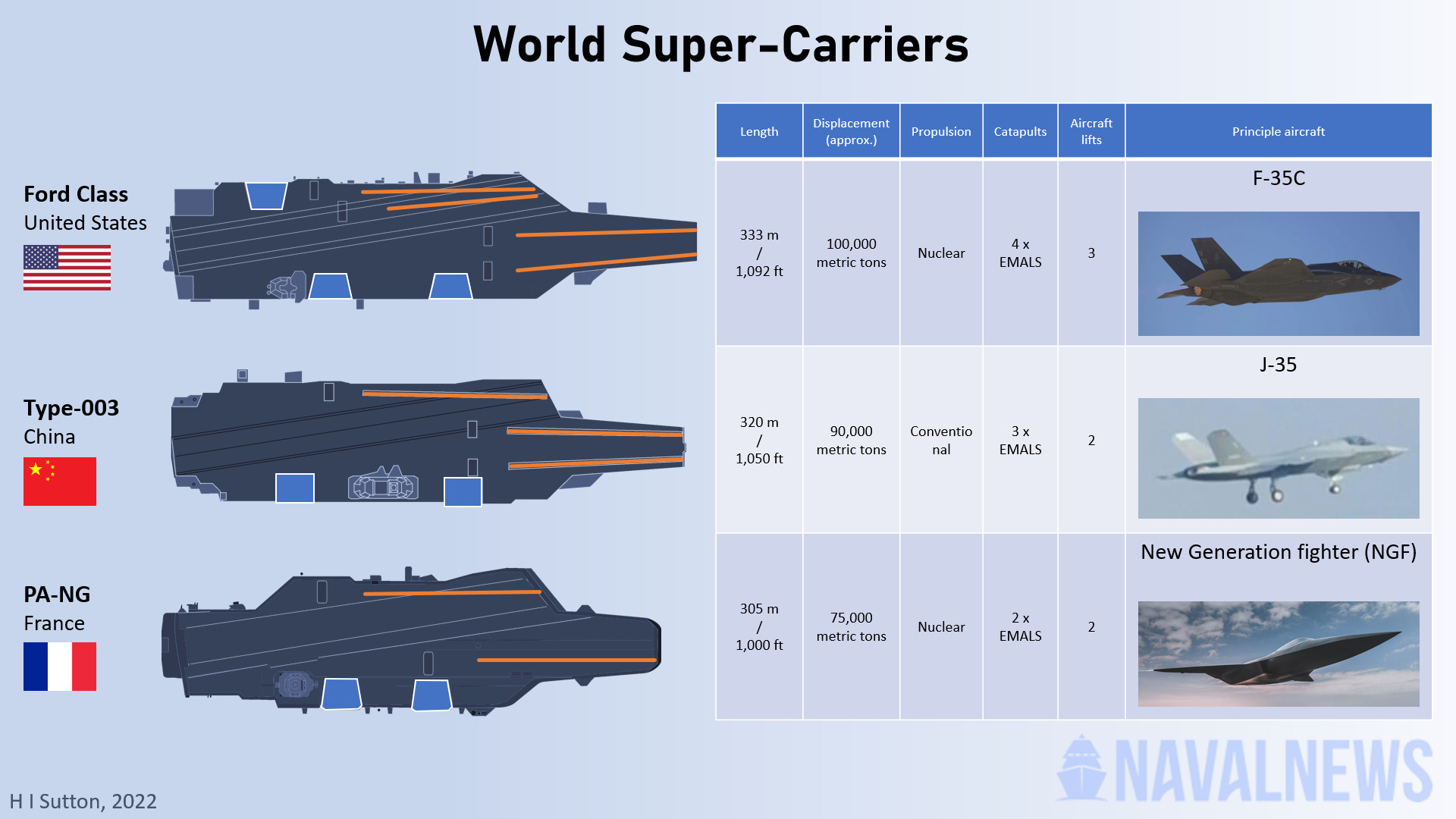
Comparative Overview of Global Aircraft Carriers
While the United States operates a large fleet of supercarriers, France’s approach is tailored to its specific national requirements and budget. The table below illustrates how the French carrier capability fits into the broader international context as of 2026.
| Vessel Name | Country | Propulsion | Launch System | Approximate Displacement |
|---|---|---|---|---|
| Charles de Gaulle | France | Nuclear | CATOBAR | 42,500 tonnes |
| Gerald R. Ford | USA | Nuclear | CATOBAR (EMALS) | 100,000 tonnes |
| Queen Elizabeth | UK | Conventional | STOVL (Ski-jump) | 65,000 tonnes |
| Liaoning | China | Conventional | STOBAR | 60,000 tonnes |
| Cavour | Italy | Conventional | STOVL | 27,000 tonnes |
Note: CATOBAR refers to Catapult Assisted Take-Off But Arrested Recovery. STOBAR refers to Short Take-Off But Arrested Recovery. STOVL refers to Short Take-Off and Vertical Landing.
Future Naval Aspirations: The PANG Program
Looking toward the future, the French government has initiated the Porte-Avions de Nouvelle Génération (PANG) program. As of 2026, this program represents the strategic intent of the French Republic to maintain its aircraft carrier capability well into the latter half of the 21st century.
The PANG is envisioned as a significantly larger vessel than the Charles de Gaulle, likely displacing upwards of 75,000 tonnes. The move toward a larger platform is intended to accommodate future naval aviation technologies, including the next generation of fighter aircraft currently in development. By transitioning to a larger ship, the French Navy aims to improve operational efficiency, increase the number of aircraft sorties per day, and provide a more robust command-and-control platform.
The necessity of this replacement project underscores a critical lesson in naval architecture: aircraft carriers have a finite service life. The fatigue caused by repeated catapult launches and the harsh, corrosive environment of the open sea means that even the most robust vessels require eventual replacement. The PANG project ensures that France will not face a "carrier gap" when the Charles de Gaulle finally reaches the end of its operational life, which is currently projected for the mid-2030s.
Operational Limitations and Strategic Constraints
Operating a single aircraft carrier carries inherent risks and limitations. The most significant challenge is availability. Because the Charles de Gaulle requires periodic "Major Technical Overhauls" (ATM - Arrêt Technique Majeur), there are long intervals where the French Navy has no carrier-based air wing available.
During these periods, France must rely on land-based aviation, such as the Rafale detachments stationed in foreign territories or at domestic airbases. While land-based air support is effective, it lacks the inherent mobility and sovereign immunity of a sea-based platform. A carrier strike group can move through international waters without the political complexities associated with securing overflight rights or basing agreements in foreign nations. Consequently, the reliance on a single ship remains a primary focus of defense analysts who argue for the necessity of a second, potentially smaller, carrier to ensure continuous presence.
Technical Maintenance and Human Capital
The operation of a nuclear-powered aircraft carrier requires a highly specialized crew of approximately 1,200 to 1,800 personnel, including aircrews and reactor engineers. The training required to maintain such a vessel is extensive. Beyond the technical skill required to manage a nuclear reactor, the crew must be proficient in damage control, flight deck operations—which are among the most dangerous industrial environments on earth—and complex naval communication protocols.
Maintenance is not merely a matter of repairing parts; it involves deep-cycle refits where the nuclear fuel cores are replaced and the electronics, radar, and sensor suites are upgraded to keep pace with evolving threats. This iterative approach to modernization is how the Charles de Gaulle remains relevant more than two decades after its initial commission.
Frequently Asked Questions
Does France have a second aircraft carrier?
No, France does not have a second aircraft carrier. The Charles de Gaulle is the sole carrier in the Marine Nationale. While there have been historical studies and political debates regarding the construction of a second, smaller carrier to complement the flagship, budgetary and strategic priorities have favored maintaining a single, highly capable nuclear-powered asset.
Why is France’s carrier nuclear-powered?
Nuclear propulsion provides the Charles de Gaulle with unlimited range and high endurance. Unlike conventional ships, which must stop for fuel, the carrier can remain at sea for years without refueling its reactor. This allows it to reach any point in the world with minimal logistical support for the ship itself, which is a key requirement for France's global maritime strategy.
Can the Charles de Gaulle land any jet?
The Charles de Gaulle is specifically configured for aircraft compatible with its catapult and arresting gear system. Its primary fixed-wing aircraft is the Dassault Rafale M. It can also support other carrier-capable aircraft, such as the U.S. Navy’s F/A-18 Super Hornet or E-2 Hawkeye, provided the pilots are carrier-qualified and the aircraft are configured for catapult launches.
How many aircraft can the carrier hold?
The Charles de Gaulle typically carries an air wing of 30 to 40 aircraft. This includes the Rafale M multi-role fighters, E-2C Hawkeye airborne early warning aircraft, and several types of helicopters used for search and rescue, logistics, and anti-submarine warfare.
Is the Charles de Gaulle effective against modern threats?
Yes, the vessel is equipped with advanced self-defense systems, including the Aster 15 surface-to-air missile system and the Sadral point-defense system. When protected by a modern carrier strike group, it remains a highly effective deterrent capable of conducting high-intensity operations against peer and near-peer adversaries.
Conclusion and Strategic Outlook
France remains a premier naval power, partly due to its ability to field a nuclear-powered aircraft carrier capable of supporting a sophisticated air wing. By relying on a single carrier, France maximizes its investment in high-end technology, though it must carefully navigate the logistical realities of maintenance cycles and the absence of a secondary platform. As the Marine Nationale continues its transition toward the future PANG project, the focus remains on maintaining this critical sovereign capability for the coming decades. For those interested in tracking the current status or deployment schedules of the Charles de Gaulle, official updates from the État-major des armées (French Armed Forces General Staff) remain the primary source of verified information regarding the operational state of the vessel.
Image Gallery
Select an image to open it in a new tab.

Mateo Castillo
Decentralized Finance and E-Payments Strategist
